Positive Poilievre polling leads to talk of easing border restrictions: Tories

Advertisement

Advertise with us

OTTAWA - The government was motivated to reconsider COVID-19 restrictions at Canada's border because of the growing popularity of new Conservative leader Pierre Poilievre, MPs from his caucus said Wednesday.

Read this article for free:


By clicking the button above, an account will be created and you will begin to receive some of our recommended newsletters. You may opt out of any newsletter by visiting your Email and Communication Preferences page or by clicking "unsubscribe" at the bottom of any email.

or

Already have an account? Log in here »

To continue reading, please subscribe:

Digital Subscription

One year of digital access for only $1.44 a week*

  • Enjoy unlimited reading on winnipegfreepress.com
  • Read the E-Edition, our digital replica newspaper
  • Access News Break, our award-winning app
  • Play interactive puzzles

*Billed as $5.77 plus GST every four weeks. After 52 weeks, price increases to the regular rate of $19.95 plus GST every four weeks. Offer available to new and qualified returning subscribers only. Cancel any time.

To continue reading, please subscribe:

Add Free Press access to your Brandon Sun subscription for only an additional

$1 for the first 4 weeks*

  • Enjoy unlimited reading on winnipegfreepress.com
  • Read the E-Edition, our digital replica newspaper
  • Access News Break, our award-winning app
  • Play interactive puzzles
Start now

*Your next Brandon Sun subscription payment will increase by $1.00 and you will be charged $17.95 plus GST for four weeks. After four weeks, your payment will increase to $24.95 plus GST every four weeks.

Hey there, time traveller!
This article was published 21/09/2022 (1493 days ago), so information in it may no longer be current.

OTTAWA – The government was motivated to reconsider COVID-19 restrictions at Canada’s border because of the growing popularity of new Conservative leader Pierre Poilievre, MPs from his caucus said Wednesday.

Several Liberal ministers confirmed they were discussing whether to continue the mandatory use of the ArriveCan app for international travellers and COVID-19 border restrictions like face masks which are set to expire on Sept. 30.

The cabinet has not made any final decisions but is set to meet Thursday afternoon.

Conservative MP Kevin Waugh rises during Question Period in the House of Commons Tuesday April 13, 2021 in Ottawa. Conservative members of Parliament say the Liberals are playing politics with COVID-19 border restrictions, and talk of scrapping those restrictions may have something to do with the new Conservative leader.THE CANADIAN PRESS/Adrian Wyld

That is when Prime Minister Justin Trudeau returns from the UN General Assembly, where he did not confirm whether his government is ready to lift, or change, any of pandemic measures.

“Every step of the way we have followed the recommendations and the best advice of medical experts, of public health experts, and we will continue to do that,” Trudeau said at a news conference at the United Nations on Wednesday night.

“I can assure you that when we make decisions on how we can move forward and change the situation around various tools that we have in place to keep Canadians safe, Canadians will be the first to know,” he said.

Tourism Minister Randy Boissonnault also said Wednesday the government would “follow the science” when asked about the plans on Parliament Hill.

“We’re going to continue to make sure that as we open up the economy we do so in a systematic and respectful way,” he said.

Current border restrictions mean most foreign nationals are not allowed to travel to Canada unless they have completed a primary series of an approved COVID-19 vaccine, unless they qualify for an exemption. For most vaccines that means at least two doses.

Unvaccinated foreigners who fall into specific categories, such as temporary foreign workers, health-care workers, or crew on airlines or ships, are subject to mandatory arrival tests and a 14-day quarantine.

Vaccinated travellers, including Canadians, may also be selected for mandatory random testing — a system that public health officials have used as an “early warning system” for new variants of the virus entering the country.

Several Conservative MPs welcomed the possibility of ending COVID-19 restrictions for travellers Wednesday, but said they don’t understand what has triggered these discussions — aside from changing political tides.

“I think it might have something to do with the science changing Saturday night when Pierre (Poilievre) was coronated,” quipped Ontario MP Marilyn Gladu on her way into a Conservative caucus meeting.

Poilievre is a staunch opponent of vaccine mandates, and his position on COVID-19 restrictions was a popular element of his leadership campaign.

Saskatoon—Grasswood MP Kevin Waugh said the possible change could have something to do with the latest poll figures.

“Finally they have woken up, because we have a new leader and the polls are not favourable for the Liberals,” Waugh said. “I mean, they’re in trouble.”

Boissonnault rejected the Conservatives’ suggestions outright.

“The measures that we put in place during COVID have nothing to do with the Conservative party and leadership at that time, and nothing that they’re doing on their side affects how we’re governing, or the steps we’re taking to keep Canadians safe,” he said on his way into the Liberal caucus meeting Wednesday.

“As minister of tourism, I want to see as many people come here as safely as possible and so we’re going to continue to discuss this inside government.”

Federal ministers won’t say what recommendations they plan to bring to their cabinet meeting, but assured their decisions will be directed by science rather than politics.

“As everyone knows, these measures are always being reviewed on the basis of the evidence, prudence and the epidemiology,” Health Minister Jean-Yves Duclos said Wednesday.

Conservatives have criticized the government for the lack of transparency about the evidence used to inform COVID-19 public health decisions.

A case study by international research group Pandemics and Borders published in April highlighted similar concerns.

“Claims about the use of scientific evidence to guide decisions have been extensively made but with limited disclosure of what constitutes that scientific evidence,” the researchers concluded after examining Canada’s pandemic border policies.

“The reliance on science-driven narratives, in this context, increased politicization in ways that ultimately undermined the use of science.”

This report by The Canadian Press was first published Sept. 21, 2022.

— With files from Stephanie Taylor and Mia Rabson in Ottawa and James McCarten in New York.

Report Error Submit a Tip

More Stories

Dozens, if not hundreds, of wounds inflicted on man, murder trial told

Dean Pritchard 3 minute read Preview

Dozens, if not hundreds, of wounds inflicted on man, murder trial told

Dean Pritchard 3 minute read Tuesday, Oct. 20, 2026

The body of a Winnipeg man beaten to death in a North End drug house was outside a Flora Avenue church for nearly a week before it was discovered, a court has been told.

Christopher Kyle Wattman, 38, Hazel Flett, 38 and Victoria Lee Andrews, 28, are on trial charged with first-degree murder in the December 2023 killing of 20-year-old Brooklyn Elijah Hiebert.

Prosecutor Theresa Cannon laid out the Crown’s theory of the case in an opening address before Court of King’s Bench Justice Joan McKelvey on Monday.

Hiebert and the three accused were at a Selkirk Avenue “trap house” on the evening of Dec. 24, 2023, when Hiebert got into an argument with Flett and a number of unidentified people.

Read
Tuesday, Oct. 20, 2026

Several masked and armed suspects forced their way into a home on Lake Ridge Road in Winnipeg’s west suburbs late on Monday, terrorizing the elderly residents as they robbed the place.

Winnipeg Police Service major crimes investigators, who are asking the public for assistance, are trying to identify the suspects and learn about their movements in the area before and after the robbery, said police spokesman Const. Stephen Spencer.

“It would definitely help to have some more information as to who the individuals are. It would be great if somebody had video of the individuals prior to arriving at this location, when they weren’t wearing face coverings, or after,” said Spencer.

“If neighbours in the area maybe noticed something suspicious, around the Lakeridge Park area… around that time of night, if they did see something suspicious, definitely come forward — it could be helpful with solving this case.”

Berry opens at Olympic trials: 'I want to impact the world'

Eddie Pells, The Associated Press 5 minute read Preview

Berry opens at Olympic trials: 'I want to impact the world'

Eddie Pells, The Associated Press 5 minute read Thursday, Jun. 24, 2021

EUGENE, Ore. (AP) — Gwen Berry raised her fist, then thumped it against her chest two times and set off on her quest for an even bigger stage to spread her message.

The hammer thrower, who forced the U.S. Olympic world into an uncomfortable conversation about raised fists, kneeling and other demonstrations at the games, finished sixth in qualifying at track and field trials Thursday. She'll be in the final Saturday competing for one of three tickets to Tokyo.

“Today means a lot to me,” said the 31-year-old mom, who wore a T-shirt emblazoned with the words ‘Activist Athlete.’ “My message is very powerful. I want to impact the world.”

She's hardly the only athlete using their platform to send a message.

Read
Thursday, Jun. 24, 2021

Mysterious book takes woman to pivotal moments in her past, present and future

Reviewed by Andrea Geary 4 minute read Preview

Mysterious book takes woman to pivotal moments in her past, present and future

Reviewed by Andrea Geary 4 minute read Saturday, Sep. 26, 2026

Having the ability to see yourself in the past and future might be a blessing or a curse — you could be forced to relive transformative or traumatic incidents from your past, or discover a happy or tragic future. B.C. author Gail Anderson-Dargatz explores this cosmic dilemma in her new novel, The Atlas Keeper.

Anderson-Dargatz won acclaim for both her first novel, The Cure for Death by Lightning, and her second, A Recipe for Bees, both of which were Giller Prize finalists. The Cure for Death by Lightning won the U.K.’s Betty Trask Award, the B.C. Book Prize for Fiction and the Vancity Book Prize. Among her other work, she’s also written thrillers, including The Almost Wife, a Canadian bestseller, and The Almost Widow.

The life changes in The Atlas Keeper’s protagonist are reflected in her first name, as she cycles through calling herself Ellie, Elsie, Beth, Eliza, Lizzy, Ziz, Liz and finally Elizabeth. When the story begins, she’s almost 28, living in a moldy basement suite in a house rented by her sister Bailey, and working as a mapper at her father’s forestry consulting company. She’s barely recovered from a severe depression caused by witnessing her mother’s accidental death on a mountainside. Feeling trapped in her dull life, she doesn’t see a bright future ahead.

However, Elsie’s life takes a major turn during a hike with attractive astrologist Zander to mark the fifth anniversary of her mother’s death. Upon reaching the plateau where her mother fell, she sees an old woman in a white nightgown who appears to vanish into thin air. The geocache left on the plateau includes a strange-looking book titled The Pocket Atlas of Nostalgia and Longing which is decorated with the phases of the moon and contains astrological charts.

Read
Saturday, Sep. 26, 2026

Ottawa earmarks another $60M for national sport organizations

Joshua Frey-Sam 3 minute read Preview

Ottawa earmarks another $60M for national sport organizations

Joshua Frey-Sam 3 minute read 3:35 PM CDT

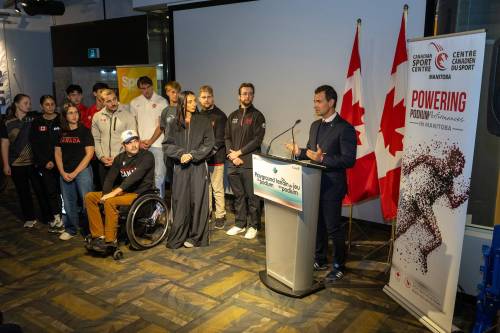
Another chunk of cash earmarked to increase participation in sport and develop homegrown athletic talent is being wired across the country.

On Thursday, the federal government announced an additional $60 million in financial backing for national sport organizations (NSOs).

Some extra wiggle room on mid fiscal-year budgets was not expected by Canada’s 63 NSOs, which were slated to receive a combined $112 million in core Sport Support Program (SSP) funding, and will now see north of $150 million in total.

“Sport has the power to shape lives and bring people together in a way few things can. Today’s announcement reflects a new era for sport in Canada, one where more kids have the opportunity to get out and play, and Team Canada athletes have the support they need to compete and win,” Secretary of State for Sport Adam van Koeverden said in a statement.

Read
3:35 PM CDT

Fact Check

1 minute read Thursday, Nov. 30, 2023

Fact Check

Having problems with the form?Contact Us Directly |