‘Now is not the time to travel,’ Duclos says as Canada warns against trips abroad

Advertisement

Advertise with us

OTTAWA - The federal government is now warning Canadians against all non-essential international travel in the face of the rapidly spreading Omicron variant of COVID-19.

Read this article for free:


or

Already have an account? Log in here »

To continue reading, please subscribe:

Subscribe and receive a limited-edition Free Press branded hat or tote.

Digital Subscription

One year of digital access for only $205*

  • Enjoy unlimited reading on winnipegfreepress.com
  • Read the E-Edition, our digital replica newspaper
  • Access News Break, our award-winning app
  • Play interactive puzzles

*First annual payment billed as $205.00 + GST for one year. This annual subscription will automatically renew at $233.00 + GST every 52 weeks (10% off the regular annual price of $259.35). Offer available to new and qualified returning subscribers only. Cancel any time.

To continue reading, please subscribe:

Add Free Press access to your Brandon Sun subscription for only an additional

$1 for the first 4 weeks*

  • Enjoy unlimited reading on winnipegfreepress.com
  • Read the E-Edition, our digital replica newspaper
  • Access News Break, our award-winning app
  • Play interactive puzzles
Start now

*Your next Brandon Sun subscription payment will increase by $1.00 and you will be charged $17.95 plus GST for four weeks. After four weeks, your payment will increase to $24.95 plus GST every four weeks.

Hey there, time traveller!
This article was published 15/12/2021 (1732 days ago), so information in it may no longer be current.

OTTAWA – The federal government is now warning Canadians against all non-essential international travel in the face of the rapidly spreading Omicron variant of COVID-19.

“To those who were planning to travel I say very clearly, now is not the time to travel,” Health Minister Jean-Yves Duclos said Wednesday at a news conference in Ottawa.

“The rapid spread of the Omicron variant on a global scale makes us fear the worst for Canadians that may think of travelling.”
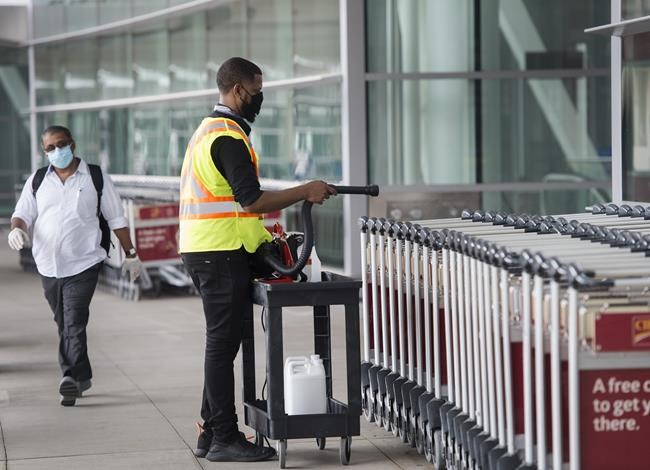
A man uses a sanitizer spray to wash down luggage carts at Toronto's Pearson International Airport  in Toronto on Tuesday, June 23, 2020. Prime Minister Justin Trudeau says people will have to be careful as they finalize their Christmas plans this year, now that the highly transmissible Omicron variant is spreading through Canada. THE CANADIAN PRESS/Nathan Denette

Duclos said the highly transmissible variant is now spreading in Canadian communities, and just about everywhere else in the world. He said that people who leave the country risk spreading the virus, and getting stranded abroad.

The new advisory takes a stronger stance than the one published shortly after the emergence of the Omicron variant, urging Canadians to be aware that travel to an area with Omicron could hamper their ability to return to Canada.

“We know that this may sound very drastic,” Duclos said. “But we must avoid overloading our hospital system and our health-care workers.”

The news came as a bit of a blow to Brian Hayes and his family. He and his wife weren’t able to spend Christmas with their kids last year because of the pandemic, so they resolved to meet in Hawaii this holiday season.

“You kind of beat yourself up a bit about making these plans a year in advance but we thought vaccinations would make a big, big difference, having no idea of course about the science of the variants,” Hayes said.

They paid off the trip over the course of the year. Now, because their travel insurance does not cover advisory changes, it looks like the family won’t be able to recoup the cost if they cancel.

Tempting as it is to head to sunny shores regardless of the government’s advice, the family has opted to stay in Canada for the holidays.

“At least we’ll all be together this Christmas,” he said

Duclos would not offer advice on domestic travel, adding that any travel restrictions within Canada will come from provincial governments, but Prime Minister Justin Trudeau urged Canadians to be cautious when making their travel plans.

“I understand this sucks,” Trudeau said Wednesday. “The reality is Omicron is here in Canada, and we have to cut down community spread.”

“Canadians will, I know, be continuing to demonstrate the thoughtfulness and the care that they’ve shown not just for themselves and their loved ones, but also for health-care workers and front-line workers and our health-care systems that have come so close to being overwhelmed time and time again,” he said.

Dr. Stephen Ellis, who has been tapped to help Conservatives take policy positions around COVID-19, told reporters Canadians are tired of COVID-19 and people are losing hope, so the focus needs to be on how people are going to live with the pandemic.

“The frustration, I think, that we hear from Canadians is what’s the endgame here?” he said. “The pragmatic approach becomes, how are we going to live with COVID in our lives?”

Ministers warned more measures at the border could still be on the way, and did not rule out the possibility of reinstating the requirement for travellers who leave the country for less than 72 hours to complete a molecular COVID-19 test in order to re-enter Canada.

Health Minister Jean-Yves Duclos listens to a question during a news conference, Tuesday, November 30, 2021 in Ottawa. THE CANADIAN PRESS/Adrian Wyld

Currently, Canada has banned all foreign nationals who have been in 10 specific African countries in the last 14 days from entering the country to offset the threat of importing Omicron cases. That policy should be re-examined, chief public health officer Dr. Theresa Tam said Wednesday. Duclos hinted the government may “clarify” that policy soon.

The announcement came after Trudeau spoke with provincial and territorial premiers Tuesday evening to discuss how to respond to Omicron.

Ottawa has agreed to send shipments of booster doses and rapid tests to provinces and territories to quickly ramp up vaccination campaigns to combat the virus at home.

Trudeau and the premiers also discussed potential domestic measures to stop community spread.

Meanwhile, Tam has advised against all mass gatherings, even for people who are fully vaccinated.

“At this point in time, what we know is that even if you have two doses, there’s a possibility you could be infected and spread to others,” Tam said Wednesday.

Finance Minister Chrystia Freeland dedicated $4.5 billion in Tuesday’s fiscal update to respond to the Omicron variant.

The government has also set aside $1.7 billion to buy and distribute rapid tests to the provinces, and $2 billion for drugs to treat people who have been infected.

“I know that the rising threat Omicron poses is not something any of us want to be dealing with, especially now, just before the holidays,” Freeland said Wednesday.

This report by The Canadian Press was first published Dec. 15, 2021.

— With files from Stephanie Taylor

Report Error Submit a Tip

More Stories

Is ‘tornado alley’ moving north?

Editorial 4 minute read Preview

Is ‘tornado alley’ moving north?

Editorial 4 minute read Yesterday at 2:00 AM CDT

There’s a famous fictional story in which a ruby-slippered, tornado-tossed traveller takes a wide-eyed look around and declares, “I’ve a feeling we’re not in Kansas anymore.”

There are probably some residents of south River Heights, on the other hand, who looked out their windows last Sunday and felt as if Kansas — the U.S. state that lies smack-dab in the middle of meteorological maps outlining the area known as “tornado alley” — was exactly where they’d somehow ended up.

There is now confirmation of a tornado touching down within Winnipeg, after several residents reported seeing funnel-shaped clouds during the intense thunderstorm, and the magnitude and extremely localized nature of the damage — including felled trees, snapped hydro poles, scattered fences and the deposit of a random automobile on one resident’s front lawn — certainly shows forces more formidable than strong wind gusts were at play.

As Manitoba Hydro and City of Winnipeg crews continued the days-long effort to clean up the mess and restore power to thousands of homes affected by the long-weekend weather blast, some of the conversation related to the storm focused on how extreme events such as this have become more commonplace in a region where tornadoes were long considered a rarity.

Read
Yesterday at 2:00 AM CDT

Goodness alive, well in N.L.-set musical

Jen Zoratti 4 minute read Preview

Goodness alive, well in N.L.-set musical

Jen Zoratti 4 minute read 2:02 AM CDT

I first saw Come From Away — the true-story musical about the incredible efforts of the residents of Gander, N.L. on Sept. 11, 2001, who welcomed nearly 7,000 travellers diverted to their remote town after the attacks on the World Trade Center and the Pentagon — in 2022, when Broadway Across Canada brought it to the Centennial Concert Hall.

I went in cold, but with blunted expectations; it seemed, on premise alone, like it could tilt too far into shmaltzy sentimentality, that it would be too earnest in its goodness.

So, when I wept until my face was as wet and salty as though it had been slapped by the waves of the North Atlantic, I was pleasantly surprised. I loved it. It’s emotional, yes. It’s sentimental, yes. But you can’t help but feel both buoyed — and, dare I say, patriotic — by the end of it.

Written by Canadians Irene Sankoff and David Hein, Come From Away seemed an unlikely hit when it opened on Broadway in 2017. But there was, by then, an appetite for it.

Read
2:02 AM CDT

Evaluating the athletic complaint process

Mac Horsburgh 4 minute read 2:00 AM CDT

Be careful what you wish for.

The fervent desire of our Canadian sports communities to attain objectivity in processing complaints has led to the creation of a completely unregulated industry for complaint investigations.

As it stands, professional self-regulation has been criticized for operating in its own self-interest rather than the public interest.

But now we have a new Independent Third Party (ITP) industry which operates without licensing or oversight in carrying out its duties relating to reviewing and conducting investigations into athletic complaints.

Awareness is the first line of defence

Joseph Borsa 4 minute read Preview

Awareness is the first line of defence

Joseph Borsa 4 minute read Updated: Yesterday at 8:15 AM CDT

September is Prostate Cancer Awareness Month in Canada. This proclamation helps focus public attention on the very important protective role that such awareness can play in reducing the death and suffering associated with this disease.

The underlying reason for that is simple. In its beginning, prostate cancer, as is true for all cancers, starts and grows silently and stealthily, giving no indication through pain or other symptoms of its presence and of the developing pathology. Everything appears normal to the unsuspecting host until the cancer has grown to an extent that it interferes with normal function. There might then be pain, bleeding or some other manifestation of the growing tumour.

Unfortunately, by that time the disease may have reached an advanced stage, which is much more difficult to treat, and less likely to have a favourable outcome. It is a general truth in dealing with all types of cancer that the earlier it is discovered and treated, the better the likelihood of a favourable outcome. Awareness can be a major determinant of whether such early discovery happens or not.

Discovery of the cancer during its period of silent, surreptitious growth creates the opportunity for early treatment. Fortunately, in the case of prostate cancer such detection is favoured by two factors.

Read
Updated: Yesterday at 8:15 AM CDT

CMU offers free residence for students

Maggie Macintosh 2 minute read Preview

CMU offers free residence for students

Maggie Macintosh 2 minute read Wednesday, Oct. 22, 2025

Canadian Mennonite University will provide incoming students with free on-campus housing, starting in 2026-27.

The new incentive for first-year undergraduate students is valued at $3,000.

The faith-based school is touting the registration bonus as a way to increase relationship building on the Shaftesbury Boulevard campus.

The change will also lower both student commuting expenses and carbon footprints, senior administration said in a news release Wednesday.

Read
Wednesday, Oct. 22, 2025

The port of Churchill — but done right

Editorial 4 minute read Preview

The port of Churchill — but done right

Editorial 4 minute read 2:00 AM CDT

The seagoing grain carrier wasn’t christened with a champagne bottle. There was no confetti or streamers. Nevertheless, the Aug. 31 event marking the first shipment of grain to be loaded at the Port of Churchill since 2020 was celebrated like the launch of a brand new vessel.

The presence of the federal minister of northern and arctic affairs, provincial cabinet ministers and leaders and elders from several northern First Nations signalled that the fast-tracked process of refurbishing and buffing up Manitoba’s deep-water seaport gem is gaining momentum.

For OneNorth, the partnership of 29 First Nations and 12 northern communities which owns the Port of Churchill and the Hudson Bay Railway (both operated by the Arctic Gateway Group) the event heralded a new beginning. It’s been eight years since OneNorth purchased the port and railroad, and six years since grain was moved by rail through Manitoba and then by ship to European markets. Two more grain shipments, plus shipments of potash and critical minerals, will continue through the fall.

When Prime Minister Mark Carney solicited the premiers to suggest “nation-building” projects following his election in 2025, Premier Wab Kinew pitched a Manitoba trade corridor that would move wheat, critical minerals, potash and energy (oil or liquid natural gas) through the Port of Churchill.

Read
2:00 AM CDT