Montreal public health says Omicron variant spreading rapidly, 95 cases in the city

Advertisement

Advertise with us

Montreal's public health director on Wednesday encouraged people to cancel parties at schools and at workplaces ahead of Christmas, as the city faced the double threat of rising COVID-19 infections led by the Delta and Omicron variants.

Read this article for free:


By clicking the button above, an account will be created and you will begin to receive some of our recommended newsletters. You may opt out of any newsletter by visiting your Email and Communication Preferences page or by clicking "unsubscribe" at the bottom of any email.

or

Already have an account? Log in here »

To continue reading, please subscribe:

Digital Subscription

One year of digital access for only $1.44 a week*

  • Enjoy unlimited reading on winnipegfreepress.com
  • Read the E-Edition, our digital replica newspaper
  • Access News Break, our award-winning app
  • Play interactive puzzles

*Billed as $5.77 plus GST every four weeks. After 52 weeks, price increases to the regular rate of $19.95 plus GST every four weeks. Offer available to new and qualified returning subscribers only. Cancel any time.

To continue reading, please subscribe:

Add Free Press access to your Brandon Sun subscription for only an additional

$1 for the first 4 weeks*

  • Enjoy unlimited reading on winnipegfreepress.com
  • Read the E-Edition, our digital replica newspaper
  • Access News Break, our award-winning app
  • Play interactive puzzles
Start now

*Your next Brandon Sun subscription payment will increase by $1.00 and you will be charged $17.95 plus GST for four weeks. After four weeks, your payment will increase to $24.95 plus GST every four weeks.

Hey there, time traveller!
This article was published 15/12/2021 (1779 days ago), so information in it may no longer be current.

Montreal’s public health director on Wednesday encouraged people to cancel parties at schools and at workplaces ahead of Christmas, as the city faced the double threat of rising COVID-19 infections led by the Delta and Omicron variants.

The “rapid increase” in cases is being driven by outbreaks of the Delta variant across the city’s schools and by community transmission of the Omicron mutation, Dr. Mylène Drouin told reporters. She reported 844 new infections Wednesday and said her department had so far detected 95 cases of Omicron in the city.

Drouin said people should avoid in-person parties at work and at school over the next 10 days.
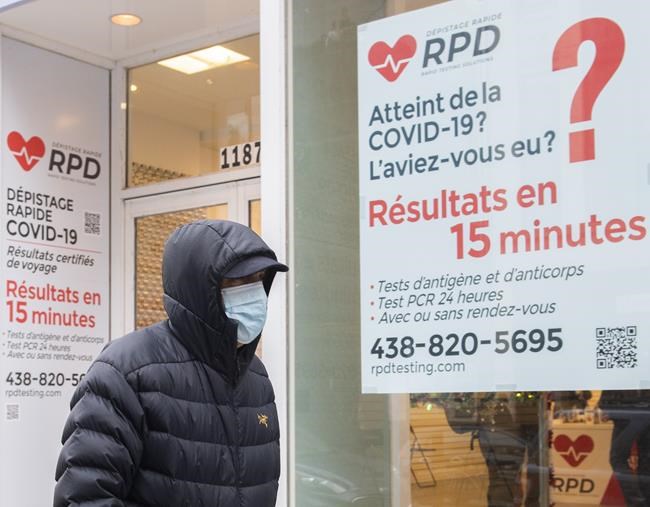
A man walks by a COVID-19 rapid testing business in Montreal, Saturday, Dec. 4, 2021. THE CANADIAN PRESS/Graham Hughes

“In this context, clearly, our tracing is not sufficient, vaccination will not be sufficient,” she said. “It’s necessary to add an overall reduction in contacts.”

She said gatherings of up to 20 people over the holiday period may not be a good idea, referring to the provincial government’s plan to raise indoor gathering limits on Dec. 23. The limit is currently 10 people.

“We’re facing a double situation,” Drouin said. “We have on one side, the Delta variant wave that is being amplified by outbreaks in schools … On the other side, we have the rapid progression of the Omicron variant.”

Half the Omicron cases in the city involved people who recently travelled outside the country, while the other half were among people who were infected in Montreal, she said. The majority of the Omicron cases associated with international travel were acquired in the United States, Drouin said, adding that there were five cases associated with travel to Europe and five cases linked to travel in Africa.

Drouin told reporters that cases of Omicron have been detected at two primary schools and two universities in Montreal. Younger people account for the majority of infections involving the variant, she said, adding that the average age of Omicron cases in the city is 32.

“Ninety per cent of the cases are people who have had two doses of vaccine,” she said. “Eighty per cent have symptoms, but we do not have any hospitalizations or death associated with the Omicron variant.”

Drouin said the Delta variant, which is the dominant mutation in Montreal, will likely be replaced by the more transmissible Omicron variant, adding that she expects the number of Omicron cases in the city to double every two to three days.

Quebec’s public health institute said earlier on Wednesday it had detected 11 confirmed cases of Omicron across the province and 24 suspected cases. The variant has now been detected in every province in Canada.

Earlier on Wednesday, Premier François Legault said his government may reconsider its decision to ease indoor gathering limits for the holidays after health officials reported 2,386 new infections across the province.

“With 2,300 cases, it wouldn’t be responsible to not look at all possibilities,” Legault told reporters in Quebec City. “But we have to keep measures that will have an impact on hospitalizations.”

The percentage of positive tests in Quebec has also been rising. On Wednesday, 5.8 per cent of tests came back positive. The test positivity rate in the province was 3.3 per cent two weeks ago. In Montreal, Drouin said, eight per cent of tests conducted Tuesday were positive.

The premier said that for now, he would stick with his decision to increase indoor gathering limits on Dec. 23, because the number of COVID-19-related hospitalizations was manageable and within the health system’s 800-bed capacity.

The Health Department said 309 people were in hospital Wednesday, a rise of 16 from the day before, and 73 people were in intensive care.

This report by The Canadian Press was first published Dec.15, 2021.

———

This story was produced with the financial assistance of the Facebook and Canadian Press News Fellowship.

Report Error Submit a Tip

More Stories

Multi-year budget to force councillors, bureaucrats to focus on the big picture

Aldo Santin 12 minute read Preview

Multi-year budget to force councillors, bureaucrats to focus on the big picture

Aldo Santin 12 minute read Tuesday, Feb. 26, 2019

City hall is putting the final touches on the 2019 preliminary budget -- but the real tough job will start after that.

The city is committed to developing a four-year budget beginning with 2020, and having it in place by the end of this year.

It's a process that is filled with uncertainties, trying to balance four successive annual budgets at the same time, using assumptions on revenues and expenses that can change without notice: a provincial government that has frozen funding to city hall at 2016 levels and is reluctant to disclose annual funding commitments or share in unexpected revenues; erratic fuel prices; a possible change in government in Ottawa, which could bring new spending priorities. And in the middle of that four-year span, another civic election where new members of council may have other priorities than those laid out by the current crop of office holders.

Municipal governments across Manitoba are required to approve their annual operating and capital budgets by the end of March each year. But the criticism of decision-making at city hall has been that all the decisions are made on a year-to-year basis, keeping voters happy with an eye on the next election.

Read
Tuesday, Feb. 26, 2019

Adult education should be the foundation of the North

Jim Silver 5 minute read 2:00 AM CDT

Major economic developments are, we are being told, coming to northern Manitoba, focusing on the port of Churchill and the railway system that leads to it, and the production and export via that port of various commodities. Many challenges, particularly environmental, lie along that path, and they deserve particularly serious consideration if any development is to proceed.

One aspect of northern development about which almost nothing has been said is: “Who will do the work in the north?”

For decades past and still today, great reliance has been placed on bringing skilled tradespeople and other skilled workers to northern Manitoba from the south. The result has been that not only has the bulk of corporate profits been drained south, but so too have wages. As a result, rates of poverty are higher and formal educational levels are lower in the north than elsewhere in Manitoba. This is obviously detrimental to the north and particularly to those who live in the north.

If northerners themselves are to benefit from economic development in the north by forming the skilled labour force that will be needed, then we will need more of those northerners to be educationally prepared to undertake training for skilled employment.

Election results: School trustees 2026

Staff 1 minute read Preview

Election results: School trustees 2026

Staff 1 minute read Friday, Oct. 23, 2026

Below you’ll find live 2026 election results for school trustees in Winnipeg divisions.

We can display results only for wards in which Winnipeg voters cast a ballot; we do not have access to live results reporting for school boards outside of Winnipeg.


Read
Friday, Oct. 23, 2026

Railways report more accidents with dangerous goods

Dylan Robertson 6 minute read Preview

Railways report more accidents with dangerous goods

Dylan Robertson 6 minute read Monday, Jan. 20, 2020

OTTAWA — The number of rail accidents involving dangerous goods more than doubled in Canada in 2018.

There were 25 accidents involving dangerous goods in 2018, involving one death, according to Transport Canada data published Monday.

There were 11 accidents recorded a year prior, and five in 2016.

These accidents involve dangerous goods — flammable or corrosive substances — that either exploded or leaked.

Read
Monday, Jan. 20, 2020

Longtime councillor Eadie ‘knew it was going to be close,’ but expected to finish on top in Mynarski

Scott Billeck 4 minute read Preview

Longtime councillor Eadie ‘knew it was going to be close,’ but expected to finish on top in Mynarski

Scott Billeck 4 minute read Updated: 1:56 PM CDT

After 16 years representing Winnipeg’s North End at city hall, Ross Eadie knew his latest re-election bid would be close. What he didn’t anticipate was losing in the very neighbourhoods where he grew up.

The longtime Mynarski councillor, defeated Wednesday by political newcomer Natalie Smith, said Thursday the result was particularly difficult to accept because some of his strongest losses came in Luxton, St. John’s Park and surrounding neighbourhoods.

“I knew it was going to be close,” Eadie said. “But I thought it was going to be close with me in first place.”

“I really lost it where I live. So that’s the worst part of it.”

Read
Updated: 1:56 PM CDT

City rec facilities crumbling

Ryan Thorpe 6 minute read Preview

City rec facilities crumbling

Ryan Thorpe 6 minute read Monday, Oct. 22, 2018

Throughout Winnipeg, decades-old community assets — pools, arenas and recreation and leisure centres — are deteriorating so quickly that service disruptions are inevitable.

Meanwhile, the city’s community services department, which is responsible for managing those assets, operates with an annual deficit of roughly $80 million, meaning there are scant resources to do little more than bail water on a sinking ship.

Soon, Winnipeggers will have a choice: fewer community services or higher costs.

“It poses a huge challenge because we have very limited dollars that we have to invest in our existing facilities. We also have growing demands for new amenities in new areas. We have to be very strategic,” said Ken McKim, manager of asset management for the department.

Read
Monday, Oct. 22, 2018