Canada confirms five Omicron cases; Ontario investigates two others
Advertisement
Read this article for free:
or
Already have an account? Log in here »
To continue reading, please subscribe:
Digital Subscription
One year of digital access for only $1.44 a week*
- Enjoy unlimited reading on winnipegfreepress.com
- Read the E-Edition, our digital replica newspaper
- Access News Break, our award-winning app
- Play interactive puzzles
*Billed as $5.77 plus GST every four weeks. After 52 weeks, price increases to the regular rate of $19.95 plus GST every four weeks. Offer available to new and qualified returning subscribers only. Cancel any time.
To continue reading, please subscribe:
Add Free Press access to your Brandon Sun subscription for only an additional
$1 for the first 4 weeks*
- Enjoy unlimited reading on winnipegfreepress.com
- Read the E-Edition, our digital replica newspaper
- Access News Break, our award-winning app
- Play interactive puzzles
*Your next Brandon Sun subscription payment will increase by $1.00 and you will be charged $17.95 plus GST for four weeks. After four weeks, your payment will increase to $24.95 plus GST every four weeks.
Read unlimited articles for free today:
or
Already have an account? Log in here »
Hey there, time traveller!
This article was published 29/11/2021 (1796 days ago), so information in it may no longer be current.
TORONTO – Canada logged three more cases of the Omicron COVID-19 variant Monday and was investigating other potential infections as hundreds of people who recently travelled back from countries deemed high-risk for the new strain were encouraged to get tested.
Quebec confirmed its first Omicron case and Ottawa Public Health confirmed two more late Monday. Those were in addition to the country’s first two infections that were recorded in Ottawa over the weekend.
Earlier in the day, officials said two potential cases were also being investigated in the Hamilton area. Both Ontario and Quebec said they wouldn’t reimpose widespread public health restrictions until more is known about the new variant of concern.
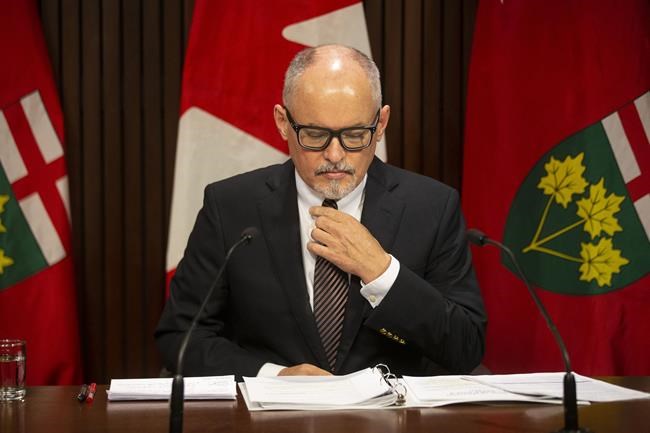
Ontario’s top doctor warned that additional infections would likely be detected and the province said it was considering speeding up COVID-19 vaccine boosters.
“I would not be surprised if we find more in Ontario, because we’ve got a very robust surveillance system,” Dr. Kieran Moore said, noting that Ontario is performing genome sequencing on all eligible positive COVID-19 tests.
Quebec’s public health director Horacio Arruda said Monday that the Omicron case in his province was in a person who recently travelled from Nigeria. He didn’t say whether that case was connected to the two in Ottawa announced Sunday.
Dr. Vera Etches, Ottawa’s medical officer of health, said all four of Ottawa’s cases are unrelated, in people who had independently travelled to Nigeria. Dr. Moore said earlier Monday that the first two cases were in people who had travelled to Ottawa through Montreal, where they were tested.
Public health officials in Hamilton said the potential cases in that region were flagged for further genome sequencing because of the residents’ recent travel to South Africa, but did not provide more information about when they travelled or were tested.
The new variant, which may be more transmissible, has prompted several countries including Canada to introduce travel restrictions. Those have focused on countries in southern Africa where the variant is known to be circulating, though cases have since been found across the globe.
Ontario public health units are reaching out to 375 people who have returned from countries deemed by the federal government to be high-risk for the variant and are offering them testing, Moore said.
Quebec’s health minister said 115 recent travellers, most returning from southern Africa, have been asked to take a PCR test and isolate.
People who recently arrived in Canada from South Africa, Botswana, Lesotho, Eswatini, Mozambique, Namibia and Zimbabwe are eligible for COVID-19 tests and are required to quarantine. Canada has also closed its borders to visitors from those countries.
Ontario wants to test all returning travellers, not just those from the designated countries, and Moore said the province is working with Ottawa on the idea after Premier Doug Ford called for it on Friday.
Alberta Premier Jason Kenney also called for Ottawa to do more on Monday, while at the same time lauding the federal government for its enhanced border measures for travellers from the southern Africa region.
Kenney said Alberta has identified 156 travellers who have returned in the last two weeks from the identified African countries. He said they and their households have been offered household rapid testing kits in addition to PCR tests, but so far none have tested positive.
Ontario Health Minister Christine Elliott said Monday that testing for all travellers is “one of the most important things that we need to do to protect Ontarians” from the variant.
She said the province is also looking at widening eligibility for third doses of COVID-19 vaccines, with more details to come later this week. Third doses are currently on offer to people over 70, long-term care residents, some health-care workers and people with specific health conditions, among others.
But Elliott said it’s too early to decide whether to reintroduce any provincewide public health restrictions, or pause plans to further ease measures in January.
“We will make any changes that we need, but we really need first to know more about this variant,” she said.
In Quebec, Health Minister Christian Dubé made similar comments, saying it could take about two weeks to size up the threat posed by Omicron before determining if more measures are necessary. He warned the population, however, that the situation could change quickly, especially for people travelling or planning to travel soon.

Ontario has slowly been rolling back restrictions based on high vaccination rates and proof-of-immunization requirements in some settings. It has maintained it will only reintroduce public health measures at a local level, even as infections have steadily risen over the last month and some health units have moved to tighten limits on gatherings among other measures.
Moore said the province will stick with the regional-first approach for now, but might reconsider if the Omicron variant is found to cause more severe illness or if it becomes widespread. He also argued the focus should be on fighting the Delta variant, which currently accounts for nearly all Ontario cases.
Opposition politicians in Ontario called for stronger action from the Progressive Conservative government on issues like booster shots, more sick day allowances for workers and greater testing capacity before the variant starts to spread further.
“The wait and see approach, it didn’t serve us well in the past,” said NDP Leader Andrea Horwath. “I’m a bit concerned about how long this government might wait before taking proactive measures.”
This report by The Canadian Press was first published Nov. 29, 2021.
Related Articles
Vaccines key to limiting spread of variants

Advertisement Advertise With Us
Advertisement Advertise With Us