WHO warns that new virus variant poses ‘very high’ risk

Advertisement

Advertise with us

GENEVA (AP) — The World Health Organization warned Monday that the global risk from the omicron variant is “very high” based on the early evidence, saying the mutated coronavirus could lead to surges with “severe consequences.”

Read this article for free:


or

Already have an account? Log in here »

To continue reading, please subscribe:

Subscribe and receive a limited-edition Free Press branded hat or tote.

Digital Subscription

One year of digital access for only $205*

  • Enjoy unlimited reading on winnipegfreepress.com
  • Read the E-Edition, our digital replica newspaper
  • Access News Break, our award-winning app
  • Play interactive puzzles

*First annual payment billed as $205.00 + GST for one year. This annual subscription will automatically renew at $233.00 + GST every 52 weeks (10% off the regular annual price of $259.35). Offer available to new and qualified returning subscribers only. Cancel any time.

To continue reading, please subscribe:

Add Free Press access to your Brandon Sun subscription for only an additional

$1 for the first 4 weeks*

  • Enjoy unlimited reading on winnipegfreepress.com
  • Read the E-Edition, our digital replica newspaper
  • Access News Break, our award-winning app
  • Play interactive puzzles
Start now

*Your next Brandon Sun subscription payment will increase by $1.00 and you will be charged $17.95 plus GST for four weeks. After four weeks, your payment will increase to $24.95 plus GST every four weeks.

Hey there, time traveller!
This article was published 28/11/2021 (1771 days ago), so information in it may no longer be current.

GENEVA (AP) — The World Health Organization warned Monday that the global risk from the omicron variant is “very high” based on the early evidence, saying the mutated coronavirus could lead to surges with “severe consequences.”

The assessment from the U.N. health agency, contained in a technical paper issued to member states, amounted to WHO’s strongest, most explicit warning yet about the new version that was first identified days ago by researchers in South Africa.

It came as a widening circle of countries around the world reported cases of the variant and moved to slam their doors in an act-now-ask-questions-later approach while scientists race to figure out just how dangerous the mutant version might be.

Japanese Prime Minister Fumio Kishida speaks to reporters at his official residence in Tokyo Monday, Nov. 29, 2021. Kishida said Monday that Japan is considering stepping up border controls as a new variant of the coronavirus found in South Africa spreads around the world. (Kyodo News via AP)

Japan announced it is barring entry to all foreign visitors, joining Israel in doing so. Morocco banned all incoming flights. Other countries, including the U.S. and members of the European Union, have moved to prohibit travelers arriving from southern Africa.

WHO said there are “considerable uncertainties” about the omicron variant. But it said preliminary evidence raises the possibility that the variant has mutations that could help it both evade an immune-system response and boost its ability to spread from one person to another.

“Depending on these characteristics, there could be future surges of COVID-19, which could have severe consequences, depending on a number of factors, including where surges may take place,” it added. “The overall global risk … is assessed as very high.”

The WHO stressed that while scientists are hunting evidence to better understand this variant, countries should accelerate vaccinations as quickly as possible.

While no deaths linked to omicron have been reported so far, little is known for certain about the variant, including whether it is more contagious, more likely to cause serious illness or more able to evade vaccines. Last week, a WHO advisory panel said it might be more likely to re-infect people who have already had a bout with COVID-19.

Japan's Prime Minister Fumio Kishida answers to reporters' questions about a measure against the new omicron variant of the coronavirus, at his official residence in Tokyo Monday, Nov. 29, 2021. Japan announced Monday it will suspend entry of all foreign visitors from around the world as a new coronavirus variant spreads. (Sadayuki Goto/Kyodo News via AP)

Scientists have long warned that the virus will keep finding new ways to exploit weaknesses in the world’s vaccination drive, and its discovery in Africa occurred in a continent where under 7% of the population is vaccinated.

“The emergence of the omicron variant has fulfilled, in a precise way, the predictions of the scientists who warned that the elevated transmission of the virus in areas with limited access to vaccine would speed its evolution,” said Dr. Richard Hatchett, head of CEPI, one of the founders of the U.N.-backed global vaccine sharing initiative COVAX.

Spain on Monday became one of the latest countries to report its first confirmed omicron case, detected in a traveler who returned Sunday from South Africa after making a stopover in Amsterdam.

While the majority of omicron infections recorded around the world have been in travelers arriving from abroad, cases in Portugal and Scotland have raised fears that the variant may already be spreading locally.

“Many of us might think we are done with COVID-19. It’s not done with us,” warned Tedros Adhanom Ghebreyesus, WHO’s director-general.
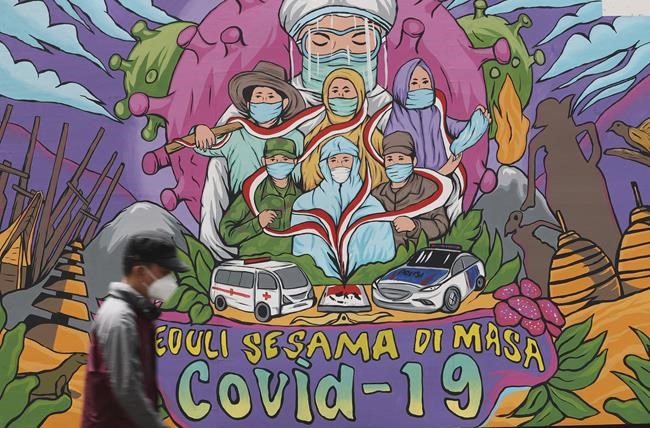
A man walks past a coronavirus-themed mural in Jakarta, Indonesia, Monday, Nov. 29, 2021. Cases of the omicron variant of the coronavirus popped up in countries on opposite sides of the world and many governments rushed to close their borders even as scientists cautioned that it's not clear if the new variant is more alarming than other versions of the virus. (AP Photo/Tatan Syuflana)

Days after the variant sent a shudder through the financial world nearly two years into the pandemic that has killed over 5 million people, markets had a mixed reaction Monday. European stocks rebounded and Wall Street steadied itself, while Asian markets fell further.

U.S. President Joe Biden called the omicron variant a cause for concern but “not a cause for panic.” He said he is not considering any widespread U.S. lockdown and instead urged mask-wearing and vaccinations, even as a federal judge blocked his administration from enforcing a requirement that thousands of health care workers in 10 states get the shot.

Dr. Rochelle Walensky, director of the U.S. Centers for Disease Control and Prevention, reacted to the potential threat by urging everyone 18 and older to get booster shots, because “strong immunity will likely prevent serious illness.” Earlier this month, the U.S. opened boosters to all adults but recommended them only for those 50 and older or people in long-term care.

The omicron infections have underscored the difficulty in keeping the virus in check in a globalized world of jet travel and open borders. Yet many countries are trying to do just that, against the urging of the WHO, which noted that border closings often have limited effect and can wreak havoc on lives and livelihoods.

Some have argued that such restrictions can buy valuable time to analyze the new variant.
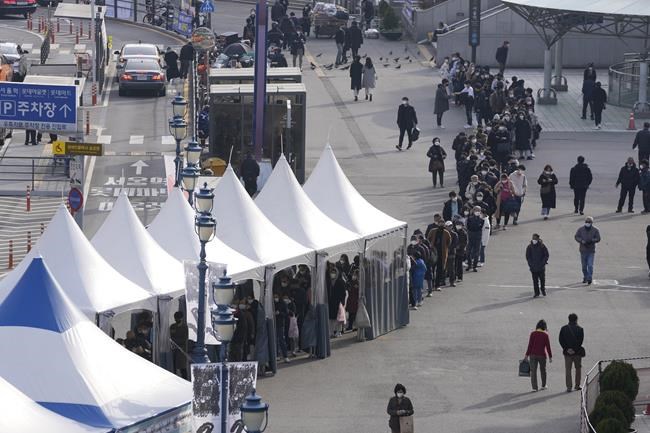
People queue in line to wait for the coronavirus testing at a temporary screening clinic for the coronavirus in Seoul, South Korea, Monday, Nov. 29, 2021. (AP Photo/Lee Jin-man)

While the initial global response to COVID-19 was criticized as slow and haphazard, the reaction to the omicron variant came quickly.

“This time the world showed it is learning,” said EU Commission President Ursula von der Leyen, singling out South African President Cyril Ramaphosa for praise. “South Africa’s analytic work and transparency and sharing its results was indispensable in allowing a swift global response.”

Late last week, von der Leyen successfully pushed the 27-nation EU to agree to ban flights from seven southern African nations, similar to what many other countries are doing.

Cases have been reported in such places as Canada, Germany, Britain, Belgium, Denmark, the Netherlands and Portugal, where authorities identified 13 omicron infections among members of the Belenenses professional soccer team.

Taking no chances, Japan, which has yet to detect any omicron cases, reimposed border controls that it had eased earlier this month.
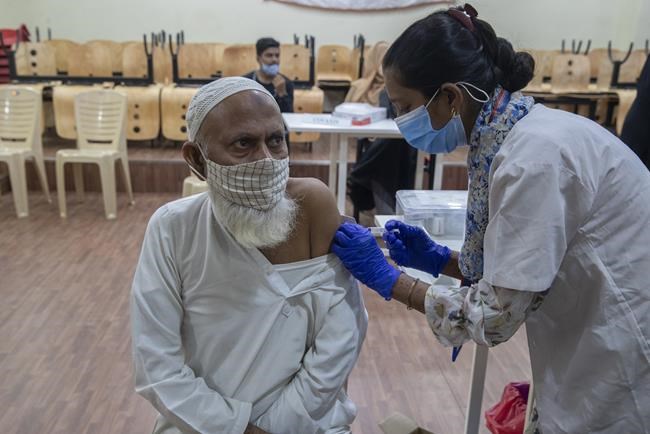
A man receives Covishield COVID-19 vaccine at a vaccination center in Mumbai, India, Monday, Nov. 29, 2021. (AP Photo/Rafiq Maqbool)

“We are taking the step as an emergency precaution to prevent a worst-case scenario in Japan,” Prime Minister Fumio Kishida said.

Israel likewise decided to bar entry to foreigners, and Morocco said it would suspend all incoming flights for two weeks.

Britain reacted by expanding its COVID-19 booster program to everyone 18 and older, making millions more people eligible. Up until now, booster shots were available only to those 40 and over and people particularly vulnerable to the virus. The U.K. has reported about a dozen omicron cases.

Despite the global worry, doctors in South Africa are reporting patients are suffering mostly mild symptoms so far. But they warn that it is early. Also, most of the new cases are in people in their 20s and 30s, who generally do not get as sick from COVID-19 as older patients.

___
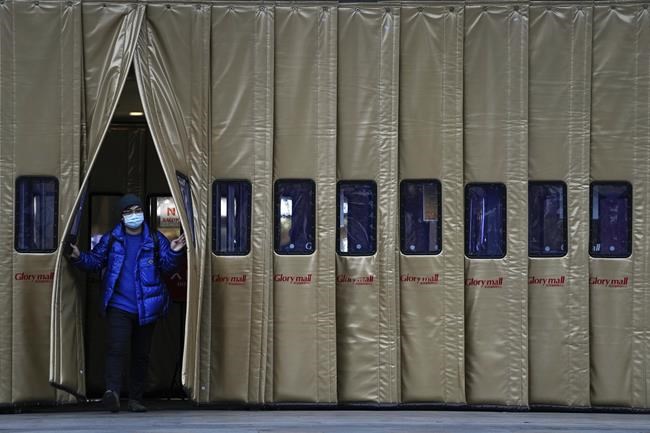
A man wearing a face mask to help curb the spread of the coronavirus walks out from a shopping mall in Beijing, Monday, Nov. 29, 2021. Cases of the omicron variant of the coronavirus popped up in countries on opposite sides of the world Sunday and many governments rushed to close their borders even as scientists cautioned that it's not clear if the new variant is more alarming than other versions of the virus. (AP Photo/Andy Wong)

Yamaguchi reported from Tokyo, Casert from Brussels. Associated Press journalists from around the world contributed to this report.

___

Follow AP’s coverage of the coronavirus pandemic at https://apnews.com/hub/coronavirus-pandemic
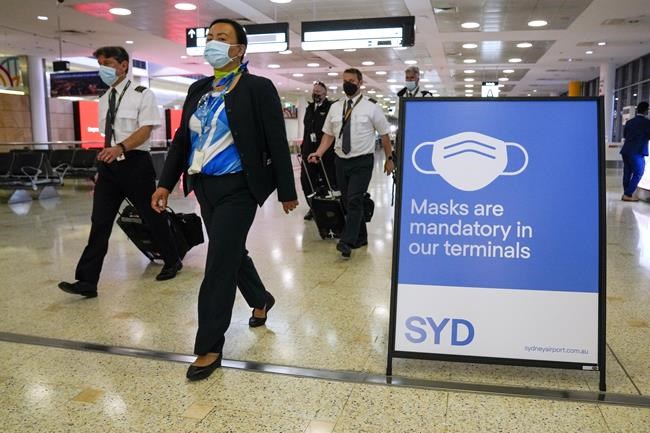
A flight crew walk through the terminal at Sydney Airport, Monday, Nov. 29, 2021. Authorities in Australia said Sunday, Nov. 28, 2021, that two travelers who arrived in Sydney from Africa became the first in the country to test positive for the new variant of the coronavirus, omicron. (AP Photo/Mark Baker)
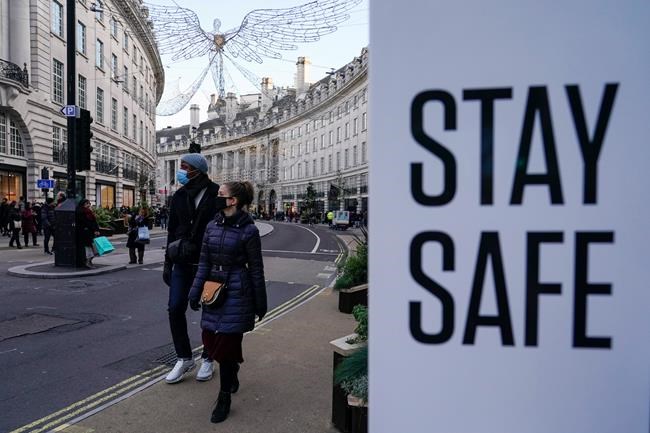
People wear face masks as they walk, in Regent Street, in London, Sunday, Nov. 28, 2021. Britain's Prime Minister Boris Johnson said it was necessary to take
People wear face masks as they walk, in Regent Street, in London, Sunday, Nov. 28, 2021. Britain's Prime Minister Boris Johnson said it was necessary to take "targeted and precautionary measures" after two people tested positive for the new variant in England. He also said mask-wearing in shops and on public transport will be required. (AP Photo/Alberto Pezzali)
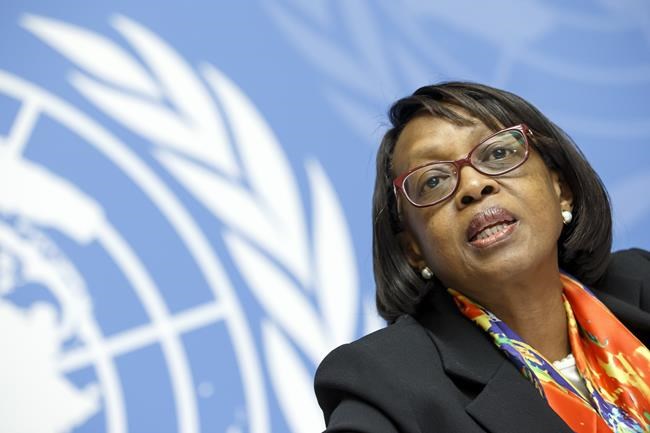
Matshidiso Moeti, World Health Organization (WHO) Regional Director for Africa, speaks at a press conference at the European headquarters of the United Nations in Geneva, Switzerland, on Feb. 1, 2019. The World Health Organization on Sunday, Nov. 28, 2021 urged countries around the world not to impose flight bans on southern African nations due to concerns over the new omicron variant. WHO's regional director for Africa, Matshidiso Moeti, called on countries to follow science and international health regulations in order to avoid using travel restrictions. (Salvatore Di Nolfi/Keystone via AP, File)
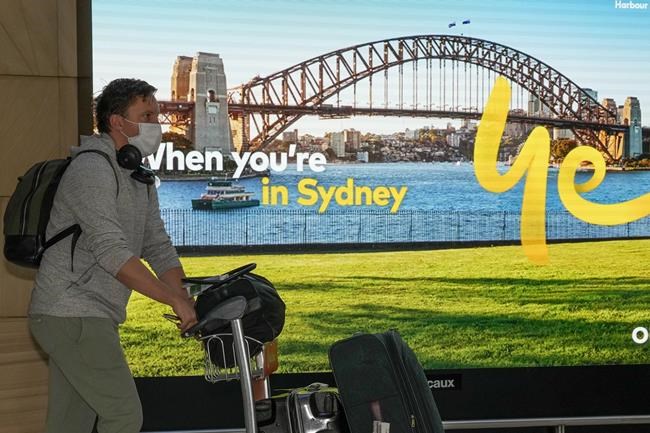
A passenger arrives on an early morning flight at Sydney Airport, Monday, Nov. 29, 2021. Authorities in Australia said Sunday, Nov. 28, 2021, that two travelers who arrived in Sydney from Africa became the first in the country to test positive for the new variant of the coronavirus, omicron. (AP Photo/Mark Baker)
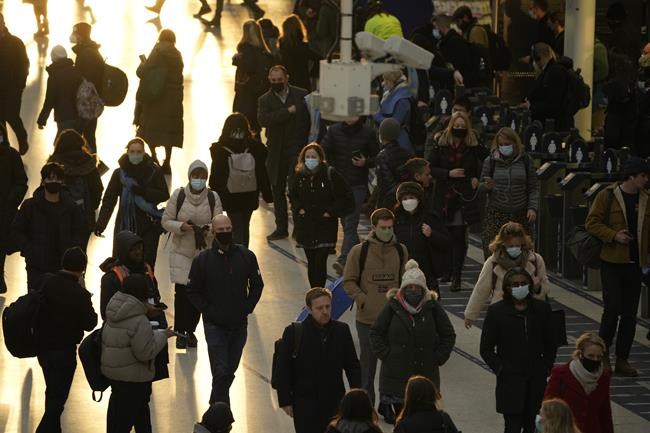
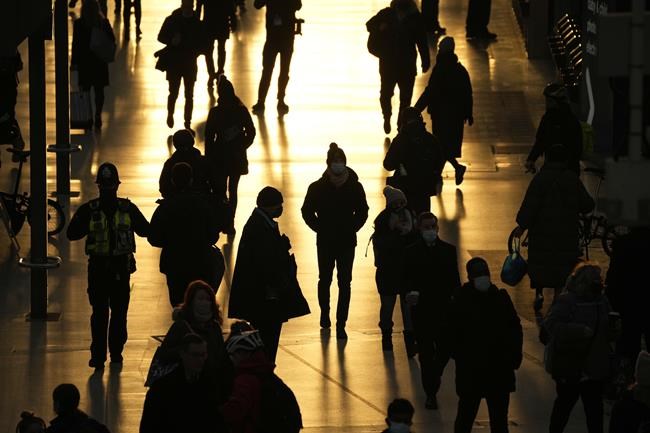
Commuters walk through Waterloo train station, in London, during the morning rush hour after disembarking from a train, Monday, Nov. 29, 2021. The new potentially more contagious omicron variant of the coronavirus popped up in more European countries on Saturday, just days after being identified in South Africa, leaving governments around the world scrambling to stop the spread. In Britain, Prime Minister Boris Johnson said mask-wearing in shops and on public transport will be required, starting Tuesday. (AP Photo/Matt Dunham)
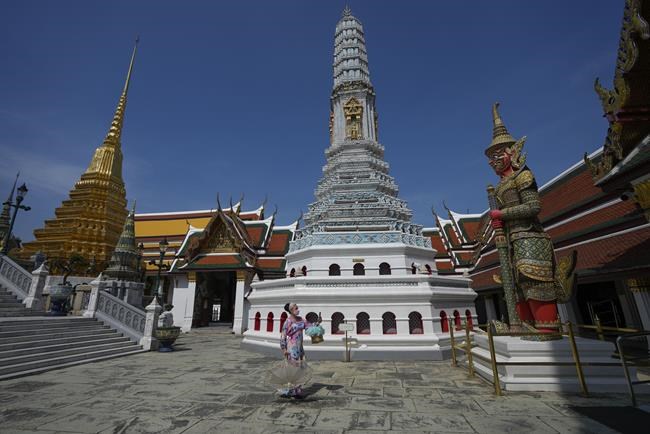
Tourist visit Grand Palace in Bangkok, Thailand, Monday, Nov. 29, 2021. Thailand, starting this Wednesday, will ban visitors from eight southern African countries where the new COVID-19 variant omicron has been found. From Dec. 15, The kingdom will require arrivals from all other African nations to undergo a 14-day hotel quarantine upon arrival. (AP Photo/Sakchai Lalit)
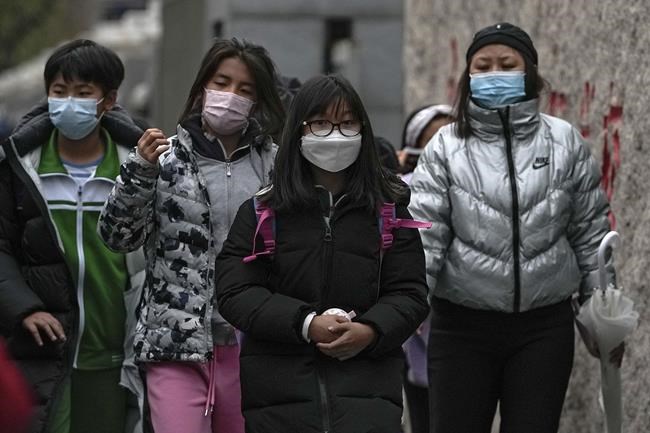
Students wearing face masks to help curb the spread of the coronavirus leave their school after classes in Beijing, Monday, Nov. 29, 2021. Despite the global worry, scientists caution that it's still unclear whether the omicron COVID-19 variant is more dangerous than other versions of the virus that has killed more than 5 million people. Some countries are continuing with previous plans to loosen restrictions, with signs of reopening in Malaysia, Singapore and New Zealand. (AP Photo/Andy Wong)
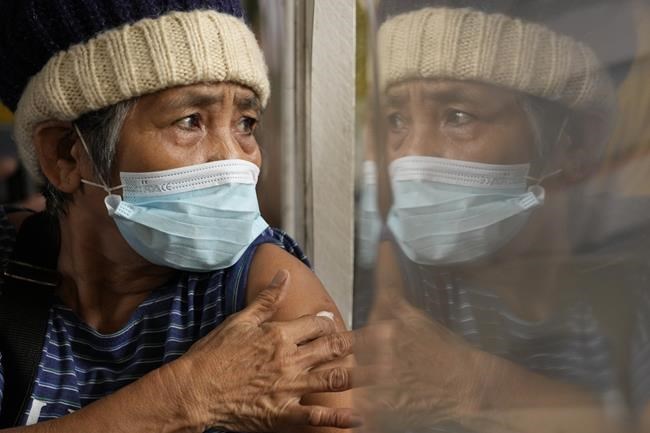
A woman holds onto a cotton pad after being inoculated with AstraZeneca's COVID-19 vaccine during the first day of a nationwide three-day vaccination drive at a school in Quezon city, Philippines on Monday, Nov. 29, 2021. There has been no reported infection so far caused by the new variant in the Philippines, a Southeast Asian pandemic hotspot where COVID-19 cases have considerably dropped to below 1,000 each day in recent days, but the emergence of the Omicron variant has set off a new alarm. (AP Photo/Aaron Favila)
People pass through Waterloo train station, in London, during the morning rush hour, Monday, Nov. 29, 2021. The new potentially more contagious omicron variant of the coronavirus popped up in more European countries on Saturday, just days after being identified in South Africa, leaving governments around the world scrambling to stop the spread. In Britain, Prime Minister Boris Johnson said mask-wearing in shops and on public transport will be required, starting Tuesday. (AP Photo/Matt Dunham)
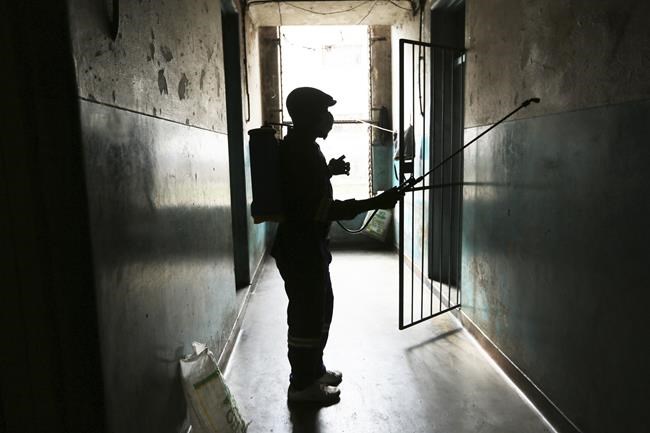
A man disinfects a wall to curb the spread of COVID-19 in Harare, Zimbabwe, Monday, Nov. 29, 2021. The World Health Organisation has urged countries not to impose flight bans on southern African countries due to concerns over the new omicron variant. (AP Photo/Tsvangirayi Mukwazhi)
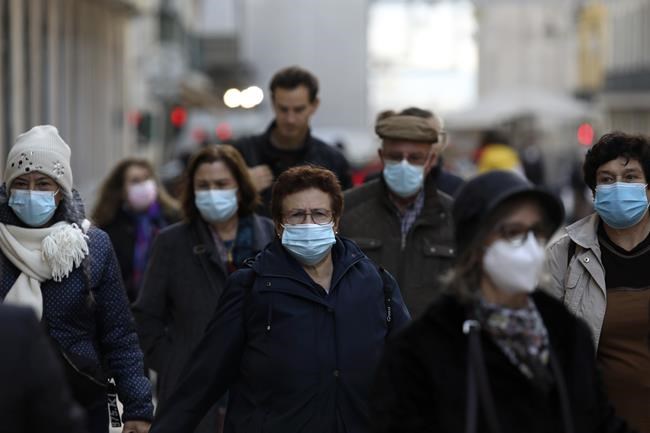
People wearing face masks to curb the spread of COVID-19 walk in downtown Lisbon, Monday, Nov. 29, 2021. Portuguese health authorities on Monday identified 13 cases of omicron, the new coronavirus variant spreading fast globally, among members of the Lisbon-based Belenenses SAD soccer club, and were investigating possible local transmission of the virus outside of southern Africa. (AP Photo/Ana Brigida)
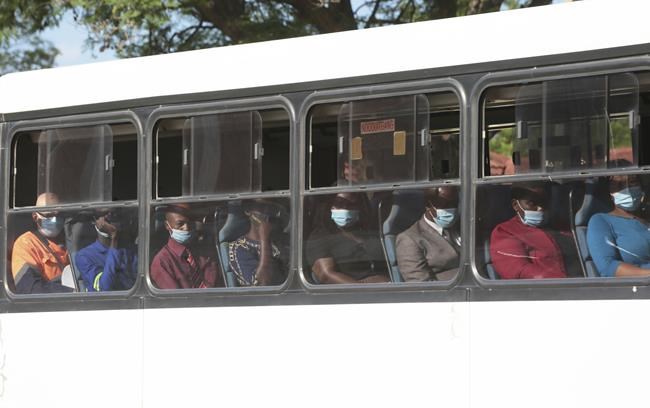
People wear face masks to curb the spread of COVID-19 on a bus in Harare, Zimbabwe, Monday, Nov, 29, 2021. The World Health Organisation has urged countries not to impose flight bans on southern African countries due to concerns over the new omicron variant. (AP Photo/Tsvangirayi Mukwazhi)
Report Error Submit a Tip

More Stories

Today’s horoscope

Georgia Nicols 4 minute read Preview

Today’s horoscope

Georgia Nicols 4 minute read 2:00 AM CDT

MOON ALERT: Caution! Avoid shopping (except food and gas) and important decisions until after 6:30 p.m. today. After that, the moon moves from Cancer into Leo.

ARIES (March 21-April 19)

Don’t expect much co-operation from partners, spouses and close friends. This is why you might feel cut off from others or a bit lonely. There’s the sense a gulf exists between you and everyone else. But this is temporary. Courage!

TAURUS (April 20-May 20)

Read
2:00 AM CDT

Volunteer pop-up library axed from Manitoba Youth Centre

Matthew Frank 4 minute read Preview

Volunteer pop-up library axed from Manitoba Youth Centre

Matthew Frank 4 minute read Yesterday at 2:01 AM CDT

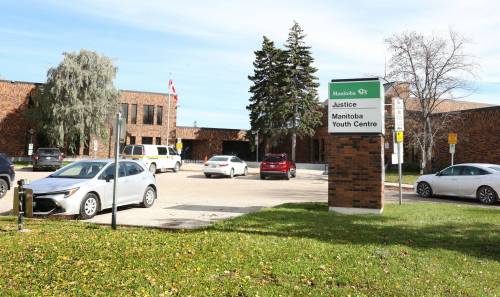
Manitoba Corrections has cancelled a pop-up library program at the Manitoba Youth Centre, leaving inmates without librarian services and fewer options to borrow certain books.

The Prison Libraries Committee, part of the non-profit Manitoba Library Association, operated and funded the volunteer program since 2024 before it was shut down by the province last month. The group previously partnered with the province to offer the service because the facility has no dedicated library of its own.

“It is concerning that community members who are incarcerated, especially youth, are losing out on meaningful programming, access to information and rehabilitation efforts, which are offered at no cost to (Manitoba) Corrections. We urge Manitoba Justice to promote more library services and programming, not less,” said a Sept. 24 letter from the non-profit addressed to the justice minister.

Ashley Huot, chair of the Prison Libraries Committee, said she was puzzled when she received an email last month from Manitoba Corrections stating that the pop-up library was no longer needed.

Read
Yesterday at 2:01 AM CDT

Transit driver stabbed with syringe by passenger

Tyler Searle 3 minute read Preview

Transit driver stabbed with syringe by passenger

Tyler Searle 3 minute read Wednesday, Aug. 5, 2026

A Winnipeg Transit driver is recovering in hospital after a passenger stabbed him in the leg with a syringe while riding the bus early Wednesday, the Amalgamated Transit Union says.

The union said the incident occurred shortly before 1 a.m. while the operator was stopped in the northbound lanes of Isabel Street, near William Avenue. A female passenger reached around the driver’s safety shield and stabbed the driver twice before getting off the bus.

The driver was taken to the Seven Oaks Hospital in stable condition, where he is undergoing treatment and further testing, union president James Van Gerwin said in an interview.

“We spoke to the member. He is doing OK, but he is still in the hospital and he is scared — as anybody would be,” Van Gerwin said.

Read
Wednesday, Aug. 5, 2026

Poster protocol

Sheldon Birnie 8 minute read Preview

Poster protocol

Sheldon Birnie 8 minute read Tuesday, Sep. 15, 2026

Although the days when telephone poles and notice boards across the city were thick with gig posters, either slopped up with wheat paste or wrapped tight with packing tape, are behind us, the art of making an appealing visual ad for live music events is still a vital part of the local creative scene.

However, a widespread backlash against a new kind of slop — the use of generative AI images — has been building, especially among creatives when it comes to promoting live music.

“Live music is and always has been a DIY type of scene, especially locally,” says Evan Simpson, who has been working as a graphic designer for nearly a decade.

“For years people have been making their own flyers, or if they have the budget, hiring a designer or artist to come up with some artwork for their flyers. It’s a whole ecosystem, a scene supporting itself. If you take away the visual side of it, the spark, individuality and uniqueness of each gig poster is lost. What a sad world it would be if all art were made by AI.”

Read
Tuesday, Sep. 15, 2026

Wet weather heats up feed grain availability

Laura Rance-Unger 4 minute read Preview

Wet weather heats up feed grain availability

Laura Rance-Unger 4 minute read Yesterday at 2:01 AM CDT

Other than those in another rain cloud, it’s hard to find the silver linings attached to this year’s soggy harvest.

A showery September continued to cause delays and more deterioration in both quality and yield. Plus, the costs of mitigating post-harvest losses to spoilage are rising as the delays push further into fall. It takes more heat and time to artificially dry down grain as temperatures cool.

Crops harvested in August before the weather turned warm and damp came off with good quality and average yields. But farmers in some areas, such as southwest Manitoba, had only started when the rains came. Now they are plagued with standing water and sprouting swaths of grain that might not even make feed quality.

Suffice to say crop insurance adjusters are going to be busy this fall.

Read
Yesterday at 2:01 AM CDT

Letters, Oct. 3

7 minute read Yesterday at 2:01 AM CDT

A morning in the life …

My very first lesson does not start when I walk into that lecture hall, oh no — it starts long before. It begins when I walk to my car, check the estimated arrival time to the University of Manitoba and hope that Winnipeg traffic agrees with it.

A drive that appears completely manageable changes almost immediately when I’m greeted by a tsunami of orange pylons and a line of cars that appears to go on forever. Traffic moves by the inch, lanes magically disappear and the detour I took yesterday now has a detour of its own. These factors make me do a calculation that I have become all too familiar with. How late can I arrive and still find parking, run to my class across campus and get to class with enough time left to make it worth it?

I have grown used to people saying, “Why not just leave earlier?” I do. But when I’m already leaving for my 8:30 a.m. class at 7 a.m., there’s only so much I can do. This drive that some would think is relaxing is one that feels like an assignment that I didn’t know I had to complete and is due at 8:30 a.m.