Head of UN health agency seeks vaccine booster moratorium

Advertisement

Advertise with us

GENEVA (AP) — The head of the World Health Organization called Wednesday for a moratorium on administering booster shots of COVID-19 vaccines as a way to help ensure that doses are available in countries where few people have received their first shots.

Read this article for free:


By clicking the button above, an account will be created and you will begin to receive some of our recommended newsletters. You may opt out of any newsletter by visiting your Email and Communication Preferences page or by clicking "unsubscribe" at the bottom of any email.

or

Already have an account? Log in here »

To continue reading, please subscribe:

Digital Subscription

One year of digital access for only $1.44 a week*

  • Enjoy unlimited reading on winnipegfreepress.com
  • Read the E-Edition, our digital replica newspaper
  • Access News Break, our award-winning app
  • Play interactive puzzles

*Billed as $5.77 plus GST every four weeks. After 52 weeks, price increases to the regular rate of $19.95 plus GST every four weeks. Offer available to new and qualified returning subscribers only. Cancel any time.

To continue reading, please subscribe:

Add Free Press access to your Brandon Sun subscription for only an additional

$1 for the first 4 weeks*

  • Enjoy unlimited reading on winnipegfreepress.com
  • Read the E-Edition, our digital replica newspaper
  • Access News Break, our award-winning app
  • Play interactive puzzles
Start now

*Your next Brandon Sun subscription payment will increase by $1.00 and you will be charged $17.95 plus GST for four weeks. After four weeks, your payment will increase to $24.95 plus GST every four weeks.

Hey there, time traveller!
This article was published 04/08/2021 (1913 days ago), so information in it may no longer be current.

GENEVA (AP) — The head of the World Health Organization called Wednesday for a moratorium on administering booster shots of COVID-19 vaccines as a way to help ensure that doses are available in countries where few people have received their first shots.

WHO Director-General Tedros Adhanom Ghebreyesus made the appeal mostly to wealthier countries that have far outpaced the developing world in numbers of vaccinations. He said richer countries have administered about 100 doses of coronavirus vaccines for every 100 people on average, while low-income countries — hampered by short supplies — have provided only about 1.5 doses per 100 people.

WHO officials say the science is unproven about whether giving booster shots to people who have already received two vaccine doses is effective in preventing the spread of the coronavirus.

World Health Organization Director-General Tedros Adhanom Ghebreyesus, left, and United Nations High Commissioner for Refugees Filippo Grandi watch the opening ceremony in the Olympic Stadium at the 2020 Summer Olympics, Friday, July 23, 2021, in Tokyo, Japan. (Leon Neal/Pool Photo via AP)

The U.N. health agency has repeatedly called for rich countries to do more to help improve access to vaccines in the developing world. It has argued that no one is safe until everyone is safe because the longer and more widely the coronavirus circulates, the greater the chance that new variants could emerge — and prolong a global crisis in fighting the pandemic.

The agency has no power to require countries to act, and many in the past have ignored its appeals on issues like donating vaccines, limiting cross-border travel and taking steps to boost production of vaccines in developing countries.

Tedros pointed to a WHO target he had announced in May seeking to ensure that 10% of the populations in all countries receive vaccines against the coronavirus.

“Accordingly, WHO is calling for a moratorium on boosters until at least the end of September to enable at least 10% of the population of every country to be vaccinated,” he told a news conference.

To help take the heat out of the pandemic, WHO has been focusing on getting vaccines to older adults, health care workers and other target populations in many countries before booster shot campaigns are carried out.

Dr. Bruce Aylward, a special adviser to Tedros, said the moratorium was about an appeal to countries considering booster doses to “put a hold” on such policies “until and unless we get the rest of the world caught up” in the fight against the pandemic.

”As we’ve seen from the emergence of variant after variant, we cannot get out of it unless the whole world gets out of it together. And with the huge disparity in vaccination coverage, we’re simply not going to be able to achieve that,” Aylward said.

World Health Organization Director-General Tedros Adhanom Ghebreyesus arrives at the opening ceremony in the Olympic Stadium at the 2020 Summer Olympics, Friday, July 23, 2021, in Tokyo, Japan. (Leon Neal/Pool Photo via AP)

Israel, France, Germany and many Middle Eastern countries have already started administering boosters, and other nations, including the United States and Britain, are considering plans to do so in the wake of the emergence of the highly transmissible delta variant.

Dr. Katherine O’Brien, WHO’s vaccines chief, noted that a “very limited number” of countries were giving booster doses though a larger number were contemplating it.

“The evidence is evolving. It’s moving. We don’t have a full set of evidence around whether this is needed or not,” O’Brien said, adding that the main message was that “we need instead to focus on those people who are most vulnerable.”

Asked about the WHO position, White House press secretary Jen Psaki called it a “false choice” and suggested the United States could both donate vaccines abroad and provide boosters at home.

“We announced just yesterday that we hit an important milestone of over 110 million vaccines donated to the world. That is more than any other country has shared combined,” she said. “We also, in this country, have enough supply, to ensure that every American has access to a vaccine. We will have enough supply to ensure, if the FDA decides that boosters are recommended for a portion of the population, to provide those as well.”

WHO officials reiterated their call for global “solidarity” to help battle the coronavirus pandemic and appealed to wealthy countries and corporations to help.

FILE - In this file photo dated Tuesday, July 14, 2020, Director General of the World Health Organization, Tedros Adhanom Ghebreyesus, attends the Bastille Day military parade, in Paris. The head of the World Health Organization has appealed Wednesday Aug. 4, 2021, for a moratorium on administering booster shots of COVID-19 vaccines, to ensure doses are available in countries where few people have yet received their first shots. (AP Photo/Christophe Ena, FILE)

“We need everyone’s cooperation, especially the handful of countries and companies that control the global supply of vaccines,” Tedros said, appealing in particular to the influential Group of 20 large economies. “The G-20 has a vital leadership role to play as the countries that are the biggest producers, the biggest consumers and the biggest donors of COVID-19 vaccines.”

He urged the G-20, which currently is chaired by Italy, to make “concrete commitments to support global vaccination targets.”

“We call on everyone with influence — Olympic athletes, investors, business leaders, faith leaders and every individual in their own family and community — to support our call for a moratorium on booster shots until at least the end of September,” Tedros said.

Report Error Submit a Tip

More Stories

A timeline of the WE Charity controversy

The Canadian Press 9 minute read Wednesday, Aug. 19, 2020

OTTAWA - A timeline of events regarding the Canada Student Service Grant program, based on public documents, events and statements from cabinet ministers, government officials, and WE Charity:

March 6, 2020: WE Charity staff prepare a concept paper on service learning for public servants at Employment and Social Development Canada.

April 5: Finance Minister Bill Morneau and Prime Minister Justin Trudeau talk over the phone about how to help students whose summer job and volunteer opportunities were vanishing due to the COVID-19 pandemic. Finance Department officials are tasked with considering options the next morning.

April 7: Small Business Minister Mary Ng and WE co-founder Craig Kielburger have an introductory phone call in which Ng asks WE to send what it calls a ``pre-established proposal'' to help young people launch businesses.

Submit a news tip

1 minute read Monday, Mar. 16, 2026

Submit a news tip

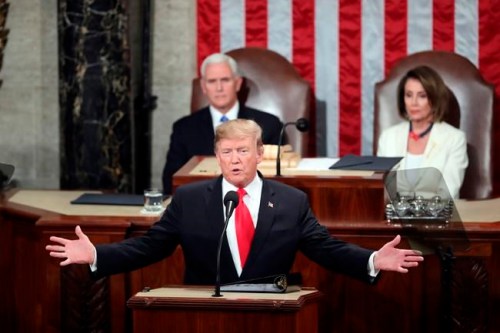
Trump touts USMCA win in state of the union

James McCarten, The Canadian Press 6 minute read Preview

Trump touts USMCA win in state of the union

James McCarten, The Canadian Press 6 minute read Tuesday, Feb. 4, 2020

WASHINGTON - President Donald Trump declared his scorched-earth political style an unmitigated success Tuesday in a fiercely partisan, made-for-TV state of the union speech that made it clear he expects to be back in the White House next year on the strength of the U.S. economy and his trade deals with Canada, Mexico and China.

Trump, addressing a joint session of Congress in the very chamber where House Democrats voted to impeach him less than two months ago, became only the second president in American history — Bill Clinton was the first — to deliver a state of the union while standing trial in the Senate.

Unrepentant, he pointedly refused to shake the offered hand of House Speaker Nancy Pelosi on the dais before singing the praises of what he billed as "the great American comeback," pointing to strong job growth, a soaring stock market and low unemployment as evidence of his leadership. And when he was done, Pelosi ripped up the speech in full view of the television cameras.

"America's enemies are on the run, America's fortunes are on the rise, and America's future is blazing bright. The years of economic decay are over," Trump declared, taking full credit for the country's "roaring economy," including what he billed as seven million new jobs and the lowest jobless rate in half a century — a "blue-collar boom" that he's counting on to help his re-election chances in November.

Read
Tuesday, Feb. 4, 2020

Notable quotes from 2020 Tokyo Olympics

The Canadian Press 4 minute read Sunday, Jul. 25, 2021

Correctional Services Canada is reopening prison farms. But in B.C., where it has no such programs, a wife and her late husband, who killed a man in a botched holdup, started Emma’s Acres, a unique prison farm she hopes to see expanded.

City rec facilities crumbling

Ryan Thorpe 7 minute read Preview

City rec facilities crumbling

Ryan Thorpe 7 minute read Monday, Oct. 22, 2018

Throughout Winnipeg, decades-old community assets — pools, arenas and recreation and leisure centres — are deteriorating so quickly that service disruptions are inevitable.

Meanwhile, the city’s community services department, which is responsible for managing those assets, operates with an annual deficit of roughly $80 million, meaning there are scant resources to do little more than bail water on a sinking ship.

Soon, Winnipeggers will have a choice: fewer community services or higher costs.

“It poses a huge challenge because we have very limited dollars that we have to invest in our existing facilities. We also have growing demands for new amenities in new areas. We have to be very strategic,” said Ken McKim, manager of asset management for the department.

Read
Monday, Oct. 22, 2018

Must-see Folk Fest workshops

16 minute read Preview

Must-see Folk Fest workshops

16 minute read Thursday, Jul. 5, 2018

Workshops have always been an integral part of the Winnipeg Folk Festival.

They are magic-moment makers; a curated group of musicians — sometimes friends, sometimes strangers — on one stage playing together, supporting each other, creating something that will only exist for an hour or two. No one knows what will come out of the collaboration, but usually it’s something special.

When the Free Press spoke to Winnipeg Folk Festival artistic director Chris Frayer ahead of the lineup release in early March, he noted he would be paying some extra attention to workshops this year, as some of the special projects occurring during the past couple of festivals had pulled some of his attention away.

And with 37 workshops on the books, it would seem he followed through on his promise.

Read
Thursday, Jul. 5, 2018