The opposite of distancing; rugby 7s set for kickoff

Advertisement

Advertise with us

TOKYO (AP) — They’ll wear their masks and keep their distance in public, until the tackling and rucking starts.

Read this article for free:


or

Already have an account? Log in here »

To continue reading, please subscribe:

Subscribe and receive a limited-edition Free Press branded hat or tote.

Digital Subscription

One year of digital access for only $205*

  • Enjoy unlimited reading on winnipegfreepress.com
  • Read the E-Edition, our digital replica newspaper
  • Access News Break, our award-winning app
  • Play interactive puzzles

*First annual payment billed as $205.00 + GST for one year. This annual subscription will automatically renew at $233.00 + GST every 52 weeks (10% off the regular annual price of $259.35). Offer available to new and qualified returning subscribers only. Cancel any time.

To continue reading, please subscribe:

Add Free Press access to your Brandon Sun subscription for only an additional

$1 for the first 4 weeks*

  • Enjoy unlimited reading on winnipegfreepress.com
  • Read the E-Edition, our digital replica newspaper
  • Access News Break, our award-winning app
  • Play interactive puzzles
Start now

*Your next Brandon Sun subscription payment will increase by $1.00 and you will be charged $17.95 plus GST for four weeks. After four weeks, your payment will increase to $24.95 plus GST every four weeks.

Hey there, time traveller!
This article was published 25/07/2021 (1892 days ago), so information in it may no longer be current.

TOKYO (AP) — They’ll wear their masks and keep their distance in public, until the tackling and rucking starts.

This is one sport where COVID-19 restrictions cannot separate 14 humans competing for a ball in 14-minute chunks of time, a dozen times a day.

It’s likely to be hot and humid, too, when defending Olympic champion Fiji kicks off the rugby sevens competition against Japan in Tokyo on Monday, followed by 2016 silver medalist Britain against Canada.
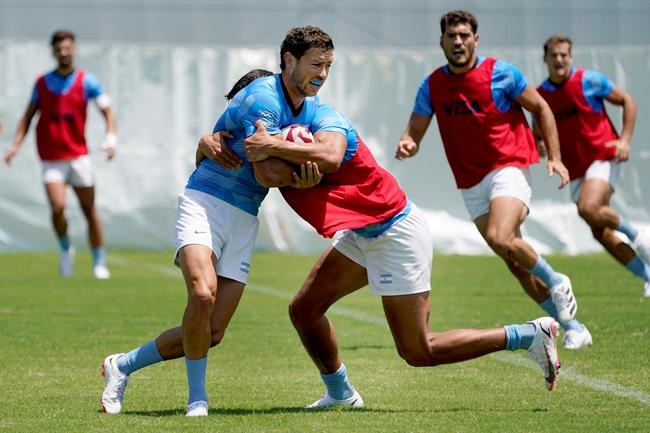
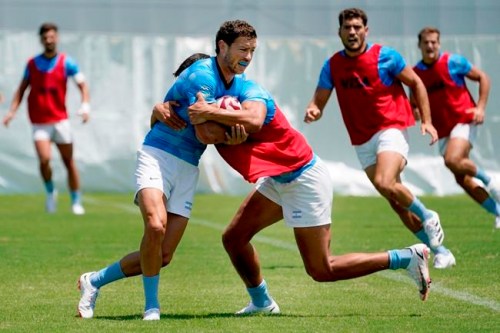
Argentina's Lucio Cinti, right, tackles Franco Sabato during a men's rugby sevens practice at the Tokyo 2020 Olympics, in Tokyo, Friday, July 23, 2021. (AP Photo/David Goldman)

New Zealand, Australia and South Africa – without its head coach because of a positive pre-tournament coronavirus test – will also have played before U.S. veteran Perry Baker gets to start his second Olympic tournament in a match against Kenya. The women’s tournament starts Thursday.

Like most events at the Tokyo Games, there will be no fans in the stadium for the rugby sevens because of the COVID-19 restrictions that also limit where players and staff can go and with whom they can mix.

It makes sense to Baker, a two-time sevens world series player of the year who has recovered from a broken leg to make the U.S. roster.

“I feel like it would put the players, and it would put the fans in harm’s way by having them here with this whole COVID situation that’s going on,” Baker told The Associated Press. “But you can still watch rugby. You can still get that excitement on television because, hey, we’re still able to play.

“So it’s a win-win situation.”

South Africa’s Blitzboks have taken what they’re calling the “optimistic route,” saying it’s a win just to be competing still after head coach Neil Powell tested positive for the coronavirus at a pre-Olympic training camp in the southern Japanese city of Kagoshima and was put into isolation there for 14 days. The players, who were held at a quarantine facility after arriving in Japan because of a positive COVID-19 test involving their flight, were divided into two smaller groups before relocating to Tokyo. They are not being allowed to practice as a full squad.

“Everything that happened so far has not broken down our desire, commitment to the team and the brotherhood; nothing will,” team captain Siviwe Soyizwapi said. “This game of sevens has influenced us as a group and in our personal lives and made us better. Spiritually, mentally and physically, we have grown as people and that helps us to cope with all this adversity.”

Most teams competing have had to overcome obstacles of some kind to make it to Tokyo, with the world sevens series called off early last season and international competition drying up during the pandemic.

The Fijian players, the pride of their nation, have been separated from their families for months already because of a virus outbreak at home.

After helping deliver Fiji its first-ever Olympic medal, 2019 world sevens player of the year Jerry Tuwai will be under more pressure than any captain at the tournament to deliver gold.

In their only international competition since early 2020, the Fijians beat New Zealand and Australia to win the Oceania Sevens warmup tournament last month in Townsville, Australia, to set a benchmark for preparations.

The New Zealand men surprisingly missed out on a medal when rugby sevens made its debut at Rio de Janeiro in 2016, getting upset by Japan in the group stage and never really having the aura of the All Blacks, their powerful national XV.

They’re entering the Olympic tournament as world sevens series champions, knowing they need to make amends for missing the podium in Rio.

“The Olympic Games is the pinnacle. That is why we are here — to win gold,” co-captain Tim Mikkelson said. “That is what we are working towards. This team is really confident. We have huge belief in the way we have performed over the last four or five years. This team is as ready as it has ever been to perform.”

With South Africa’s disruptions, Japan’s home-ground advantage and a narrowing of the gap between the traditional favorites and the chasing pack, Olympic chances could hinge on every result.

Perry, a prolific try scorer in the annual world sevens series, is expecting the Americans to be a threat against the likes of Fiji and New Zealand. The U.S. qualified for Tokyo in the top four in the rankings.

“They’re powerhouse teams. And we always wanted to be a powerhouse team, too,” he said. “Over the years, we’ve made that mark now, where people know we’re a threat now. We’re up there with those top-tier teams.”

___

More AP Olympics: https://apnews.com/hub/2020-tokyo-olympics and https://twitter.com/AP_Sports

Report Error Submit a Tip

More Stories

City considers first-come, first-served Transit Plus

Kevin Rollason 5 minute read Preview

City considers first-come, first-served Transit Plus

Kevin Rollason 5 minute read Friday, Sep. 11, 2020

The city's much-maligned Transit Plus, which is for people with disabilities, could soon do away with a system that prioritizes jobs and medical trips over recreation and visits with friends, in favour of first-come, first-served bookings.

While the city says the changes could mean Transit Plus users would no longer be guaranteed to get to work or medical appointments, several disability advocates are in favour of the move. They don't believe any trip should take priority over another.

Natalie Pirson has used Transit Plus, and the former Handi Transit system, for more than 20 years. She is pleased with the proposed changes, which will be discussed by the city's public works committee next week. Pirson was quick to point out the city will have to do more than change the booking system.

"I rely on Transit Plus for every aspect of my life," Pirson said on Thursday.

Read
Friday, Sep. 11, 2020

Retiree sues neighbour over alleged dog attack

Scott Billeck 2 minute read 2:00 AM CDT

A Winnipeg man is suing his neighbour over an alleged dog attack he says occurred while he was helping him with a lawnmower.

Arthur Cabel, a retiree who lives on Selkirk Avenue, is seeking unspecified damages from neighbour Saisamone Saegone, according to a statement of claim filed in the Manitoba Court of King’s Bench last week.

Cabel claims he went to Saegone’s home in the afternoon on Sept. 23, 2024, to help him with his lawnmower.

According to the lawsuit, Saegone’s large dog, initially in a fenced backyard, escaped, approaching Cabel and “mauling, attacking and biting him.”

Dealing now with increasing judicial dangers

Ben Wickstrom 5 minute read 2:00 AM CDT

For years, the Manitoba Association of Crown Attorneys (“MACA”) has been engaged in a dispute with the Manitoba government over the workload of its lawyers. That dispute is expected to come to a head at the end of November, when two weeks of grievance hearings are scheduled.

We remain hopeful that we can reach an agreement with our employer. But if we cannot, our union’s lawyers are prepared to make our case. As those hearings approach, we want to explain how we got here, what is at stake, and why this dispute matters beyond the working conditions of our members.

These problems are longstanding and predate the election of Manitoba’s current government. Our concern with the current government is not that it created these problems, but that it is now responsible for addressing them.

Despite the evidence before it, the government has not meaningfully addressed the workload concerns we have raised throughout its time in office.

Supervised consumption site can be delayed no longer

Tom Brodbeck 5 minute read Preview

Supervised consumption site can be delayed no longer

Tom Brodbeck 5 minute read Friday, Apr. 17, 2026

If not now, then when?

That question hangs over Manitoba’s long-delayed supervised drug consumption site as the province weathers yet another surge in overdoses — one that front-line workers say is among the worst they’ve ever seen.

In just two weeks, organizations on the ground report as many as 15 deaths tied to drug toxicity.

Main Street Project executive director Jamil Mahmood calls it “the worst spring I’ve ever seen.” That’s a warning from someone watching the crisis unfold in real time.

Read
Friday, Apr. 17, 2026

Plenty of losses all around

Gwynne Dyer 4 minute read Wednesday, Jul. 15, 2026

The last time oil-tankers were being shot up in the Persian Gulf, back in the 1980s, it was Saddam Hussein’s brutal tyranny in Iraq versus Ayatollah Khomeini’s revolutionary Islamist regime in Iran.

The United States backed Saddam because he was just another murderous thug, whereas the new regime in Tehran was an actual threat to American interests. It had overthrown Iran’s American-backed puppet king and wanted to spread its Islamist ideology across the region.

So, of course, Ronald Reagan’s administration chose Saddam’s side. It sent Iraq arms by clandestine means (because Congress wouldn’t authorize it) and even provided targeting information for Iraqi poison gas attacks on Iran. The Americans chose the “lesser evil,” but at least they knew it was evil.

Once in a while they would even say it out loud, quoting U.S. diplomat Henry Kissinger: “It’s a shame that both sides can’t lose.” But they never did anything about it, and after eight years of slaughter, the war ended in a no-score draw.

AI, animals and us

Jordan Laidlaw 5 minute read 2:00 AM CDT

It is now perhaps axiomatic to declare that artificial intelligence will revolutionize the world, as researchers and industry insiders are projecting the novel technology to become the greatest technological breakthrough in human history.

There has been a flurry of discussion in both our local and international contexts — and with good cause. We must remain steadfast to ensure our youth, local workforces, and environment are not negatively impacted by this burgeoning technology.

I wish to accentuate, however, a somewhat neglected area of public discussion around AI developments. Specifically, we urgently need to re-evaluate the ethos of humanity, particularly cognizant of the emergence of this digitally superintelligent species.

If artificial superintelligence (ASI) is ultimately achieved, leading academics theorize that these digital agents will be sentient, conscious, and astronomically more intelligent and powerful than us. In fact, numerous scholars believe AI to already possess some level of consciousness in its current iteration. This position is held by eminent evolutionary biologist Richard Dawkins, for example.