Swimming warmup at Olympics can be a chaotic ‘nightmare’

Advertisement

Advertise with us

TOKYO (AP) — Cate Campbell was a 17-year-old swimming phenomenon when she learned the dangers of warmup at major competitions the hard way.

Read this article for free:


or

Already have an account? Log in here »

To continue reading, please subscribe:

Subscribe and receive a limited-edition Free Press branded hat or tote.

Digital Subscription

One year of digital access for only $205*

  • Enjoy unlimited reading on winnipegfreepress.com
  • Read the E-Edition, our digital replica newspaper
  • Access News Break, our award-winning app
  • Play interactive puzzles

*First annual payment billed as $205.00 + GST for one year. This annual subscription will automatically renew at $233.00 + GST every 52 weeks (10% off the regular annual price of $259.35). Offer available to new and qualified returning subscribers only. Cancel any time.

To continue reading, please subscribe:

Add Free Press access to your Brandon Sun subscription for only an additional

$1 for the first 4 weeks*

  • Enjoy unlimited reading on winnipegfreepress.com
  • Read the E-Edition, our digital replica newspaper
  • Access News Break, our award-winning app
  • Play interactive puzzles
Start now

*Your next Brandon Sun subscription payment will increase by $1.00 and you will be charged $17.95 plus GST for four weeks. After four weeks, your payment will increase to $24.95 plus GST every four weeks.

Hey there, time traveller!
This article was published 23/07/2021 (1879 days ago), so information in it may no longer be current.

TOKYO (AP) — Cate Campbell was a 17-year-old swimming phenomenon when she learned the dangers of warmup at major competitions the hard way.

That’s what a head-on collision with Michael Phelps will do for you.

“He was doing a sprint butterfly down the wrong side of the lane. Straight into me doing backstroke,” Campbell recalled about the incident at the 2009 world championships in Rome. “There was a lot of velocity and power in that. He swims really fast, apparently.”
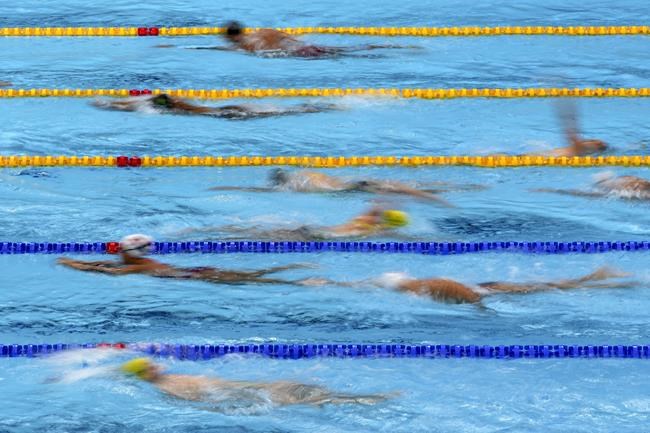
FILE - In this July 21, 2021, file photo, athletes exercise during a swimming training session at the Tokyo Aquatics Centre at the 2020 Summer Olympics in Tokyo, Japan. With hundreds of swimmers scrambling to get their warmup done at the same time, multiple athletes in each lane, everyone diving over one another and some competitors using snorkels, kickboards and other paraphernalia, warmup is organized chaos. (AP Photo/Matthias Schrader, File)

Campbell came away with three vertebrae compacted in her neck — which was rendered practically immobile — and a big lump on her head.

Now entering her fourth Olympics with five medals to her name, Campbell knows the most important rule of warmup.

“Everyone for themselves,” she said in a recent interview. “Sometimes it is honestly a nightmare. … You’re touching the people in front of you, their feet, and someone’s touching your feet. Everyone’s swimming over the breaststrokers, who are a real hazard.”

With hundreds of swimmers scrambling to get their warmup done at the same time, multiple athletes in each lane, everyone diving over one another and some competitors using snorkels, kickboards and other paraphernalia, warmup is organized chaos.

It’s swimming’s version of Shibuya Crossing, the famous Tokyo intersection where thousands of people hurry every which way at once.

Amid a pandemic, warmup could be considered a health hazard.

“At this point, we’ve gotten comfortable being in a large crowd,” said American swimmer Zach Harting, who will race the 200-meter butterfly. “I’m vaccinated so that provides a little bit of comfort there. I’m not worried about it. It’ll be fun. If not, we’ll leave. That’s my motto.”

While it’s not a rule that’s strictly enforced, swimming governing body FINA suggests that only the athletes competing each morning or evening warm up in the competition pool in the 90 minutes before each session. Other swimmers can go to a nearby warmup pool — which is usually just as chaotic.

In Saturday’s opening swimming session, there are 26 different heats in six different events, including the women’s 4×100-meter freestyle relay. That could amount to nearly 300 swimmers warming up at once.

Overall, there are nearly 1,000 swimmers at the Tokyo Games from nearly 200 countries.

“You can’t be telling people that they can’t warm up,” said Bronte Campbell, Cate’s younger sister and a member of Australia’s heavily favored 4×100 free relay team, which will be aiming for its third consecutive gold medal in Monday’s final.

“They’re going to do their best to keep everyone safe and we all want to keep each other safe,” Bronte Campbell added. “But the warmup pool is going to be a very interesting space this time around.”

The warmup pool was also in the spotlight at the 2015 world championships in Kazan, Russia, when Sun Yang of China got into a confrontation with a female Brazilian swimmer then failed to show up for the 1,500 free final as reigning champion.

“It’s quite chaotic,” said Chad le Clos, a four-time Olympic medalist from South Africa. “I’ve been jumped on a few times. I’ve jumped on people a few times. Because obviously the first lane is the diving lane. But sometimes if people go quickly under the lane you don’t see it.”

Problems arise depending on which side of the lane is used for which direction.

“It depends who jumps in first — they choose the circles and then it just stays like that. At the Commonwealth Games you go on the left,” Le Clos said.

In most of the world, though, swimmers stay to the right.

And while Australians stay left at home, they fall in line with the rest of the world at major meets, the Campbells said.

“I was on the right side of the lane and (Phelps) was on the wrong side of the lane,” Cate Campbell said of that 2009 collision. “So we’ll hand over the blame to him.”

___

AP Sports Writer Beth Harris contributed to this report.

___

More AP Olympics: https://apnews.com/hub/2020-tokyo-olympics and https://twitter.com/AP_Sports

___

Andrew Dampf is at https://twitter.com/AndrewDampf

Report Error Submit a Tip

More Stories

On the Night Table: Sean Burns

2 minute read Preview

On the Night Table: Sean Burns

2 minute read Yesterday at 2:00 AM CDT

Sean Burns

Musician, songwriter and host of Boots and Saddle on CKUW 95.9 FM

I’m reading Jimmy McDonough’s Gary Stewart: I Am From the Honky-Tonks again. Any chance I can talk about this book, I’ll take it. (Stewart) should be in the Country Music Hall of Fame; he sort of rejected the machine so hard that they kind of let him sink himself. But he was a fantastic performer. He was just so passionate about playing, he didn’t care about the other stuff — to his detriment. It’s sad. The fellow who wrote the book was a superfan who chased (Stewart) down and just showed up at his place and really got to know him. The context, from when Gary was a young child to the very end, and the details are incredible. You get a really good sense of who he was as a person. I learned some stuff about how the music business operated that I never knew.

Sean Burns & Lost Country release their album Better Off In Time & Other Songs For the Dance Floor on Friday at Sidestage (700 Osborne St.). For an interview with Burns, see Friday’s Free Press.

Read
Yesterday at 2:00 AM CDT

What do we elect a school trustee to do?

Laura Reimer 5 minute read Yesterday at 2:00 AM CDT

On Oct. 28, Manitobans will once again elect the people who serve on our local school boards. School trustee races rarely attract the attention given to other elections. Yet school boards are among our most immediate forms of representative democracy.

Before asking who should be a school trustee, perhaps we should ask a more basic question:

What, exactly, are we electing a school trustee to do?

Trustees are elected to govern a school division. They are not elected to run it.

The port of Churchill — but done right

Editorial 4 minute read Preview

The port of Churchill — but done right

Editorial 4 minute read Yesterday at 2:00 AM CDT

The seagoing grain carrier wasn’t christened with a champagne bottle. There was no confetti or streamers. Nevertheless, the Aug. 31 event marking the first shipment of grain to be loaded at the Port of Churchill since 2020 was celebrated like the launch of a brand new vessel.

The presence of the federal minister of northern and arctic affairs, provincial cabinet ministers and leaders and elders from several northern First Nations signalled that the fast-tracked process of refurbishing and buffing up Manitoba’s deep-water seaport gem is gaining momentum.

For OneNorth, the partnership of 29 First Nations and 12 northern communities which owns the Port of Churchill and the Hudson Bay Railway (both operated by the Arctic Gateway Group) the event heralded a new beginning. It’s been eight years since OneNorth purchased the port and railroad, and six years since grain was moved by rail through Manitoba and then by ship to European markets. Two more grain shipments, plus shipments of potash and critical minerals, will continue through the fall.

When Prime Minister Mark Carney solicited the premiers to suggest “nation-building” projects following his election in 2025, Premier Wab Kinew pitched a Manitoba trade corridor that would move wheat, critical minerals, potash and energy (oil or liquid natural gas) through the Port of Churchill.

Read
Yesterday at 2:00 AM CDT

Double climate whammy hits home

Editorial 4 minute read Preview

Double climate whammy hits home

Editorial 4 minute read Wednesday, Sep. 9, 2026

It’s a bit of a one-two punch.

First, the show-and-tell of what global warming could be bringing us.

Then, the fact we’ve already failed our best chance of halting climate change.

On Sept. 3, the World Meteorological Organization released its forecast of the potential effects of the rapidly-developing super El Niño phenomenon.

Read
Wednesday, Sep. 9, 2026

Bundled Bourdain thrillers a delight

David Pitt 4 minute read Saturday, Sep. 5, 2026

Most people know the late Anthony Bourdain as a chef, culinary author/memoir writer and TV personality. But did you know he also wrote mystery fiction?

Between 1995 and 2002 Bourdain published three mystery novels: Bone in the Throat, Gone Bamboo and The Bobby Gold Stories. They’re collected here as Three Crime Novels by Anthony Bourdain (Bloomsbury, 608 pages, $32) and they are, well, delightful.

You know you’re in good hands when an author describes a character as “a cross between Sonny Bono and Hermann Göring” — this is a guy who knows how to turn a phrase.

And this is a guy who knows how to spin a yarn: these stories, starring an ex-con, a retired government assassin and (yes) a chef, are pure gold — not merely mostly forgotten curiosities written by a guy who’s famous for something else entirely, but exciting, entertaining mysteries that demand to be read simply because they’re so damned good.

Flooding shutters Nordale School for months

Maggie Macintosh 3 minute read Friday, Sep. 11, 2026

The start of the school year has been delayed for hundreds of students in Winnipeg thanks to mould and moisture-related damage

Two school divisions announced disruptions to their scheduled programming this week owing to building safety.

“It’s not the start of the school year that anybody hopes for,” said Jackie Connell, superintendent of the Louis Riel School Division.

Nordale School is anticipated to be closed for four months as crews clean up “substantial” destruction from a storm on the long weekend, Connell said.