Looking at Tokyo Olympics through the lens of the 1964 Games

Advertisement

Advertise with us

TOKYO (AP) — Just 19 years after devastating defeat in World War II, the 1964 Tokyo Olympics showcased the reemergence of an innovative country that was showing off bullet trains, miniature transistor radios, and a restored reputation.

Read this article for free:


By clicking the button above, an account will be created and you will begin to receive some of our recommended newsletters. You may opt out of any newsletter by visiting your Email and Communication Preferences page or by clicking "unsubscribe" at the bottom of any email.

or

Already have an account? Log in here »

To continue reading, please subscribe:

Digital Subscription

One year of digital access for only $1.44 a week*

  • Enjoy unlimited reading on winnipegfreepress.com
  • Read the E-Edition, our digital replica newspaper
  • Access News Break, our award-winning app
  • Play interactive puzzles

*Billed as $5.77 plus GST every four weeks. After 52 weeks, price increases to the regular rate of $19.95 plus GST every four weeks. Offer available to new and qualified returning subscribers only. Cancel any time.

To continue reading, please subscribe:

Add Free Press access to your Brandon Sun subscription for only an additional

$1 for the first 4 weeks*

  • Enjoy unlimited reading on winnipegfreepress.com
  • Read the E-Edition, our digital replica newspaper
  • Access News Break, our award-winning app
  • Play interactive puzzles
Start now

*Your next Brandon Sun subscription payment will increase by $1.00 and you will be charged $17.95 plus GST for four weeks. After four weeks, your payment will increase to $24.95 plus GST every four weeks.

Hey there, time traveller!
This article was published 22/07/2021 (1930 days ago), so information in it may no longer be current.

TOKYO (AP) — Just 19 years after devastating defeat in World War II, the 1964 Tokyo Olympics showcased the reemergence of an innovative country that was showing off bullet trains, miniature transistor radios, and a restored reputation.

Japan’s resiliency is on display again, attempting to stage the postponed 2020 Tokyo Olympics in the midst of a once-in-a century pandemic. The challenge is different, and this time there is widespread public opposition that has divided the country over the health hazards with nagging questions about who benefits from staging the Games.

Roy Tomizawa, who documented the ’64 Olympics in a recent book, described those distant Games 57 years ago as the “Inclusion Games” in an email to The Associated Press.
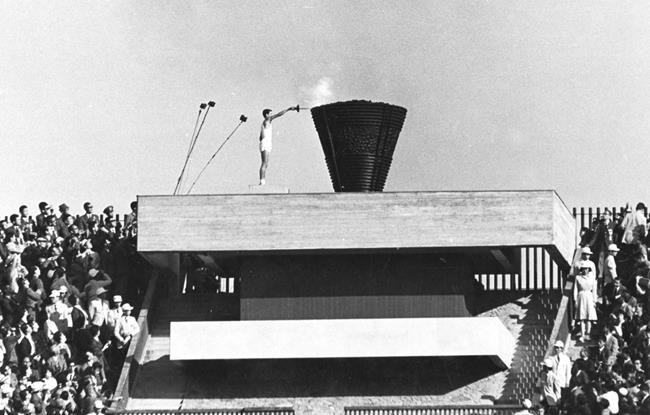
FILE - In this Oct. 10, 1964 file photo, Japanese runner Yoshinori Sakai lights the Olympic cauldron during the opening ceremony of the 1964 Summer Olympics in Tokyo. The famous 1964 Tokyo Olympics highlighted Japan’s resiliency. It was a prospering country that was showing off bullet trains, transistor radios, and a restored reputation just 19 years after devastating defeat in World War II. Now Japan and Tokyo are on display again, attempting to stage the postponed 2020 Tokyo Olympics in the midst of a once-in-a century pandemic. (AP Photo, File)

He called the attempt this time the “Exclusion Games.” But he offered some hope.

“Whether you agree or disagree with the Japanese government, the Games are going ahead in the face of significant risk,” Tomizawa said. But he said these Games might also be turned into “Inclusion Games.”

“With a high degree of difficulty,” he added.

“Organizing an Olympics and Paralympics during this pandemic is like Simone Biles executing a Yurchenko Double Pike, a vault so difficult no other female gymnast wants to do it. Biles can. Maybe Japan can, too,” Tomizawa said.

Tomizawa’s book is titled: “ 1964 — The Greatest Year in the History of Japan: How the Tokyo Olympics Symbolized Japan’s Miraculous Rise from the Ashes. ” It came out last year, just months before the postponed Olympics were to open.

Tomizawa writes in the book about the massive effort to be ready in ’64:

“Police were taking pickpockets off the streets and ensuring bars in Tokyo were complying with directives to close down early. … In fact, every man, woman, and child in Japan was getting ready to welcome the world to their country believing it was their civic duty to ensure that foreigners who came to town were not deprived of any necessity or assistance.”

This was the year that Cassius Clay won the heavyweight championship and became Muhammad Ali. It was when Roy Emerson of Australia and Maria Bueno of Brazil took the titles at Wimbledon, when Arnold Palmer claimed his fourth and final Masters, and when the Beatles arrived on a Pan Am flight from London to play their first concert in the United States.

And it was later that same year in Tokyo when Yoshinori Sakai — born on Aug. 6, 1945, in Hiroshima, the day the atomic bomb was dropped on the city — ignited the cauldron in the national stadium to open the 18th Olympic Games.

Tomizawa grew up in New York, and his father, Tom, a second-generation Japanese-American, was an editor who worked for the television network NBC at the Olympics in Tokyo — the first to be shown internationally using communication satellites.

The family connection and curiosity got Tomizawa looking for a history in English of those 1964 Games. He couldn’t find one, so he wrote his own.

Tomizawa, who has worked for 20 years in Japan, interviewed 70 Olympians from 16 nations. Some were famous at the time: Australian swimmer Dawn Fraser or American 10,000-meter gold-medalist Billy Mills.

Some made other history, like Bulgarian teammates Nikolai Prodanov and Diana Yorgova, who were married in Tokyo during the Olympics. It was billed as the first Olympic wedding and featured a Shinto priest, sake, traditional Bulgarian dances, and an interpreter to explain what was going on.

He said his favorite interview was with Jerry Shipp, a shooting guard on the American gold-medal winning basketball team coached by Hank Iba. It lasted for several hours with Shipp recounting a tough childhood growing up in an Oklahoma orphanage.
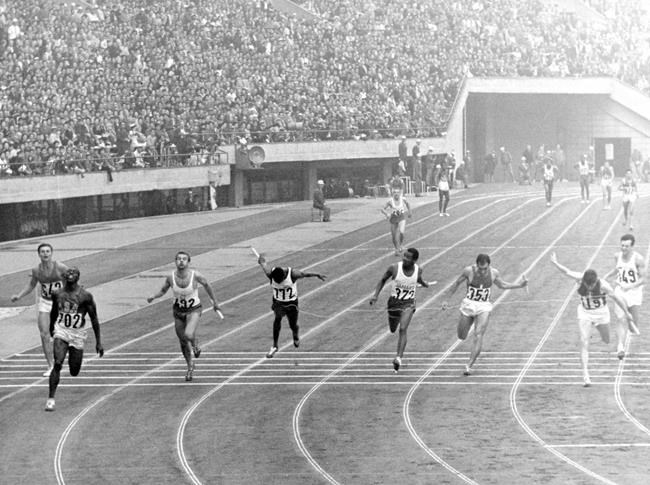
This Oct. 21, 1964, file photo shows the finish scene of men's 4 x100 meter relay finals at the National Stadium in Tokyo. From left are B. Savchuk, of Soviet Union, Bob Hayes, of U.S., winner, M. Dudzuak, of Poland, second, H. Herrerfa Fucil, of Venezuela, D.O. Johnson, of Jamaica, P. Gionnattasio, of Italy, J. Delecour, of France, third, and L. Davies of Britain. (AP Photo, File)

Shipp led the Americans in scoring ahead of Bill Bradley on a team that also included Larry Brown and Walt Hazzard. In addition to Shipp, Tomizawa also interviewed Jeff Mullins, Mel Counts and Luke Jackson.

“I think the Olympians tell more of the story of the Games themselves and their reaction to what they saw of Japan,” Tomizawa said. “Some had been to Japan in ’50s and ’60s. I think everyone was surprised and shocked when they arrived in Japan thinking it would be a backward economy.”

They were also taken aback by the nature of the Japanese.

“For the Canadians, the Australians, the Americans, the Brits — it was the brutal enemy,” Tomizawa said. “When they came, they were welcomed and given such help and support and cheering. It was a surprise to all of them.”

They also found what Tomizawa called “operational excellence,” convincing doubters about the country’s capabilities. The current Tokyo organizers will need that resiliency, although just getting through these Olympics is sure to be portrayed as a success no matter the details and the financial costs.

Japan is officially spending $15.4 billion on the Olympics, but government auditors say the costs are much higher. All but $6.7 billion is public money.

The International Olympic Committee chips in about $1.5 billion, and some of this is payment-in-kind rather than cash. Its payoff is the $3 billion to $4 billion it earns in broadcasts rights, much of which would be lost with a cancellation.

“Now with the world struggling to combat the coronavirus, there is a question whether Japan can get ready for a global competition within its borders,” Tomizawa said by email. ”If it can, then Tokyo 2020 is an opportunity for Japan to show the world how resilient this nation, and the world can be. Just bringing athletes from around the globe to compete in Japan will be a monumental achievement.”

___

More AP Olympics: https://apnews.com/hub/olympic-games and https://twitter.com/AP_Sports

Report Error Submit a Tip

More Stories

Brandon cancer patients lament oncologist’s depature

Rylee Gerrard 4 minute read 8:41 PM EST

BRANDON — Cancer patients across Brandon say they are heartbroken by the impending departure of medical oncologist Dr. Brady Anderson from the Western Manitoba Cancer Centre.

When Lesa Carey learned Anderson would be leaving his role as the sole medical oncologist outside of Winnipeg due to burnout and a lack of additional compensation, she said it made her “sick to my stomach.”

“I can honestly say that the three scariest words someone I think could ever hear is, ‘You have cancer,’” said Carey, a Brandon resident who was diagnosed with breast cancer in 2024.

“My husband and I walked into the appointment at CancerCare overwhelmed, terrified and scared for my life. After meeting with Dr. Anderson, we left informed, listened to, and felt extremely cared about.”

Track records keep falling in fast Tokyo Games

Jim Vertuno, The Associated Press 4 minute read Preview

Track records keep falling in fast Tokyo Games

Jim Vertuno, The Associated Press 4 minute read Wednesday, Aug. 4, 2021

Sweden’s Madelene Sagstrom grabbed the first-round lead with a five-under-par round of 66, the conversation mostly revolved around the 42 C conditions in Tokyo.

Read
Wednesday, Aug. 4, 2021

Butterworth dips under Olympic standard in 800

The Canadian Press 7 minute read Preview

Butterworth dips under Olympic standard in 800

The Canadian Press 7 minute read Friday, Jun. 25, 2021

MONTREAL - After years of flirting with the two-minute barrier, Lindsey Butterworth finally smashed it -- in emphatic fashion.

The 27-year-old from North Vancouver, B.C., kicked hard down the final straightaway to win the women's 800 metres at the Olympic track and field trials on Friday.

Crossing the finish line, she looked at the time, and both hands flew to her mouth in delight. Butterworth won in one minute 59.19 seconds, dipping under the automatic Olympic standard of 1:59.50 -- and shattering that elusive two-minute mark, finally.

"I just saw the time and was in shock and happiness," Butterworth said.

Read
Friday, Jun. 25, 2021

A guide to some of television’s greatest Christmas sitcom episodes

Jen Zoratti 8 minute read Preview

A guide to some of television’s greatest Christmas sitcom episodes

Jen Zoratti 8 minute read Monday, Dec. 13, 2021

Many of us return to the well-loved holiday specials every year — your Rudolphs, your Charlie Browns — but the Christmas Episode is also tradition.

Most sitcoms do them; in the days before streaming, they aired in the weeks leading up to The Big Show.

Encountering a Christmas episode in reruns in July or during an unseasonal series binge watch is a bit like eating a candy cane in April, but it’s no accident that many holiday episodes end up being the classic, well-quoted ones. The holidays, with their pressures and relatives and parties, are loaded with comedic potential, sure, but they’re also a chance for a sitcom to show its heart.

Thanks to streaming, you can pretty much watch anything, anytime, so we’ve assembled a little advent calendar of seasonal episodes to get you into the spirit.

Read
Monday, Dec. 13, 2021

Bob Saget, beloved TV dad of 'Full House,' dead at 65

Lynn Elber, The Associated Press 6 minute read Preview

Bob Saget, beloved TV dad of 'Full House,' dead at 65

Lynn Elber, The Associated Press 6 minute read Monday, Jan. 10, 2022

LOS ANGELES (AP) — Bob Saget, the actor-comedian known for his role as beloved single dad Danny Tanner on the sitcom “Full House” and as the wisecracking host of “America’s Funniest Home Videos,” died while on a stand-up tour. He was 65.

Deputies in Orange County, Florida, were called Sunday about an “unresponsive man” in a hotel room at the Ritz-Carlton in Orlando and found Saget dead, according to a sheriff’s statement on Twitter. Detectives found “no signs of foul play or drug use in this case.”

Saget was in Florida as part of his “I Don't Do Negative Comedy Tour.” After warm audience receptions to his gigs Friday in Orlando and Saturday in the Ponte Vedra Beach resort area, he celebrated online.

“I’m back in comedy like I was when I was 26. I guess I’m finding my new voice and loving every moment of it,” he posted Saturday on Instagram.

Read
Monday, Jan. 10, 2022

Province tables legislation to cover health-care system changes

Larry Kusch 4 minute read Preview

Province tables legislation to cover health-care system changes

Larry Kusch 4 minute read Wednesday, Mar. 6, 2019

The Pallister government has introduced broad legislation to support several of its key planned health-care reforms.

Health Minister Cameron Friesen said Wednesday that Bill 10 (The Regional Health Authorities Amendment Act) will provide the framework to simplify the administration of the health-care system and improve accountability.

All health services in Manitoba will be delivered through the five current regional health authorities, CancerCare Manitoba and a new provincial authority called Shared Health. The administrative changes are set to begin next month and will continue to be rolled out over the next two to three years.

The Health Department will cease to administer health services directly and focus its activities on planning, policy development, funding and oversight. It will set system-wide performance goals and track results.

Read
Wednesday, Mar. 6, 2019