IOC’s Bach gets mixed reaction in one-day visit to Hiroshima

Advertisement

Advertise with us

HIROSHIMA, Japan - IOC President Thomas Bach got a mixed reception in his visit on Friday to Hiroshima to mark the first day of the so-called Olympic Truce.

Read this article for free:


or

Already have an account? Log in here »

To continue reading, please subscribe:

Subscribe and receive a limited-edition Free Press branded hat or tote.

Digital Subscription

One year of digital access for only $205*

  • Enjoy unlimited reading on winnipegfreepress.com
  • Read the E-Edition, our digital replica newspaper
  • Access News Break, our award-winning app
  • Play interactive puzzles

*First annual payment billed as $205.00 + GST for one year. This annual subscription will automatically renew at $233.00 + GST every 52 weeks (10% off the regular annual price of $259.35). Offer available to new and qualified returning subscribers only. Cancel any time.

To continue reading, please subscribe:

Add Free Press access to your Brandon Sun subscription for only an additional

$1 for the first 4 weeks*

  • Enjoy unlimited reading on winnipegfreepress.com
  • Read the E-Edition, our digital replica newspaper
  • Access News Break, our award-winning app
  • Play interactive puzzles
Start now

*Your next Brandon Sun subscription payment will increase by $1.00 and you will be charged $17.95 plus GST for four weeks. After four weeks, your payment will increase to $24.95 plus GST every four weeks.

Hey there, time traveller!
This article was published 16/07/2021 (1901 days ago), so information in it may no longer be current.

HIROSHIMA, Japan – IOC President Thomas Bach got a mixed reception in his visit on Friday to Hiroshima to mark the first day of the so-called Olympic Truce.

Such a one-day visit by a dignitary would ordinarily be routine, but the Olympics are set to open next week with Tokyo under a state of emergency and with a substantial part of the population opposed to the Games being held during the COVID-19 pandemic.

Bach’s vice president John Coates also appeared Friday in Nagasaki, the second city that was hit by an American atomic bomb in 1945.
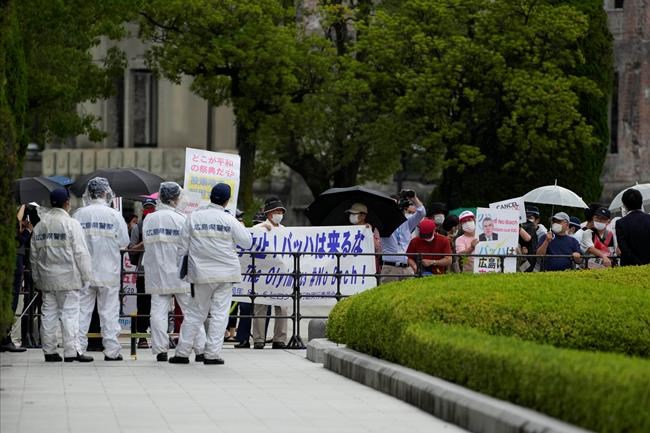
Protesters gather before International Olympic Committee President Thomas Bach visits Hiroshima Memorial Cenotaph Friday, July 16, 2021, in Hiroshima, western Japan. (AP Photo/Eugene Hoshiko, Pool)

Bach and Coates have been meeting daily with Japanese officials from Prime Minister Yoshihide Suga to Tokyo Governor Yuriko Koike, repeating their message that the Olympics will be “safe and secure.” He was accompanied to Hiroshima by Seiko Hashimoto, the president of the Tokyo Olympic organizing committee.

The Olympics and Paralympic involve 15,400 athletes and tens of thousands of others entering Japan, including media, broadcasters, officials, and judges and others.

The Olympics, already delayed by 12 months because of the pandemic, will be held with virtually no fans. Fans from abroad were banned several months ago, and last week Tokyo and three neighboring prefectures banned all local fans. A few outlying venues are expected to allow a smattering of fans.

Japan’s Kyodo news agency reported earlier this week that Bach asked Suga about the possibility of having some fans if conditions improve.

New COVID-19 cases on Friday in Tokyo were reported at 1,271. They were 822 a week ago, and it marks the 27th straight day that cases were higher than a week previous. New cases on Thursday were reported at 1,308, which was the highest in six months.

Bach has said there is “zero” risk of athletes in the Olympic Village on Tokyo Bay passing on the virus to Japanese or other residents of the village.

A group of 11 anti-Olympic and pacifists groups submitted a letter to the city earlier this week opposing Bach’s visit. Separately, an online petition opposing the visit garnered 70,000 signatures.

Bach laid a wreath and observed a minute of silence in the rain in front of the Peace Memorial Park cenotaph. Faint voices of protesters, who were kept at a distance, could be heard shouting “go home Bach” and “you’re not welcome here.”

Dozens of protesters were seen near the Atomic Bomb Dome with signs that read “Cancel The Olympics” and “No Bach.”

“You should understand you are not welcome here,” one protester said, speaking into a microphone.

“The COVID-19 situation is getting worse, it hasn’t come to an end, and I wonder why this has to go ahead,” said Sayuri Yamada, who identified herself as a medical worker. She was not among the protesters.

She said she did not oppose Bach’s visit, but raised questions about running unnecessary risks for the Olympics.

“It’s not that I don’t want him to come absolutely,” she said. “But rather, thinking about the safety of people, including the athletes, my opinion is like he doesn’t have to do this at a time when the risk is high.”

Takayoshi Kayano, who said he was an office worker, respected Bach’s right to visit but raised other issues.

“I think it’s fine to host the Olympics. But the no-spectator policy is a bit disappointing,” he said. “But to me, I feel the IOC seems to be only focused on making money.”

The official cost of the Tokyo Olympics is $15.4 billion, although government auditors have suggested it’s much larger. All but $6.7 billion is public money.

As Bach was in Hiroshima, a Ugandan athlete was reported missing by local officials.

The 20-year-old man was training as part of the nine-member Ugandan team in Izumisano, Osaka prefecture, city officials said.

Teammates realized the athlete was absent around noon Friday when his saliva test sample was not delivered and they found his hotel room empty, city officials said. There was no training Friday morning and he was last seen in his room in the early hours of Friday.

—-

Yamaguchi reported from Tokyo.

—-

More AP Olympics: https://apnews.com/hub/olympic-games and https://twitter.com/AP_Sports

Report Error Submit a Tip

More Stories

Today’s horoscope

Georgia Nicols 4 minute read Preview

Today’s horoscope

Georgia Nicols 4 minute read 2:00 AM CDT

MOON ALERT: Avoid shopping (except food and gas) and important decisions after 6 p.m. The moon is in Taurus.

ARIES (March 21-April 19)

You might find you identify with your possessions more than usual. In fact, this could be why you might be tempted to be a bit extravagant or go overboard buying something. This same sense of largesse might creep into your financial negotiations. Be aware of this.

TAURUS (April 20-May 20)

Read
2:00 AM CDT

WSO season kicks off with two fateful fifths

Holly Harris 5 minute read Preview

WSO season kicks off with two fateful fifths

Holly Harris 5 minute read Sunday, Sep. 27, 2026

On a dark and stormy autumnal night, the Winnipeg Symphony Orchestra opened its 2026-27 season with a pair of equally foreboding works both driven by fate — and ultimately, the triumphant power of the human spirit.

Saturday night’s Masterworks program, titled Beethoven 5 and Tchaikovsky 5 and led by Daniel Raiskin, also officially introduced the WSO’s new composer-in-residence, Kelly-Marie Murphy, to the weekend crowd of 1,720. She was met with enthusiastic applause and cheers upon taking the stage.

The 120-minute evening — and the WSO season — launched with the Ottawa-based Murphy’s Dark Nights, Bright Stars, Vast Universe, commissioned by the National Arts Centre Orchestra under the baton of its former music director Alexander Shelley in 2023.

With the internationally renowned composer’s compelling works heard on this stage during many a Winnipeg New Music Festival, local music fans (and music critics) are still jumping for joy over this truly fine appointment.

Read
Sunday, Sep. 27, 2026

City considers first-come, first-served Transit Plus

Kevin Rollason 5 minute read Preview

City considers first-come, first-served Transit Plus

Kevin Rollason 5 minute read Friday, Sep. 11, 2020

The city's much-maligned Transit Plus, which is for people with disabilities, could soon do away with a system that prioritizes jobs and medical trips over recreation and visits with friends, in favour of first-come, first-served bookings.

While the city says the changes could mean Transit Plus users would no longer be guaranteed to get to work or medical appointments, several disability advocates are in favour of the move. They don't believe any trip should take priority over another.

Natalie Pirson has used Transit Plus, and the former Handi Transit system, for more than 20 years. She is pleased with the proposed changes, which will be discussed by the city's public works committee next week. Pirson was quick to point out the city will have to do more than change the booking system.

"I rely on Transit Plus for every aspect of my life," Pirson said on Thursday.

Read
Friday, Sep. 11, 2020

Pallister’s ego behind carbon tax flip-flop

Dan Lett 7 minute read Preview

Pallister’s ego behind carbon tax flip-flop

Dan Lett 7 minute read Thursday, Oct. 4, 2018

It doesn't make any sense.

Earlier this week, Manitoba Premier Brian Pallister stunned onlookers inside and outside the province with a decision to abandon his own $25-per-tonne carbon tax — the core lever in a complex, provincewide plan to curb carbon emissions.

The premier told reporters Wednesday he was throwing out nearly two years of work on a homegrown climate change plan because Ottawa did not "respect" Manitoba's desire to hold carbon taxes at about half the level demanded by the federal government.

It was not clear what Pallister meant by respect; the two levels of government disagree about the level at which carbon taxes should be set. Up until this week, the two levels of government disagreed over policy and methodology.

Read
Thursday, Oct. 4, 2018

The Brazilian election

Gwynne Dyer 5 minute read Preview

The Brazilian election

Gwynne Dyer 5 minute read 2:00 AM CDT

“Flávio Bolsonaro is Trump’s candidate and what Trump wants is to colonize Brazil, take our riches, steal our future and leave us in the dust,” claims the latest video released by President Luiz Inácio ‘Lula’ da Silva’s re-election campaign. The weird thing is about half of Brazil’s voters would be okay with Trump running the country (through Bolsonaro).

Nobody in Brazil thinks that Flávio Bolsonaro is his own man. He is the son of Jair Bolsonaro, the hard right ex-soldier and former president who tried a coup after he lost the 2022 election. It was even clumsier and more half-hearted than Trump’s brief excursion in sedition after he lost the U.S. 2020 election — but Jair Bolsonaro went to jail for his attempt.

In a strange way Trump even recognizes the parallel, showing special sympathy for his imprisoned fellow traveler. He claimed that the senior Bolsonaro was the victim of a “witch-hunt” by the Brazilian Supreme Court and slapped 50 per cent tariffs on the country. And next Sunday (Oct. 4) the junior Bolsonaro faces Lula in another presidential election.

We already know that there will be a second round of voting on Oct. 25, when the other three candidates have dropped out and it’s a straight race between Lula and Junior. We have no idea what that outcome will be, because the two men have been only one or two points apart (i.e. ‘within the margin of error’) in every opinion poll for months.

Read
2:00 AM CDT

AI, animals and us

Jordan Laidlaw 5 minute read 2:00 AM CDT

It is now perhaps axiomatic to declare that artificial intelligence will revolutionize the world, as researchers and industry insiders are projecting the novel technology to become the greatest technological breakthrough in human history.

There has been a flurry of discussion in both our local and international contexts — and with good cause. We must remain steadfast to ensure our youth, local workforces, and environment are not negatively impacted by this burgeoning technology.

I wish to accentuate, however, a somewhat neglected area of public discussion around AI developments. Specifically, we urgently need to re-evaluate the ethos of humanity, particularly cognizant of the emergence of this digitally superintelligent species.

If artificial superintelligence (ASI) is ultimately achieved, leading academics theorize that these digital agents will be sentient, conscious, and astronomically more intelligent and powerful than us. In fact, numerous scholars believe AI to already possess some level of consciousness in its current iteration. This position is held by eminent evolutionary biologist Richard Dawkins, for example.