WEATHER ALERT

Screen-shared vision: Biden-Trudeau meeting to feature common ground, old irritants

Advertisement

Advertise with us

WASHINGTON - Call it the Screen-Shared Summit.

Read this article for free:


By clicking the button above, an account will be created and you will begin to receive some of our recommended newsletters. You may opt out of any newsletter by visiting your Email and Communication Preferences page or by clicking "unsubscribe" at the bottom of any email.

or

Already have an account? Log in here »

To continue reading, please subscribe:

Digital Subscription

One year of digital access for only $1.44 a week*

  • Enjoy unlimited reading on winnipegfreepress.com
  • Read the E-Edition, our digital replica newspaper
  • Access News Break, our award-winning app
  • Play interactive puzzles

*Billed as $5.77 plus GST every four weeks. After 52 weeks, price increases to the regular rate of $19.95 plus GST every four weeks. Offer available to new and qualified returning subscribers only. Cancel any time.

To continue reading, please subscribe:

Add Free Press access to your Brandon Sun subscription for only an additional

$1 for the first 4 weeks*

  • Enjoy unlimited reading on winnipegfreepress.com
  • Read the E-Edition, our digital replica newspaper
  • Access News Break, our award-winning app
  • Play interactive puzzles
Start now

*Your next Brandon Sun subscription payment will increase by $1.00 and you will be charged $17.95 plus GST for four weeks. After four weeks, your payment will increase to $24.95 plus GST every four weeks.

Hey there, time traveller!
This article was published 22/02/2021 (2079 days ago), so information in it may no longer be current.

WASHINGTON – Call it the Screen-Shared Summit.

Tuesday’s bilateral meeting of Prime Minister Justin Trudeau and President Joe Biden — a strictly virtual affair, thanks to COVID-19 — offers hope of a new start for Canada-U. S. relations.

It will be the new president’s first meeting with a foreign leader, and Trudeau’s first chance to advance Canadian interests with the White House without the chaos and anxiety of the last four years.
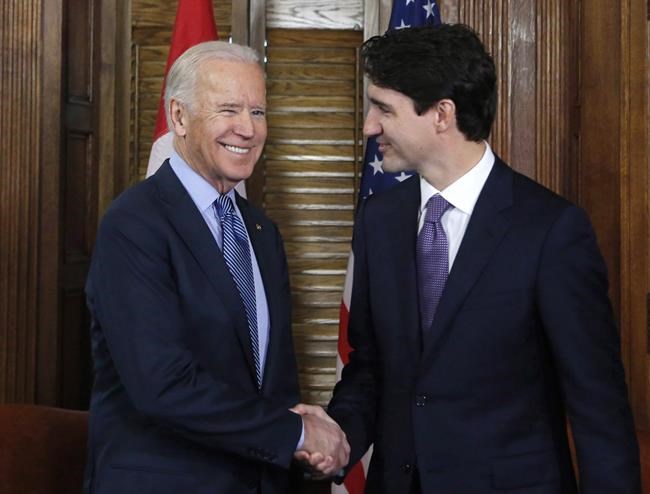
Prime Minister Justin Trudeau shakes hands with U.S. Vice-President Joe Biden on Parliament Hill in Ottawa on Friday, December 9, 2016. THE CANADIAN PRESS/Patrick Doyle

And while the pandemic may ensure it doesn’t register on the same scale as Brian Mulroney’s 1985 Shamrock Summit with Ronald Reagan, the expectations in Canada are still high.

Whether they are met remains anyone’s guess.

“I don’t want people to rest on their laurels and say, ‘Well, we got the first meeting, so good for us,'” said Maryscott Greenwood, CEO of the Canadian American Business Council.

There is plenty of hard work ahead, including on the Canada-U. S. border, navigating Buy American protectionism, a way forward on China and the thorny issue of cross-border pipelines.

To make progress, Greenwood said, the Prime Minister’s Office might do well to pretend Donald Trump is still president.

“Canada embarked on a very, very forward-leaning, activist agenda about engaging the U.S., inside and outside of D.C.” when Trump was in office, she said.

“It’s going to be important to have that level of urgency and that level of effort, and not just assume that everything’s good now that Biden’s here.”

Biden has signalled a hard line on Buy American, his suite of protectionist measures aimed at ensuring domestic contractors and suppliers are the primary beneficiaries of U.S. tax dollars spent on infrastructure projects and procurement efforts.

He may take a similar line with Trudeau, White House press secretary Jen Psaki suggested Monday.

“He signed an executive order; we’re of course evaluating procurement components of that, but no changes anticipated,” Psaki said.

“Of course, the prime minister will bring up whatever he would like to bring up, as is true of any bilateral meeting.”

Psaki offered up familiar bromides — a shared vision on climate change, cross-border economic ties and the “strong and deep partnership” between two “neighbours, friends and NATO allies.”

But she avoided saying whether Biden would further commit to help secure the release of Canadians Michael Kovrig and Michael Spavor, who have been held in China for more than two years.

The two were swept up after Canada arrested Huawei chief financial officer Meng Wanzhou to face extradition to the U.S., where she has been charged with violating sanctions on Iran.

Resolving the three-way diplomatic standoff that ensued will be a top priority for Trudeau, said Eric Miller, a Canada-U. S. expert and president of the D.C.-based Rideau Potomac Strategy Group.

The 2022 Olympics, to be hosted in Beijing, could provide the perfect inflection point, he said — particularly if the Chinese have reason to fear prominent protests during a moment of national pride.

“What are the Chinese going to do if the Canadian team marches into the stadium with armbands that say, ‘Free the Michaels?'” Miller said.

“I do think Biden’s at a phase now where there’s some receptivity to some different ideas. And as is often the case with this stuff, it often falls to Canada to kind of push the needle.”

Speaking of needles: Trudeau is widely expected to press Biden on making more of the U.S. COVID-19 vaccine supply available for export to Canada, where production delays in Europe have been plaguing efforts to get shots in arms.

Politically, however, it will be hard for Biden to sell the idea of providing relief to other countries when the vaccination effort at home still has a long way to go.

“Fundamentally, Trudeau has no choice but to make to make a push on this,” Miller said.

“Trudeau is going to make a big deal of asking, and the Biden people will commit to look into it, and nothing will happen.”

Look for a similar outcome if Trudeau complains about Biden’s decision to cancel the cross-border Keystone XL pipeline expansion, which he did with the stroke of a pen on his first day in the White House.

Canada remains a country heavily dependent on its natural resources, said Bill Reilly, who served as head of the Environmental Protection Agency under former president George Bush, from 1989 to 1993.

“It’s very likely to be raising issues that run counter to some of the environmental aspirations that animate the Biden administration,” Reilly told a panel discussion Monday.

“I don’t think some of these issues are going to lend themselves to easy resolution.”

This report by The Canadian Press was first published Feb. 22, 2021.

Report Error Submit a Tip

More Stories

Another embarrassing loss: Arniel

Mike McIntyre 7 minute read Preview

Another embarrassing loss: Arniel

Mike McIntyre 7 minute read Yesterday at 6:15 PM EST

RALEIGH — No sticks were smashed. No walls punched. And nary a naughty word was uttered.

Instead, the Winnipeg Jets filed off the ice here at Lenovo Center on Sunday afternoon much like they’d just played the preceding game against the Carolina Hurricanes — with no emotion, no passion, no urgency.

You’d have thought yet another loss, this one in truly humiliating fashion and a ninth consecutive overall, might have triggered something.

Anything.

Read
Yesterday at 6:15 PM EST

Trudeau, Biden to hold virtual bilateral meeting

James McCarten, The Canadian Press 5 minute read Preview

Trudeau, Biden to hold virtual bilateral meeting

James McCarten, The Canadian Press 5 minute read Monday, Feb. 22, 2021

WASHINGTON - Call it the Screen-Shared Summit.

Tuesday's bilateral meeting of Prime Minister Justin Trudeau and President Joe Biden — a strictly virtual affair, thanks to COVID-19 — offers hope of a new start for Canada-U. S. relations.

It will be the new president's first meeting with a foreign leader, and Trudeau's first chance to advance Canadian interests with the White House without the chaos and anxiety of the last four years.

And while the pandemic may ensure it doesn't register on the same scale as Brian Mulroney's 1985 Shamrock Summit with Ronald Reagan, the expectations in Canada are still high.

Read
Monday, Feb. 22, 2021

A little toponder, a lot to celebrate

Erna Buffie 5 minute read Saturday, Oct. 31, 2026

Well, another civic election season has come and gone, and I have to say it was a doozy. The most surprising event was the steady climb in support for young mayoral candidate Noah Redden, who started out with just four per cent public support in September but had reached a solid 14 per cent support in October.

On election day, Redden nearly came in second, less than one percentage point behind Kevin Klein, an experienced politician.

Indeed, the 27-year-old’s accomplishment was nothing short of astonishing. Particularly given that his shoestring campaign was given very little coverage — largely, according to one pundit, because he didn’t send out any press releases.

This when Redden’s unwritten press releases were there for everyone to see on Instagram, as he popped up in locations across the city, posting videos about what he hoped to achieve as mayor.

Province tables legislation to cover health-care system changes

Larry Kusch 4 minute read Preview

Province tables legislation to cover health-care system changes

Larry Kusch 4 minute read Wednesday, Mar. 6, 2019

The Pallister government has introduced broad legislation to support several of its key planned health-care reforms.

Health Minister Cameron Friesen said Wednesday that Bill 10 (The Regional Health Authorities Amendment Act) will provide the framework to simplify the administration of the health-care system and improve accountability.

All health services in Manitoba will be delivered through the five current regional health authorities, CancerCare Manitoba and a new provincial authority called Shared Health. The administrative changes are set to begin next month and will continue to be rolled out over the next two to three years.

The Health Department will cease to administer health services directly and focus its activities on planning, policy development, funding and oversight. It will set system-wide performance goals and track results.

Read
Wednesday, Mar. 6, 2019

Walkout creates chaos at St. James Smitty’s

Morgan Modjeski 3 minute read Preview

Walkout creates chaos at St. James Smitty’s

Morgan Modjeski 3 minute read Saturday, Oct. 31, 2026

Gordon Sharpe wanted to eat a meal at the St. James Smitty’s Wednesday, but he got a helping of bad news instead.

He saw several workers walk out of the restaurant, at 1017 St. James St.

“(The waiter) came back about 10 minutes later and stood over the table, looking a little distraught and said, ‘I’m quitting right now and so is everybody else,’” Sharpe said. “He said, ‘This is my last time serving you,’ and he was quite choked up.”

“I’ve never seen anything like it,” he said, adding that the managers scrambled to serve patrons.

Read
Saturday, Oct. 31, 2026

The new normal in Canadian politics

David McLaughlin 5 minute read Preview

The new normal in Canadian politics

David McLaughlin 5 minute read Saturday, Oct. 31, 2026

“Nothing happening, all at once.”

Welcome to the new normal of Canadian politics, where normality is the new normal. Routine and stable are in; disruptive and excessive are out. Exhibits A and B are the Alberta referendum and the British Columbia election. Voters opted for stability over volatility.

The opposite of being normal is being different from the norm. In politics that means different from where we’ve been and what we’ve come to expect. Two competing trends have dominated our politics for the past decade and a half — progressivism and populism. Think Justin Trudeau and liberal, progressive identity politics in Canada, and Donald Trump and conservative, populist MAGA politics in America. We are now experiencing a swing away from both those trends.

Representing this “new normal” are Prime Minister Mark Carney, for one, and newly elected British Columbia premier, Lorne Doerksen, for another. Both are considered normal because they talk and act like adults in a childish political world. Their political flair is to not have any political flair. They stand out for not standing out.

Read
Saturday, Oct. 31, 2026