Holiday season vacations coincide with rise in COVID-19 travel-related cases

Advertisement

Advertise with us

OTTAWA - As the federal government prepares to slap new restrictions on international travel, Health Canada data suggest a worrying uptick of infections directly connected to foreign arrivals.

Read this article for free:


By clicking the button above, an account will be created and you will begin to receive some of our recommended newsletters. You may opt out of any newsletter by visiting your Email and Communication Preferences page or by clicking "unsubscribe" at the bottom of any email.

or

Already have an account? Log in here »

To continue reading, please subscribe:

Digital Subscription

One year of digital access for only $1.44 a week*

  • Enjoy unlimited reading on winnipegfreepress.com
  • Read the E-Edition, our digital replica newspaper
  • Access News Break, our award-winning app
  • Play interactive puzzles

*Billed as $5.77 plus GST every four weeks. After 52 weeks, price increases to the regular rate of $19.95 plus GST every four weeks. Offer available to new and qualified returning subscribers only. Cancel any time.

To continue reading, please subscribe:

Add Free Press access to your Brandon Sun subscription for only an additional

$1 for the first 4 weeks*

  • Enjoy unlimited reading on winnipegfreepress.com
  • Read the E-Edition, our digital replica newspaper
  • Access News Break, our award-winning app
  • Play interactive puzzles
Start now

*Your next Brandon Sun subscription payment will increase by $1.00 and you will be charged $17.95 plus GST for four weeks. After four weeks, your payment will increase to $24.95 plus GST every four weeks.

Hey there, time traveller!
This article was published 28/01/2021 (2105 days ago), so information in it may no longer be current.

OTTAWA – As the federal government prepares to slap new restrictions on international travel, Health Canada data suggest a worrying uptick of infections directly connected to foreign arrivals.

While travel exposures account for less than two per cent of all Canada’s COVID-19 cases, the number of cases in recent travellers, and people they came into close contact with after arriving, shows continual growth in recent months.

In December, 486 cases of COVID-19 were diagnosed in recent travellers, the most since March and up from 312 in November and 204 in October. Despite mandatory two-week quarantines for international travellers, there were 1,258 COVID-19 cases confirmed in people who had close contact with a recent traveller in December, up from 744 in November and 704 in October.

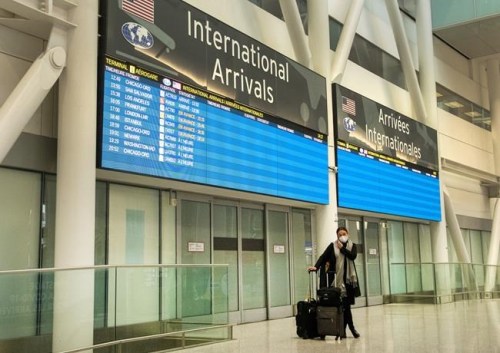
A lone passenger stands outside the International Arrivals area at Pearson Airport in Toronto on Tuesday, Jan. 26, 2021. As the federal government prepares to slap new restrictions on foreign arrivals, Health Canada data suggest a growing number of infections directly connected to international travel. THE CANADIAN PRESS/Frank Gunn

In the first three weeks of January, 384 travel cases and 607 traveller-contact cases were confirmed.

The figures also correspond with a recent rise in the number of people travelling, at least by air. Land-border arrivals are typically fewer in the winter because of the weather in much of the country, but more people arrived from the U.S. by air in December than any month since March. Arrivals from other international locations were higher in December than any month except August.

Reports of notable Canadians ignoring pleas not to travel during the pandemic in favour of sun-kissed days on foreign beaches angered much of the country in the weeks after Christmas, and led to several high-profile provincial and federal politicians and health officials being fired, demoted or reprimanded.

Between Nov. 30 and Dec. 27, 86,953 people flew into Canada from the United States, and 184,260 arrived by air from other international locations.

Prime Minister Justin Trudeau has been promising for more than a week that the government will bring in stronger measures for international arrivals, as Canada fears the impact of new variants of COVID-19 that have arisen in other countries.

That is on top of a mandatory two-week quarantine for all arrivals, which has been in place since last spring, restricting international flights to just four airports, and a more recent requirement for foreign travellers to provide proof of recent negative COVID-19 tests within three days of boarding planes to Canada.

A spokesman for Health Minister Patty Hajdu said “Canada has some of the strongest border measures in the world” and all future measures will be guided by both science and evidence. Cole Davidson said 6,500 phone calls are made daily to verify travellers are in quarantine, and that 99 per cent of nearly 50,000 checks on quarantine made by police have found people are where they are supposed to be.

There are more than 50 cases of the new coronavirus variants from the United Kingdom and South Africa now confirmed in Canada, most, but not all of them, in people who recently travelled into Canada from those countries. The variants are believed to spread more easily, and in recent days concerns have arisen about whether they are more likely to cause serious illness or death.

Conservative Health Critic Michelle Rempel Garner said while community spread within Canada still accounts for the vast majority of this country’s cases, Canada has to do more at the borders. She said the most effective option is to impose a mandatory rapid COVID-19 test on all arrivals, and have that test repeated midway through the two-week quarantine period.

Rempel Garner said Canada can’t “hermetically seal” our border as island nations like New Zealand have done, so testing all travellers for the virus, screening them all for the variants, and maintaining the quarantine would be effective and more efficient than requiring travellers to quarantine at a hotel for two weeks at their own expense.

Similar rules have been in place in Iceland for months. Singapore began requiring testing at all airports on Jan. 24, along with using drones and electronic surveillance to monitor people in quarantine.

NDP Leader Jagmeet Singh said a trend in more travel-related cases is “alarming” and that Trudeau can’t wait any longer to act to stop it.

“With the catastrophic situation we are in, we cannot afford a spike because of non-essential travel,” Singh said.

This report by The Canadian Press was first published Jan. 28, 2021.

Report Error Submit a Tip

More Stories

Travel-related COVID-19 cases on the rise

Mia Rabson, The Canadian Press 4 minute read Preview

Travel-related COVID-19 cases on the rise

Mia Rabson, The Canadian Press 4 minute read Thursday, Jan. 28, 2021

OTTAWA - As the federal government prepares to slap new restrictions on international travel, Health Canada data suggest a worrying uptick of infections directly connected to foreign arrivals.

While travel exposures account for less than two per cent of all Canada's COVID-19 cases, the number of cases in recent travellers, and people they came into close contact with after arriving, shows continual growth in recent months.

In December, 486 cases of COVID-19 were diagnosed in recent travellers, the most since March and up from 312 in November and 204 in October. Despite mandatory two-week quarantines for international travellers, there were 1,258 COVID-19 cases confirmed in people who had close contact with a recent traveller in December, up from 744 in November and 704 in October.

In the first three weeks of January, 384 travel cases and 607 traveller-contact cases were confirmed.

Read
Thursday, Jan. 28, 2021

Manitoba film and music ambassador calling it quits

Jen Zoratti 5 minute read Preview

Manitoba film and music ambassador calling it quits

Jen Zoratti 5 minute read Wednesday, Aug. 29, 2018

After more than three decades as a leader and champion in this province’s film and music industries, Manitoba Film & Music CEO and film commissioner Carole Vivier is retiring, effective June 2019.

Since joining MFM in 1985 — and serving at its helm for the past 26 years — Vivier has supported some of Manitoba’s biggest cultural exports, including Guy Maddin, the Weakerthans, Doc Walker, the Crash Test Dummies, Norma Bailey and Tanya Tagaq, since the beginning of their careers. She has built a local, national and international reputation for being a passionate and committed ambassador for Manitoba filmmakers, musicians, producers, creators and crew.

Vivier was not available on Tuesday to comment on the announcement, but had this to say in the press release:

“I am grateful to have been a part of this industry for the past three decades and to witness the growth and success of our amazing artists and professionals. I am immensely proud of the talent in this province. Although I will miss MFM, I am tremendously encouraged that a strong foundation is in place, from which new talent can reach even greater heights. The future of film and music in Manitoba is very bright.”

Read
Wednesday, Aug. 29, 2018

Oliveira inks three-year extension with Bombers

Taylor Allen 2 minute read Preview

Oliveira inks three-year extension with Bombers

Taylor Allen 2 minute read Tuesday, Dec. 16, 2025

Brady Oliveira is staying home.

The Winnipeg Blue Bombers announced Monday afternoon the star running back has agreed to a three-year contract extension through the 2028 season.

The 28-year-old was scheduled to become a free agent in February.

“I know what I can bring and I know I’m a calibre of player that can help a team win a championship, so I want to put myself in the best situation to win a championship,” said Oliveira in his end of season press conference in November.

Read
Tuesday, Dec. 16, 2025

With the start of 2022 comes a new framework for Manitoba’s real estate industry

Ben Waldman 6 minute read Preview

With the start of 2022 comes a new framework for Manitoba’s real estate industry

Ben Waldman 6 minute read Monday, Jan. 10, 2022

New year, new rules for Manitoba real estate.

On Jan. 1, the Real Estate Services Act came into effect in the province, bringing with it an updated regulatory framework for the local industry to follow, along with some key changes for parties on either side of a real estate transaction.

One of the most notable changes to consumers is likely the introduction of a service agreement requirement: any buyers, sellers, or renters of residential or commercial properties are now required to sign such an agreement with a realtor prior to any services being rendered. But there are other moves that will impact real estate business moving forward.

The regulatory Manitoba Securities Commission’s real estate division consulted with industry groups such as the Manitoba Real Estate Association in drafting the legislation, which replaces the Real Estate Brokers Act, and which the commission’s website says “reflects the changing face” of the provincial real estate landscape.

Read
Monday, Jan. 10, 2022

Tools, technology required to retain doctors

4 minute read Preview

Tools, technology required to retain doctors

4 minute read 2:01 AM EST

Manitoba has made some encouraging progress in addressing its doctor shortage. But attracting more physicians to the province will accomplish only so much if the health-care system can’t give them the tools, technology and working conditions they need to do their jobs.

A new report from Doctors Manitoba suggests the province is making progress in growing its physician workforce. But serious gaps remain.

The organization’s annual Physicians in Manitoba report contains some welcome news. The province now has a record number of physicians practising here, with 235 doctors per 100,000 residents. That’s getting closer to the national average of 245.

The overall physician shortage has also been cut nearly in half from its peak three years ago, when Manitoba needed 445 additional doctors to reach the national average. It now needs 229.

Read
2:01 AM EST

TV that makes the cut

Denise Duguay 3 minute read Preview

TV that makes the cut

Denise Duguay 3 minute read 2:01 AM EST

Ambition is a great motivator in fields as diverse as professional boxing, high-school dance team, photography, animal wrangling and even — stay with me here — bank robbery and alien-summoning?

Sure, some of these are more relatable than others, but the solutions, and the series and movie that contain them, are intriguing. Press play to become a better you.

● The Greatest (docudrama series premières Wednesday, Nov. 4 on Prime Video)

This dramatization of the life of acclaimed boxer and activist Muhammad Ali is billed as the first authorized scripted series on the subject. Its executive producers include his widow, Lonnie Ali, as well as serious name brands Jay-Z and Michael B. Jordan. Newcomer Jaalen Best plays the title role, supported by Giovanni Ribisi (American Hostage) playing Angelo Dundee and Michael Ealy (The Following) as Malcolm X.

Read
2:01 AM EST