A look at what provinces and territories have said about COVID-19 vaccine plans
Advertisement
Read this article for free:
or
Already have an account? Log in here »
To continue reading, please subscribe:
Digital Subscription
One year of digital access for only $1.44 a week*
- Enjoy unlimited reading on winnipegfreepress.com
- Read the E-Edition, our digital replica newspaper
- Access News Break, our award-winning app
- Play interactive puzzles
*Billed as $5.77 plus GST every four weeks. After 52 weeks, price increases to the regular rate of $19.95 plus GST every four weeks. Offer available to new and qualified returning subscribers only. Cancel any time.
To continue reading, please subscribe:
Add Free Press access to your Brandon Sun subscription for only an additional
$1 for the first 4 weeks*
- Enjoy unlimited reading on winnipegfreepress.com
- Read the E-Edition, our digital replica newspaper
- Access News Break, our award-winning app
- Play interactive puzzles
*Your next Brandon Sun subscription payment will increase by $1.00 and you will be charged $17.95 plus GST for four weeks. After four weeks, your payment will increase to $24.95 plus GST every four weeks.
Read unlimited articles for free today:
or
Already have an account? Log in here »
Hey there, time traveller!
This article was published 13/12/2020 (2147 days ago), so information in it may no longer be current.
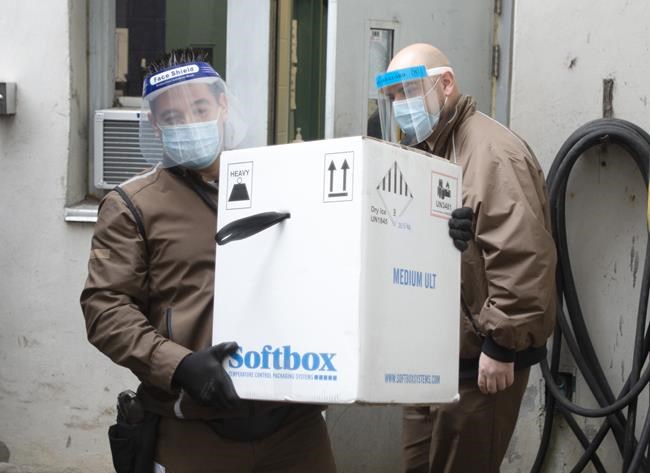
The largest mass immunization effort in Canadian history began Monday in Ontario and Quebec after the country received its first COVID-19 vaccine shipment over the weekend.
The Canadian military is assisting a massive effort to distribute 249,000 doses developed by pharmaceutical giant Pfizer and German partner BioNTech. Here’s a look at what the various provinces have said about their rollout plans:
—
Newfoundland and Labrador
Premier Andrew Furey says he anticipates receiving 1,950 doses of the COVID-19 vaccine at the St. John’s receiving site this week.
Furey says the province expects another shipment of the vaccine later in the month.
—
Prince Edward Island
Health officials on Prince Edward Island say they are ready to administer the COVID-19 vaccine when the first shipment arrives this week.
Chief medical officer of health Dr. Heather Morrison says the province plans to begin by administering the Pfizer vaccine to priority groups, including residents and staff of long-term care homes, health-care workers and adults in Indigenous communities.
Morrison says she expects to receive 1,950 doses in the first shipment, and the clinic will have to be held at the storage location because the Pfizer vaccine must be kept frozen.
The owner of a bluefin tuna exporting company in the eastern part of P.E.I. has offered up two freezers to the provincial government to aid in the effort to store the vaccine.
—
New Brunswick
New Brunswick’s health minister says its shipment of 1,950 doses of the Pfizer vaccine would be used to inoculate long-term care residents and staff, staff from rapid COVID-19 response teams, ambulance workers, health-care workers involved in COVID units, seniors 85 and older and First Nations nurses.
Dorothy Shephard says the vaccine plan would be carried out by the provincial Emergency Measures Organization.
The first round of vaccinations will be carried out Dec. 19 and 20 at the Miramichi Regional Hospital, which has an ultralow-temperature freezer to store the vaccine.
—
Nova Scotia
Nova Scotia’s chief medical officer of health says the province will receive 1,950 doses of Pfizer’s vaccine for an initial test run beginning Tuesday.
Dr. Robert Strang says the first doses will be used to immunize front-line health workers in the Halifax area who are most directly involved in the pandemic response.
Strang says because the vaccine has specific handling requirements, Pfizer has stipulated that the initial round of immunizations take place near where the doses are stored.
Nova Scotia has one ultralow-temperature freezer to store the vaccine at the tertiary care teaching complex at the Queen Elizabeth II Health Sciences Centre.
Strang says the province is getting another freezer through Ottawa that will operate out of a central depot for vaccines at the public health office in Halifax. The province is also looking at securing freezers from the private sector.
—
Quebec
The first doses of Pfizer’s COVID-19 vaccine were administered in the province Monday.
Residents of long-term care homes and health-care workers are to have first priority.
The groups next in line are people living in private seniors residences, followed by residents of isolated communities and then anyone aged 80 and over.
—
Ontario
Ontario received 6,000 doses of Pfizer’s COVID-19 vaccine over the weekend and began giving them out on Monday.
Retired gen. Rick Hiller, who is leading Ontario’s vaccine task force, says half the shots will be administered this week, and the other half will be intentionally held back to give the same workers a required second dose 21 days later.
“Given the sort of information flow of what we know about the supply, which is very little at this time … we decided it was better to err on the side of caution,” he says.
An additional 90,000 doses of the Pfizer vaccine are expected to arrive later this month and are to be provided to 14 hospitals in COVID-19 hot spots.
Hillier has said the province also expects to receive between 30,000 and 85,000 doses of the Moderna vaccine by the new year, pending its approval by Health Canada.
Ontario’s Solicitor General Sylvia Jones said that the hospitals receiving the first shots have made security arrangements to ensure the vaccine is safe from theft.
—
Manitoba
Premier Brian Pallister says some 900 health-care workers in critical care units will be the first to receive the vaccine after doses start to arrive this week.
As more shipments come in, priority will be given to other health-care workers, seniors and Indigenous people.
Manitoba hopes to start vaccinating on Wednesday.
The province plans to vaccinate more than 100,000 people by March — that’s roughly seven per cent of Manitoba’s population.
Officials say they’ve been setting up a large-scale “supersite” to deliver the vaccine. The first freezer able to store the Pfizer vaccine at low temperatures has been delivered and installed, with another four on the way.
The province says the vaccine will become more widely available at a larger number of sites, similar to a conventional vaccination campaign, such as the annual flu shot.
—
Saskatchewan
Saskatchewan plans to start immunizing critical health-care workers against COVID-19 in a pilot project this week.
Premier Scott Moe says the province expects to receive 1,950 doses of Pfizer’s vaccine by Tuesday. A pilot vaccination program at the Regina General Hospital will give the vaccine to health-care workers in intensive and emergency care, COVID-19 units and those working in testing and assessment centres.
The first official stage of Saskatchewan’s vaccination program will be in late December when the province receives more doses.
It will target more health-care workers, staff and residents in long-term care, seniors over 80 and people in remote areas who are at least 50.
Some 202,052 doses of the Pfizer vaccine are expected to arrive within the first quarter of next year, and there are to be 10,725 weekly allocations.
Moe says vaccinations for the general population is expected to begin in April.
—
Alberta
Alberta Premier Jason Kenney announced in a video released late Monday and recorded next to a cargo plane at Calgary International Airport that the province’s first 3,900 vaccine doses had arrived.
Kenney said in the video that ICU nurses are queued up to be the first to receive the vaccine, and that he expected the first dose to be administered in the next 24 hours.
Alberta Health Minister Tyler Shandro said earlier in the day that the doses would go to health-care workers and would begin in Edmonton and Calgary.
Shandro said another 25,000 Pfizer doses are coming next week and will also be administered to health workers.
Doses of the Moderna vaccine are expected by the end of the month.
The province says it eventually plans to roll out the vaccine from 30 different locations.
—
British Columbia
British Columbia’s provincial health officer, Dr. Bonnie Henry, says the province will start its immunization program on Tuesday with some health workers in long-term care homes getting the vaccine first.
Regions of the province covered by the Vancouver Coastal and Fraser health authorities are first in line to get the Pfizer vaccine, which arrived on Monday.
The vaccine is expected to be available in the rest of the province by next week.
Workers in long-term care facilities are at the top of the list to get the vaccine.
Henry expects about 400,000 people to be vaccinated by March.
The province said it is developing a system so people can register to get the vaccine and receive a formal record of immunization.
—
Nunavut
Nunavut’s premier says the territory will get the vaccine made by Moderna in the first quarter of 2021.
Joe Savikataaq says Prime Minister Justin Trudeau has told him Nunavut will get enough doses to vaccinate 75 per cent of the population.
Chief public health officer Dr. Michael Patterson says Nunavut will prioritize elders and health-care workers first for the vaccine.
Savikataaq says his government is still working on its plan to roll out the vaccine once it arrives in the territory.
__
Northwest Territories
The premier of the Northwest Territories says N.W.T. will receive 51,000 doses of the Moderna vaccine in the new year.
Caroline Cochrane says that’s enough to vaccinate 75 per cent of the population ages 18 and up.
The territory is creating a vaccine team made up of nurses and support staff to travel to smaller communities.
Health Minister Julie Green says two specialized freezers for storing the vaccines are on their way from the federal government and will be placed in Yellowknife and Inuvik.
Smaller, portable freezers are also on the way and will be placed in smaller communities.
—
Yukon

Yukon says it will get enough of the Moderna vaccine by spring to vaccinate 75 per cent of its residents.
A statement from the Yukon government says the territory’s allocation is in recognition of it’s large Indigenous populations and remote communities.
Premier Sandy Silver says getting vaccinated is the best thing residents can do to protect themselves and their loved ones.
“Over time, widespread immunization will allow us to return to a life without COVID-19 restrictions.”
This report by The Canadian Press was first published Dec. 14, 2020.
Related Articles
Canada's first COVID vaccines given in Ont., Que.
Advertisement Advertise With Us
Advertisement Advertise With Us