

A fond farewell to the Hercules
Advertisement
Read this article for free:
or
Already have an account? Log in here »
To continue reading, please subscribe:
Digital Subscription
One year of digital access for only $1.44 a week*
- Enjoy unlimited reading on winnipegfreepress.com
- Read the E-Edition, our digital replica newspaper
- Access News Break, our award-winning app
- Play interactive puzzles
*Billed as $5.77 plus GST every four weeks. After 52 weeks, price increases to the regular rate of $19.95 plus GST every four weeks. Offer available to new and qualified returning subscribers only. Cancel any time.
To continue reading, please subscribe:
Add Free Press access to your Brandon Sun subscription for only an additional
$1 for the first 4 weeks*
- Enjoy unlimited reading on winnipegfreepress.com
- Read the E-Edition, our digital replica newspaper
- Access News Break, our award-winning app
- Play interactive puzzles
*Your next Brandon Sun subscription payment will increase by $1.00 and you will be charged $17.95 plus GST for four weeks. After four weeks, your payment will increase to $24.95 plus GST every four weeks.
Read unlimited articles for free today:
or
Already have an account? Log in here »
Fans at the NHL’s outdoor Heritage Classic game last weekend were no doubt thrilled by the sight and sound of two CF-18 Hornet fighter jets conducting a flyover at Princess Auto Stadium shortly before the puck was dropped for the much-anticipated Winnipeg Jets/Montreal Canadiens matchup.
Flyovers such as these always create a spectacular scene, as the speed and power of the jets are on full display for the brief moments they’re in view above the stadium bowl. But fans who maintained their skyward gaze for a few seconds after the Hornets’ blink-and-you’ll-miss-it appearance were treated to a much more poignant aeronautical exhibition, as a CC-130H Hercules aircraft passed over the stadium in the fighter jets’ wake.
Compared to the supersonic CF-18s, the massive, propeller-driven transport plane probably seemed to be doing more of a “crawl-over”; what most folks at the outdoor game probably didn’t realize, however, was that this was almost certainly the last time they’ll see one of these ubiquitous Canadian Forces aircraft in the sky.
Free Press files
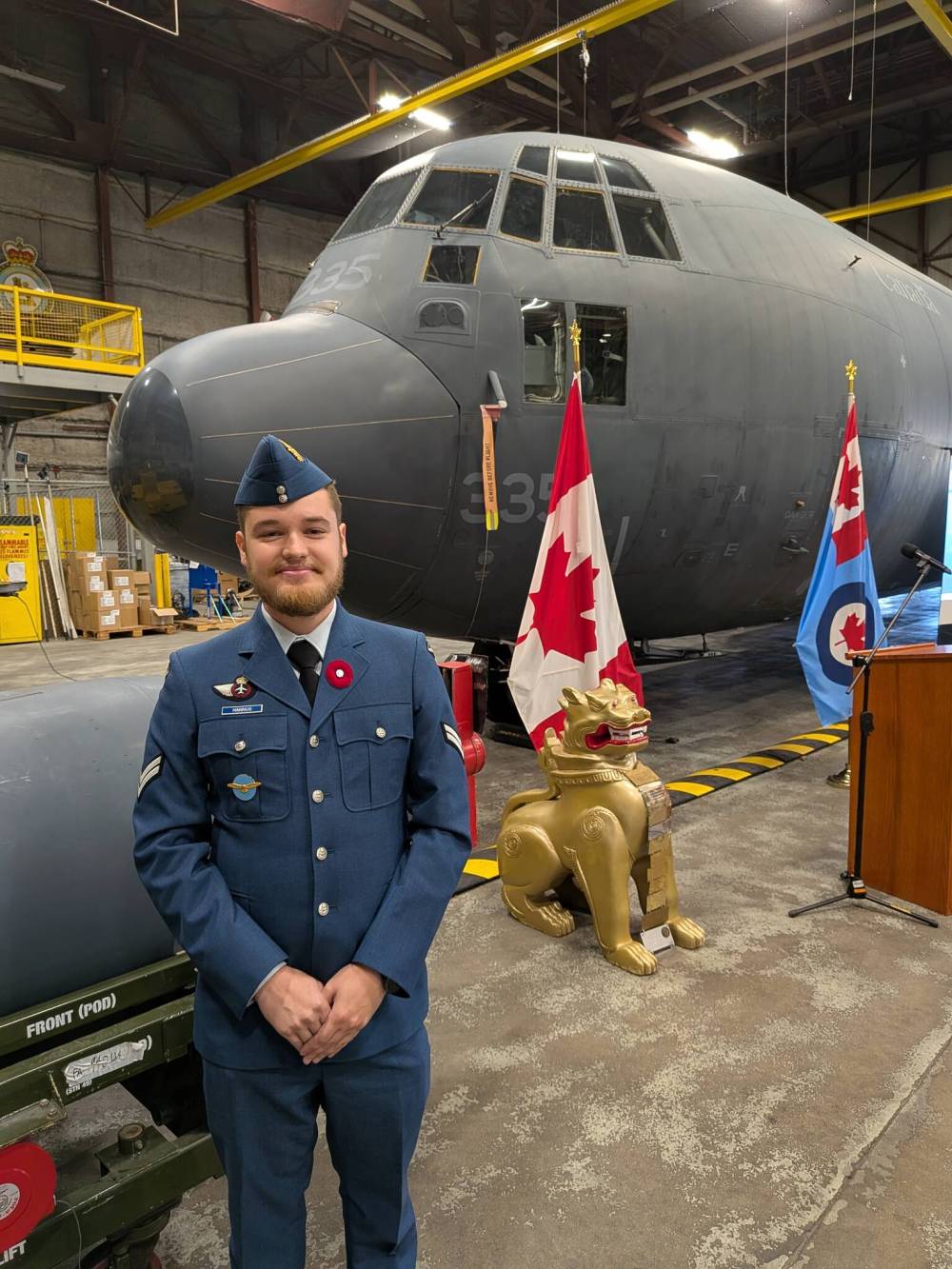
Cpl. Andrew Hannus, an aviation systems technician, attended the Oct. 24 retirement ceremony for the CC-130H Hercules at 17 Wing Winnipeg.
The CC-130H is being retired after more than half a century as the RCAF’s combat, rescue and transport workhorse. The “Herc” will be replaced by more modern aircraft, including the smaller and more nimble CC-295 Kingfisher, which will be used for search-and-rescue missions out of 17 Wing Winnipeg, beginning next month.
The 435 Transport Search and Rescue Squadron, based at 17 Wing, is the final RCAF unit to employ the Herc; its two remaining planes will be taken out of service on Nov. 1 and Nov. 18. Of the dozen Hercs decommissioned this year by the RCAF, 10 have been sold to British Columbia-based Coulson Aviation and will be converted for use in fighting wildfires; the other two CC-130H aircraft will be put on public display on bases or in museums, with one possibility being the locally based Royal Aviation Museum of Western Canada.
Winnipeg would be a fitting final destination, given the significant contribution the aircraft has made to the city’s aviation history.
“It’s really part of our family, and one of us,” 17 Wing Winnipeg commander Col. Curtis Wright said last week at a ceremony marking the Herc’s retirement. “This was the backbone of a lot of things that we do here out of Winnipeg.”
Though its size and interior capacity made it seem best suited to cargo transport, the CC-130H’s principal role was in serving the RCAF’s search and rescue mandate. With a range of 7,200 km and available space for up to 80 passengers, along with an ability to operate on short, unpaved runways and in severe weather conditions, the Herc flew missions from the Arctic to Afghanistan and was often used to evacuate residents of remote and northern communities under threat from natural disasters.

Most recently, search-and-rescue personnel were transported by CC-130H to the site of the wildfire near Wainwright, Alta., where primary-care paramedics were parachuted in to assist at a hospital after the fire claimed the lives of four soldiers and injured dozens more on Oct. 17.
The removal of the CC-130H from service is an emotional moment for the RCAF crews that flew it and personnel that maintained it.
“People have been flying on this aircraft for their entire careers,” Wright explained.
Its departure will also be felt by many civilians who were aware of the unique, ungainly aircraft’s massive contribution to Canada’s military endeavours and could immediately recognize a Herc among the untold dozens of planes that traverse Winnipeg’s skies daily.
In its own way, the Herc is a heritage classic.