Canadian cannabis, psychedelics industries cheer state measures in U.S. election

Advertisement

Advertise with us

TORONTO - Canadian cannabis and psychedelics companies that have been eyeing the U.S. market have a few new reasons to celebrate.

Read this article for free:


By clicking the button above, an account will be created and you will begin to receive some of our recommended newsletters. You may opt out of any newsletter by visiting your Email and Communication Preferences page or by clicking "unsubscribe" at the bottom of any email.

or

Already have an account? Log in here »

To continue reading, please subscribe:

Digital Subscription

One year of digital access for only $1.44 a week*

  • Enjoy unlimited reading on winnipegfreepress.com
  • Read the E-Edition, our digital replica newspaper
  • Access News Break, our award-winning app
  • Play interactive puzzles

*Billed as $5.77 plus GST every four weeks. After 52 weeks, price increases to the regular rate of $19.95 plus GST every four weeks. Offer available to new and qualified returning subscribers only. Cancel any time.

To continue reading, please subscribe:

Add Free Press access to your Brandon Sun subscription for only an additional

$1 for the first 4 weeks*

  • Enjoy unlimited reading on winnipegfreepress.com
  • Read the E-Edition, our digital replica newspaper
  • Access News Break, our award-winning app
  • Play interactive puzzles
Start now

*Your next Brandon Sun subscription payment will increase by $1.00 and you will be charged $17.95 plus GST for four weeks. After four weeks, your payment will increase to $24.95 plus GST every four weeks.

Hey there, time traveller!
This article was published 06/11/2020 (2182 days ago), so information in it may no longer be current.

TORONTO – Canadian cannabis and psychedelics companies that have been eyeing the U.S. market have a few new reasons to celebrate.

Through U.S. election ballot questions, five states — Arizona, New Jersey, South Dakota, Mississippi and Montana — this week voted in favour of legalizing recreational or medical cannabis, while Oregon supported the sale of psilocybin mushrooms and Washington, D.C. decriminalized some psychedelic drugs.

Experts say the growing support for cannabis and psychedelic drugs in the United States could be a boon for its neighbours to the north.
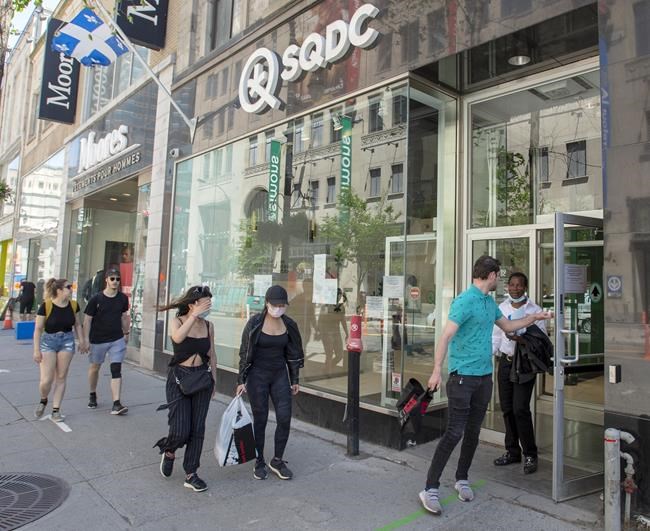
A Quebec cannabis outlet is seen Thursday, June 11, 2020 in Montreal. Canadian cannabis and psychedelics companies that have been eyeing the U.S. market got a few reasons to celebrate this week. THE CANADIAN PRESS/Ryan Remiorz

“The size of the market dwarfs the overall opportunity in Canada,” said Omar Khan, Hill+Knowlton Strategies’ national cannabis sector lead.

“A lot of the players here have gone through ups and downs in the industry, learned what to do and not to do and are now able to perhaps apply some of those learnings to the U.S. market.”

On top of benefits from states that green-lit legalization, Khan said a Joe Biden and Kamala Harris White House could deliver more cannabis wins.

He pointed to the Safe Banking Act, a Democratic bill with some Republican support stalled in the U.S. Senate. It would allow financial institutions to work with cannabis companies without retribution and could pass under a new administration.

“If you’re a Canadian company looking to get into retail down south, that’s potentially a game-changer for you in terms of access to capital,” Khan said.

Biden and Harris could also be good for cannabis companies because they committed to decriminalizing pot and expunging criminal records related to its possession, he said.

“On the flip side, a Donald Trump victory would mean more status quo and I don’t think that’s necessarily a bad thing for cannabis companies because it just gives them that much more time and it allows capital to move back … into Canadian companies,” said Deepak Anand, the chief executive of Materia Ventures, which produces and distributes medical cannabis.

The U.S. election came as the Canadian cannabis sector is facing turmoil. The optimism that circled the industry two years ago, when cannabis was legalized in Canada, has largely dissipated.

Pot companies now are restructuring and laying off thousands of workers. Industry closures, mergers and acquisitions are materializing and many believe more are on their way.

A U.S. toehold could be a step to reversing those trends, said David Culver, Canopy Growth Corp.‘s head of U.S. government relations.

“There’s a lot of eyes in Canada on the U.S. market, and we’re excited about the possibilities there because it will have a very positive impact on my company and many others,” he said.

He believes U.S. election developments signal the growing normalization of cannabis and indicate where policies can be pushed further forward, even during the pandemic.

For example, he said states facing ballooning budget deficits will be “looking under every rock” for tax revenue. Cannabis-friendly policies could create a cash injection while signalling that they are open for businesses in the sector.

When states are ready for cannabis, he said, Canopy has the “crystal ball” advantage because it knows how legalization works from its experience in Canada and can easily deploy strategies it used before.

Aurora Cannabis chief executive Miguel Martin agreed.

“This is the right moment to improve financial systems, address social injustices, and realize the potential benefits of sound, evidence-based cannabis public policy,” he said in an email. “Aurora remains focused on and optimistic for the U.S. CBD market and long-term prospects for federal legalization.”

It’s not just cannabis companies that stand to win through the U.S. election.

Companies working hard to normalize psychedelics and get them seen as potential aids in the fight against mental illness can reap rewards too, said Ronan Levy, Field Trip Health Ltd.’s chief executive.

His Toronto-based company, which has been exploring ketamine-enhanced psychotherapy, believes the psychedelic drug industry will grow and may become more significant than the cannabis sector.

Oregon’s support for the growth, administration and sale of psilocybin mushrooms in licensed facilities is a “bellwether,” Levy said.

“We know for a fact that other states were looking to move forward with a ballot similar to Oregon, but got really sidelined by the pandemic … I think this is really going to drive the industry forward.”

The U.S.’s large population and influence may also change consumer sentiment and hesitation around psychedelics, creating an opportunity for Canadian companies, he said.

“If you see the U.S. start to embrace psychedelic therapies, it’s going to accelerate global acceptance of psychedelic therapies and really drive things forward for us.”

This report by The Canadian Press was first published Nov. 6, 2020.

Companies in this story: (TSX:WEED, TSX:ACB)

Report Error Submit a Tip

More Stories

AI and the quiet erosion of human judgment

Rod Lastra 5 minute read 2:00 AM CDT

In 1986, Paul Simon sang of “days of miracle and wonder” in the song The Boy in the Bubble, from his Graceland album. It was hardly a hymn to progress. Scientific ingenuity coexisted with violence and vulnerability. The world was becoming more technologically capable but not necessarily wiser.

Four decades later, I find the sentiment difficult to improve upon. Since ChatGPT’s release in November 2022, predictions about AI have arrived in rapid succession. Sam Altman, Dario Amodei, Elon Musk and others in the tech industry’s so-called “broligarchy” have fuelled recent headlines about approaching “superintelligence” and futures ranging from human flourishing to catastrophe. The advances are real but the predictions often carry more confidence than evidence. The future, it seems, is permanently scheduled for an upgrade.

Yet a more immediate question risks being lost — as AI systems become more capable and we delegate increasingly complex work to them, will our capacity to understand, question and oversee their outputs keep pace?

That question begins with understanding what we are delegating. AI is not a single technology. Specialized systems have helped scientists predict protein structures. ChatGPT relies on general-purpose language models trained on vast datasets. The most advanced systems are often called “frontier models”. They can write, translate, analyze and converse across subjects, but fluency does not guarantee accuracy. Success at one task does not establish competence at another.

Lula’s historic Brazilian election victory

Peter McKenna 5 minute read Preview

Lula’s historic Brazilian election victory

Peter McKenna 5 minute read Yesterday at 2:01 AM CDT

This was supposed to go down as one of the closest presidential elections in Brazilian history — until it wasn’t. In the end, 80-year-old leftist President Luiz Inácio (Lula) da Silva of the Workers Party bested (by some four million votes) Flávio Bolsonaro, the hard-right Liberal Party leader and senator, by a lopsided 3.5 per cent of the popular vote.

Speaking of Brazilian history, it rarely happens that the second-place finisher in the first round ends up winning the second, run-off contest in such a decisive manner. More significant, Lula has now won an unprecedented (non-consecutive) fourth term as an elected Brazilian president.

While Bolsonaro has waffled on making a concession speech (like his father in 2022), the writing on the wall shows clearly that he lost badly. He has evidently taken issue with a ruling by a justice of the Supreme Court that extended polling hours country-wide by an additional two hours in light of high voter turnout and other interruptions.

Flávio’s supporters, many galvanized around the “never Lula” camp, were desperate for change — even if it meant the kind of change that could turn Brazil on its head. So Lula resorted to one of the oldest political tricks in the campaign handbook — namely, using fear of an anti-democratic Bolsonaro to swing voters to his side (along with a host of last-minute announcements involving financial incentives to Brazilians). With a right-leaning Congress, voters were understandably worried that Flávio would go about systematically dismantling Brazil’s democratic ethos and institutions.

Read
Yesterday at 2:01 AM CDT

Letters, Oct. 28

7 minute read 2:00 AM CDT

Vote, people!

Re: Get out and exercise your franchise (Editorial, Oct. 24)

I’m now in the autumn of my life but have voted in every single election since I was first eligible, which at that time was the age of 21. This was impressed upon me at a very young age by my father, who said it was every citizen’s duty to vote.

The apathy with regard to voting these days is appalling. And I know that some of the people who do the most complaining about how things are being done are those who don’t bother to vote. Perhaps to overcome this, Canada should look at doing what Australia and several countries in Europe and Latin America have done, which is to make voting compulsory.

Letters, Oct. 27

7 minute read Yesterday at 2:01 AM CDT

Time for ranked ballots?

Re: Get out and exercise your franchise (Editorial, Oct. 24)

Declining turnout is indeed a threat to our democracy and, while I am grateful that the editorial mentioned proportional representation, the issue on the municipal level can be solved far more simply — using ranked-choice voting.

In the last Winnipeg municipal election, the mayor “won” the election with only 27 per cent of the vote. Multiply that by the turnout of 37.5 per cent and the mayor’s positive mandate — the portion of the electorate that voted for him as mayor — drops to a paltry 10 per cent. That number should shock us into an awareness that the single-mark ballot has failed us miserably.

Express the merry widow you truly are

Maureen Scurfield 5 minute read Yesterday at 2:00 AM CDT

DEAR MISS LONELYHEARTS: My husband died a while back, and I don’t miss him! He had grown old in a strange and cranky way, and I’m a cheerful person by nature. It was hard to hear him shoot down every idea I had to go out and do things together.

He wasn’t physically ill — just finished with having any fun. He had gotten depressed and wouldn’t take anti-depressants, although he was fine with getting drunk and critical towards me.

He was particularly negative about seeing friends and relatives, and living the active way we used to — always the first to get tickets to concerts and encouraging other friends to go with us for dinners at new restaurants. We also went to a lot of sports games, and visited friends and relatives. We arrive with lots of good food and drink.

So now when people ask me in that pitying voice used for widows, “Poor darling, how are you doing?” I respond, “He was miserable towards the end, and it was a relief when he died.” They look shocked, but it’s the truth, and they know it.

Man accused of assaulting unconscious woman has lengthy record of abuse

Erik Pindera 5 minute read Preview

Man accused of assaulting unconscious woman has lengthy record of abuse

Erik Pindera 5 minute read Yesterday at 2:01 AM CDT

A convicted sex offender accused of sexually assaulting an unconscious woman last week — only to be stopped in the process by police officers — has a lengthy history of abusing vulnerable victims.

Harley Aaron Okemow, 34, was arrested Oct. 21 on Stanley Street, near Henry Avenue, and charged with sexual assault causing bodily harm.

He had been released from provincial jail in mid-September, with a sentence of two years of supervised probation plus the time he served behind bars awaiting court, after pleading guilty to several breaches of court orders committed earlier this year.

“Mr. Okemow … does have a serious record … that includes sexually offending against six different victims, five of which were children,” said Crown prosecutor Katie Dojack at Okemow’s sentencing last month.

Read
Yesterday at 2:01 AM CDT