WEATHER ALERT

High vaccine use urged by Tam, Njoo to beat COVID-19, restore pre-pandemic life

Advertisement

Advertise with us

OTTAWA - Canadians will need to roll up their sleeves and get vaccinated in large numbers to finally corral COVID-19 before life can return to a semblance of its pre-pandemic state, Canada's top public health officers said Tuesday.

Read this article for free:


By clicking the button above, an account will be created and you will begin to receive some of our recommended newsletters. You may opt out of any newsletter by visiting your Email and Communication Preferences page or by clicking "unsubscribe" at the bottom of any email.

or

Already have an account? Log in here »

To continue reading, please subscribe:

Digital Subscription

One year of digital access for only $1.44 a week*

  • Enjoy unlimited reading on winnipegfreepress.com
  • Read the E-Edition, our digital replica newspaper
  • Access News Break, our award-winning app
  • Play interactive puzzles

*Billed as $5.77 plus GST every four weeks. After 52 weeks, price increases to the regular rate of $19.95 plus GST every four weeks. Offer available to new and qualified returning subscribers only. Cancel any time.

To continue reading, please subscribe:

Add Free Press access to your Brandon Sun subscription for only an additional

$1 for the first 4 weeks*

  • Enjoy unlimited reading on winnipegfreepress.com
  • Read the E-Edition, our digital replica newspaper
  • Access News Break, our award-winning app
  • Play interactive puzzles
Start now

*Your next Brandon Sun subscription payment will increase by $1.00 and you will be charged $17.95 plus GST for four weeks. After four weeks, your payment will increase to $24.95 plus GST every four weeks.

Hey there, time traveller!
This article was published 01/09/2020 (2253 days ago), so information in it may no longer be current.

OTTAWA – Canadians will need to roll up their sleeves and get vaccinated in large numbers to finally corral COVID-19 before life can return to a semblance of its pre-pandemic state, Canada’s top public health officers said Tuesday.

“Widespread vaccine uptake is the best shot Canadians have in regaining some of what we’ve lost and returning to things that we cherish — things like holding family and friends closely, having community events and living our lives without the fear of contracting the disease,” said Dr. Theresa Tam, the country’s chief medical officer.

Tam and her deputy, Dr. Howard Njoo, offered that assessment one day after the Trudeau government announced the latest instalment in its plan to pre-buy tens of millions of doses of potential vaccines, signing deals with two American firms.
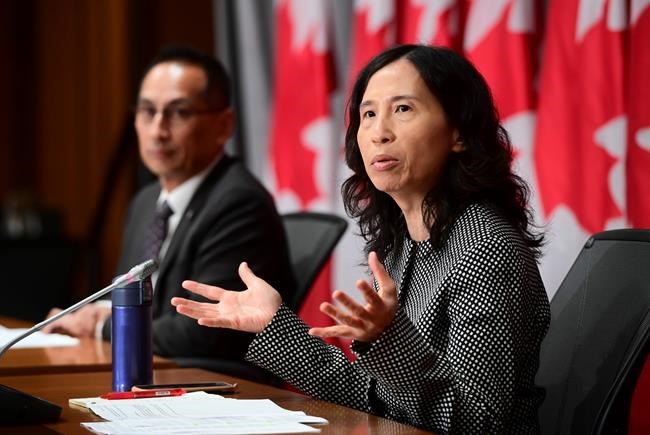
Chief Public Health Officer Dr. Theresa Tam and Dr. Howard Njoo, Deputy Chief Public Health Officer, hold a press conference on Parliament Hill in Ottawa on Tuesday, Sept. 1, 2020. THE CANADIAN PRESS/Sean Kilpatrick

The newest deals will allow Canada to buy as many as 76 million doses of a vaccine candidate from Maryland-based biotech company Novavax, and up to 38 million doses of the vaccine being developed by Johnson & Johnson’s pharmaceutical company Janssen Inc.

Last month, the government signed similar deals with U.S. companies Pfizer and Moderna that would give Canada access to up to 76 million more doses.

Njoo said it is not clear what percentage of Canadians will need to get vaccinated to achieve broad immunity but “the more Canadians that take advantage, the better.”

Both physicians evoked the dark days of forced quarantines, school closures and bans on public gatherings during the measles and polio outbreaks of the 1930s, ’40s and ’50s.

“Most of us are lucky. We have not had to live through these types of measures because of safe and effective vaccines for these diseases,” said Tam.

“What Canada and the world needs to have for the best shot at normalcy is safe and effective vaccines.”

Tam suggested that the threshold for effective immunization is a moving target because understanding the science around COVID-19 is itself a work in progress.

For regulatory purposes, she said, that level has to be continuously evaluated.

“The international consensus is that we should at least look at around the 50 per cent vaccine efficacy mark,” said Tam, adding that there simply isn’t a “yes or no” answer.

More will be known when the data from ongoing Phase 3 clinical trials become available, she said.

“It’s a matter of remaining open to the evidence and being flexible.”

Right now, there appears to be low immunity to the disease around the world, “so getting a high enough vaccine uptake is going to be quite important,” said Tam.

Njoo said a vaccine could be available sometime in 2021, perhaps as early as the spring.

“We’re very optimistic here in Canada and because there are number of vaccine candidates being evaluated,” said Njoo.

“There could be an effective and safe vaccine, perhaps in 2021. We don’t know exactly when. Perhaps in the spring, maybe a little bit later. But it’s a very good thing to stay optimistic.”

As for whether such a vaccine should be mandatory, Njoo said it is better for people to educated about the benefits of immunization rather than have it forced upon them because that’s the best way to increase the number of vaccinations.

“I think it is more important to maybe change people’s attitudes who may be more reticent about getting vaccinated rather than having regulations to make vaccination mandatory,” Njoo said.

While vaccines have never been made compulsory in Canada, the practice in hospitals and long-term care facilities that have had outbreaks of respiratory illnesses has been for health-care workers to be vaccinated before being allowed to return to work, he noted.

As for testing for COVID-19, Njoo said the gold standard remains the so-called PCR test, or polymerase chain reaction testing which relies on a sample collected from a person’s nose or throat.

Asked about the possibility of a home test for the disease, Njoo said: “It’s quite complicated but the bottom line is: we’re open to examining all types of testing technologies because the more tools we have in the toolbox in terms of different types of tests available to use in different types of contexts, the better.”

This report by The Canadian Press was first published Sept. 1, 2020.

Report Error Submit a Tip

More Stories

The Leaf at Assiniboine Park welcomes first visitors

Ryan Thorpe 5 minute read Preview

The Leaf at Assiniboine Park welcomes first visitors

Ryan Thorpe 5 minute read Saturday, Dec. 3, 2022

The parking lot was full and Winnipeggers came out in droves Saturday morning for the public opening of The Leaf, the new indoor horticultural attraction at Assiniboine Park.

Read
Saturday, Dec. 3, 2022

Letters, Nov. 2

6 minute read 2:00 AM EST

Post-election reflection

The civic election offered both predictable and surprising results. The re-election of Mayor Scott Gillingham and the defeat of Transcona councillor Russ Wyatt were anticipated.

What was surprising was that, in addition to Wyatt, three other incumbents lost their bids for re-election. Devi Sharma (Old Kildonan), Ross Eadie (Mynarski) and Shawn Dobson (St. James) all went down to defeat, and it is clear to me their replacements will bring stronger voices to city hall.

A total of nine new councillors is a seismic shift in Winnipeg civic politics, not seen since the establishment of the 15-member council some 35 years ago. What is most interesting is the political leanings of the new councillors and how they will work with Mayor Gillingham.

Expect a reasonable approach to keep Manitoba’s minimum wage out of cellar

Tom Brodbeck 5 minute read Preview

Expect a reasonable approach to keep Manitoba’s minimum wage out of cellar

Tom Brodbeck 5 minute read Tuesday, May. 31, 2022

The devil will be in the details when it comes to how much the Stefanson government will increase the minimum wage in 2022 under proposed legislation that’s expected to become law this week.

My prediction: government will boost the base wage by at least $1.10 an hour this year.

As expected, the Stefanson government plans to alter its inflation-based formula for setting the minimum wage, which now stands at $11.95 an hour. Normally, the base wage is indexed to the previous year’s rate of inflation. That’s sound policy during normal times. However, with inflation growing at rates not seen in more than 30 years, an immediate adjustment is required to ensure minimum-wage earners don’t lose purchasing power.

Conservative governments in Saskatchewan, Ontario and New Brunswick have all announced significant increases to their base wages in 2022, putting pressure on the Stefanson government to follow suit. Failure to do so would see Manitoba’s minimum wage (previously scheduled to rise 40 cents an hour to $12.35 on Oct. 1) rank lowest in the country.

Read
Tuesday, May. 31, 2022

Manitoba’s First Nations and the Indian Act

Hersh Seth 6 minute read 2:00 AM EST

On Monday in Ottawa, Manitoba Premier Wab Kinew called for the Indian Act to be abolished. Prime Minister Mark Carney said he was open to working with First Nations to reform or repeal this law, calling it racist.

The act was created in 1876 and still controls Indian status, reserve lands and band governance. It’s understandable why many people want a better relationship.

But repealing a law and building a new relationship are not the same. What would replace the act’s protections? Who decides? How do governments ensure removing federal authority gives First Nations power while the Crown keeps its promises?

Manitoba has faced these questions before. In 1971, First Nations created a document called Wahbung: Our Tomorrows, in response to then-prime minister Pierre Trudeau’s white paper on assimilation. More than 45 years later, elders and knowledge keepers met at Turtle Lodge, north of Winnipeg, to continue the conversation. Manitobans Dave Courchene Sr. and his son, Dave Courchene Jr., are generational links to the broader movement, and their story should be part of this discussion.

The ‘Gang of Nine’ and business as usual at city hall

Editorial 4 minute read Preview

The ‘Gang of Nine’ and business as usual at city hall

Editorial 4 minute read 2:00 AM EST

In the early 1990s, after the province reduced the number of municipal wards in Winnipeg to 15, critics spoke at length of how a theoretical “Gang of Eight” could control all decision making at city hall. In subsequent years, there were various incarnations of a Gang of Eight, although it was never conclusively shown that eight members of city council could consistently stay on the same page long enough to dominate civic affairs.

That is an apt tale to consider now, as Winnipeg city hall welcomes nine rookie councillors, the largest number of non-incumbents elected in more than 30 years.

Theoretically, this new group of councillors could band together and push through various reforms. It’s a highly intriguing scenario for anyone who has watched the city, on occasion, shun riskier strategies in favor of status quo politics.

However, as was the case in the early 1990s, the chances of that happening begin to fall apart once you consider the work of building and sustaining a coalition of rookie councillors who come from a broad array of backgrounds.

Read
2:00 AM EST

Another embarrassing loss: Arniel

Mike McIntyre 7 minute read Preview

Another embarrassing loss: Arniel

Mike McIntyre 7 minute read Yesterday at 6:15 PM EST

RALEIGH — No sticks were smashed. No walls punched. And nary a naughty word was uttered.

Instead, the Winnipeg Jets filed off the ice here at Lenovo Center on Sunday afternoon much like they’d just played the preceding game against the Carolina Hurricanes — with no emotion, no passion, no urgency.

You’d have thought yet another loss, this one in truly humiliating fashion and a ninth consecutive overall, might have triggered something.

Anything.

Read
Yesterday at 6:15 PM EST