Quebec slowly reopens but Mohawks demand their territory remains closed

Advertisement

Advertise with us

MONTREAL - As Quebec continued to slowly reopen Wednesday following weeks of pandemic-induced shutdowns, members of the Mohawk community of Kanesatake outside Montreal demanded that authorities slow down.

Read this article for free:


By clicking the button above, an account will be created and you will begin to receive some of our recommended newsletters. You may opt out of any newsletter by visiting your Email and Communication Preferences page or by clicking "unsubscribe" at the bottom of any email.

or

Already have an account? Log in here »

To continue reading, please subscribe:

Digital Subscription

One year of digital access for only $1.44 a week*

  • Enjoy unlimited reading on winnipegfreepress.com
  • Read the E-Edition, our digital replica newspaper
  • Access News Break, our award-winning app
  • Play interactive puzzles

*Billed as $5.77 plus GST every four weeks. After 52 weeks, price increases to the regular rate of $19.95 plus GST every four weeks. Offer available to new and qualified returning subscribers only. Cancel any time.

To continue reading, please subscribe:

Add Free Press access to your Brandon Sun subscription for only an additional

$1 for the first 4 weeks*

  • Enjoy unlimited reading on winnipegfreepress.com
  • Read the E-Edition, our digital replica newspaper
  • Access News Break, our award-winning app
  • Play interactive puzzles
Start now

*Your next Brandon Sun subscription payment will increase by $1.00 and you will be charged $17.95 plus GST for four weeks. After four weeks, your payment will increase to $24.95 plus GST every four weeks.

Hey there, time traveller!
This article was published 20/05/2020 (2357 days ago), so information in it may no longer be current.

MONTREAL – As Quebec continued to slowly reopen Wednesday following weeks of pandemic-induced shutdowns, members of the Mohawk community of Kanesatake outside Montreal demanded that authorities slow down.

Mohawks were preventing access to Oka provincial park, which was scheduled to partially reopen Wednesday morning, according to Oka Mayor Pascal Quevillon.

He said members of the adjacent First Nations community began blocking access around 8:30 a.m., adding provincial police weren’t doing anything about the blockade.
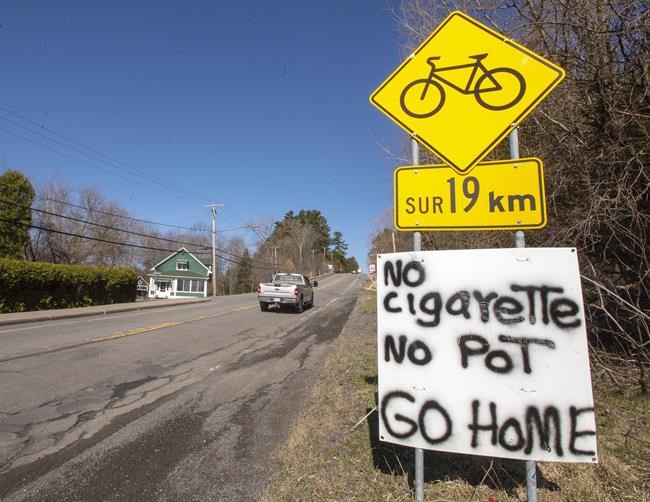
A sign advises non-residents at the entry to the Mohawk territory of Kanasateke to turn around as the community tightens access to the reserve amid the COVID-19 pandemic Monday, April 20, 2020 in Oka, Que. The mayor of Oka, Que., says members of the neighbouring Mohawk community of Kanesatake are blocking access to a provincial park that was supposed to partially reopen today. THE CANADIAN PRESS/Ryan Remiorz

“I asked Premier Francois Legault to ask the Surete du Quebec to intervene,” Quevillon said in an interview.

Kanesatake Grand Chief Serge Simon sent a letter earlier in the week to Legault, urging him to keep the park closed until his community is consulted.

Simon’s letter said that “even if all proper precautions are taken, the risks of community spread in our area are too high.” He insisted that the park and a ferry to the region remain closed “until we are consulted on any reopening of tourist services that may affect the health of our region.”

Deputy premier and Public Security Minister Genevieve Guilbault told reporters Wednesday that members of the cabinet were in discussions with Simon and with local public health officials. Simon was not immediately available for comment.

“We understand that there are concerns in various places in Quebec, but especially in that area, about the deconfinement,” Guilbault said. “We have to try to see how we can reassure them, and how we can come to a solution,” adding that prohibiting access to the park is not the answer.”

The people in Kanesatake and in the adjacent town of Oka usually live peacefully side-by-side but flare-ups have occurred over the years, often due to land disputes. Simon and Quevillon got into a public spat last summer when a developer wanted to donate land to the Mohawks.

Also Wednesday, Quebec announced that limited outdoor gatherings will be permitted starting Friday as the province continues to record a downward trend of new COVID-19 cases.

Authorities also announced private health-care providers across the province can begin operating again June 1. Those providers include dentists, physiotherapists, massage therapists, optometrists and several others. Also allowed to open June 1 are centres for animal grooming.

Outside the greater Montreal area and the region around the city of Joliette, hair salons and other personal care businesses such as tattoo parlours can open June 1. The government still hasn’t set a date to reopen those services in the Montreal and Joliette regions.

Starting Friday, Quebecers will be allowed to host outdoor gatherings of up to 10 people, from a maximum of three families, as long as they keep a two-metre distance from one another. The province, however, had already authorized people to be outside together as long as they kept a two-metre distance.

Guilbault said authorities wanted to be more clear with Wednesday’s announcement. She said authorities had been telling people to avoid outdoor gatherings in private settings as much as possible. But, as the springtime weather improved, she said, people began increasingly meeting outside.
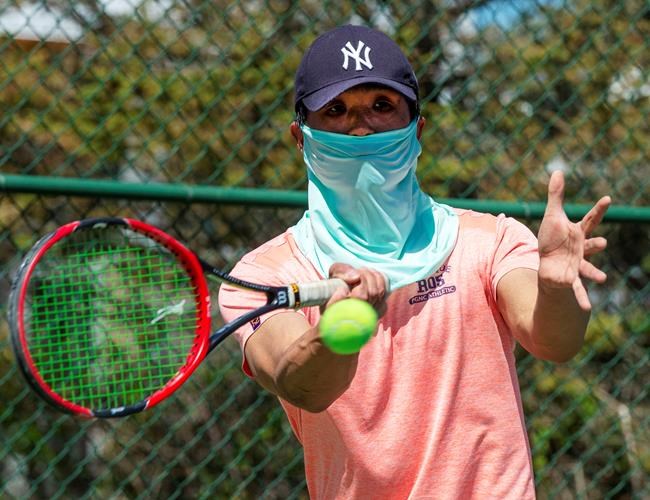
Young Park returns a shot while playing tennis Wednesday May 20, 2020 in Montreal. The Quebec government has lifted restrictions on several leiaure activities imposed due to the COVID-19 pandemic.THE CANADIAN PRESS/Ryan Remiorz

“So, we’re saying: Perfect, we have to be realistic. People are fed up, people want to see each other, they are getting bored. It’s nice out, it’s getting hot. We want people to get together, but now we are announcing clear rules.”

The province is starting to ease restrictions as the number of new cases of COVID-19 continues to decrease. Quebec recorded 71 new deaths from COVID-19, for a total of 3,718, and the number of total cases increased by 578 to 44,775. A total of 12,822 people are classified as recovered.

But Quebec also recorded the first death among its provincial prison population. A Quebec civil liberties group, la Ligue des droits et Libertes, said in a statement Wednesday the 72-year-old inmate’s death could have been prevented if authorities had reduced the number of seniors detained in provincial jails.

Guilbault said about 2 per cent of Quebec’s inmate population has become infected with the virus, including about 60 people at the detention centre in Montreal that housed the inmate who died.

“Despite the impossibility of avoiding any cases of COVID (in provincial jails),” she said, “I consider that, in general, it is going relatively well in the prison network.”

This report by The Canadian Press was first published on May 20, 2020.

— With files from Pierre Saint-Arnaud

Note to readers: This is a corrected story. A previous version said hair salons across Quebec would be allowed to reopen June 1. Those in the Montreal and Joliette regions are not allowed to reopen.

Report Error Submit a Tip

More Stories

Submit a news tip

1 minute read Monday, Mar. 16, 2026

Submit a news tip

The ‘Gang of Nine’ and business as usual at city hall

Editorial 4 minute read Preview

The ‘Gang of Nine’ and business as usual at city hall

Editorial 4 minute read 2:00 AM EST

In the early 1990s, after the province reduced the number of municipal wards in Winnipeg to 15, critics spoke at length of how a theoretical “Gang of Eight” could control all decision making at city hall. In subsequent years, there were various incarnations of a Gang of Eight, although it was never conclusively shown that eight members of city council could consistently stay on the same page long enough to dominate civic affairs.

That is an apt tale to consider now, as Winnipeg city hall welcomes nine rookie councillors, the largest number of non-incumbents elected in more than 30 years.

Theoretically, this new group of councillors could band together and push through various reforms. It’s a highly intriguing scenario for anyone who has watched the city, on occasion, shun riskier strategies in favor of status quo politics.

However, as was the case in the early 1990s, the chances of that happening begin to fall apart once you consider the work of building and sustaining a coalition of rookie councillors who come from a broad array of backgrounds.

Read
2:00 AM EST

Second plant-based protein plant planned in Manitoba to meet vegan meat demand

Martin Cash 5 minute read Preview

Second plant-based protein plant planned in Manitoba to meet vegan meat demand

Martin Cash 5 minute read Tuesday, Jul. 16, 2019

Manitoba is about to become a key production centre for plant-based protein with a second pea-protein production plant about to break ground.

Merit Functional Foods Corporation is building a $65-million, 65,000-square-foot facility that will produce both pea and canola protein.

The French company, Roquette, is building a $400-million pea protein plant in Portage la Prairie.

Merit is a 60-40 partnership between an investor group made up of Shaun Crew, Barry Tomiski and Ryan Bracken -- all veteran senior management and founders of Hemp Oil Canada Inc./Manitoba Harvest -- and Burcon NutraScience Corp., a publicly traded Vancouver company with strong links to Winnipeg where it has had a research lab for 20 years.

Read
Tuesday, Jul. 16, 2019

US rolls to women's hoops gold medal in Bird's last Olympics

Doug Feinberg, The Associated Press 6 minute read Preview

US rolls to women's hoops gold medal in Bird's last Olympics

Doug Feinberg, The Associated Press 6 minute read Sunday, Aug. 8, 2021

SAITAMA, Japan (AP) — Sue Bird and Diana Taurasi walked off the basketball court together, arm-in-arm, one last time at the Tokyo Games.

They started their journey together five Olympics ago and ended it in the same fashion as always — with gold medals hanging around their necks.

“All of what we’ve done for USA Basketball, we’ve done together. It’s fitting,” Bird said after the 90-75 win over Japan on Sunday.

And now it's over — at least for the 40-year-old Bird.

Read
Sunday, Aug. 8, 2021

Cottage communities constrained by COVID

Cassandra Szklarski, The Canadian Press 6 minute read Preview

Cottage communities constrained by COVID

Cassandra Szklarski, The Canadian Press 6 minute read Friday, May. 1, 2020

TORONTO - A springtime trickle of Manitobans entering Ontario to visit their lakeside cottages alarmed Kenora Mayor Daniel Reynard a month ago.

Now that Manitoba is poised to restart some non-essential services Monday, Reynard fears an even bigger influx — this time sun-seekers expecting amenities that are simply unavailable.

The message in Ontario is still one of restraint: Avoid non-essential travel, and do not visit your cottage. Provincial travel is not prohibited, but vacationers and day-trippers will find little to do.

Restaurants are closed, as are all beaches, golf courses, parks, trails and marinas.

Read
Friday, May. 1, 2020

Letters, Nov. 2

6 minute read 2:00 AM EST

Post-election reflection

The civic election offered both predictable and surprising results. The re-election of Mayor Scott Gillingham and the defeat of Transcona councillor Russ Wyatt were anticipated.

What was surprising was that, in addition to Wyatt, three other incumbents lost their bids for re-election. Devi Sharma (Old Kildonan), Ross Eadie (Mynarski) and Shawn Dobson (St. James) all went down to defeat, and it is clear to me their replacements will bring stronger voices to city hall.

A total of nine new councillors is a seismic shift in Winnipeg civic politics, not seen since the establishment of the 15-member council some 35 years ago. What is most interesting is the political leanings of the new councillors and how they will work with Mayor Gillingham.