Long-term care deaths expected to rise as growth of total cases slows: Tam

Advertisement

Advertise with us

OTTAWA - The number of deaths in long-term care facilities is expected to keep rising, even as the growth of overall COVID-19 cases begins to slow, Canada's top public health official warned Monday.

Read this article for free:


or

Already have an account? Log in here »

To continue reading, please subscribe:

Subscribe and receive a limited-edition Free Press branded hat or tote.

Digital Subscription

One year of digital access for only $205*

  • Enjoy unlimited reading on winnipegfreepress.com
  • Read the E-Edition, our digital replica newspaper
  • Access News Break, our award-winning app
  • Play interactive puzzles

*First annual payment billed as $205.00 + GST for one year. This annual subscription will automatically renew at $233.00 + GST every 52 weeks (10% off the regular annual price of $259.35). Offer available to new and qualified returning subscribers only. Cancel any time.

To continue reading, please subscribe:

Add Free Press access to your Brandon Sun subscription for only an additional

$1 for the first 4 weeks*

  • Enjoy unlimited reading on winnipegfreepress.com
  • Read the E-Edition, our digital replica newspaper
  • Access News Break, our award-winning app
  • Play interactive puzzles
Start now

*Your next Brandon Sun subscription payment will increase by $1.00 and you will be charged $17.95 plus GST for four weeks. After four weeks, your payment will increase to $24.95 plus GST every four weeks.

Hey there, time traveller!
This article was published 13/04/2020 (2367 days ago), so information in it may no longer be current.

OTTAWA – The number of deaths in long-term care facilities is expected to keep rising, even as the growth of overall COVID-19 cases begins to slow, Canada’s top public health official warned Monday.

Dr. Theresa Tam, the chief public health officer, said the spread of the virus in nursing and retirement homes has been at the root of half of the more than 700 deaths across the country.

“Even as the numbers of cases slows down the number of deaths, unfortunately, are expected to increase,” Tam said at a media briefing in Ottawa.
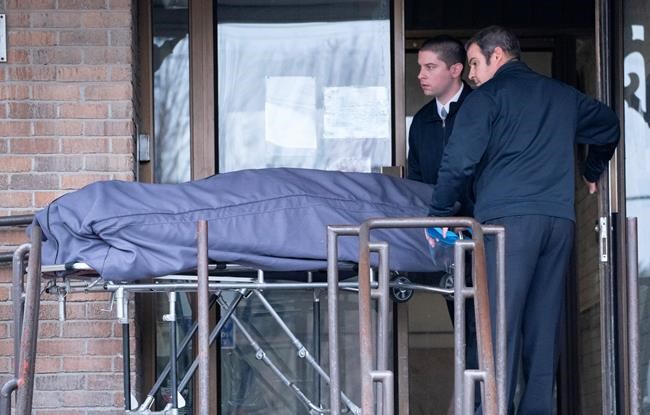
A body is removed from the long care home Yvon-Brunet in Montreal on Monday, April 13, 2020. Canada’s top public health doctor says deaths in long-term care facilities will likely continue to rise, even as the growth of overall COVID-19 cases begin to slow.THE CANADIAN PRESS/Paul Chiasson

Last week the federal government released its projected trajectory for the outbreak. The total number of deaths projected in Canada — between 4,400 and 44,000 in the best-case scenario — was based on a fatality rate of 1.1 per cent.

On Monday, Tam said that fatality rate is expected to rise given the outbreaks in long-term care homes across the country.

The news follows a gruesome weekend discovery in a private long-term care home in Dorval, Que., where police are investigating the deaths of 31 people since March 13. Five of the deaths have been definitively linked to COVID-19.

Quebec Premier Francois Legault alleged there was “gross negligence,” at Residence Herron.

But Quebec is not alone in its struggle to contain cases in seniors’ and long-term care homes, Tam said.

“Almost all jurisdictions are essentially trying to deal with the outbreaks at long-term care facilities,” she said. “That’s really across the board.”

Twenty-nine residents in a 65-bed nursing home in Bobcaygeon, Ont., have died amid the pandemic. Eighteen deaths at North Vancouver’s Lynn Valley Care Centre have been attributed to COVID-19. Other facilities from coast to coast have had outbreaks and in many cases numerous workers have been sickened as well.

While provinces and territories are ultimately responsible for their own public health response to the pandemic, federal Seniors Minister Deb Schulte highlighted new federal guidelines for all care homes in the country to try to stall the spread of the virus in other facilities that care for vulnerable people.

She said long-term care homes are at particular risk, not only because of the older populations they serve, but also communal living spaces and the number of people who come and go.

Residents are exposed to visitors and health-care workers who travel from facility to facility in some cases.

“Providing consistent guidance for long-term care homes across the country will save lives,” Schulte said Monday.

The non-mandatory guidelines, developed in tandem with provincial and territorial health authorities, lay out how those risks can be mitigated.

The suggestions include limiting visitors, screening workers at the beginning of each shift and screening residents daily.

They also suggest limiting the number of homes workers serve to just one, where possible.

Some provinces, including Ontario, have already instituted similar measures. Ontario has so far reported outbreaks in 89 care homes, leading to 120 deaths as of Sunday.

Premier Doug Ford said he knows from experience how difficult the restrictions on family visits can be, but said they are necessary.

Ford’s mother-in-law is in a long-term care home, and Ford said it is heartbreaking to watch his wife, Karla, stand outside in tears.

“It’s very, very difficult for families right now. Very difficult. Especially when you want to help a loved one,” Ford said Monday.

“It’s heart-wrenching, but we have to rely on our medical professionals.”

As for why federal guidelines are being released weeks after the first long-term care home outbreak was reported in British Columbia in early March, Tam said it took time to draw on the expertise needed to draft them.

She said the guidelines are the result of expert input from long-term care workers, infection-control experts, lessons learned from provincial health authorities, and recently accepted evidence about asymptomatic transmission.

Those guidelines are likely to change as the epidemic continues to unfold in Canada, she said.

Meanwhile provinces are “stepping up” to support long-term care homes and their workers, Schulte said, by providing funds for them to implement better protections against the virus.

She said B.C. has provided $10 million, Quebec has pledged $133 million and Ontario has said it will spend $243 million to enhance infection-control measures in their respective centres.

This report by The Canadian Press was first published April 13, 2020.

Report Error Submit a Tip

More Stories

City emergency crews to administer drug that stops opioid withdrawal symptoms

Joyanne Pursaga 5 minute read Preview

City emergency crews to administer drug that stops opioid withdrawal symptoms

Joyanne Pursaga 5 minute read Monday, Aug. 10, 2026

Winnipeg Fire Paramedic Service crews will soon give out a medication that stops withdrawal symptoms after someone is treated for an opioid overdose.

Emergency workers will be administering a drug called buprenorphine, after Health Canada granted WFPS permission to use the controlled substance.

“Buprenorphine is a medication that offers people who are in active addiction — so those people who have received naloxone as a result of an overdose and those that are experiencing significant and, at times, dangerous withdrawal symptoms — just a bit of a reprieve … (It) reduces cravings and prevents those immediate withdrawal symptoms, which allows more time to connect those patients to further care,” said Michelle Long, WFPS assistant chief of paramedic operations.

The treatment option is in response to a persistently high number of WFPS opioid calls.

Read
Monday, Aug. 10, 2026

With a bang, B.C. applauds health-care workers

Amy Smart, The Canadian Press 4 minute read Preview

With a bang, B.C. applauds health-care workers

Amy Smart, The Canadian Press 4 minute read Wednesday, Mar. 25, 2020

VANCOUVER - At the same time each night, Rev. Gary Paterson and about half a dozen other neighbours have begun gathering at least two metres apart on the rooftop patio of their building in Vancouver's west end.

They don't know who will signal the beginning, and everyone's clocks are slightly different, but just before 7 p.m., they hear clapping in the distance.

"It's usually at about two minutes to seven, like people can't restrain their enthusiasm, and then it starts to move like a wave," he said on Wednesday.

The applause is for health-care workers and other essential service providers on the frontlines of the COVID-19 pandemic.

Read
Wednesday, Mar. 25, 2020

Festival riffs off Main Street’s storied past

Melissa Martin 7 minute read Preview

Festival riffs off Main Street’s storied past

Melissa Martin 7 minute read Friday, Jun. 10, 2022

Fifty years later, Billy Joe Green can still remember one of the biggest breaks of his career. It was 1971, and his band was asked to become the house band at the Brunswick, an old Main Street hotel and bar.

People would line up around the block to see them, and for a while Green, who was barely out of his teens, could really feel as if he’d made it.

“That was like the high-end place to play for our people,” he says, with a nostalgic smile.

Oh, if the walls of the Main Street strip could talk, they would tell a million stories, and Green would be in a bunch of them. An Ojibwa man and member of Shoal Lake 40 First Nation, Green is one of Winnipeg’s most iconic blues guitarists; back then, he was jamming on the Main Street circuit, slinging out country and rock hits.

Read
Friday, Jun. 10, 2022

Tokyo Olympic aftermath still being untangled a year later

Stephen Wade, The Associated Press 7 minute read Preview

Tokyo Olympic aftermath still being untangled a year later

Stephen Wade, The Associated Press 7 minute read Thursday, Jul. 21, 2022

TOKYO (AP) — The Tokyo Olympics survived the COVID-19 postponement, soaring expenses and some public opposition. A year later, the costs and benefits remain as difficult to untangle as the Games were to pull off.

In his speech at the closing ceremony, IOC President Thomas Bach said a major accomplishment of the Games was simply reaching the end.

“We did it,” Bach said. “We did it together," he repeated, crediting the athletes, Japanese government officials, and deep-pocketed broadcasters for refashioning the Games despite no fans, disappointed sponsors, and no buzz around the city.

Organizers said the Games would drive tourism, showcase Japan's technological prowess, and create memories similar to the 1964 Tokyo Olympics. The pandemic erased that.

Read
Thursday, Jul. 21, 2022

Wasteful operations should be held accountable

Barry E. Prentice 5 minute read Preview

Wasteful operations should be held accountable

Barry E. Prentice 5 minute read Yesterday at 2:00 AM CDT

Rising water bills are a top-of-mind issue for residents of Winnipeg going into the fall election. Management of the water and waste system is under question, with citizen’s groups, as well as the Free Press, calling for proper oversight of rates (Time for the PUB to review Winnipeg water rates, Editorial, Sept. 26).

The need to increase rates to build the North End sewage plant is understandable. Siphoning off utility proceeds to make up other tax revenue shortfalls is another matter. But it is not the only questionable practice. If there was Public Utilities Board oversight of Winnipeg’s water and sewer rates, it would certainly be asking why the city is spending more than $3 million annually to operate the 164-kilometre-long, Greater Winnipeg Water District railway (GWWD) on ratepayers’ behalf.

The GWWD has come to the attention of the Railway Relocation Study, led by Lloyd Axworthy. All existing rail lines within the city are under review, as is the feasibility of a new railway bypass.

The GWWD is an example of a railway that has outlived its usefulness and sits on a pocket of land close to downtown that could be converted to higher-value uses.

Read
Yesterday at 2:00 AM CDT

Essential workers ruling raises questions

Editorial 4 minute read Preview

Essential workers ruling raises questions

Editorial 4 minute read 2:00 AM CDT

Ever been to a Dynacare clinic? Most of us have been. It’s an amazing demographic and ethnic slice of the city we’ve become. Old patients. Young patients. New arrivals. Long-time Canadians. People who know the ropes — others who are startled by the crowds and the noise and the lockstep forward motion of professionals doing what they have been trained to do. It seems, all at the same time, both chaotic and diagnostic, as names of patients are steadily called out and thousands of tests are performed.

But Dynacare is at the centre of a new kind of test and this time, we’re all in the test tube together.

It’s the first real test for new labour law put in place by the government of Premier Wab Kinew in 2024 — a law that redefined what essential services are for provincially-regulated workplaces. Under this law, companies and their employee and unions must have an agreement of which employees are essential — which ones must stay on the job during a legal strike for the protection of the health and safety of the public.

Dynacare had that kind of essential employee agreement with its staff and union — the company and the union had agreed the employees were not essential.

Read
2:00 AM CDT