Mongolia closes border, China extends holiday to fight virus

Advertisement

Advertise with us

BEIJING - China expanded its sweeping efforts on Monday to contain a dangerous new virus, extending the Lunar New Year holiday to keep the public at home and avoid spreading infection as the death toll rose to 81.

Read this article for free:


By clicking the button above, an account will be created and you will begin to receive some of our recommended newsletters. You may opt out of any newsletter by visiting your Email and Communication Preferences page or by clicking "unsubscribe" at the bottom of any email.

or

Already have an account? Log in here »

To continue reading, please subscribe:

Digital Subscription

One year of digital access for only $1.44 a week*

  • Enjoy unlimited reading on winnipegfreepress.com
  • Read the E-Edition, our digital replica newspaper
  • Access News Break, our award-winning app
  • Play interactive puzzles

*Billed as $5.77 plus GST every four weeks. After 52 weeks, price increases to the regular rate of $19.95 plus GST every four weeks. Offer available to new and qualified returning subscribers only. Cancel any time.

To continue reading, please subscribe:

Add Free Press access to your Brandon Sun subscription for only an additional

$1 for the first 4 weeks*

  • Enjoy unlimited reading on winnipegfreepress.com
  • Read the E-Edition, our digital replica newspaper
  • Access News Break, our award-winning app
  • Play interactive puzzles
Start now

*Your next Brandon Sun subscription payment will increase by $1.00 and you will be charged $17.95 plus GST for four weeks. After four weeks, your payment will increase to $24.95 plus GST every four weeks.

Hey there, time traveller!
This article was published 26/01/2020 (2469 days ago), so information in it may no longer be current.

BEIJING – China expanded its sweeping efforts on Monday to contain a dangerous new virus, extending the Lunar New Year holiday to keep the public at home and avoid spreading infection as the death toll rose to 81.

Mongolia closed its vast border with China, and Hong Kong and Malaysia announced they were barring entry to visitors from the Chinese province at the centre of the outbreak following a warning by Chinese officials that the virus’ ability to spread was growing. Travel agencies were ordered to cancel group tours nationwide, adding to the rising economic losses.

Stock markets around the world were down sharply Monday as investors worried the outbreak could hurt the global economy. The Dow Jones Industrial Average fell as much as 550 points following a sell-off in in markets in Europe and Japan, and closed with a loss of 453 points, or 1.6%. Airlines, resorts and other companies that rely on travel and tourism suffered steep losses, while apparel and technology companies that get a significant amount of revenue from China also declined.

In this Sunday, Jan. 26, 2020 photo, an ambulance crew member in protective gear uses their phone in Wuhan in central China's Hubei Province. A new viral illness being watched with a wary eye around the globe accelerated its spread in China on Sunday with 56 deaths so far, while the U.S. Consulate in the city at the epicenter announced it will evacuate its personnel and some private citizens aboard a charter flight. (Chinatopix via AP)

China has confirmed more than 2,700 cases of the new virus, most in the central city of Wuhan where the illness first surfaced last month. More than 40 cases have been confirmed elsewhere in the world with virtually all of them involving Chinese tourists or people who visited Wuhan recently.

China’s increasingly drastic containment efforts began with the Jan. 22 suspension of plane, train and bus links to Wuhan, a city of 11 million people in central China where the virus was first detected last month. That lockdown has expanded to 17 cities with more than 50 million people — the most far-reaching disease-control measures ever imposed.

The end of the Lunar New Year holiday, China’s busiest travel season, was pushed back to Sunday from Thursday to “reduce mass gatherings” and “block the spread of the epidemic,” a Cabinet statement said. The government of Shanghai, a metropolis of 25 million people and a global business centre, extended the Lunar New York holiday by an additional week to Feb. 9. It ordered sports stadiums to close and religious events to cancel.

Tens of millions of people in China and around Asia had been due to crowd into planes, trains and buses to return to work after visiting their hometowns or tourist sites for the holiday. Schools will postpone reopening until further notice, the Cabinet said.

The death toll rose Monday when the southern island province of Hainan in the South China Sea reported its first fatality, an 80-year-old woman whose family arrived from Wuhan on Jan. 17.

In this Sunday, Jan. 26, 2020 photo, medical workers spray disinfectant in goggles in Wuhan in central China's Hubei Province. A new viral illness being watched with a wary eye around the globe accelerated its spread in China on Sunday with 56 deaths so far, while the U.S. Consulate in the city at the epicenter announced it will evacuate its personnel and some private citizens aboard a charter flight. (Chinatopix via AP)

Hubei province, where Wuhan is located, has accounted for 76 of the deaths reported so far. There have been one each in Shanghai and the provinces of Hebei in the north, Heilongjiang in the northeast and Henan in central China.

The spread of the illness is being watched around the globe, with a small number of cases appearing in other countries. Sri Lanka confirmed its first case Monday. Infections also have been confirmed in the United States, Thailand, Taiwan, Japan, South Korea, Vietnam, Singapore, Malaysia, Nepal, France, Canada and Australia.

As of Monday, there were five Americans diagnosed with the virus in Washington state, Chicago, Southern California and Arizona, all of whom had recently travelled to central China. U.S. health officials said they had no evidence the virus was spreading in the U.S. and they believe the risk to Americans remains low.

China also reported eight cases in Hong Kong and five in Macao. Dr. Chuang Shuk-kwan, the head of Hong Kong’s communicable disease branch, said the city’s eight cases all have Hubei ties, so there was no no sign yet that it is spreading to Hong Kong’s general population.

Mongolia is the second country to close its border with China, following North Korea. Neither has reported any cases of the virus. Mongolia also closed its schools, universities and playgrounds for more than a month — until March 2.

In this Sunday, Jan. 26, 2020 photo, ambulance crew members in protective gear get into their ambulance in Wuhan in central China's Hubei Province. A new viral illness being watched with a wary eye around the globe accelerated its spread in China on Sunday with 56 deaths so far, while the U.S. Consulate in the city at the epicenter announced it will evacuate its personnel and some private citizens aboard a charter flight. (Chinatopix via AP)

China’s No. 2 leader, Premier Li Keqiang, visited Wuhan to “guide epidemic prevention work,” the Cabinet website said. Photos showed Li, in a blue smock and green face mask, meeting hospital employees.

Later, the premier, wearing a face mask and a dark windbreaker, visited a supermarket in the beleaguered city. Shoppers, also wearing masks, cheered to him, “Happy New Year!”

“To get the epidemic under control in Wuhan and the good health of people in Wuhan will be good news for the whole country,” Li told the crowd.

Elsewhere, the Potala Palace in Lhasa, the Tibetan capital, closed indefinitely to tourists on Monday. The former imperial palace in Beijing closed Friday and other major tourist sites also have shut down, including two of Hong Kong’s most popular tourist attractions, Hong Kong Disneyland and Ocean Park.

The disruption to industry and consumer spending threaten to depress Chinese economic growth that Beijing is struggling to shore up after it sank to a multi-decade low of 6.1% last year. That could spread shock waves to other Asian economies that rely on China as a source of tourists and export markets.

Map highlights areas with cases of the new coronavirus.;

The outbreak is a “notable downside risk” to growth, though it could potentially be a “high impact but short-lived event,” said Tommy Wu and Priyanka Kishore of Oxford Economics in a report.

They pointed to the 2002-2003 SARS outbreak, when economic activity plunged but recovered relatively quickly. The impact should be less severe than SARS because of faster official reaction and “increased transparency,” they said.

Abroad, economies including Hong Kong, Thailand, Vietnam, Singapore and the Philippines with big tourism industries that rely on Chinese travellers “seem most at risk,” said Wu and Kishore.

The U.S. Consulate in Wuhan, said it was arranging to evacuate its diplomats and some American citizens on Wednesday. The French government said it would fly its citizens in Wuhan to France and quarantine them there. Japan also was preparing to fly its citizens out of Wuhan, and Germany was considering evacuating its estimated 90 citizens in Wuhan.

On Monday U.S. health officials expanded their online advisory to recommend avoiding non-essential travel to any part of China, rather than just Wuhan and other areas most affected by the outbreak.

In this Jan. 26, 2020, photo released by Xinhua News Agency, members of a military medical team head for Wuhan Jinyintan Hospital in Wuhan, central China's Hubei province. China on Monday expanded sweeping efforts to contain a viral disease by postponing the end of this week's Lunar New Year holiday to keep the public at home and avoid spreading infection. (Cheng Min/Xinhua via AP)

The National Health Commission said 2,744 cases in mainland China were confirmed by midnight Sunday. The youngest is a 9-month-old girl in Beijing.

China’s health minister, Ma Xiaowei, warned Sunday that the country was entering a “crucial stage” as “it seems like the ability of the virus to spread is getting stronger.”

The epidemic has revived memories of the SARS outbreak that originated in China and killed nearly 800 people. Then, Chinese authorities were criticized for reacting slowly and failing to disclose information. The government has responded more aggressively to the latest outbreak.

The National Health Commission said anyone travelling from Wuhan is required to register with community health stations and quarantine themselves at home for 14 days — the virus’ maximum incubation period.

Wuhan is building two hospitals, one with 1,500 beds and another with 1,000, for the growing number of patients. The first is scheduled to be finished next week.

Chinese paramilitary police wear face masks as they stand guard beneath the large portrait of Chinese leader Mao Zedong at Tiananmen Gate adjacent to Tiananmen Square in Beijing, Monday, Jan. 27, 2020. China on Monday expanded sweeping efforts to contain a viral disease by postponing the end of this week's Lunar New Year holiday to keep the public at home and avoid spreading infection. (AP Photo/Mark Schiefelbein)

The virus is from the coronavirus family that includes the common cold but also more severe illnesses like SARS and Middle East Respiratory Syndrome. The new virus causes cold- and flu-like symptoms, including cough and fever, and in more severe cases, shortness of breath and pneumonia.

The virus is thought to have spread to people from wild animals sold at a market in Wuhan. On Sunday, authorities banned trade in wild animals and urged people to stop eating meat from them.

___

Associated Press video journalist Alice Fung in Hong Kong and writers Eileen Ng in Kuala Lumpur, Malaysia, Frank Jordans in Berlin and Carlo Piovano in London contributed to this story.

People queue up to purchase face masks outside a shop in Hong Kong, Monday, Jan. 27, 2020. Hong Kong announced it would bar entry to visitors from the mainland province at the center of the outbreak of a viral disease. Travel agencies were ordered to cancel group tours nationwide following a warning the virus's ability to spread was increasing. (AP Photo/Vincent Yu)
Medical workers in protective gear talk with a woman suspected of being ill with a coronavirus at a community health station in Wuhan in central China's Hubei Province, Monday, Jan. 27, 2020. China on Monday expanded sweeping efforts to contain a viral disease by extending the Lunar New Year holiday to keep the public at home and avoid spreading infection. (Chinatopix via AP)
Report Error Submit a Tip

More Stories

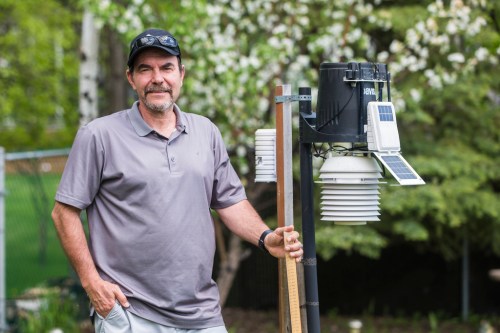
Meteorologist behind Rob’s Obs is moving weather station to Ontario

Ben Waldman 8 minute read Preview

Meteorologist behind Rob’s Obs is moving weather station to Ontario

Ben Waldman 8 minute read Monday, Jun. 13, 2022

In a Winnipeg winter, there are always at least two certainties: it will be cold, and it will snow. A third certainty: the people will talk endlessly about how frigid the temperature is, and argue about how much snow is cloaking their driveways. Is it colder than it ever has been? Is there more snow today than the same time last year?

Rob Paola likely knows the answers to those questions.

Paola possesses no super powers. He is but a man with a metre stick and 40 years of professional meteorological experience, in the midst of a lifelong love affair with Mother Nature, a most turbulent mistress who rarely, if ever, reciprocates.

Each year when snow begins to fall, Paola heads outside his Charleswood home to figure out how much. He sticks his ruler in the ground, grabs his clipboard, and clicks his pen. In neat script, he records the temperature, what time precipitation began, how deep the powder is stacked. Then, he shares his data and insights online with thousands of followers who want a clear answer to the eternal questions: Why is this happening? When will it stop? How much snow has fallen in the city of Winnipeg?

Read
Monday, Jun. 13, 2022

Fact Check

1 minute read Thursday, Nov. 30, 2023

Fact Check

Having problems with the form?Contact Us Directly |

One-on-one Journalism Training

0 minute read Wednesday, Jun. 18, 2025

Is Canada headed for time chaos this weekend?

Michelle Bastian 5 minute read 2:00 AM CDT

When Manitoba Premier Wab Kinew declared Sept. 17 that the province would remain on permanent daylight time, he suggested it was a historical moment people would share with their “great-great-grandkids.” But, while Sunday, Nov. 1 has been heralded as the date many Canadians will stop changing their clocks, there are rumblings behind the scenes suggesting this will actually cause more trouble than ever before.

There are, of course, the warnings from chrono-biologists and sleep scientists about the damage permanent daylight time will do. The lighter evenings will mean many more dark mornings. But there is another set of problems in the offing in the critical infrastructure that underpins our digital lives.

While it used to be common to spend the Sunday morning after a time change going around our homes updating the clocks, we now wake up to devices that have already adjusted to the new time. These automatic updates occur regularly for daylight time, as well as when we travel to new time zones.

Our clocks are able to change by themselves owing to the hard work of a group of volunteers who were recently named in a list of the people who hold up the internet. This group, led by Paul Eggert, a computer scientist at UCLA, maintains a little-known tool called the Time Zone Database. Since the 1980s, it has kept track of regional, national and international debates about clock time and provided an up-to-date table of what time it should be on our walls.

Trump touts USMCA win in state of the union

James McCarten, The Canadian Press 6 minute read Preview

Trump touts USMCA win in state of the union

James McCarten, The Canadian Press 6 minute read Tuesday, Feb. 4, 2020

WASHINGTON - President Donald Trump declared his scorched-earth political style an unmitigated success Tuesday in a fiercely partisan, made-for-TV state of the union speech that made it clear he expects to be back in the White House next year on the strength of the U.S. economy and his trade deals with Canada, Mexico and China.

Trump, addressing a joint session of Congress in the very chamber where House Democrats voted to impeach him less than two months ago, became only the second president in American history — Bill Clinton was the first — to deliver a state of the union while standing trial in the Senate.

Unrepentant, he pointedly refused to shake the offered hand of House Speaker Nancy Pelosi on the dais before singing the praises of what he billed as "the great American comeback," pointing to strong job growth, a soaring stock market and low unemployment as evidence of his leadership. And when he was done, Pelosi ripped up the speech in full view of the television cameras.

"America's enemies are on the run, America's fortunes are on the rise, and America's future is blazing bright. The years of economic decay are over," Trump declared, taking full credit for the country's "roaring economy," including what he billed as seven million new jobs and the lowest jobless rate in half a century — a "blue-collar boom" that he's counting on to help his re-election chances in November.

Read
Tuesday, Feb. 4, 2020

City rec facilities crumbling

Ryan Thorpe 7 minute read Preview

City rec facilities crumbling

Ryan Thorpe 7 minute read Monday, Oct. 22, 2018

Throughout Winnipeg, decades-old community assets — pools, arenas and recreation and leisure centres — are deteriorating so quickly that service disruptions are inevitable.

Meanwhile, the city’s community services department, which is responsible for managing those assets, operates with an annual deficit of roughly $80 million, meaning there are scant resources to do little more than bail water on a sinking ship.

Soon, Winnipeggers will have a choice: fewer community services or higher costs.

“It poses a huge challenge because we have very limited dollars that we have to invest in our existing facilities. We also have growing demands for new amenities in new areas. We have to be very strategic,” said Ken McKim, manager of asset management for the department.

Read
Monday, Oct. 22, 2018