Canadian public health agencies ramping up preparations in response to new virus

Advertisement

Advertise with us

Canadian public health agencies are ramping up preparations to deal with a new virus that has infected hundreds of people in China and killed at least 17.

Read this article for free:


By clicking the button above, an account will be created and you will begin to receive some of our recommended newsletters. You may opt out of any newsletter by visiting your Email and Communication Preferences page or by clicking "unsubscribe" at the bottom of any email.

or

Already have an account? Log in here »

To continue reading, please subscribe:

Digital Subscription

One year of digital access for only $1.44 a week*

  • Enjoy unlimited reading on winnipegfreepress.com
  • Read the E-Edition, our digital replica newspaper
  • Access News Break, our award-winning app
  • Play interactive puzzles

*Billed as $5.77 plus GST every four weeks. After 52 weeks, price increases to the regular rate of $19.95 plus GST every four weeks. Offer available to new and qualified returning subscribers only. Cancel any time.

To continue reading, please subscribe:

Add Free Press access to your Brandon Sun subscription for only an additional

$1 for the first 4 weeks*

  • Enjoy unlimited reading on winnipegfreepress.com
  • Read the E-Edition, our digital replica newspaper
  • Access News Break, our award-winning app
  • Play interactive puzzles
Start now

*Your next Brandon Sun subscription payment will increase by $1.00 and you will be charged $17.95 plus GST for four weeks. After four weeks, your payment will increase to $24.95 plus GST every four weeks.

Hey there, time traveller!
This article was published 22/01/2020 (2473 days ago), so information in it may no longer be current.

Canadian public health agencies are ramping up preparations to deal with a new virus that has infected hundreds of people in China and killed at least 17.

Authorities in several countries have confirmed cases of the illness, including one in the United States, and public health officials in Canada say they would not be surprised if the virus does make its way here — or already has.

The head of Quebec’s public health authority said Wednesday five people in that province were under surveillance for possible exposure. The five, from the Montreal and Quebec City areas, had travelled to China “and have a history that could be compatible with the fact they could have been exposed,” Horacio Arruda said.

Passengers wear masks to prevent an outbreak of a new coronavirus in a subway station, in Hong Kong, Wednesday, Jan. 22, 2020. The first case of coronavirus in Macao was confirmed on Wednesday, according to state broadcaster CCTV. The infected person, a 52-year-old woman, was a traveller from Wuhan. (AP Photo/Kin Cheung)

Ontario’s chief medical officer of health, Dr. David Williams, said the province recently evaluated three patients that “met some case definition:” flu-like symptoms and travel to Wuhan, the Chinese city at the epicentre of the outbreak.

“We tested all those fairly quickly and ruled them out,” Williams said, adding there is still a lot to learn about the new coronavirus.

He noted the virus comes from the same family that can lead to the common cold, and caused the outbreak of severe acute respiratory syndrome, or SARS, about 17 years ago that killed at least 774 people worldwide, including 44 in Canada.

However, Williams said the country is “much better prepared” now than it was in 2003.

“The system is on alert … and we’re monitoring,” he told The Canadian Press. “If it’s a false alarm for Canada, so be it.”

The World Health Organization has convened a group of experts to advise whether the outbreak should be declared a global emergency. The group will meet again Thursday to figure out the best way forward.

Canada’s chief public health officer said earlier this week the risk to Canadians of contracting the virus remains low, but airports in Vancouver, Toronto and Montreal — all of which have direct flights from China — would begin screening passengers as one measure of defence.

Williams and Ontario’s associate chief medical officer of health, Dr. Barbara Yaffe, said global travel and the diverse nature of Canada’s population are the main reasons the virus could come here.

The pair say they have been in close contact with the Public Health Agency of Canada, which was established in 2004 in the wake of the SARS outbreak.

“If there is (human-to-human) transmission, it doesn’t so far seem to be as rapid or aggressive as SARS, but all these viruses are a little different in their communicability … and mortality,” he said.

Bonnie Henry, the provincial health officer for B.C., credited Chinese health officials for their early detection of the virus and its genetic sequencing, which has given authorities around the world the ability to test for it.

“We’re in influenza season, and this causes an illness that is similar to influenza, so having a test and being able to say, ‘No you don’t’ or ‘Yes you do have it — and here is what you should do,’ is incredibly important,” said Henry, who was with Toronto Public Health during the SARS outbreak.

“It really is an important step ahead from where we were with SARS.”

Communication — both among health agencies and to the front lines — is also markedly better, health officials said.

Yaffe said public health agencies, hospitals and paramedics have all received numerous memos with up-to-date information about the new virus. Front-line workers are also now asking anyone who has flu-like symptoms to take a travel history.

Health-care practitioners are also being reminded to gear up with protective masks and gloves as well as regular hand-washing — practices that not only help against this coronavirus, but also work for preventing the spread of the flu and other viruses, Henry said.

New Brunswick has issued a similar edict to its regional health authorities, according to Dr. Jennifer Russell, the province’s chief medical officer of health.

The doctors also want Canadians to be careful if travelling to China, and to tell their health-care provider if they have flu-like symptoms.

— with files from Kevin Bissett in Fredericton and Giuseppe Valiante in Montreal

This report by The Canadian Press was first published Jan. 22, 2020.

Note to readers: This is a corrected story. A previous version cited an incorrect number of people killed by SARS.

Report Error Submit a Tip

More Stories

Shooting, stand off net nine year prison sentence

Dean Pritchard 4 minute read Preview

Shooting, stand off net nine year prison sentence

Dean Pritchard 4 minute read 2:00 AM CDT

Daniel Larsen had been out of prison just five days when he shot up a Point Douglas house and sparked a 10-hour armed standoff with police that shut down a portion of the Disraeli Freeway.

Larsen, sentenced last week to nine years in prison, believed residents of the Grove Street home had sold fentanyl to his son, court heard.

“The speed with which Mr. Larsen was able to obtain a firearm, formulate a plan and become criminally involved is… horrifying from a public safety standpoint,” Crown attorney Amy Wood told provincial court Judge Malcolm McDonald.

Larsen, 37, pleaded guilty to reckless discharge of a firearm for the June 14, 2025, incident and two related weapons offences.

Read
2:00 AM CDT

Westman to lose sole medical oncologist

Rylee Gerrard 5 minute read Preview

Westman to lose sole medical oncologist

Rylee Gerrard 5 minute read Updated: 9:26 AM CDT

BRANDON — Western Manitoba is about to lose its only medical oncologist, leaving just 22 in the province — all of whom are in Winnipeg.

Brandon West MLA Wayne Balcaen raised the issue during question period Thursday, saying the departure of Dr. Brady Anderson will be a “major loss” for the region.

After four years working out of the Western Manitoba Cancer Centre in Brandon, Anderson’s last day will be Nov. 13.

“He literally sees hundreds of patients within the Westman area, and now those individuals will have to travel to Winnipeg to get that personal service,” Balcaen said, calling Anderson’s impending departure “catastrophic.”

Read
Updated: 9:26 AM CDT

A fond farewell to the Hercules

Editorial 4 minute read Preview

A fond farewell to the Hercules

Editorial 4 minute read 2:00 AM CDT

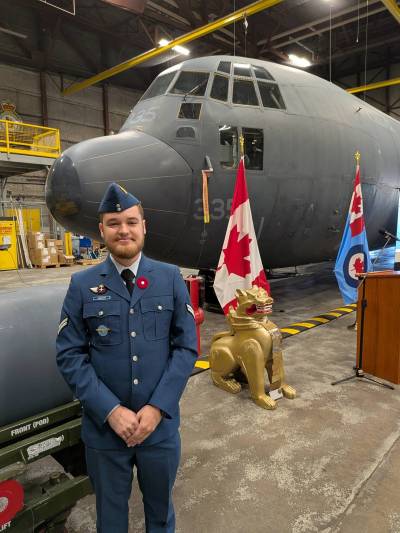
Fans at the NHL’s outdoor Heritage Classic game last weekend were no doubt thrilled by the sight and sound of two CF-18 Hornet fighter jets conducting a flyover at Princess Auto Stadium shortly before the puck was dropped for the much-anticipated Winnipeg Jets/Montreal Canadiens matchup.

Flyovers such as these always create a spectacular scene, as the speed and power of the jets are on full display for the brief moments they’re in view above the stadium bowl. But fans who maintained their skyward gaze for a few seconds after the Hornets’ blink-and-you’ll-miss-it appearance were treated to a much more poignant aeronautical exhibition, as a CC-130H Hercules aircraft passed over the stadium in the fighter jets’ wake.

Compared to the supersonic CF-18s, the massive, propeller-driven transport plane probably seemed to be doing more of a “crawl-over”; what most folks at the outdoor game probably didn’t realize, however, was that this was almost certainly the last time they’ll see one of these ubiquitous Canadian Forces aircraft in the sky.

The CC-130H is being retired after more than half a century as the RCAF’s combat, rescue and transport workhorse. The “Herc” will be replaced by more modern aircraft, including the smaller and more nimble CC-295 Kingfisher, which will be used for search-and-rescue missions out of 17 Wing Winnipeg, beginning next month.

Read
2:00 AM CDT

Science-art collaboration injects dose of emotion into cold, hard truths

Sarah Lawrynuik 5 minute read Preview

Science-art collaboration injects dose of emotion into cold, hard truths

Sarah Lawrynuik 5 minute read Wednesday, Apr. 28, 2021

Looking at spreadsheets and map plots of trees is far beyond Rhian Brynjolson’s typical day as a visual artist, but she became entranced and inspired by data collected by Canadian scientists for a new art project.

Her hope is to try and bring the numbers, map dots and statistics to life in a new way to help the public better connect to climate science.

Falcon Lake’s Brynjolson is one of 12 Canadian artists who participated in an art-science collaboration exhibit, co-ordinated by the Global Water Futures program out of the University of Saskatchewan. The project saw the artists paired with researchers and scientists across the country who then engaged in conversations to try to inspire a new angle to their art.

“The whole idea behind it is: water is life,” says Louise Arnal, the project lead, and a post-doctoral fellow at the Centre for Hydrology and Coldwater Laboratory.

Read
Wednesday, Apr. 28, 2021

Opera singer David Daniels no longer in singers’ union following sexual assault guilty plea

The Associated Press 2 minute read Preview

Opera singer David Daniels no longer in singers’ union following sexual assault guilty plea

The Associated Press 2 minute read Thursday, Dec. 21, 2023

NEW YORK (AP) — Countertenor David Daniels is no longer a member of the union for singers following his guilty plea to a charge of sexual assault.

The 57-year-old and his husband, Scott Walters, pleaded guilty to sexual assault of an adult, a second-degree felony, in Houston's Harris County District Court on Aug. 4. Their accuser was aspiring opera singer Sam Schultz.

They both were sentenced to eight years’ probation and required to register as sex offenders.

American Guild of Musical Artists spokesperson Alicia Cook said Wednesday that Daniels is no longer a member of the union.

Read
Thursday, Dec. 21, 2023

Letters, Oct. 30

7 minute read 2:00 AM CDT

Embarrassed by turnout

I am ashamed by the poor turnout of voters in the recent municipal election in Winnipeg. Just 38 per cent of eligible voters is a disgrace to the thousands of men and women who gave their lives in past wars, where they were defending democracy and the right to vote.

My grandfather was an infantry soldier in the First World War, and my father-in-law flew in Avro Lancasters in the Second World War. For both I am grateful.

Maybe the 62 per cent that had a flimsy excuse for not voting will keep this mind for the next election. People died for our right to vote.