UN report ‘must sound death knell’ for fossil fuels as Canada faces climate urgency
Advertisement
Read this article for free:
or
Already have an account? Log in here »
To continue reading, please subscribe:

Digital Subscription
One year of digital access for only $205*
- Enjoy unlimited reading on winnipegfreepress.com
- Read the E-Edition, our digital replica newspaper
- Access News Break, our award-winning app
- Play interactive puzzles
*First annual payment billed as $205.00 + GST for one year. This annual subscription will automatically renew at $233.00 + GST every 52 weeks (10% off the regular annual price of $259.35). Offer available to new and qualified returning subscribers only. Cancel any time.
To continue reading, please subscribe:
Add Free Press access to your Brandon Sun subscription for only an additional
$1 for the first 4 weeks*
- Enjoy unlimited reading on winnipegfreepress.com
- Read the E-Edition, our digital replica newspaper
- Access News Break, our award-winning app
- Play interactive puzzles
*Your next Brandon Sun subscription payment will increase by $1.00 and you will be charged $17.95 plus GST for four weeks. After four weeks, your payment will increase to $24.95 plus GST every four weeks.
Read unlimited articles for free today:
or
Already have an account? Log in here »
Hey there, time traveller!
This article was published 09/08/2021 (1885 days ago), so information in it may no longer be current.
OTTAWA – The secretary-general of the United Nations says a new report “must sound the death knell for coal and fossil fuels,” raising renewed questions about Canada’s climate plan and the long-term viability of its traditional energy sector.
The UN scientific paper says Earth is heating up so quickly due to human activity that temperatures in about a decade will blow past a level of warming that world leaders have sought to prevent.
Released Monday, the landmark study amounts to a “‘code red’ for humanity” as increasingly extreme heat waves, droughts, flooding and wildfires threaten the globe, said UN chief António Guterres.
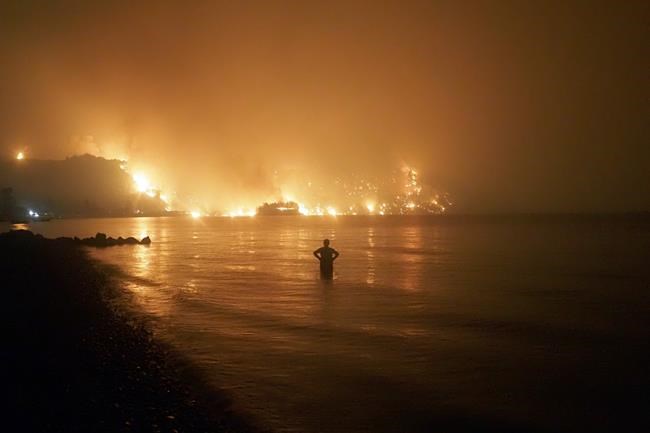
Federal Environment Minister Jonathan Wilkinson acknowledged that parts of Western and Northern Canada are warming at three times the global average, with the ramifications playing out in a cycle of floods and wildfires in British Columbia and elsewhere.
The Liberal government has taken “aggressive climate action” through carbon pricing and a pledge to reduce greenhouse gas emissions by 40 to 45 per cent below 2005 levels by 2030, he said in a statement.
Amara Possian, Canada campaign director for 350.org, said the report is a “clarion call” that the country’s climate plan falls far short.
“With an election around the corner and climate-fuelled wildfires still raging across this country, the real question is if our politicians are listening and if any of them will step up and be the climate champions that we need,” she said in a statement.
The advocacy group (named for a “safe” level of carbon dioxide in the atmosphere) is demanding a moratorium on fossil-fuel expansion and a halt to the Trans Mountain pipeline expansion.
The Petroleum Services Association of Canada sought to dampen any echoes of a death knell.
“At the end of the day we cannot go to renewables overnight, and the world still needs fossil fuels,” Gurpreet Lail, head of the Calgary-based trade group, said in an email.
Alberta Premier Jason Kenney pointed to carbon-capture technology as helping ring in a cleaner oilpatch, but deemed the idea of abandoning hydrocarbons “utopian.”
“The flick of a switch is patently unrealistic,” he told reporters Monday. “The cost to human life would be incalculable.”
The authoritative Intergovernmental Panel on Climate Change report, which calls climate change clearly caused by humans and “unequivocal,” makes more precise and warmer forecasts for the 21st century than it did last time it was issued in 2013.
Each of five scenarios for the future, based on how much carbon emissions are cut, passes the more stringent of two thresholds set in the 2015 Paris climate agreement. World leaders agreed then to try to limit warming to 1.5 C above levels in the late 19th century because problems mount quickly after that. The world has already warmed nearly 1.1 C since then.
Under each scenario, the 3,949-page report said, the world will cross the 1.5-C warming mark in the 2030s, earlier than some past predictions. Warming has ramped up in recent years, data shows.
Canada, along with the United States and Australia, is among the top three biggest carbon-dioxide emitters per capita in the world.
Eddy Pérez from Climate Action Network said the report shows that limiting global warming to 1.5 C above pre-industrial levels is “simply not negotiable.”
“It is the only choice for a safe and healthy future, and it’s still possible. We need to fight to restore our broken relationship with nature and with ourselves; we need to fight back against any delays to urgent climate action.”
Opposition leaders weighed in Monday, with a stress on green jobs as a path to emissions reductions and economic stability.
Conservative Leader Erin O’Toole sidestepped a question on whether the bell tolls for fossil fuels and coal, but called climate change an “urgent threat” for Canada.
“We will meet our Paris targets, we will reduce emissions, but we will also get people working,” he told reporters.
O’Toole cited the Tories’ carbon-price policy on fuel — announced in April, after Conservative MPs spent years fighting a so-called carbon tax — stating that their climate plan will cut emissions by the 30 per cent committed to under the Paris Agreement while supporting more jobs.
NDP Leader Jagmeet Singh accused Prime Minister Justin Trudeau of letting big polluters off easy, referring to the government’s decision in 2018 to relax proposed carbon-price limits on large emitters.
“That price on pollution exempts the biggest polluters. People are asking, what’s the point of that?” Singh said.
“The only way forward is to make sure workers are the heart of the solution,” he added, citing building retrofits, electric vehicles and public transit.
Under the federal climate plan, the number of jobs in clean energy is expected to grow by nearly 50 per cent to 639,200 by 2030, in step with a sector GDP jump of 58 per cent, according to a June report from Clean Energy Canada.
Green party Leader Annamie Paul called the UNreport’s results “frightening” and “sad,” but said she hopes it will firm up Canadians’ resolve on climate change.
“It’s not just altruism or a concern for the planet that is moving the EU and the U.S. and China and all other major economies towards a green economy. What’s moving them toward that is the competitive advantage that is going to give them, the jobs that is going to create,” she said in a phone interview.

Paul also said Canada has failed to hit a single climate target and seen its greenhouse gas emissions rise each year since 2015. The Liberal goal of up to 45 per cent reduction by 2030 falls short of the 60 per cent she has her sights on.
“The top note of the report is really that climate change is here, its impacts are already being felt. And the question now is, how bad do we want it to get?”
This report by The Canadian Press was first published Aug. 9, 2021.
— With files from The Associated Press
Note to readers: This is a corrected story. A previous version provided an incorrect given name for federal Environment Minister Jonathan Wilkinson.
Related Articles
IPCC report signals code red for planet Earth


Advertisement Advertise With Us
Advertisement Advertise With Us