‘Code red’: UN scientists warn of worsening global warming

Advertisement

Advertise with us

BERLIN - Earth is getting so hot that temperatures in about a decade will probably blow past a level of warming that world leaders have sought to prevent, according to a report released Monday that the United Nations called a “code red for humanity.”

Read this article for free:


or

Already have an account? Log in here »

To continue reading, please subscribe:

Subscribe and receive a limited-edition Free Press branded hat or tote.

Digital Subscription

One year of digital access for only $205*

  • Enjoy unlimited reading on winnipegfreepress.com
  • Read the E-Edition, our digital replica newspaper
  • Access News Break, our award-winning app
  • Play interactive puzzles

*First annual payment billed as $205.00 + GST for one year. This annual subscription will automatically renew at $233.00 + GST every 52 weeks (10% off the regular annual price of $259.35). Offer available to new and qualified returning subscribers only. Cancel any time.

To continue reading, please subscribe:

Add Free Press access to your Brandon Sun subscription for only an additional

$1 for the first 4 weeks*

  • Enjoy unlimited reading on winnipegfreepress.com
  • Read the E-Edition, our digital replica newspaper
  • Access News Break, our award-winning app
  • Play interactive puzzles
Start now

*Your next Brandon Sun subscription payment will increase by $1.00 and you will be charged $17.95 plus GST for four weeks. After four weeks, your payment will increase to $24.95 plus GST every four weeks.

Hey there, time traveller!
This article was published 08/08/2021 (1848 days ago), so information in it may no longer be current.

BERLIN – Earth is getting so hot that temperatures in about a decade will probably blow past a level of warming that world leaders have sought to prevent, according to a report released Monday that the United Nations called a “code red for humanity.”

“It’s just guaranteed that it’s going to get worse,” said report co-author Linda Mearns, a senior climate scientist at the U.S. National Center for Atmospheric Research. “Nowhere to run, nowhere to hide.”

But scientists also eased back a bit on the likelihood of the absolute worst climate catastrophes.
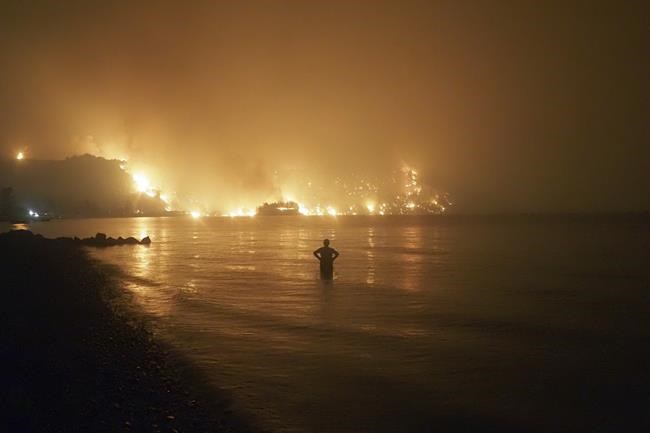
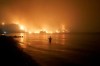
FILE - In this file photo dated Friday, Aug. 6, 2021, a man watches as wildfires approach Kochyli beach near Limni village on the island of Evia, about 160 kilometers (100 miles) north of Athens, Greece. A new massive United Nations science report is scheduled for release Monday Aug. 9, 2021, reporting on the impact of global warming due to humans. (AP Photo/Thodoris Nikolaou)

The authoritative Intergovernmental Panel on Climate Change (IPCC) report, which calls climate change clearly human-caused and “unequivocal” and “an established fact,” makes more precise and warmer forecasts for the 21st century than it did last time it was issued in 2013.

Each of five scenarios for the future, based on how much carbon emissions are cut, passes the more stringent of two thresholds set in the 2015 Paris climate agreement. World leaders agreed then to try to limit warming to 1.5 degrees Celsius (2.7 degrees Fahrenheit) above levels in the late 19th century because problems mount quickly after that. The world has already warmed nearly 1.1 degrees Celsius (2 degrees Fahrenheit) since then.

Under each scenario, the report said, the world will cross the 1.5-degree-Celsius warming mark in the 2030s, earlier than some past predictions. Warming has ramped up in recent years, data shows.

“Our report shows that we need to be prepared for going into that level of warming in the coming decades. But we can avoid further levels of warming by acting on greenhouse gas emissions,” said report co-chair Valerie Masson-Delmotte, a climate scientist at France’s Laboratory of Climate and Environment Sciences at the University of Paris-Saclay.

In three scenarios, the world will also likely exceed 2 degrees Celsius (3.6 degrees Fahrenheit) over pre-industrial times — the less stringent Paris goal — with far worse heat waves, droughts and flood-inducing downpours unless there are deep emissions cuts, the report said.
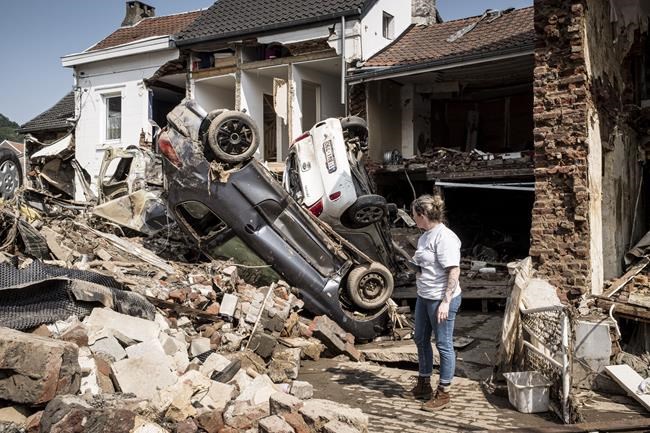
FILE - In this file photo dated Monday, July 19, 2021, a woman looks at cars and homes damaged after torrential rain caused flooding in Liege, Belgium. A new massive United Nations science report is scheduled for release Monday Aug. 9, 2021, reporting on the impact of global warming due to humans. (AP Photo/Valentin Bianchi, FILE)

“This report tells us that recent changes in the climate are widespread, rapid and intensifying, unprecedented in thousands of years,” said IPCC Vice Chair Ko Barrett, senior climate adviser for the U.S. National Oceanic and Atmospheric Administration.

With crucial international climate negotiations coming up in Scotland in November, world leaders said the report is causing them to try harder to cut carbon pollution. U.S. Secretary of State Anthony Blinken called it “a stark reminder.”

The 3,000-plus-page report from 234 scientists said warming is already accelerating sea level rise and worsening extremes such as heat waves, droughts, floods and storms. Tropical cyclones are getting stronger and wetter, while Arctic sea ice is dwindling in the summer and permafrost is thawing. All of these trends will get worse, the report said.

For example, the kind of heat wave that used to happen only once every 50 years now happens once a decade, and if the world warms another degree Celsius (1.8 degrees Fahrenheit), it will happen twice every seven years, the report said.

As the planet warms, places will get hit more not just by extreme weather but by multiple climate disasters at once, the report said. That’s like what’s now happening in the Western U.S., where heat waves, drought and wildfires compound the damage, Mearns said. Extreme heat is also driving massive fires in Greece and Turkey.
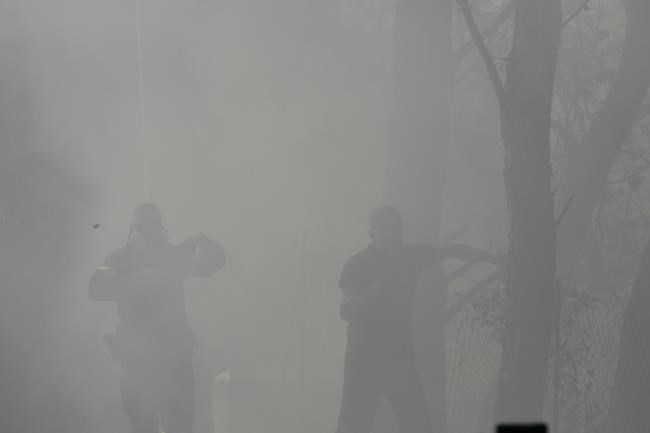
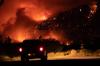
FILE - In this file photo dated Saturday, Aug. 7, 2021, firefighters operate in Thrakomacedones area, in northern Athens, Greece, as wildfires raged uncontrolled through much of Greece and Turkey, forcing thousands to flee by land and sea. A new massive United Nations science report is scheduled for release Monday Aug. 9, 2021, reporting on the impact of global warming due to humans. (AP Photo/Michael Varaklas, FILE)

Some harm from climate change — dwindling ice sheets, rising sea levels and changes in the oceans as they lose oxygen and become more acidic — is “irreversible for centuries to millennia,” the report said.

The world is “locked in” to 15 to 30 centimeters (6 to 12 inches) of sea level rise by mid-century, said report co-author Bob Kopp of Rutgers University.

Scientists have issued this message for more than three decades, but the world hasn’t listened, said United Nations Environment Program Executive Director Inger Andersen.

For the first time, the report offers an interactive atlas for people to see what has happened and may happen to where they live.

Nearly all of the warming that has happened on Earth can be blamed on emissions of heat-trapping gases such as carbon dioxide and methane. At most, natural forces or simple randomness can explain one- or two-tenths of a degree of warming, the report said.
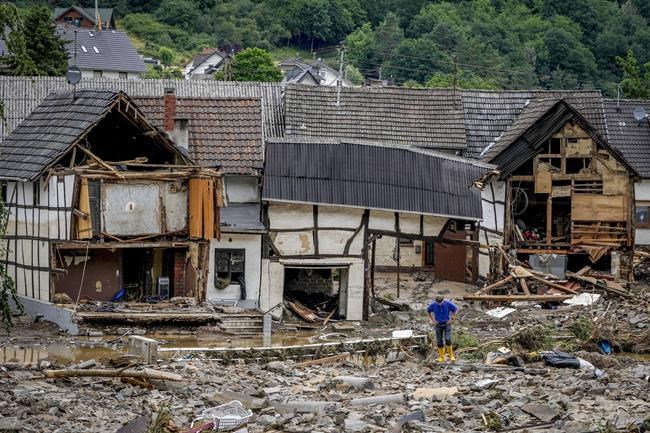
FILE - This Thursday, July 15, 2021 file photo shows destroyed houses in Schuld, Germany. Due to heavy rains, the Ahr River dramatically flooded over its banks the previous evening. (AP Photo/Michael Probst)

The report described five different future scenarios based on how much the world reduces carbon emissions. They are: a future with incredibly large and quick pollution cuts; another with intense pollution cuts but not quite as massive; a scenario with moderate emission cuts; a fourth scenario where current plans to make small pollution reductions continue; and a fifth possible future involving continued increases in carbon pollution.

In five previous reports, the world was on that final hottest path, often nicknamed “business as usual.” But this time, the world is somewhere between the moderate path and the small pollution reductions scenario because of progress to curb climate change, said report co-author Claudia Tebaldi, a scientist at the U.S. Pacific Northwest National Lab.

While calling the report “a code red for humanity,” U.N. Secretary-General Antonio Guterres kept a sliver of hope that world leaders could still somehow prevent 1.5 degrees of warming, which he said is “perilously close.”

Alok Sharma, the president of the upcoming climate negotiations in Scotland, urged leaders to do more so they can “credibly say that we have kept 1.5 degrees alive.”

“Anything we can do to limit, to slow down, is going to pay off,” Tebaldi said. “And if we cannot get to 1.5, it’s probably going to be painful, but it’s better not to give up.”
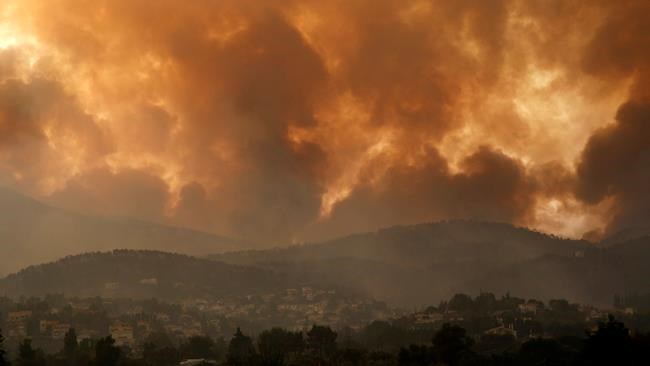
FILE - In this Friday, Aug. 6, 2021 file photo, smoke spreads over Parnitha mountain during a wildfire in the village of Ippokratios Politia, Greece, about 35 kilometres (21 miles), north of Athens. Thousands of people fled wildfires burning out of control in Greece and Turkey on Friday, as a protracted heat wave left forests tinder-dry and flames threatened populated areas and electricity installations. (AP Photo/Lefteris Pitarakis)

In the report’s worst-case scenario, the world could be around 3.3 degrees Celsius (5.9 degrees Fahrenheit) hotter than now by the end of the century. But that scenario looks increasingly unlikely, said report co-author and climate scientist Zeke Hausfather, climate change director of the Breakthrough Institute.

“We are a lot less likely to get lucky and end up with less warming than we thought,” Hausfather said. “At the same time, the odds of ending up in a much worse place than we expected if we do reduce our emissions are notably lower.”

The report also said ultra-catastrophic disasters — commonly called “tipping points,” like ice sheet collapses and the abrupt slowdown of ocean currents — are “low likelihood” but cannot be ruled out. The much talked-about shutdown of Atlantic ocean currents, which would trigger massive weather shifts, is something that’s unlikely to happen in this century, Kopp said.

A “major advance” in the understanding of how fast the world warms with each ton of carbon dioxide emitted allowed scientists to be far more precise in the scenarios in this report, Mason-Delmotte said.

In a new move, scientists emphasized how cutting airborne levels of methane — a powerful but short-lived gas that has soared to record levels — could help curb short-term warming. Lots of methane the atmosphere comes from leaks of natural gas, a major power source. Livestock also produces large amounts of the gas, a good chunk of it in cattle burps.
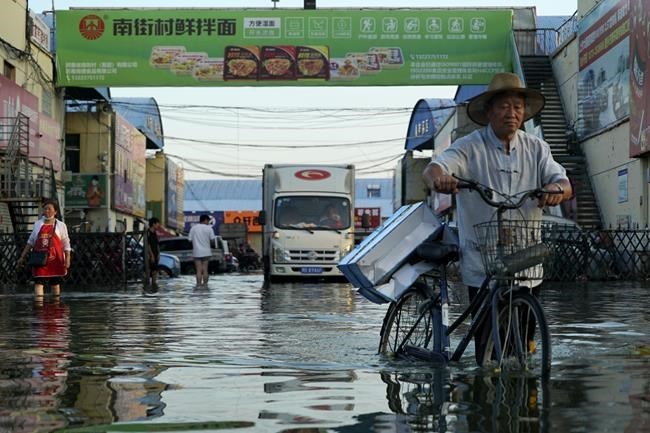
FILE - In this Monday, July 26, 2021 file photo, a man carries goods on his bicycle as he walks out of the the Yubei Agricultural and Aquatic Products World in Xinxiang in central China's Henan Province. The Intergovernmental Panel on Climate Change report released on Monday, Aug. 9, 2021, says warming already is smacking Earth hard and quickly with accelerating sea level rise, shrinking ice and worsening extremes such as heat waves, droughts, floods and storms. (AP Photo/Dake Kang, File)

More than 100 countries have made informal pledges to achieve “net zero” human-caused carbon dioxide emissions sometime around mid-century, which will be a key part of the negotiations in Scotland. The report said those commitments are essential.

“It is still possible to forestall many of the most dire impacts,” Barrett said.

___

Read more of AP’s climate coverage at http://www.apnews.com/Climate

___
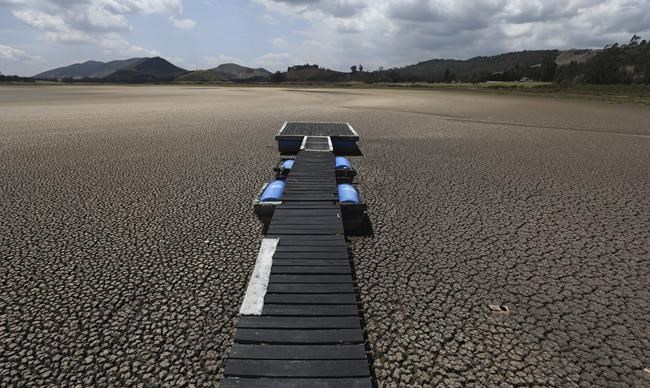
FILE - In this Wednesday, Feb. 17, 2021 file photo, a floating dock sits on the lakebed of the Suesca lagoon, in Suesca, Colombia. The lagoon, a popular tourist destination near Bogota that has no tributaries and depends on rain runoff, has radically decreased its water surface due to years of severe droughts in the area and the deforestation and erosion of its surroundings. (AP Photo/Fernando Vergara, File)

Follow Seth Borenstein on Twitter at @borenbears

___

The Associated Press Health and Science Department receives support from the Howard Hughes Medical Institute’s Department of Science Education. The AP is solely responsible for all content.
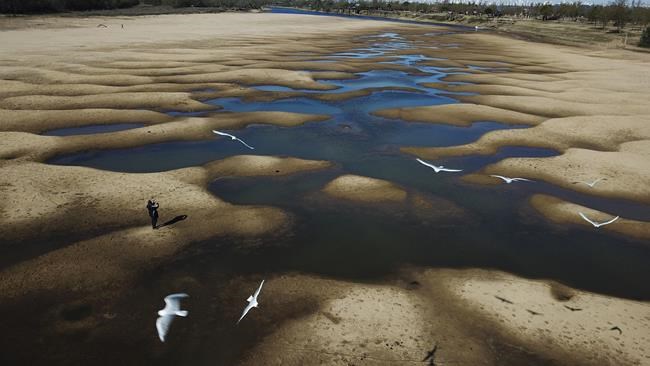
FILE - In this Thursday, July 29, 2021 file photo, birds fly over a man taking photos of the exposed riverbed of the Old Parana River, a tributary of the Parana River during a drought in Rosario, Argentina. Parana River Basin and its related aquifers provide potable water to close to 40 million people in South America, and according to environmentalists the falling water levels of the river are due to climate change, diminishing rainfall, deforestation and the advance of agriculture. (AP Photo/Victor Caivano, File)
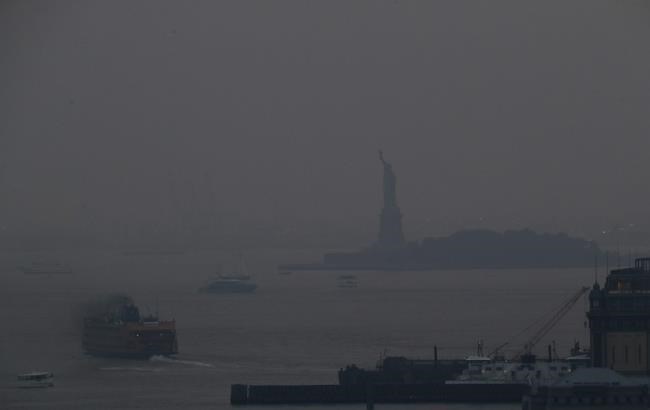
FILE - In this Tuesday, July 20, 2021 file photok the Staten Island Ferry departs from the Manhattan terminal through a haze of smoke with the Statue of Liberty barely visible in New York. Wildfires in the American West, including one burning in Oregon that's currently the largest in the U.S., are creating hazy skies as far away as New York as the massive infernos spew smoke and ash into the air in columns up to six miles high. (AP Photo/Julie Jacobson)
Report Error Submit a Tip

More Stories

Foreign workers at Manitoba hotel are owed $138K in unpaid wages and fees, labour board rules

Abiola Odutola 4 minute read Preview

Foreign workers at Manitoba hotel are owed $138K in unpaid wages and fees, labour board rules

Abiola Odutola 4 minute read 11:47 AM CDT

BRANDON — The Manitoba Labour Board has ordered the Western Star All Suites Hotel to pay nearly $138,000 in unpaid wages and administrative fees after it dismissed the appeals involving three foreign workers employed by the company.

In a decision dated Aug. 25, the board ordered 6692452 Manitoba Ltd. (doing business as Western Star All Suites Hotel), 1638185 Alberta Ltd. and company director P.X. to pay a total of $137,915.79 to the Employment Standards Branch for wages owed to foreign workers S.J., J.B. and G.R.

The decision was edited to protect the personal information of the employees, who worked at a hotel, reportedly in Melita, at different times and also lived there during their employment.

The board stated the employees were owed wages after hearing evidence about long working hours, irregular payments, inadequate employment records and working conditions.

Read
11:47 AM CDT

‘Fine wine’: Vintage Collaros shows up in big win over Als after 38th birthday

Ken Wiebe 6 minute read Preview

‘Fine wine’: Vintage Collaros shows up in big win over Als after 38th birthday

Ken Wiebe 6 minute read 10:29 AM CDT

Zach Collaros was in no mood for I-told-you-so’s.

There were no references – either thinly veiled or direct – to the naysayers, many of whom thought the Blue Bombers were in deep trouble as the league-leading Montreal Alouettes rolled into town on a roll for a matchup on Friday that could have left Winnipeg with a sub-.500 record heading into the Labour Day Classic.

No, that’s not Collaros’ style or part of how he operates.

After outduelling Alouettes quarterback Davis Alexander in a convincing 44-28 victory, Collaros stood in front of a group of reporters and displayed almost no emotion, despite delivering what can easily be described as his best showing of the season.

Read
10:29 AM CDT

Main Street Project to expand to former Mitchell Fabrics building

Ryan Thorpe 5 minute read Preview

Main Street Project to expand to former Mitchell Fabrics building

Ryan Thorpe 5 minute read Tuesday, Sep. 25, 2018

The Main Street Project is moving on up.

The shelter’s administration finalized the purchase of the former Mitchell Fabrics building at Main Street and Logan Avenue on Sept. 21, a move that will revolutionize the services the facility offers to the city’s chronically homeless and addicted.

“It’s still very fresh for us, and we’re very excited. This is probably the first significant shelter, mental health and addictions support expansion of this size in the last 30 years for Winnipeg,” Main Street Project executive director Rick Lees said.

The purchase is the culmination of efforts that began two years ago, when the agency did long-term planning to identify the biggest hurdles it faced moving forward. One key challenge identified was lack of space.

Read
Tuesday, Sep. 25, 2018

Winnipeg woman among those mourned after shooting rampage

Sarah Lawrynuik 7 minute read Preview

Winnipeg woman among those mourned after shooting rampage

Sarah Lawrynuik 7 minute read Tuesday, Apr. 21, 2020

One of the presumed victims of Nova Scotia’s deadly weekend rampage is being remembered as a kind and gentle soul by those who knew her during her childhood in Winnipeg.

(Elizabeth) Joanne Thomas, 58, and her husband John Zahl, 69, are presumed dead following the events of the weekend in Portapique, N.S. Their home was burned to the ground, but their bodies have not yet been located and identified by authorities.

The nation was left reeling by the deadly events of the weekend, during which a man impersonating an RCMP officer shot multiple people and burned homes in a rampage across the Maritime province. By Tuesday afternoon the death toll had risen to 23 people. The alleged shooter, identified by police as Gabriel Wortman, 51, was killed after being intercepted by police in Enfield, N.S.

“It’s unbelievable that with all the crappy people in this world, that their family is one to get hit like this. It doesn’t even make sense, and we’ll probably never know what happened,” said Jeanine Remillard, from her Winnipeg home.

Read
Tuesday, Apr. 21, 2020

After 20 years, Planet of Sound is still in its own orbit around the world of music

David Sanderson 9 minute read Preview

After 20 years, Planet of Sound is still in its own orbit around the world of music

David Sanderson 9 minute read Sunday, Sep. 20, 2020

According to a press release issued last week by the Recording Industry Association of America, for the first time since 1986 — the year songs such as Madonna’s Papa Don’t Preach, Peter Gabriel’s Sledgehammer and Falco’s Rock Me Amadeus were topping charts all over the globe — sales of vinyl records outstripped sales of compact discs for the initial six months of the year.

Hey, Mr. Mister, it wasn’t even close. The RIAA report stated that between January and June, audiophiles doled out US$232.1 million on vinyl albums as compared with just less than US$130 million on their digital counterparts. And while that bit of news was music to the ears of Planet of Sound owner Dave Wright, it certainly didn’t come as some big surprise.

“Vinyl is definitely on the upswing and has been for a while, which is precisely why we started carrying it in the store about 10 years ago,” says Wright, whose cosy, 800-square-foot shop at 1109 Henderson Hwy., which stocks a healthy number of LPs in addition to CDs, DVDs and Blu-rays, even an assortment of long-considered extinct LaserDiscs, will celebrate its 20th anniversary in November.

“It’s not just people who grew up listening to vinyl, either,” he goes on, sporting the office uniform: sneakers, dark jeans and an aquamarine-coloured, zip-up hoodie, the latter of which only partially conceals a well-worn, Joy Division T-shirt. “The other day there was a gal in here who I would have put at around 14. She picked up the Tea Party’s Edges of Twilight plus an album by the Wallflowers, the one that had their first big hit on it (we think he means Bringing Down the Horse). As she was taking out her debit card to pay I was like, how do you even know about these groups? Don’t they predate you by at least 10 years?”

Read
Sunday, Sep. 20, 2020

Province urges federal government to continue vital health-care funding

Carol Sanders 4 minute read Preview

Province urges federal government to continue vital health-care funding

Carol Sanders 4 minute read Saturday, Nov. 8, 2025

Manitoba wants the federal government to renew an annual $150-million health-care agreement that, for the last three years, has helped the province go “further, faster” to staff up the front lines.

“The loss of these agreements would mean that we’re losing predictable targeted federal contributions that have helped us stabilize staffing and strengthen health care — not just health care in our hospitals, but community-based care as well,” Health Minister Uzoma Asagwara said Friday.

The program, dubbed “Working Together to Improve Health Care for Canadians,” was announced in February 2023; the federal government has earmarked close to $150 million a year in 2023-24, 2024-25 and 2025-26. Tuesday’s federal budget made no mention of renewing those funding agreements.

“I think there was an opportunity missed today to signal that the bilateral funding agreements for your health care are going to continue,” Premier Wab Kinew noted in his response to the budget on Tuesday. One of the deals Manitoba signed is set to expire at the end of March.

Read
Saturday, Nov. 8, 2025