Kenney says Alberta didn’t prep carbon tax fallback plan, was hoping to win in court

Advertisement

Advertise with us

EDMONTON - Alberta Premier Jason Kenney says his government didn't prepare a fallback plan on implementing a consumer carbon tax because they were hoping to win in the country's top court.

Read this article for free:


By clicking the button above, an account will be created and you will begin to receive some of our recommended newsletters. You may opt out of any newsletter by visiting your Email and Communication Preferences page or by clicking "unsubscribe" at the bottom of any email.

or

Already have an account? Log in here »

To continue reading, please subscribe:

Digital Subscription

One year of digital access for only $1.44 a week*

  • Enjoy unlimited reading on winnipegfreepress.com
  • Read the E-Edition, our digital replica newspaper
  • Access News Break, our award-winning app
  • Play interactive puzzles

*Billed as $5.77 plus GST every four weeks. After 52 weeks, price increases to the regular rate of $19.95 plus GST every four weeks. Offer available to new and qualified returning subscribers only. Cancel any time.

To continue reading, please subscribe:

Add Free Press access to your Brandon Sun subscription for only an additional

$1 for the first 4 weeks*

  • Enjoy unlimited reading on winnipegfreepress.com
  • Read the E-Edition, our digital replica newspaper
  • Access News Break, our award-winning app
  • Play interactive puzzles
Start now

*Your next Brandon Sun subscription payment will increase by $1.00 and you will be charged $17.95 plus GST for four weeks. After four weeks, your payment will increase to $24.95 plus GST every four weeks.

Hey there, time traveller!
This article was published 26/03/2021 (2043 days ago), so information in it may no longer be current.

EDMONTON – Alberta Premier Jason Kenney says his government didn’t prepare a fallback plan on implementing a consumer carbon tax because they were hoping to win in the country’s top court.

Kenney said the province was buoyed by a lower court win in Alberta, and noted that three of the nine Supreme Court justices had concerns with Thursday’s majority decision that the tax is onside with the Constitution.

“It was our hope that we would win,” Kenney told reporters Friday.

Alberta Premier Jason Kenney listens as the 2021 budget is delivered in Edmonton on Thursday, Feb. 25, 2021. Kenney says his government did not prepare a fallback plan on implementing a consumer carbon tax because they were hoping they would win in court. THE CANADIAN PRESS/Jason Franson

“But now we’re going to consult with Albertans on the path forward.”

Alberta is currently paying a federally imposed levy, which is set to go up to $40 a tonne this year and $50 a tonne next year. It will collect more than $2 billion in annual revenue by 2022.

About 90 per cent of that is rebated to Albertans and the rest is invested in green projects.

Alberta, Saskatchewan and Ontario had challenged the federal tax in court, arguing it was an unconstitutional intrusion on provincial rights to manage their resources.

The high court, in a six-three decision, said climate change is a critical global problem and that Canada cannot effectively fight it by allowing a patchwork of programs or opt-outs.

Saskatchewan Premier Scott Moe said Thursday that, in light of the court decision, his government would look at introducing its own carbon tax for fuel, similar to a model used in New Brunswick.

Kenney said Alberta is looking at many options, including the New Brunswick model or perhaps Quebec’s cap-and-trade system.

“Our key goal will be to minimize the cost of any new policy on Albertans and on our economy as we struggle to recover from the COVID recession,” Kenney said Friday.

New Brunswick’s program sets a per-tonne price on carbon, then reduces the province’s gas tax by a similar amount to help neutralize the cost to consumers.

Alberta has had a carbon tax on large greenhouse gas emitters for more than a decade.

Alberta Opposition NDP Leader Rachel Notley said Kenney has wasted precious time by not having an Alberta friendly Plan B ready to go.

Alberta had its own consumer carbon tax under Notley when she was premier.

The NDP tax on gasoline and fossil fuel home heating delivered about $2 billion a year. Much of that money was rebated to low and middle-income families, and the balance funded green initiatives ranging from home renovations to rapid transit.

Kenney cancelled it as the first act of his new United Conservative government in the spring of 2019. He said the tax was expensive, intrusive and ineffectual at combating climate change.

Notley said Albertans have been paying for that decision, contributing since the start of 2020 to a federal backstop plan rather than a made-in-Alberta program that could have delivered a bigger bang for its economy.

Notley said a greener economy and a thriving oil and gas industry are not mutually exclusive, but said leaders have to make it happen.

She said the lack of a Plan B underscores Kenney’s rigidity on adapting to climate change and the modern economy.

“He has been distracted for two years with this particular battle, which many people suggested he was not likely to win,” said Notley following the Supreme Court decision.

“He’s now saying, ‘Oh, I guess starting tomorrow I’m going to have to talk to Albertans about how to do a made-in-Alberta plan that will protect our economy and protect jobs.’ That work should have been underway two years ago.

“For this to only start tomorrow is a continuation of the weak and ineffective leadership of this premier.”

This report by The Canadian Press was first published March 26, 2021.

Report Error Submit a Tip

More Stories

Waiting for Cormier verdict the ‘calm before the storm’

Katie May 6 minute read Preview

Waiting for Cormier verdict the ‘calm before the storm’

Katie May 6 minute read Thursday, Feb. 22, 2018

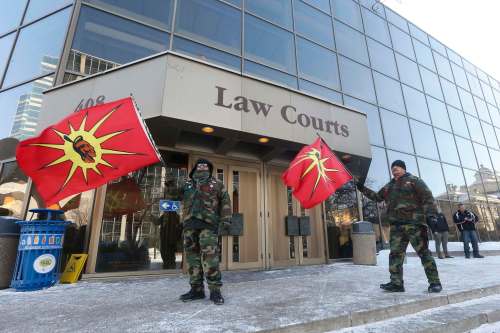
As the jury room door closed behind the seven women and four men who are now deliberating on the evidence against Tina Fontaine’s accused killer, Thelma Favel rose from the chair she’s occupied for most of Raymond Cormier’s second-degree murder trial.

Almost every day over the past three weeks, Favel, the woman who raised 15-year-old Tina, has sat right up front, directly across from the jury box, listening, sobbing and soaking in disturbing details of the teen’s last days that have come to light over the course of Cormier’s second-degree murder trial.

On Wednesday afternoon, after Court of Queen’s Bench Chief Justice Glenn Joyal instructed the jury and sent them off to be sequestered until they decide whether 56-year-old Raymond Cormier is guilty of killing Tina, Favel got up and hugged Crown prosecutor Breta Passler. It was one of many moments, this one shielded from jurors, that have long since proven the emotional impact of the case and the lasting power of Tina’s legacy.

Tina’s death sparked a public outcry that renewed calls for a national inquiry into disproportionately high rates of missing and murdered Indigenous women and girls across Canada, and the criminal trial for the man accused of killing her hasn’t happened in a vacuum.

Read
Thursday, Feb. 22, 2018

Adult education should be the foundation of the North

Jim Silver 5 minute read 2:00 AM CDT

Major economic developments are, we are being told, coming to northern Manitoba, focusing on the port of Churchill and the railway system that leads to it, and the production and export via that port of various commodities. Many challenges, particularly environmental, lie along that path, and they deserve particularly serious consideration if any development is to proceed.

One aspect of northern development about which almost nothing has been said is: “Who will do the work in the north?”

For decades past and still today, great reliance has been placed on bringing skilled tradespeople and other skilled workers to northern Manitoba from the south. The result has been that not only has the bulk of corporate profits been drained south, but so too have wages. As a result, rates of poverty are higher and formal educational levels are lower in the north than elsewhere in Manitoba. This is obviously detrimental to the north and particularly to those who live in the north.

If northerners themselves are to benefit from economic development in the north by forming the skilled labour force that will be needed, then we will need more of those northerners to be educationally prepared to undertake training for skilled employment.

Carrying a torch for tiki

Eva Wasney 5 minute read Preview

Carrying a torch for tiki

Eva Wasney 5 minute read Monday, Nov. 15, 2021

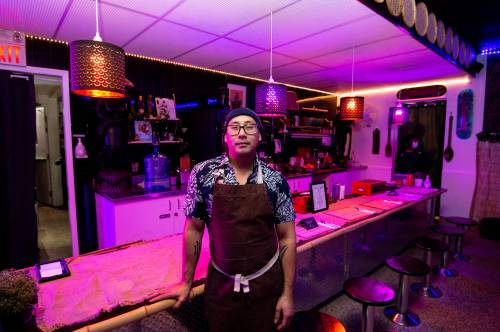
A paper tiki mask is the only indication that the door it’s affixed to leads somewhere other than a dive bar. Ring the doorbell and walk through the kitchen, however, and you’ll be transported to an island-themed lounge that’s equal parts kitschy and comfortable.

“This is just from people’s houses, like my mom’s,” says Allan Pineda, pointing to the wood carvings, water-buffalo horns and rattan furniture decorating the room. “A lot of the stuff you see in here, you’d see in a Filipino’s house back in the day — like second-wave immigrants in the ‘60s and ‘70s, they’d bring this stuff home (from the Philippines).”

Pineda is a local chef and part of the team behind the Bahay Kubo Tiki Bar, a pop-up Filipino drinking and dining experience hosted weekly at an undisclosed Winnipeg establishment.

The details are hush-hush because the temporary eatery is meant to operate like a speakeasy. The dinners are an offshoot of Baon Manila Nights, which Pineda started as a way to highlight Winnipeg’s Filipino culinary scene.

Read
Monday, Nov. 15, 2021

The landscape that taught us to see

Stephen Borys 6 minute read Preview

The landscape that taught us to see

Stephen Borys 6 minute read 2:01 AM CDT

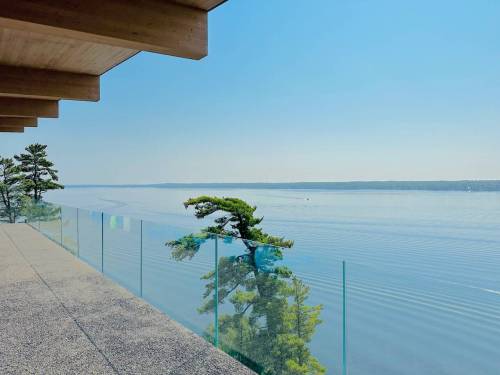
The white pine stood at the edge of the lake, leaning out over the water, its branches bent by years of wind and weather. Beyond it stretched an expanse of blue water beneath a clear sky, a distant tree line and other pines rising along the rocky shoreline. From the deck above, the landscape seemed both expansive and remarkably still.

I had been looking at it for only a few moments when Tom Thomson and the Group of Seven entered the picture. Not literally, of course. But once the association appeared, I could not unsee it. The pine became The Jack Pine and The West Wind. The surrounding rocks, water and sky called up A.Y. Jackson, Arthur Lismer, Franklin Carmichael and Lawren Harris. A landscape I had been looking at all weekend suddenly became part of a visual history Canadians have carried with them for more than a century.

Perhaps that is the Group of Seven’s greatest achievement. They did not simply paint the Canadian landscape. They changed the way we see it.

I was at the lake for a quiet weekend, reflecting on the cultural, community and development projects that occupy much of my work through Civic Muse. Increasingly, I see these pursuits as part of the same conversation — place and identity, how we understand it, care for it and decide what is worth carrying forward.

Read
2:01 AM CDT

No Christmas trees, no Christmas trees — the lots are empty as can be

Doug Speirs  3 minute read Preview

No Christmas trees, no Christmas trees — the lots are empty as can be

Doug Speirs  3 minute read Monday, Dec. 7, 2020

It might take a Christmas miracle to get your hands on even a scraggly Charlie Brown-style tree this holiday season.

Winnipeg garden centre owners interviewed Monday morning said they are totally sold out and they’ve never seen stock vanish this quickly in all their years in the business.

They likened it to the holiday version of panicked shoppers binge-buying toilet paper when the COVID-19 pandemic first arrived in the province back in March.

“I’m sold out,” declared Ray DuBois, owner of Ron Paul Garden Centre on St. Mary’s Road. “I could see it coming back in August. When we placed our order, I bumped it up by 10 per cent.”

Read
Monday, Dec. 7, 2020

Director Schrader returns to silver screen with complex view of religion and belief

Alison Gillmor 4 minute read Preview

Director Schrader returns to silver screen with complex view of religion and belief

Alison Gillmor 4 minute read Thursday, Jun. 14, 2018

Bleak, wintry and rigorously controlled — until it’s not — this Book of Job-like drama from American filmmaker Paul Schrader looks at the challenges of faith.

The 71-year-old Schrader, known for scripting four Martin Scorsese films (including Taxi Driver and Raging Bull) and for directing his own (including American Gigolo, Affliction and Auto Focus), grew up in a strict Calvinist home — he famously did not see a film until he was 17 — and has always been drawn to stories of agonizing and uncertain redemption.

As the Rev. Toller (Ethan Hawke) wrestles with what it means to lead a righteous life in our badly broken world, his spiritual fate remains in doubt. It is certain, however, that First Reformed marks a cinematic rebirth for Schrader after recent disasters like The Canyons and Dog Eat Dog. Serious, complex and moving, this is not a perfect film, but even its flaws are powerful.

Toller is a solitary man who has come to the ministry late in life, after a family tragedy and a failed marriage. First Reformed, a historic church in upstate New York that was once a stop on the Underground Railroad, has since been reduced to an austerely beautiful tourist shop, more of a museum than a place of worship.

Read
Thursday, Jun. 14, 2018