Kenney warns cancelled energy projects stand in the way of Indigenous prosperity

Advertisement

Advertise with us

CALGARY - A $1-billion fund established last year to support Indigenous participation in major projects won't have any projects to back if the circumstances that led to the cancelling of the Frontier oilsands mining project this week continue, Alberta Premier Jason Kenney warned on Wednesday.

Read this article for free:


or

Already have an account? Log in here »

To continue reading, please subscribe:

Subscribe and receive a limited-edition Free Press branded hat or tote.

Digital Subscription

One year of digital access for only $205*

  • Enjoy unlimited reading on winnipegfreepress.com
  • Read the E-Edition, our digital replica newspaper
  • Access News Break, our award-winning app
  • Play interactive puzzles

*First annual payment billed as $205.00 + GST for one year. This annual subscription will automatically renew at $233.00 + GST every 52 weeks (10% off the regular annual price of $259.35). Offer available to new and qualified returning subscribers only. Cancel any time.

To continue reading, please subscribe:

Add Free Press access to your Brandon Sun subscription for only an additional

$1 for the first 4 weeks*

  • Enjoy unlimited reading on winnipegfreepress.com
  • Read the E-Edition, our digital replica newspaper
  • Access News Break, our award-winning app
  • Play interactive puzzles
Start now

*Your next Brandon Sun subscription payment will increase by $1.00 and you will be charged $17.95 plus GST for four weeks. After four weeks, your payment will increase to $24.95 plus GST every four weeks.

Hey there, time traveller!
This article was published 26/02/2020 (2412 days ago), so information in it may no longer be current.

CALGARY – A $1-billion fund established last year to support Indigenous participation in major projects won’t have any projects to back if the circumstances that led to the cancelling of the Frontier oilsands mining project this week continue, Alberta Premier Jason Kenney warned on Wednesday.

In a speech at the Indigenous Participation in Major Projects conference in Calgary that heavily criticized “green left urban militants,” Kenney insisted his government is the one that has the best interests of First Nations at heart because it supports building major energy projects.

He blamed uncertainty created by environmental activists for the decision by Teck Resources Ltd. last Sunday to withdraw its application for the $20-billion oilsands mine, just days before the federal government was expected to announce a ruling on whether or not it could proceed.
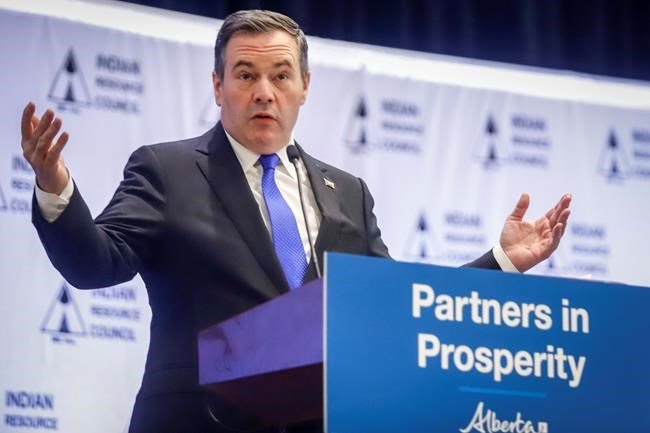
Alberta Premier Jason Kenney delivers remarks at the Indigenous Participation in Major Projects conference in Calgary, Alta., Wednesday, Feb. 26, 2020.THE CANADIAN PRESS/Jeff McIntosh

“We can create greater access to capital but if the folks that succeeded in shutting down Teck continue, there won’t be deals to be made,” Kenney said. “There won’t be opportunities or jobs to be created.”

He added: “I think here in Alberta we can point the way forward because we understand in Alberta that poverty is not the path to reconciliation.”

Teck CEO Don Lindsay said Monday that tensions over Indigenous rights, climate change and resource development that led to ongoing rail blockades helped his company decide there was “no constructive path forward” for the project.

The Vancouver-based company has taken a $1.13-billion writedown on Frontier, which was expected to create 7,000 construction jobs, 2,500 operating jobs and about $12 billion in federal income and capital taxes, but was also expected to produce about four million tonnes of greenhouse gas emissions per year over 40 years.

The future and economic viability of Frontier was uncertain enough that analysts did not factor it into their valuation of the company.

Critics say the mine, designed to produce 260,000 barrels of oil a day, wouldn’t have been profitable unless North American oil prices were much higher, although Teck said new technologies would have been employed to bring down costs.

Kenney announced Wednesday that the Woodland Cree First Nation in northwest Alberta will receive a $187,688 grant — the first approved under the $10-million Indigenous Litigation Fund announced last year — to intervene in support of Alberta’s constitutional challenge of the federal government’s Bill C-69, which revamped the way major infrastructure projects win regulatory approval.

Blood Tribe Chief Roy Fox, chairman of the Indian Resource Council that sponsored the conference, praised the province for its programs to help Indigenous projects get off the ground and criticized federal bureaucrats who have stood in the way of economic development opportunities in the past.

“Now is the time to assert our political and business leadership capabilities and reduce the poverty that plagues many of those that rely on us,” he said.

Chief Ouray Clark Crowfoot of the Siksika Nation said most Indigenous investment in the oil and gas sector has been in the upstream production sector and said the next logical step is to look at midstream and downstream assets like pipelines and refineries.

In the provincial throne speech on Tuesday, Kenney’s government said it is prepared to invest directly in the resource industry if that’s what it takes to boost Alberta’s wellspring industry.

But he didn’t mention the pledge in his speech at the conference and left without speaking to reporters.

Companies in this story: (TSX:TECK)

This report by The Canadian Press was first published Feb. 26, 2020.

Report Error Submit a Tip

More Stories

Your fall gardening checklist

Colleen Zacharias 6 minute read Preview

Your fall gardening checklist

Colleen Zacharias 6 minute read Saturday, Sep. 12, 2026

September is as pivotal a time for the garden and landscape as early spring.

Admittedly, it feels different. Spring is all about anticipation and the excitement of sweeping away winter and transforming the garden. But autumn presents opportunities as well.

The weather this year has been a mixed bag that has meant misery for some and joy for others. Closing the garden for the season may mean a greater cleanup burden if recent storms caused fallen trees, broken branches or damage to your property.

But with predictions for a milder-than-normal winter by Environment and Climate Change Canada and other meteorologists, it’s important to prepare the garden. Milder temperatures in winter can mean less snow cover, and less snow cover can lead to drier conditions next spring. In addition, milder conditions do not exclude the possibility of extreme cold snaps that, without the benefit of a deep snowpack, can be a killer for plants.

Read
Saturday, Sep. 12, 2026

Manitoba marks end of sending simple workplace problems to doctor’s office

Tory McNally 7 minute read Preview

Manitoba marks end of sending simple workplace problems to doctor’s office

Tory McNally 7 minute read Yesterday at 2:01 AM CDT

There are some changes in the workplace that make you think: “Well, it’s about time.”

This is one of them.

Starting Oct. 1, Manitoba changed the rules around sick notes. I think it is going to be a wonderful change — not just for doctors and patients, but for employers, employees and the way we think about accountability at work.

The change comes from Bill 11, the Employment Standards Code Amendment Act (Sick Notes for Employee Absences), which received royal assent on June 1 and came into force Thursday. Under the new rules, employers generally cannot require a sick note for an illness or injury unless the employee is away for more than one week or has been absent because of illness or injury for more than 10 scheduled workdays in the calendar year.

Read
Yesterday at 2:01 AM CDT

Poster protocol

Sheldon Birnie 7 minute read Preview

Poster protocol

Sheldon Birnie 7 minute read Tuesday, Sep. 15, 2026

Although the days when telephone poles and notice boards across the city were thick with gig posters, either slopped up with wheat paste or wrapped tight with packing tape, are behind us, the art of making an appealing visual ad for live music events is still a vital part of the local creative scene.

However, a widespread backlash against a new kind of slop — the use of generative AI images — has been building, especially among creatives when it comes to promoting live music.

“Live music is and always has been a DIY type of scene, especially locally,” says Evan Simpson, who has been working as a graphic designer for nearly a decade.

“For years people have been making their own flyers, or if they have the budget, hiring a designer or artist to come up with some artwork for their flyers. It’s a whole ecosystem, a scene supporting itself. If you take away the visual side of it, the spark, individuality and uniqueness of each gig poster is lost. What a sad world it would be if all art were made by AI.”

Read
Tuesday, Sep. 15, 2026

Letters, Oct. 3

7 minute read Yesterday at 2:01 AM CDT

A morning in the life …

My very first lesson does not start when I walk into that lecture hall, oh no — it starts long before. It begins when I walk to my car, check the estimated arrival time to the University of Manitoba and hope that Winnipeg traffic agrees with it.

A drive that appears completely manageable changes almost immediately when I’m greeted by a tsunami of orange pylons and a line of cars that appears to go on forever. Traffic moves by the inch, lanes magically disappear and the detour I took yesterday now has a detour of its own. These factors make me do a calculation that I have become all too familiar with. How late can I arrive and still find parking, run to my class across campus and get to class with enough time left to make it worth it?

I have grown used to people saying, “Why not just leave earlier?” I do. But when I’m already leaving for my 8:30 a.m. class at 7 a.m., there’s only so much I can do. This drive that some would think is relaxing is one that feels like an assignment that I didn’t know I had to complete and is due at 8:30 a.m.

Teachers work with Microsoft and Minecraft to create Anishinaabe society

Maggie Macintosh 8 minute read Preview

Teachers work with Microsoft and Minecraft to create Anishinaabe society

Maggie Macintosh 8 minute read Wednesday, Feb. 10, 2021

In a forest abundant with birch trees, knowledge keeper Chickadee Richard greets students with a teaching about tobacco, known as semaa in Anishinaabemowin.

“Semaa is a gift of reciprocity. We give semaa to receive knowledge and healing,” Richard says about a practice that is traditional for Anishinaabe people, via a medium that is anything but.

The birch trees, much like the teepees, campfire flames and murky brown rivers that surround her, are pixelated.

And the elder from Sandy Bay First Nation? A video game version of Richard.

Read
Wednesday, Feb. 10, 2021

Today’s horoscope

Georgia Nicols 4 minute read Preview

Today’s horoscope

Georgia Nicols 4 minute read 2:00 AM CDT

MOON ALERT: Caution! Avoid shopping (except food and gas) and important decisions until after 6:30 p.m. today. After that, the moon moves from Cancer into Leo.

ARIES (March 21-April 19)

Don’t expect much co-operation from partners, spouses and close friends. This is why you might feel cut off from others or a bit lonely. There’s the sense a gulf exists between you and everyone else. But this is temporary. Courage!

TAURUS (April 20-May 20)

Read
2:00 AM CDT