Trudeau caught in middle of clash over energy, environment, Indigenous demands

Advertisement

Advertise with us

OTTAWA - The competing demands of natural resource development, environmental protection and Indigenous reconciliation appear poised for a head-on crash — with Prime Minister Justin Trudeau's minority government caught in the middle as Parliament resumes Tuesday.

Read this article for free:


By clicking the button above, an account will be created and you will begin to receive some of our recommended newsletters. You may opt out of any newsletter by visiting your Email and Communication Preferences page or by clicking "unsubscribe" at the bottom of any email.

or

Already have an account? Log in here »

To continue reading, please subscribe:

Subscribe and receive a limited-edition Free Press branded hat or tote.

Digital Subscription

One year of digital access for only $205*

  • Enjoy unlimited reading on winnipegfreepress.com
  • Read the E-Edition, our digital replica newspaper
  • Access News Break, our award-winning app
  • Play interactive puzzles

*First annual payment billed as $205.00 + GST for one year. This annual subscription will automatically renew at $233.00 + GST every 52 weeks (10% off the regular annual price of $259.35). Offer available to new and qualified returning subscribers only. Cancel any time.

To continue reading, please subscribe:

Add Free Press access to your Brandon Sun subscription for only an additional

$1 for the first 4 weeks*

  • Enjoy unlimited reading on winnipegfreepress.com
  • Read the E-Edition, our digital replica newspaper
  • Access News Break, our award-winning app
  • Play interactive puzzles
Start now

*Your next Brandon Sun subscription payment will increase by $1.00 and you will be charged $17.95 plus GST for four weeks. After four weeks, your payment will increase to $24.95 plus GST every four weeks.

Hey there, time traveller!
This article was published 17/02/2020 (2428 days ago), so information in it may no longer be current.

OTTAWA – The competing demands of natural resource development, environmental protection and Indigenous reconciliation appear poised for a head-on crash — with Prime Minister Justin Trudeau’s minority government caught in the middle as Parliament resumes Tuesday.

The NDP is asking House of Commons Speaker Anthony Rota for an emergency debate on anti-pipeline blockades that have shut down swaths of the country’s train system and interrupted traffic on highways and bridges for more than a week.

The blockades are in support of Wet’suwet’en hereditary chiefs who oppose a natural-gas pipeline project that crosses the First Nation’s territory in northern British Columbia.
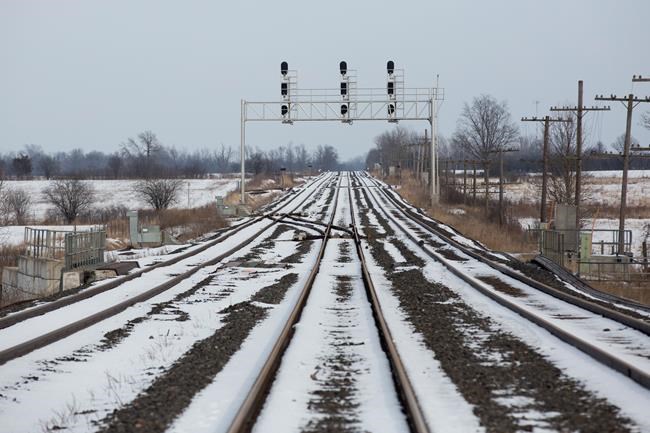
The closed train tracks are seen in Tyendinaga Mohawk Territory, Ont. on Wednesday, Feb. 12, 2020, in support of Wet'suwet'en's blockade of a natural gas pipeline in northern B.C. THE CANADIAN PRESS/Lars Hagberg

Trudeau faces a blockade of a different sort — from his own Liberal backbenchers — over another energy project.

Many Liberal MPs are openly campaigning against approval of Teck Resources’ proposed Frontier oilsands mine in Alberta, which they see as antithetical to Trudeau’s pledge to combat climate change.

Cabinet must decide by the end of this month whether to approve the project and risk the wrath of Liberal MPs and voters concerned about climate change, or nix it and risk raising “roiling western alienation to a boiling point,” as Alberta Premier Jason Kenney has warned.

Either issue is politically explosive but the combination makes for something of a perfect storm for Trudeau’s fragile minority.

NDP House leader Peter Julian wrote to Rota on Monday to request that emergency debate on anti-pipeline blockades.

“The prime minister’s refusal to take more substantive and timely action has allowed tensions to rise, put significant pressure on the Canadian economy and threatened jobs across the country,” Julian wrote.

“He has said that no relationship is as important to him as Canada’s relationship with Indigenous Peoples but those words must be backed up by actions,” he added, calling for a “swift and just resolution.”

Trudeau, who was overseas last week trying to drum up support for Canada’s bid for a seat on the United Nations Security Council, spent hours Monday holed up with some of his cabinet ministers trying to figure out a way to end the blockades quickly and peacefully. He has said governments in Canada do not order the police to clear out protesters but it was unclear Monday what other action the government might take to end the standoff.

The Conservatives, who’ve called for police enforcement of court injunctions against the protests, have an opposition day on Thursday and may use that opportunity to further pressure the government over its perceived inaction on the blockades, if the issue isn’t resolved by then.

Or they could pressure the government to approve Teck’s Frontier project. Conservative MPs have echoed Kenney’s contention that the project would create thousands of jobs and bolster Alberta’s struggling economy and that rejection would be a blow to national unity.

But many Liberal MPs aren’t buying those arguments.

Toronto MP John McKay says Liberal caucus members are “darn close” to unanimous in their opposition to the Teck mine.

“My guess is that (Trudeau) will not go against the views of caucus,” he says, adding that he sympathizes with Trudeau’s having to make a “lose-lose” decision.

Some aren’t convinced the project will ever be built, pointing to Teck CEO Don Lindsay’s admission that the mine will only proceed if oil prices substantially increase and the company obtains joint-venture partners.

Nor are they buying Kenney’s portrayal of the project as the sole saviour of Alberta’s economy. They note that there are some 20 other oilsands projects that already have approval and are ready to go but are on ice because they’re not economically viable given low world oil prices.

University of Alberta environmental economist Andrew Leach says some of those other projects could be viable at much lower oil prices than Teck but they are on hold because of production limits imposed by the Alberta government.

“It’s easier for Premier Kenney to be able to say it’s not happening because of the federal regulatory process than for him to say … the provincial government hasn’t given final approval or, in the general case, it’s not happening because of broader economic circumstances that are sort of beyond his control and don’t have an obvious someone else to blame,” Leach says.

This report by The Canadian Press was first published Feb. 17, 2020.

Report Error Submit a Tip

More Stories

Yielding attraction

Joel Schlesinger 6 minute read Preview

Yielding attraction

Joel Schlesinger 6 minute read Yesterday at 2:01 AM CDT

Yield is a Rorschach test for investors. Where one see opportunity in high payouts from an investment, another sees high risk.

Consider bonds: yields are moving higher, which implies higher risk in the market, but to an investor considering buying a bond, higher yields represent higher income.

For most of the past 18 years, bond yields have been near historical lows and investors have sought alternatives.

“Canada’s population is aging, with a growing number of investors approaching or entering retirement and looking for more income,” says Pat Sommerville, co-chief executive officer of Hamilton ETFs in Toronto.

Read
Yesterday at 2:01 AM CDT

Is this the season of secession?

David McLaughlin 5 minute read Preview

Is this the season of secession?

David McLaughlin 5 minute read Yesterday at 2:01 AM CDT

Canada has entered its season of secession. Like El Nino, the currents of grievance can blow hot and cold. Today, they are hot. But how hot for how long? The odds of Alberta and now Quebec separating from Canada are not high, but they are never zero.

After a year of waving the flag in a surge of national patriotism to confront Donald Trump’s attacks on Canada — economic and verbal — it is both jarring and frustrating for most Canadians to be reminded of the pervasive and persistent tensions that come with governing our federation.

When we need new national purpose to confront big economic sovereignty and security challenges from outside, that purpose is undermined and diminished by having to confront homegrown grievances.

We’ve seen and seen off two separation referendums in Quebec. Now we have a newly elected separatist party coming to power. In Alberta, voters will soon decide whether the independence road is one they want to travel.

Read
Yesterday at 2:01 AM CDT

Religious groups must keep careful eye on artificial intelligence

John Longhurst 5 minute read Saturday, May. 23, 2026

Programmers, computer scientists and software, mechanical, data and prompt engineers — these are some of the professions behind the creation of artificial intelligence. Should theologians and faith leaders also be involved?

Meghan Sullivan, a Roman Catholic who teaches philosophy at the University of Notre Dame, says yes. That’s why she was glad to attend a meeting in March at the invitation of Anthropic, the creator of Claude AI, about the role religion can play in the creation of this life-changing technology.

Sullivan, who also directs the university’s Institute for Ethics and the Common Good, was there with 15 other Christian philosophers, theologians and leaders to discuss the implications of AI for society today — and how it can be taught to behave ethically and morally using religion as a guide.

I spoke with Sullivan this week about that meeting. “I’m very grateful for Anthropic’s leadership in this area with faith communities,” she said, noting that most AI companies are not doing that. “It should have happened sooner, but better late than never.”

Musk’s meddlesome trolling

Editorial 4 minute read Preview

Musk’s meddlesome trolling

Editorial 4 minute read Yesterday at 2:01 AM CDT

It seems obvious the world’s first trillionaire thought he was helping separatists within the Canadian federation when he encouraged three provinces — Alberta, Saskatchewan and Quebec — to leave Canada.

Unfortunately for Elon Musk, a man suffering from a profound deficit of self-awareness, his comments may only help those who want to keep the country together.

Musk entered the national unity debate on Wednesday, two days after the pro-independence Parti Quebecois was returned to power in Quebec with a minority mandate. The PQ has promised to hold a third referendum on separation at some point in its current term.

Musk — who has a Canadian mother and attended university in Ontario — took to X, the social media platform formerly known as Twitter (which he owns) and encouraged Quebec to forge ahead with plans to separate. He said Alberta — which will hold a vote this fall on whether to hold a binding referendum on separation — and Saskatchewan should follow suit.

Read
Yesterday at 2:01 AM CDT

Final hurdles are moving on in your mind and life

Maureen Scurfield 3 minute read Yesterday at 2:01 AM CDT

DEAR MISS LONELYHEARTS: I just ran into my former husband with his new woman. It was a shock. She looked nothing like me — not nearly as good. In fact, she’s the opposite of me — red-haired, freckled, tall and skinny like a rake. I’m short, dark, with golden skin from my Italian background. That was what my husband used to say he loved in a woman.

Does that mean he lied — that he really didn’t like my looks and secretly longed for the opposite? That seems crazy to me. But I should mention that in our last miserable years together he didn’t even want to hold me in his arms and look at me. He sometimes slept at his office (or so he said) because he was “too tired to drive home.”

He could have been elsewhere — like in some other woman’s home — because he always used his cellphone to call me, not his office line.

How can I forget about the man I loved so much and finally move on?

Americans 75 and older are wealthiest age group, Fed survey finds

Christopher Rugaber, The Associated Press 3 minute read Friday, Oct. 9, 2026

WASHINGTON (AP) — Bolstered by steady gains in the stock market, families headed by someone aged 75 or older are now America's wealthiest, while the youngest families saw their wealth decline in the past three years, a government report released Friday said.

The finding from the Federal Reserve's Survey of Consumer Finances underscores how robust stock market gains have made wealthier American families even richer since the survey, conducted every three years, was last completed in 2022. The median net worth of the richest one-tenth of American families soared 31% to $3.6 million from 2022 to 2025, the survey found. The median is the midpoint between the richest and poorest families.

For the oldest families aged 75 and over, median net worth jumped to nearly $505,000, up from just over $367,000 in 2022. Three years ago, families aged 65 to 74 were the richest. All the figures are adjusted for inflation.

Average wealth for the oldest age group rose 10% to $1.96 million. The higher average, compared with the median, reflects the fact that wealthier Americans pulled up the average relative to the median.