Archbishop urges Catholics to learn about Indigenous spirituality

Advertisement

Advertise with us

Roman Catholics will benefit by taking time to learn more about Indigenous spirituality, the head of the Archdiocese of Winnipeg says.

Read this article for free:


or

Already have an account? Log in here »

To continue reading, please subscribe:

Subscribe and receive a limited-edition Free Press branded hat or tote.

Digital Subscription

One year of digital access for only $205*

  • Enjoy unlimited reading on winnipegfreepress.com
  • Read the E-Edition, our digital replica newspaper
  • Access News Break, our award-winning app
  • Play interactive puzzles

*First annual payment billed as $205.00 + GST for one year. This annual subscription will automatically renew at $233.00 + GST every 52 weeks (10% off the regular annual price of $259.35). Offer available to new and qualified returning subscribers only. Cancel any time.

To continue reading, please subscribe:

Add Free Press access to your Brandon Sun subscription for only an additional

$1 for the first 4 weeks*

  • Enjoy unlimited reading on winnipegfreepress.com
  • Read the E-Edition, our digital replica newspaper
  • Access News Break, our award-winning app
  • Play interactive puzzles
Start now

*Your next Brandon Sun subscription payment will increase by $1.00 and you will be charged $17.95 plus GST for four weeks. After four weeks, your payment will increase to $24.95 plus GST every four weeks.

Hey there, time traveller!
This article was published 23/03/2026 (199 days ago), so information in it may no longer be current.

Roman Catholics will benefit by taking time to learn more about Indigenous spirituality, the head of the Archdiocese of Winnipeg says.

“It can help us deepen our own faith,” said Archbishop Murray Chatlain. “It can help us ask better questions about what we believe.”

Chatlain was responding to news that the Portage la Prairie School Division upheld a decision to reject a Roman Catholic family’s request for a religious exemption from activities related to Indigenous spirituality. Portage la Prairie is part of the Archdiocese of Winnipeg.
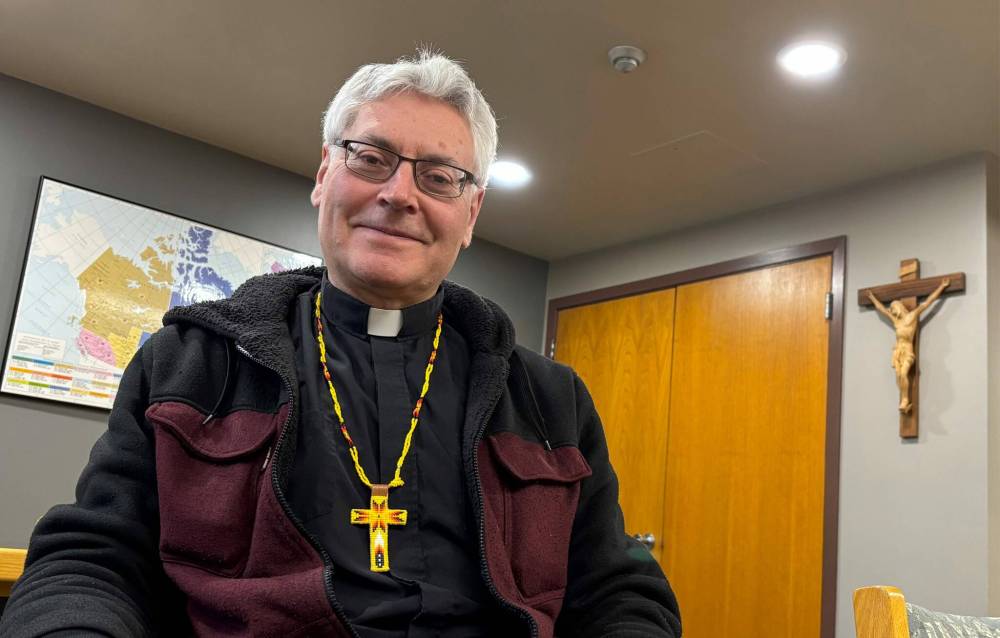
JOHN LONGHURST / FREE PRESS Archbishop Murray Chatlain

JOHN LONGHURST / FREE PRESS Archbishop Murray Chatlain

Sharon Sanders Zettler and Vince Zettler had been seeking accommodation for their children at Yellowquill School. They wanted them to be held out of activities about Indigenous spirituality they say conflict with their personal beliefs.

That included making tobacco pouches and participating in elk-hide scraping.

While not wanting to specifically address the family’s request, Chatlain — who spent years serving among Indigenous people in Canada’s North, including as bishop of Keewatin Le Pas in Manitoba — said learning about Indigenous spirituality has helped him grow as a Christian.

He said learning about Indigenous people has helped him view the land differently and he’s come to appreciate how creation is seen as alive and dynamic.

“Elders say that when they don’t go out on the land, the land misses them,” Chatlain said.

Being open to Indigenous spirituality is a good thing for Roman Catholics, Chatlain said. “There is a gift there for us. Indigenous people can contribute to our understanding of God.”

It’s like what happens when Christians engage with people from other faiths, he said, noting that is something the Roman Catholic Church encourages as a way to promote peace and mutual understanding between religious groups.

Although there are differences between Indigenous Spirituality and Christianity, there are also many commonalities, Chatlain said, citing the similarities between the Seven Sacred Teachings of Indigenous spirituality — love, respect, courage, honesty, wisdom, humility, truth — and the Ten Commandments.

In addition to learning about Indigenous spirituality, Chatlain has also taken part in various ceremonies over the years such as a vision quest, sweat lodges and sun and round dances.

“Looking back, I never say I shouldn’t have done those things,” he said. “They are all OK. I think if people knew their bishop can say this, maybe they can feel OK about it, too.”

Kyle Mason, a Winnipeg Indigenous consultant and former evangelical pastor, believes it’s important for non-Indigenous people to learn more about Indigenous ways.

“It’s important for us to learn about each other,” the Peguis First Nation member said, adding Indigenous people aren’t interested in seeing members of other faith groups switch their beliefs.

“We have a respect for all beliefs, we honour that,” he said.

Learning more about Indigenous spirituality can bring Canadians closer together, Mason said, adding that he personally blends his spirituality with the teachings of Jesus.

“Our beliefs are complementary, not in conflict. We can enhance each other,” he said.

faith@freepress.mb.ca

The Free Press is committed to covering faith in Manitoba through our Religion in the News project. This reporting continues because readers like you step forward to fund it.

Donate now to support our reporting on religion.

Your donation is eligible for a charitable tax receipt. BECOME A FAITH JOURNALISM SUPPORTER

John Longhurst

John Longhurst
Faith reporter

John Longhurst has been writing for Winnipeg's faith pages since 2003. He also writes for Religion News Service in the U.S., and blogs about the media, marketing and communications at Making the News.

Our newsroom depends on a growing audience of readers to power our journalism. If you are not a paid reader, please consider becoming a subscriber.

Our newsroom depends on its audience of readers to power our journalism. Thank you for your support.

Report Error Submit a Tip

The Free Press acknowledges the financial support it receives from members of the city’s faith community, which makes our coverage of religion possible.
More Stories

Fantastical, moving graphic memoir explores addictions, organ procurement and more

Reviewed by Candida Rifkind 4 minute read Preview

Fantastical, moving graphic memoir explores addictions, organ procurement and more

Reviewed by Candida Rifkind 4 minute read Saturday, May. 30, 2026

At the heart of Mary Shelley’s 1818 classic Frankenstein and its many pop culture adaptations is the scene in the mad scientist’s lab where Victor Frankenstein, helped by a bolt of lightning, animates the grotesque figure made out of human and animal parts lying on his anatomy table.

As much as Shelley’s novel is a philosophical investigation into the desire of modern science to create new life, it is also a gruesome window into the clandestine European trade in graveyard and battlefield body snatching that fuelled early 19th-century anatomy research, medical training and public dissection theatres.

Whose bodies ended up on the slab to advance medical knowledge? As Montreal-based artist Arizona O’Neill explains in her captivating first graphic narrative, it was inevitably poor, racialized and criminalized bodies that were deemed appropriate for the indignities of public display and dissection in earlier periods.

But what about today? This is the central question driving the story of Opioids & Organs, O’Neill’s beautifully drawn story of coming to terms with her father’s untimely death due to a fentanyl overdose as well as the awful truth that Canada’s post-2015 opioid crisis has greatly increased the number of organs available for donation, mostly from otherwise healthy young men like her father.

Read
Saturday, May. 30, 2026

Beausejour biz has a bit of everything and a lot of buzz

David Sanderson   9 minute read Preview

Beausejour biz has a bit of everything and a lot of buzz

David Sanderson   9 minute read Sunday, May. 30, 2021

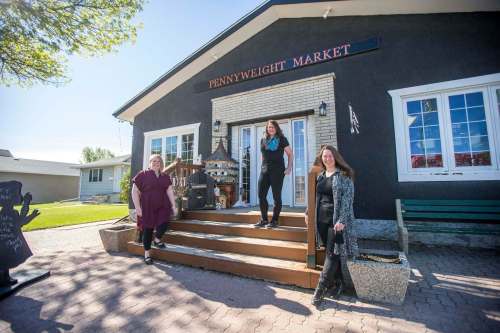
BEAUSEJOUR — Andrea Swain, co-owner of Pennyweight Market, a combination bulk food outlet, ice cream parlour and good, old-fashioned general store situated in Beausejour, laughingly opines that one of the challenges of launching a new venture in a small community such as theirs is that “everybody in town knows your business.”

Among the benefits? That’s easy, she says: everybody in town knows your business.

Not long after they acquired the space four summers ago, rumours abounded as to what it was going to be when it reopened, Swain continues, seated next to her associates Kimberley Friesen and Laurie McLean, inside their cute-as-a-button shop at 802 Park Ave. The previous owner had been around for more than 20 years, and ice cream and milk shakes were two of her main drawing cards, so there was some concern — OK, a lot — on the part of the high school students down the street that the three of them were going to turn it into a (here she lowers her voice to a whisper) health-food store.

Friesen, who, like Swain, grew up in Beausejour, located 45 kilometres northeast of Winnipeg, was at a neighbourhood pool party in July 2017, a few weeks before Pennyweight’s grand opening. She recalls being peppered with questions, including one from a 10-year-old girl splashing about in the shallow end who was under the impression the former locale’s beloved “candy island” was about to become a thing of the past. The second Friesen told the youngster not to worry, that the colourful array of gummies, licorice and chocolates wasn’t going anywhere, she came bounding out of the pool to give her a big, albeit wet, hug.

Read
Sunday, May. 30, 2021

New beds fill gaps, won’t fix health-care woes

Tom Brodbeck 5 minute read Preview

New beds fill gaps, won’t fix health-care woes

Tom Brodbeck 5 minute read 2:45 PM CDT

The NDP government is finally putting more money into one of the most important solutions to Manitoba’s emergency-room crisis: getting patients who no longer require acute-care treatment out of hospitals and into more appropriate care.

The province is adding 103 new community-based spaces in Winnipeg for patients who no longer need to be in hospital but still need somewhere safe to go.

That’s a good investment. It’s also an acknowledgement of a problem that has been clogging Manitoba’s hospitals for years.

About 600 patients are occupying hospital beds on an average day even though they no longer require acute care treatment. They are waiting for personal-care-home beds, housing, home supports, mental-health services or other community-based options.

Read
2:45 PM CDT

Time for true count of COVID-related deaths

Dan Lett 5 minute read Preview

Time for true count of COVID-related deaths

Dan Lett 5 minute read Thursday, May. 5, 2022

It has often been said the first step in solving a problem is to admit you have one. If that’s true, governments around the world are moving further and further away from finding a solution to the challenge of global pandemics.

How can we both assess the response to date and plan the response to future pandemics if we cannot agree on how many people have died from COVID-19?

The death toll has been one of the stickier points of contention between medical and scientific experts, political leaders and governments — and that segment of the population that disputes the idea COVID-19 poses any significant threat.

The expert group tends to believe deaths are under-reported; governments that seek to evade accountability for their shortcomings and the COVID-19 deniers say they are overstated.

Read
Thursday, May. 5, 2022

Michael Douglas comes to terms with fears, fame, father

Hillel Italie 6 minute read Preview

Michael Douglas comes to terms with fears, fame, father

Hillel Italie 6 minute read Yesterday at 2:01 AM CDT

NEW YORK — Michael Douglas, the award-winning actor and producer, recently turned 82. He is a cancer survivor, a recovered addict, a married man, the father and son of actors.

He is also an author, who begins his memoir with a message of thanks to his family — past and present and future — for the “sense of immortality.”

“Many times my father was asked, ‘Kirk, are you jealous of your son?’” he said during a recent interview at a Manhattan hotel, referring to his late father, fellow actor and sometime combatant Kirk Douglas.

“And he said, ‘Jealous?’ This is a sense of immortality, a continuity of generations.’”

Read
Yesterday at 2:01 AM CDT

School divisions to argue against paying property taxes on buildings

Maggie Macintosh 4 minute read Preview

School divisions to argue against paying property taxes on buildings

Maggie Macintosh 4 minute read Tuesday, Mar. 29, 2022

A fall court date has been set for Winnipeg school divisions to argue why they should not have to pay municipal property taxes on any of their buildings — not just elementary, junior high and high schools.

Under Manitoba’s Municipal Assessment Act, properties that are “used for a public school” should be exempt from taxation to a maximum exemption of 4.047 hectares.

Divisions claim that all of their non-school facilities, ranging from bus depots to education resource centres, contribute to schooling. The City of Winnipeg, however, only wants to provide exceptions to active schools.

“Schools are very different today. There’s a lot happening in the schools, in terms of all aspects of the mental, emotional, physical well-being of children,” said Mark Newman, the lawyer representing all six metro-area divisions: Winnipeg, Seven Oaks, River East Transcona, Pembina Trails, St. James-Assiniboia, and Louis Riel.

Read
Tuesday, Mar. 29, 2022