

New beds fill gaps, won’t fix health-care woes

Advertisement
Read this article for free:
or
Already have an account? Log in here »
To continue reading, please subscribe:

Digital Subscription
One year of digital access for only $205*
- Enjoy unlimited reading on winnipegfreepress.com
- Read the E-Edition, our digital replica newspaper
- Access News Break, our award-winning app
- Play interactive puzzles
*First annual payment billed as $205.00 + GST for one year. This annual subscription will automatically renew at $233.00 + GST every 52 weeks (10% off the regular annual price of $259.35). Offer available to new and qualified returning subscribers only. Cancel any time.
To continue reading, please subscribe:
Add Free Press access to your Brandon Sun subscription for only an additional
$1 for the first 4 weeks*
- Enjoy unlimited reading on winnipegfreepress.com
- Read the E-Edition, our digital replica newspaper
- Access News Break, our award-winning app
- Play interactive puzzles
*Your next Brandon Sun subscription payment will increase by $1.00 and you will be charged $17.95 plus GST for four weeks. After four weeks, your payment will increase to $24.95 plus GST every four weeks.
Read unlimited articles for free today:
or
Already have an account? Log in here »
The NDP government is finally putting more money into one of the most important solutions to Manitoba’s emergency-room crisis: getting patients who no longer require acute-care treatment out of hospitals and into more appropriate care.
The province is adding 103 new community-based spaces in Winnipeg for patients who no longer need to be in hospital but still need somewhere safe to go.
That’s a good investment. It’s also an acknowledgement of a problem that has been clogging Manitoba’s hospitals for years.
RUTH BONNEVILLE / FREE PRESS FILES
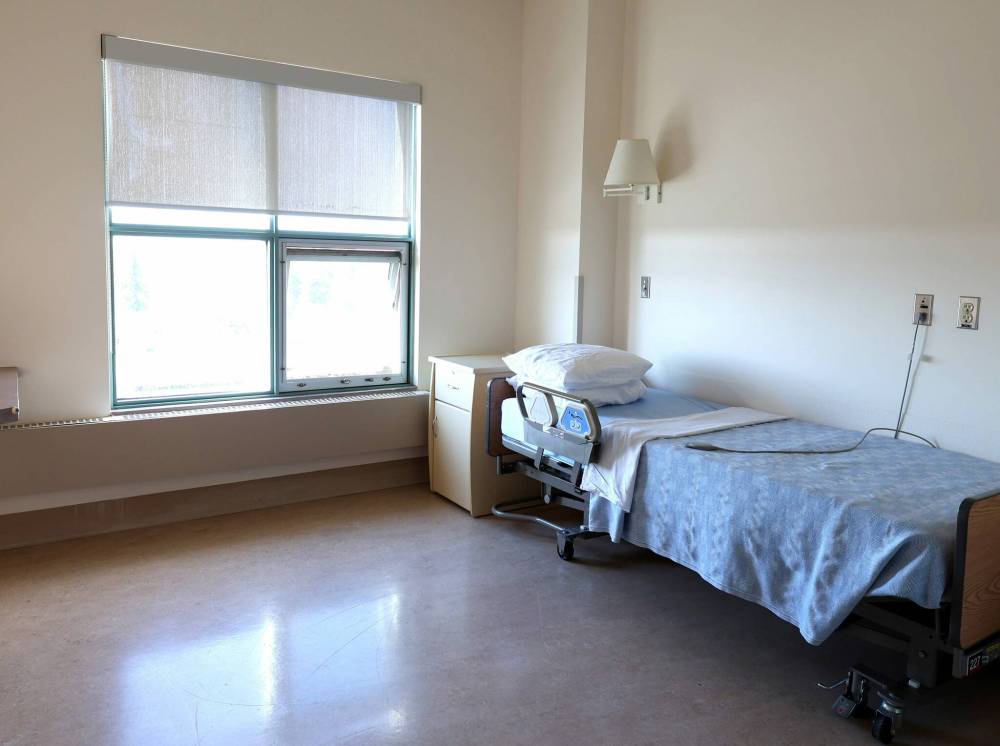
The province is adding 103 new community-based spaces in Winnipeg for patients who no longer need to be in hospital but still need somewhere safe to go. That’s a good investment.
About 600 patients are occupying hospital beds on an average day even though they no longer require acute care treatment. They are waiting for personal-care-home beds, housing, home supports, mental-health services or other community-based options.
The new community-based beds will help alleviate that congestion, although it’s nowhere near enough to make a significant impact on growing ER wait times.
Do the math. If there are 600 patients occupying acute care beds that shouldn’t be there and only 103 new community based beds, there are still hundreds of patients on medical wards causing “access block,” which prevents admitted patients in emergency wards from getting a bed on a medical ward.
Still, the 103 new spaces are a meaningful start. And it’s the right direction for the province to be taking.
The province says the new spaces will free up almost 40,000 hospital bed days a year. Health Minister Uzoma Asagwara says the goal is to make sure patients receive the “right care in the right place.”
That should be the basic principle of any functioning health-care system.
A hospital bed should be used by someone who needs acute hospital treatment. It shouldn’t become a long-term holding area simply because there is nowhere else for a patient to go.
When that happens, the effects ripple through the entire system.
Hospital beds become unavailable for patients who need them. Those patients, usually admitted through ERs, wait in emergency room treatment areas, sometimes in hallways, often for days. ERs become overcrowded, ambulances have trouble getting patients into hospital and wait times grow longer.
It’s not really an ER problem — it doesn’t originate there — it’s a system-wide one. And it all backs up into ER waiting rooms.
The latest numbers show the problem remains severe and has been getting worse under the NDP government.
The median ER wait at Winnipeg hospitals peaked at 4.47 hours on average in April and was 4.40 hours in both July and August, according to the Winnipeg Regional Health Authority’s most recent data. That’s about double what it was six years ago.
But the 90th percentile is arguably a better measure of the patient experience. That’s the point at which nine out of 10 patients waited less and one in 10 waited longer.
Across Winnipeg hospitals, the 90th-percentile wait was nearly 13 hours in August, up from 10.6 hours for the same month a year ago.
St. Boniface Hospital was the worst at 17.4 hours, followed by Grace Hospital at 16.14 hours. Health Sciences Centre was 12.65 hours
Those are extraordinarily long waits for emergency care.
The province’s renewed focus on community care deserves credit. The 103 spaces are targeted at some of the specific gaps that prevent patients from leaving hospital.
They include 32 beds at Siloam Mission for homeless patients, 15 beds at an Indigenous-run wellness centre for people requiring ongoing mental-health supports, 15 spaces through Ten Ten Sinclair Housing and eight beds at N’Dinawemak to create more accessible supported-housing options for patients.
Deer Lodge Centre is expanding its special-needs unit from 10 to 18 beds. A mobile support team will also help 25 patients make the transition home.
These aren’t abstract health-care reforms. They address a very practical problem: where do patients go when they no longer need a hospital bed but aren’t yet able to live independently?
Sometimes it has to be a personal-care home. Sometimes it’s supportive housing. Sometimes it’s transitional care or specialized mental-health services.
That’s why the government needs to keep expanding community-based resources, particularly personal-care-home beds and home care.
The Manitoba Association of Health Care Professionals is right to point out that hospital staff can’t safely discharge patients if there is nowhere appropriate for them to go.
And this is where the NDP’s health-care strategy needs to become broader than simply improving hospitals. A hospital doesn’t operate in isolation. Its ability to treat patients depends partly on what exists outside its walls, especially downstream.

If there are enough community resources, patients can move through the system. If there aren’t, they get stuck.
The NDP deserves credit for putting more emphasis on that reality. But now it has to keep going.
Manitoba desperately needs more personal-care-home beds, more home care, more supportive housing, more transitional and rehabilitation services and more mental-health supports.
The 103 new spaces won’t solve Manitoba’s ER crisis by themselves. But they point toward a solution that has been staring the health-care system in the face for years.
tom.brodbeck@winnipegfreepress.com
Tom has been covering Manitoba politics since the early 1990s and joined the Winnipeg Free Press news team in 2019.
Our newsroom depends on a growing audience of readers to power our journalism. If you are not a paid reader, please consider becoming a subscriber.
Our newsroom depends on its audience of readers to power our journalism. Thank you for your support.
Tom has been covering Manitoba politics since the early 1990s and joined the Winnipeg Free Press news team in 2019.
Our newsroom depends on a growing audience of readers to power our journalism. If you are not a paid reader, please consider becoming a subscriber.
Our newsroom depends on its audience of readers to power our journalism. Thank you for your support.
Advertisement Advertise With Us
Advertisement Advertise With Us