Heart and soul

Moving graphic memoir explores issues around addictions, organ procurement, family and more

Advertisement

Advertise with us

At the heart of Mary Shelley’s 1818 classic Frankenstein and its many pop culture adaptations is the scene in the mad scientist’s lab where Victor Frankenstein, helped by a bolt of lightning, animates the grotesque figure made out of human and animal parts lying on his anatomy table.

Read this article for free:


or

Already have an account? Log in here »

To continue reading, please subscribe:

Subscribe and receive a limited-edition Free Press branded hat or tote.

Digital Subscription

One year of digital access for only $205*

  • Enjoy unlimited reading on winnipegfreepress.com
  • Read the E-Edition, our digital replica newspaper
  • Access News Break, our award-winning app
  • Play interactive puzzles

*First annual payment billed as $205.00 + GST for one year. This annual subscription will automatically renew at $233.00 + GST every 52 weeks (10% off the regular annual price of $259.35). Offer available to new and qualified returning subscribers only. Cancel any time.

To continue reading, please subscribe:

Add Free Press access to your Brandon Sun subscription for only an additional

$1 for the first 4 weeks*

  • Enjoy unlimited reading on winnipegfreepress.com
  • Read the E-Edition, our digital replica newspaper
  • Access News Break, our award-winning app
  • Play interactive puzzles
Start now

*Your next Brandon Sun subscription payment will increase by $1.00 and you will be charged $17.95 plus GST for four weeks. After four weeks, your payment will increase to $24.95 plus GST every four weeks.

At the heart of Mary Shelley’s 1818 classic Frankenstein and its many pop culture adaptations is the scene in the mad scientist’s lab where Victor Frankenstein, helped by a bolt of lightning, animates the grotesque figure made out of human and animal parts lying on his anatomy table.

As much as Shelley’s novel is a philosophical investigation into the desire of modern science to create new life, it is also a gruesome window into the clandestine European trade in graveyard and battlefield body snatching that fuelled early 19th-century anatomy research, medical training and public dissection theatres.

Whose bodies ended up on the slab to advance medical knowledge? As Montreal-based artist Arizona O’Neill explains in her captivating first graphic narrative, it was inevitably poor, racialized and criminalized bodies that were deemed appropriate for the indignities of public display and dissection in earlier periods.

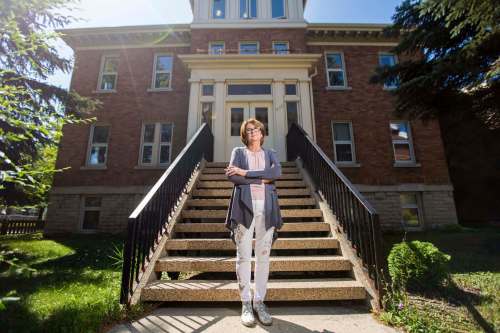
Julie Artacho photo
                                Arizona O’Neill

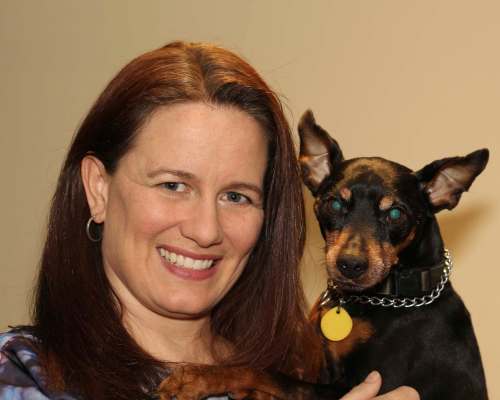
Julie Artacho photo

Arizona O’Neill

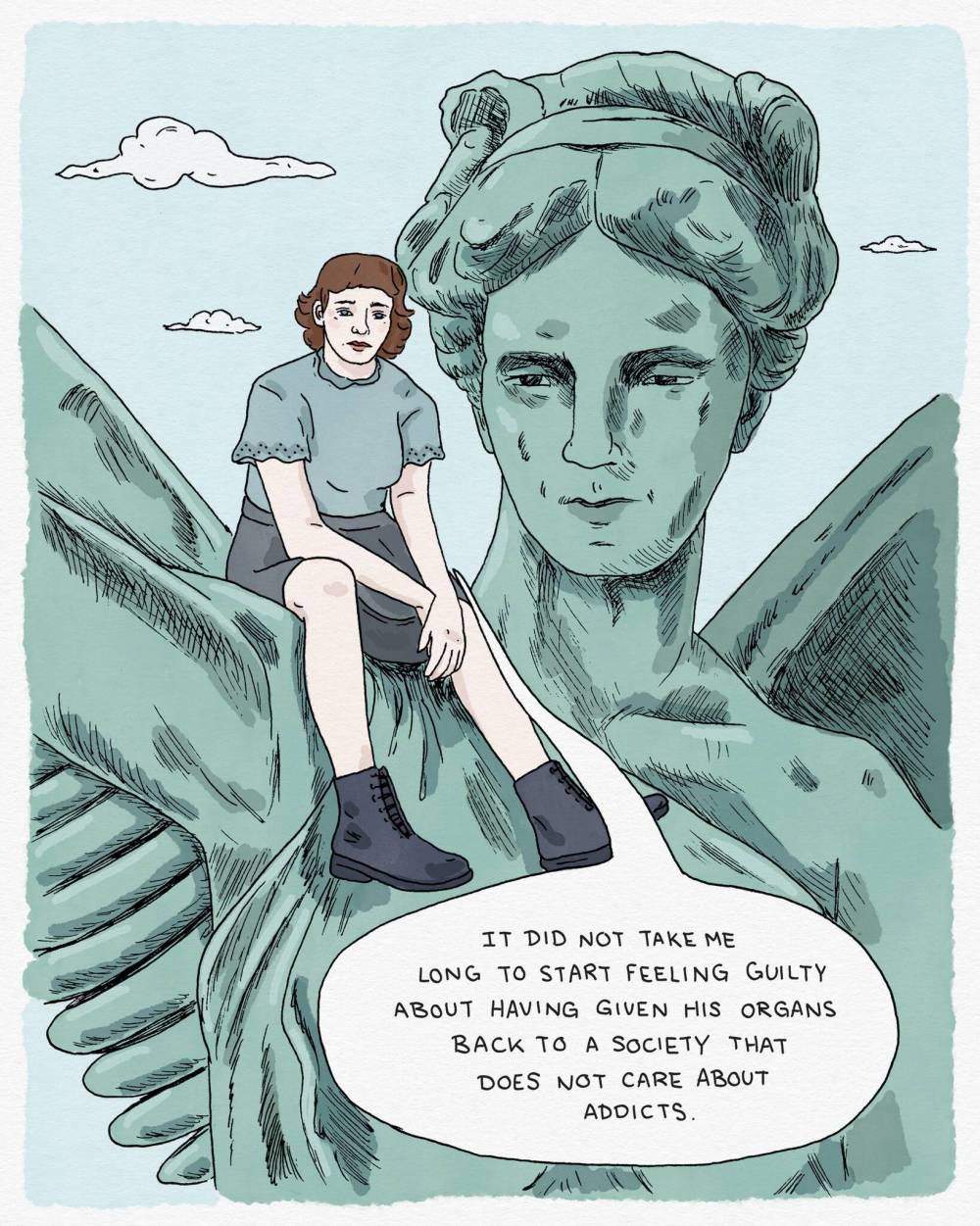
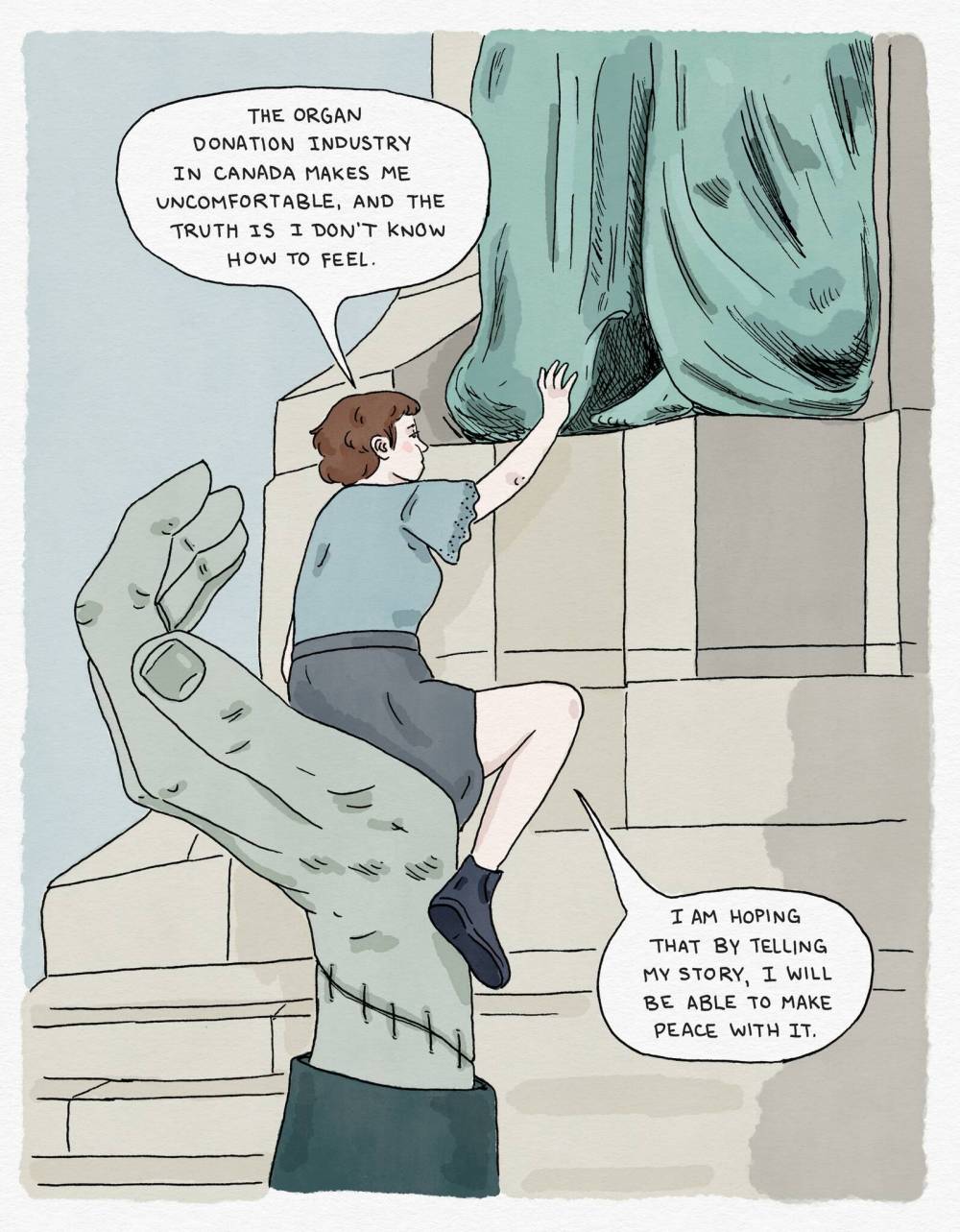
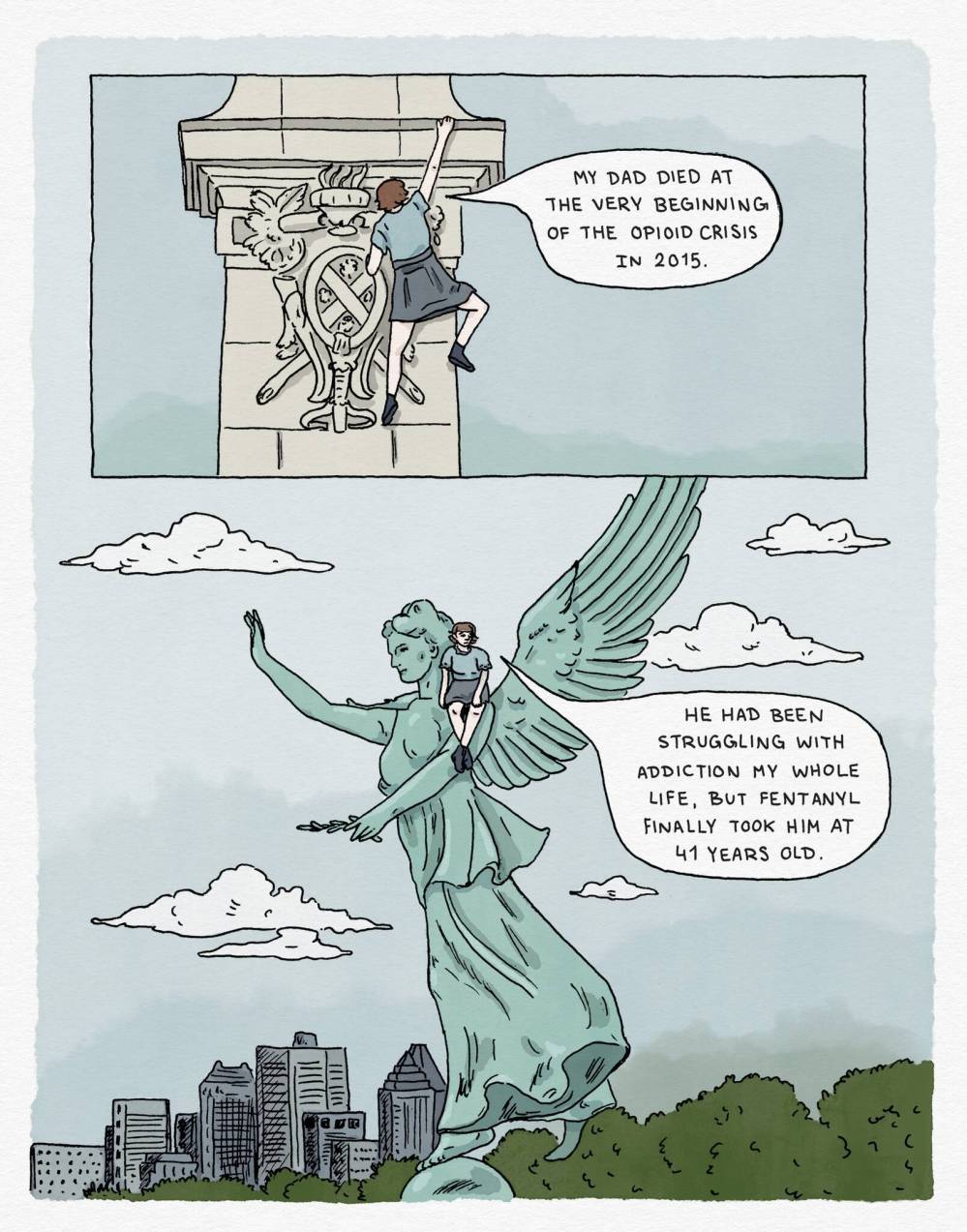
But what about today? This is the central question driving the story of Opioids & Organs, O’Neill’s beautifully drawn story of coming to terms with her father’s untimely death due to a fentanyl overdose as well as the awful truth that Canada’s post-2015 opioid crisis has greatly increased the number of organs available for donation, mostly from otherwise healthy young men like her father.

O’Neill is an author, illustrator, cartoonist, animator and regular contributor to Radio-Canada’s Il restera toujours la culture. Together with her mother, Montreal author Heather O’Neill (who also appears in Opioids & Organs), she runs the Instagram reading account @oneillreads.

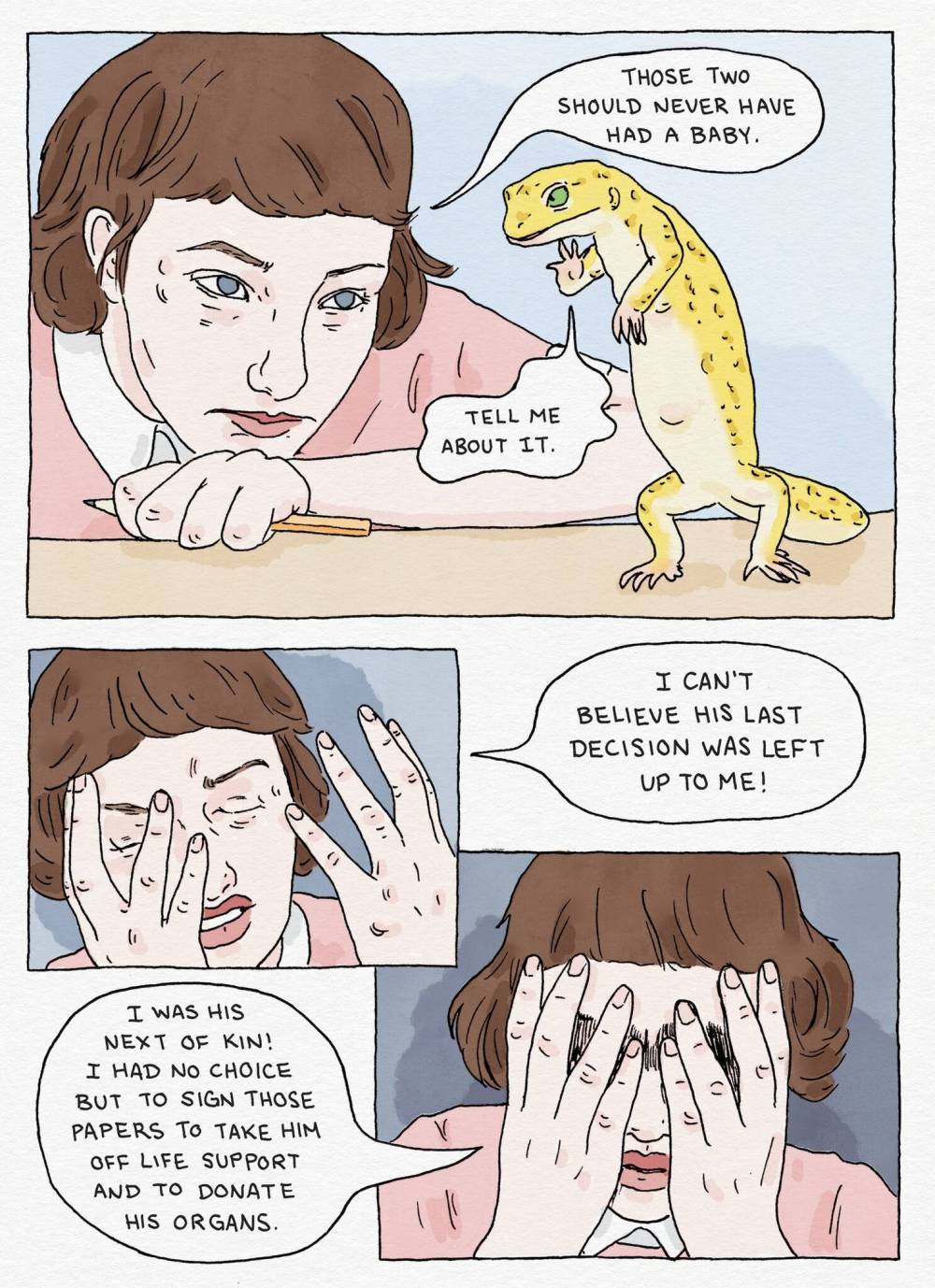
Her love of reading is obvious throughout Opioids & Organs, but it is the visual style that really elevates this graphic narrative. The clear lines and skilful use of bright and muted colours will appeal to fans of Alison Bechdel and Rutu Modan, and to those who want detailed and rich images on which to linger.

As she investigates the history and current state of organ procurement (the more acceptable term to “harvesting,” we are told), O’Neill embraces comics’ ability to combine the real with the surreal and fantastical: she sees body parts in everyday objects and her friends transform into giant organs; she daydreams herself into the past and finds herself inside classic works of literature; she is accompanied by Izzy, a cheeky lizard sidekick who goads her on because he is the embodiment of her anxieties and unhealthy obsessions; and she has a faithful companion in a kind and noble version of Dr. Frankenstein’s creature who insists on being called Frankie because he is no monster.

Together, Arizona, Izzy and Frankie do research, talk to experts and visit medical museums, libraries, cemeteries and ossuaries, from McGill University to Harvard Medical School to the Paris catacombs. This journey leads to discussions about the rights of dead bodies, the societal and medical attitudes towards people with addictions and the ethical quandaries inherent to scientific advancement.
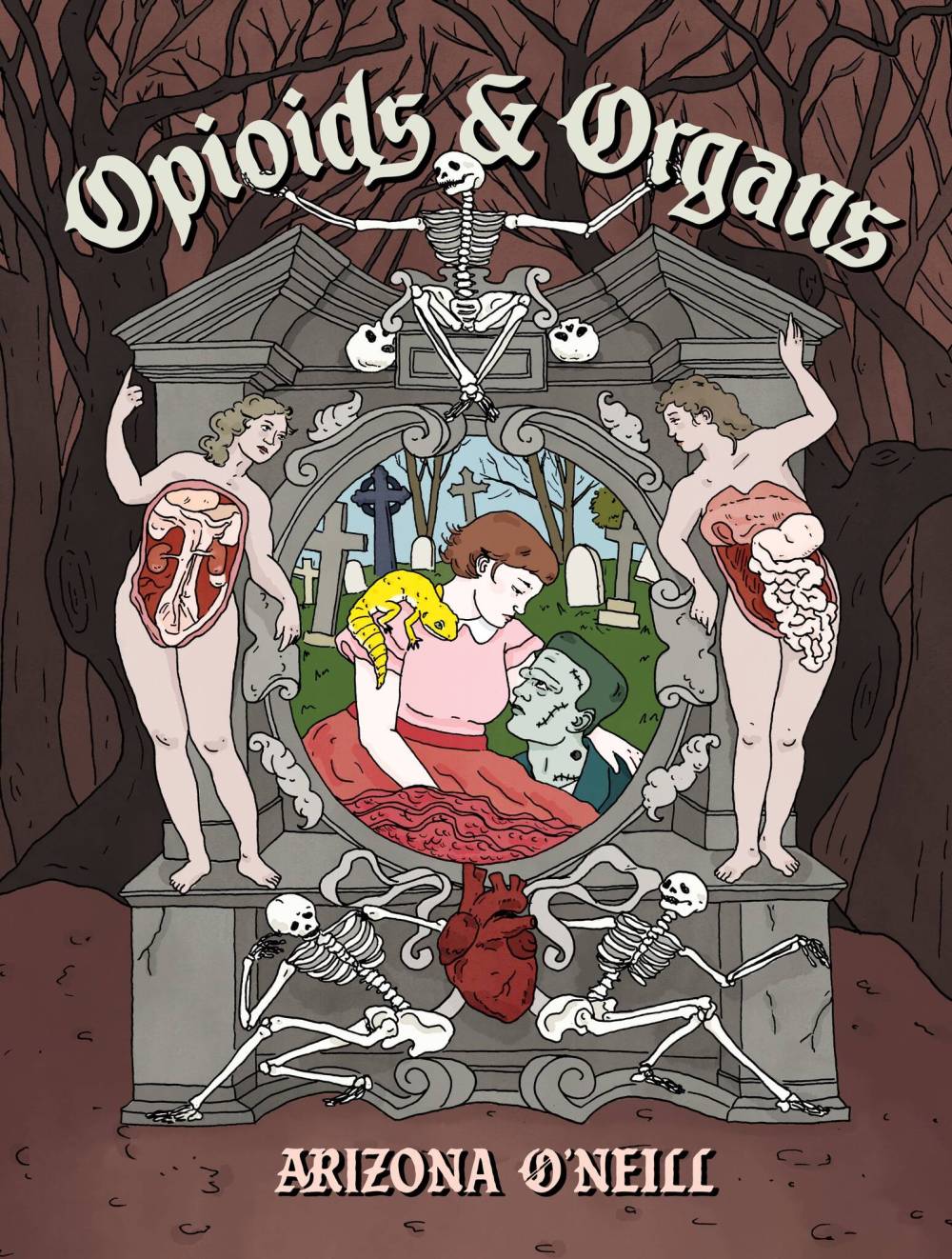
Opioids & Organs

Opioids & Organs

If this sounds like heavy material, it is — but O’Neill’s lively sense of humour, flights of fancy and self-reflexive portrayal of the project as an obsession she can turn into art all make this a compelling read. O’Neill creates a highly personal, complex journey into the afterlife of a fatal overdose as it plays out for both the deceased person and their next of kin.

Asking more questions than it can answer, Opioids & Organs also delves into philosophical debates about what makes us who we are and how much of our self lives on in our hearts, brains and other organs once they are transplanted into someone else.

This is a story that benefits from the comics format enormously; O’Neill knows how to draw readers into this dark and thorny investigation by holding onto the playful possibilities of a medium where talking animals, gentle monsters, daydreams and time travel are never out of place.

Candida Rifkind is a professor in the Department of English at the University of Winnipeg, where she teaches and researches comics and Canadian literature.
Report Error Submit a Tip

More Stories

Dangerous offender status sought for convicted killer

Erik Pindera 5 minute read Preview

Dangerous offender status sought for convicted killer

Erik Pindera 5 minute read Tuesday, Sep. 1, 2026

CROWN prosecutors intend to apply to have a convicted killer, who also admitted his guilt in an assault on a stranger at The Forks and a robbery at a local beer vendor, designated as a dangerous offender.

Daniel Christopher Dumas, who is in his mid-30s, pleaded guilty to assault causing bodily harm and robbery in front of provincial court Judge Donovan Dvorak on Monday for the attacks on June 6 and 7, 2025. He will be sentenced at a later date.

Prosecutor Monique Cam said the Crown plans to apply for a dangerous offender designation for Dumas, which, if granted, could result in him being given an indefinite prison sentence.

“The Crown does intend to make an application at a future date … for a remand for assessment to have Mr. Dumas assessed by a court-ordered assessor for the purpose of pursuing a dangerous offender application,” Cam said.

Read
Tuesday, Sep. 1, 2026

No end in sight to Ottawa’s pandemic spending

Temur Durrani 8 minute read Preview

No end in sight to Ottawa’s pandemic spending

Temur Durrani 8 minute read Monday, Nov. 30, 2020

A crucial caveat expected in Monday's fiscal statement from Ottawa failed to manifest: there is no end in sight to federal spending amidst the COVID-19 pandemic.

As Canada stares down a nearly $400-billion, record-high deficit for 2020, the Liberal government plans to spend up to $100 billion over the next three years, along with a further $25.1 billion in immediate measures to support workers and businesses affected by the novel coronavirus.

That's not all.

In a long-awaited speech from the House of Commons, Finance Minister Chrystia Freeland did not provide a spending cap to draw any red lines around the limit to which the feds will continue funnelling toward an economic recovery she acknowledged is still well-off the horizon.

Read
Monday, Nov. 30, 2020

Letters, Sept. 5

7 minute read 2:02 AM CDT

Clearing the air

Re: QDoc patients in middle of billing dispute (Sept. 4)

QDoc has been fortunate to have a genuine partner in the Manitoba government over the past several years. Premier Wab Kinew and Health Minister Uzoma Asagwara have been consistently clear that no Manitoban should go without care because of where they live, and that commitment is exactly why virtual care exists as a permanent, publicly available option today. We built MediNav, the province’s online appointment booking system, together with Manitoba Health, and that same collaborative spirit has helped make more than 350,000 patient visits possible through our platform — many of them evenings, overnights and weekends, reaching rural and underserviced communities that need it most.

We want to be direct with the people who rely on us: QDoc is not going anywhere. We continue to see patients today, and we will keep doing so tomorrow. The issue reported this week is a technical billing matter, not a service disruption, and we are actively working with the province to resolve it quickly, so we can keep growing our capacity to serve Manitobans rather than limiting it.

Smith’s pretzel logic confuses

Editorial 4 minute read Preview

Smith’s pretzel logic confuses

Editorial 4 minute read 2:02 AM CDT

Alberta Premier Danielle Smith had both sides of her mouth working overtime on Aug. 30, when she spoke at an event in Calgary to commemorate Alberta Day, the annual celebration of the province’s entry into Confederation in 1905 (officially Sept. 1, it was celebrated on the weekend).

Smith’s comments — and the things she did not say — revealed a lot about the political tightrope the premier is trying to walk over the challenges currently faced by her province. At the top of that list of challenges is a persistent campaign to separate Alberta from the aforementioned Confederation. A campaign that Smith appears to both support and oppose, depending on which day of the week it is.

Her Alberta Day remarks were an excellent case in point.

Smith has decided that on Oct. 19, Albertans will vote on a series of non-binding propositions in a province referendum. One of those questions will ask Albertans whether they want to hold a referendum on separation, thus making this fall’s vote a “referendum on whether to hold a referendum,” as some observers have dubbed it.

Read
2:02 AM CDT

Before her health took a rapid, fatal turn, Genevieve Price was an independent grandmother guided by her faith in God and love for family.

The Winnipeg senior, 82, died last weekend after going to the hospital for what began as swelling in her one of her hands.

Her daughter, Michelle Price, believes she suffered organ failure as a result of spending more than 30 hours in an emergency department hallway at Grace General Hospital as sepsis took hold.

After a Grace ER doctor discovered she had suffered a heart attack, Michelle’s mother was transferred to St. Boniface Hospital, where she died.

Not a Donut takes the circular confection in an entirely different direction

Eva Wasney 4 minute read Preview

Not a Donut takes the circular confection in an entirely different direction

Eva Wasney 4 minute read Tuesday, Nov. 2, 2021

Let’s get one thing straight: Not A Donut does indeed serve doughnuts, just not the kind most North American fried dough connoisseurs are familiar with. The small shop on Langside Street specializes in mochi doughnuts, cute flower-shaped rings with a soft, chewy texture thanks to the addition of glutinous rice flour.

It’s a nostalgic dessert for owner Echo Shen.

“I tried it when I was back in Shanghai when I was little,” says Shen, who moved to Canada from China for school. “I had it for the first time and couldn’t forget it — it’s so good, it’s not like the regular doughnuts.”

Mochi doughnuts were popularized in Japan by the Mister Donuts chain, which calls them “pon de ring,” and have recently gained a following elsewhere. Shen and her boyfriend Mumu Ma, who co-owns the business, saw an opportunity with the growing trend.

Read
Tuesday, Nov. 2, 2021