What Pope Francis left out in his words of apology to residential school survivors
Advertisement
Read this article for free:
or
Already have an account? Log in here »
To continue reading, please subscribe:
Digital Subscription
One year of digital access for only $1.44 a week*
- Enjoy unlimited reading on winnipegfreepress.com
- Read the E-Edition, our digital replica newspaper
- Access News Break, our award-winning app
- Play interactive puzzles
*Billed as $5.77 plus GST every four weeks. After 52 weeks, price increases to the regular rate of $19.95 plus GST every four weeks. Offer available to new and qualified returning subscribers only. Cancel any time.
To continue reading, please subscribe:
Add Free Press access to your Brandon Sun subscription for only an additional
$1 for the first 4 weeks*
- Enjoy unlimited reading on winnipegfreepress.com
- Read the E-Edition, our digital replica newspaper
- Access News Break, our award-winning app
- Play interactive puzzles
*Your next Brandon Sun subscription payment will increase by $1.00 and you will be charged $17.95 plus GST for four weeks. After four weeks, your payment will increase to $24.95 plus GST every four weeks.
Read unlimited articles for free today:
or
Already have an account? Log in here »
Hey there, time traveller!
This article was published 26/07/2022 (1560 days ago), so information in it may no longer be current.
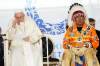
OTTAWA – Pope Francis delivered a historic apology on Monday to survivors of Canada’s residential schools. The majority of those government-funded institutions, in which thousands of Indigenous children suffered abuse and neglect, were run by the Catholic Church.
In the lead-up to the Pope’s visit, Indigenous leaders made specific calls about what they wanted to see in the apology and where they hoped it would lead to next.
Here’s what was missing:
A revocation of the Doctrine of Discovery
The Assembly of First Nations has been among the loudest bodies calling for the renouncement of the 15th-century policy.
It was a decree from the Vatican that countries including Canada used to justify the colonization of Indigenous lands.
The AFN says the doctrine ignores Indigenous sovereignty and continues to have legal impacts today.
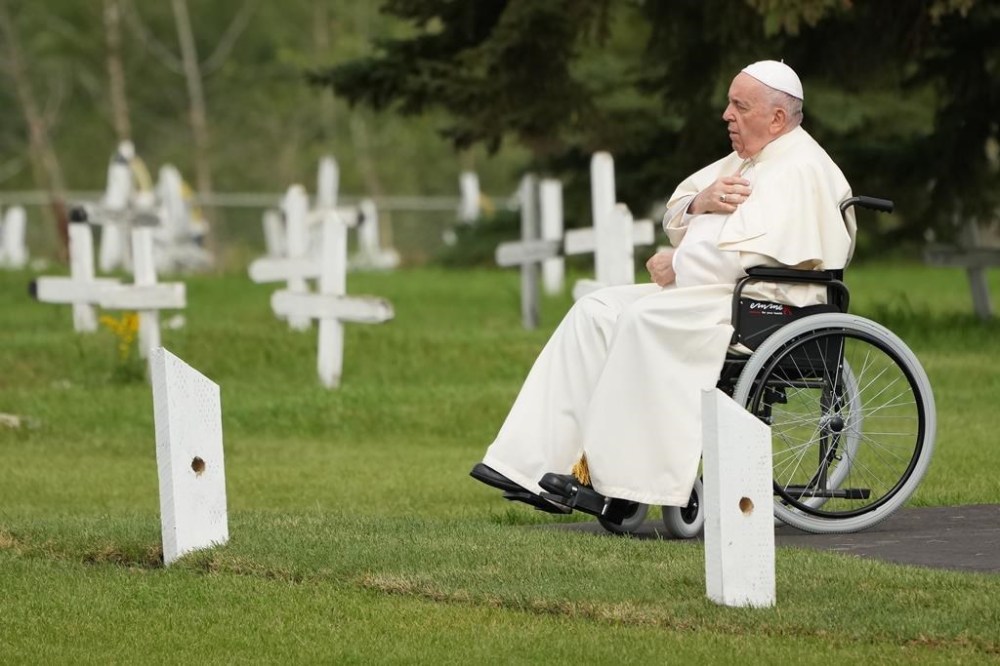
After Pope Francis’s apology, delivered before an audience of survivors and others in Maskwacis, Alta., the pontiff faced a shout from the crowd to renounce the doctrine.
An apology on behalf of the Roman Catholic Church as an institution
In his apology, the pontiff requested forgiveness “for the evil committed by so many Christians against the Indigenous Peoples.”
Murray Sinclair, who served as the chair of the Truth and Reconciliation Commission of Canada, said the Pope’s apology “left a deep hole” by failing to recognize the role the church itself played in the residential school system and instead “placing blame on individual members.”
“It was more than the work of a few bad actors — this was a concerted institutional effort to remove children from their families and cultures, all in the name of Christian supremacy,” Sinclair said in a statement Tuesday.
The TRC had listed a papal apology as one of its 94 calls to action.
Cody Groat, a professor at Western University and member of Six Nations of the Grand River in southern Ontario, says Pope Francis’s earlier apology to an Indigenous delegation that travelled to see him in Rome was found lacking for a similar reason — placing blame on individuals rather than on the institution.
Groat, whose grandparents attended a residential school operated by the Anglican Church, says people are going to see the language and terms the pontiff used in Monday’s apology in different ways, adding he feels it’s an improvement from the spring.
“When you use remarks such as apologizing on behalf of the Christian faith, it perhaps acknowledges more of a broader incident that happened within a long history of colonialism.”
Any mention of sexual abuse — or genocide
The Truth and Reconciliation Commission, in its call for a papal apology, said it should address the Catholic Church’s role in the “spiritual, cultural, emotional, physical, and sexual abuse” of Indigenous children at residential schools.
Pope Francis said children suffered “physical, verbal, psychological and spiritual abuse,” but did not mention sexual abuse.
Groat says the pontiff’s words would have been carefully vetted before he delivered them and believes leaving out sexual abuse was a conscious effort.
“That is going to be something that is called out by a lot of people,” he said.
“Not seeing Pope Francis directly acknowledge or apologize for sexual abuse, this is something that again, will be have to be followed up on.”
Also absent from the pontiff’s apology was the word “genocide.” The commission concluded in its 2015 final report that Canada’s residential school system amounted to a “cultural genocide.”
A promise to release documents and artifacts
One of the outstanding calls the Vatican and Catholic entities in Canada are facing is to release more documents related to the operation of residential schools, and to return Indigenous artifacts.
The news last year that ground-penetrating radar had located what are believed to be hundreds of unmarked graves at former residential school sites across Western Canada underscored the need for governments and church authorities to turn over records that could help identify those who died, advocates and Indigenous leaders say.
Evelyn Korkmaz, a residential school survivor who attended St. Anne’s residential school, noted the Pope’s apology didn’t mention anything about handing over of church-held documents, which she said are desperately needed.
“These documents have our history,” she said. “These documents hold the identification of these children. It would give their families and loved ones closure. Everybody needs closure in order to heal and move on. And this is all we’re asking, is for those documents to be released. They belong here in Canada. They belong to us.”
The Métis National Council had also called for artifacts held in the Vatican, which were taken from Métis people and communities, to be returned.
A commitment to reparations and compensation
The pontiff’s apology and visit to Canada comes as the Catholic Church is facing criticism over not fulfilling the financial commitments it has made to survivors.
One of the main points of contention is over a “best efforts” fundraising campaign that 48 Catholic entities signed on to as part of compensating survivors under the Indian Residential Schools Settlement Agreement struck in 2006.
Of a stated $25-million goal for the fundraising effort, less than $4 million was raised before a judge ruled in 2015 that the entities were free from their obligations.
Last September, the Canadian Conference of Catholic Bishops announced it would pledge $30 million to reconciliation-related initiatives over five years. Before Pope Francis’s arrival, the bishops announced that dioceses had contributed $4.6 million to the effort so far.

Some survivors and Indigenous leaders have said the pontiff’s apology should be followed by additional commitments to reparations or restitutions.
Cindy Blackstock, an advocate for child welfare and executive director of the First Nations Child and Family Caring Society of Canada, shared what she called a “to-do” list on social media to follow the apology.
It included: “Ensuring the church (not parishioners) provides reparations for residential school survivors, and the estates of children who died.”
This report by The Canadian Press was first published July 26, 2022
Note to readers: This is a corrected story. An earlier version incorrectly stated the century in which the Doctrine of Discovery originated.
Related Articles
Papal apology closes door on residential school denialists

Advertisement Advertise With Us
Advertisement Advertise With Us
The Free Press acknowledges the financial support it receives from members of the city’s faith community, which makes our coverage of religion possible.