Anti-Roe justices a part of Catholicism’s conservative wing
Advertisement
Read this article for free:
or
Already have an account? Log in here »
To continue reading, please subscribe:
Digital Subscription
One year of digital access for only $1.44 a week*
- Enjoy unlimited reading on winnipegfreepress.com
- Read the E-Edition, our digital replica newspaper
- Access News Break, our award-winning app
- Play interactive puzzles
*Billed as $5.77 plus GST every four weeks. After 52 weeks, price increases to the regular rate of $19.95 plus GST every four weeks. Offer available to new and qualified returning subscribers only. Cancel any time.
To continue reading, please subscribe:
Add Free Press access to your Brandon Sun subscription for only an additional
$1 for the first 4 weeks*
- Enjoy unlimited reading on winnipegfreepress.com
- Read the E-Edition, our digital replica newspaper
- Access News Break, our award-winning app
- Play interactive puzzles
*Your next Brandon Sun subscription payment will increase by $1.00 and you will be charged $17.95 plus GST for four weeks. After four weeks, your payment will increase to $24.95 plus GST every four weeks.
Read unlimited articles for free today:
or
Already have an account? Log in here »
Hey there, time traveller!
This article was published 30/06/2022 (1575 days ago), so information in it may no longer be current.
The Supreme Court overturned Roe v. Wade at a time when it has an unprecedented Catholic supermajority.
That’s not a coincidence. Nor is it the whole story.
The justices who voted to overturn Roe have been shaped by a church whose catechism affirms “the moral evil of every procured abortion” and whose U.S. bishops have declared opposition to abortion their “preeminent priority” in public policy.
But that alone doesn’t explain the justices’ votes.
U.S. Catholics as a whole are far more ambivalent on abortion than their church leaders, with more than half believing it should be legal in all or most circumstances, according to the Pew Research Center.
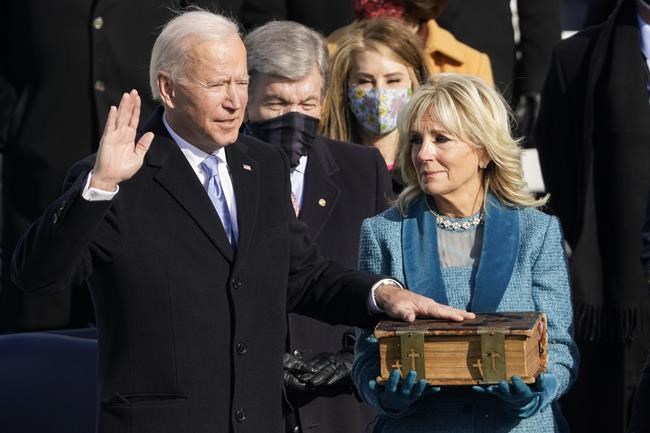
Notable Catholics who support abortion rights include President Joe Biden and House Speaker Nancy Pelosi, both Democrats. Democratic-appointed Justice Sonia Sotomayor, a Catholic, dissented in the Dobbs v. Jackson Women’s Health Organization decision that overturned Roe.
But the justices in the Dobbs majority aren’t simply cradle Catholics. Several have ties to intellectual and social currents within Catholicism that, for all their differences, share a doctrinal conservatism and strong opposition to abortion.
“It’s not simply choosing Catholics,” said Steven Millies, professor of public theology at the Catholic Theological Union in Chicago and author of “Good Intentions: A History of Catholic Voters’ Road from Roe to Trump.”
“It is because they are particular kinds of Catholics, traveling in particular Catholic circles that not everyone in your local parish is identifying with,” Millies said.
In Dobbs, five justices voted to overturn Roe — Samuel Alito, Amy Coney Barrett, Neil Gorsuch, Brett Kavanaugh and Clarence Thomas. A sixth, Chief Justice John Roberts, balked at overturning Roe but voted to uphold the Mississippi abortion restrictions in question.
All six were raised Catholic.
Most went to some combination of Catholic high schools, colleges or graduate schools. The one exception, Dobbs author Alito, has fondly described growing up in a home where “church and the family” were preeminent. Five of the six justices still identify as Catholic, while Gorsuch has attended an Episcopal church more recently.
The Supreme Court was dominated by Protestant justices for much of its history. The majority have been Catholic since the 1990s, and for several years in the last decade, the court had six Catholic justices, three Jews and no Protestants. ( Newly sworn-in Justice Ketanji Brown Jackson identifies as Protestant.)
But religious identity has mattered less of late than ideology, which is why conservative evangelicals have cheered on the Republican-nominated Catholics, said Nomi Stolzenberg, a University of Southern California Law School professor focusing on law and religion.
In fact, eight of the last nine Republican nominees to be confirmed to the Supreme Court, from the Reagan to the Trump presidencies, have had Catholic pedigrees.
That religious demographic may seem striking given Republicans’ loyal evangelical Protestant constituency.
But partly it’s a matter of the available talent pool: Catholic immigrants’ descendants have intensely pursued legal professions.
Catholic institutions built their own intellectually rigorous law schools to aid in social assimilation and upward mobility. Duquesne University School of Law in Pittsburgh began as a night school for working class immigrants.
In time, Catholics were studying at Ivy League schools and reaching the judicial elite.
“It’s an immigrant story, how Catholics and Jews overcame anti-Catholic and antisemitic resistance and eventually flooded into elite schools,” Stolzenberg said. A 2017 study found 28% of federal appellate judges are Catholic, and 19% are Jewish.
Millies said some of the earlier Republican-appointed justices disappointed conservatives by voting to uphold Roe.
“Republicans were looking for an identifier in the selection process that would make them safe,” he said. “By the ’80s, it became Catholics.”
That, too, reflects the immigrant story, Millies said, as many midcentury Catholics sought to prove their American bona fides as staunchly anti-communist social conservatives.
“Catholics earned a marquee spot in American culture as being reliable, patriotic Americans,” he said.
Even the Catholic nominees weren’t all reliable. The now-retired Anthony Kennedy affirmed Roe and gay marriage. But later Republican administrations also scrutinized candidates’ judicial records and involvement in influential organizations such as the Federalist Society, Millies said.
Gorsuch, who like several in the Dobbs majority has appeared at multiple Federalist Society events, studied at Oxford University with Catholic legal philosopher John Finnis.
Finnis is a proponent of “natural law,” described in the Catholic catechism as “the original moral sense which enables man to discern by reason the good and the evil.” Gorsuch himself applied that principle in a book opposing assisted suicide.
“It may be the case that Gorsuch is no longer a practicing Catholic — we don’t know,” Stolzenberg said. “What we do know is that his legal philosophy is shaped by the conservative Catholic philosophy of natural law.”
Barrett has long been affiliated with People of Praise, an ecumenical Christian group with a significant Catholic membership. It combines a doctrinal and moral conservatism, including opposition to abortion.
Thomas was raised Catholic in a largely Protestant extended family and briefly attended Catholic seminary, later attending an Episcopal church before returning to Catholicism. He has praised the Catholic nuns who taught him and the grandfather who raised him, a Catholic who “worked hard to provide for his family” and “a deeply religious man who lived by the Christian virtues.”
Thomas, concurring on Dobbs, went further in saying the court should reconsider other rights that past courts granted based on legal theories similar to Roe. Such precedents voided state laws against contraception, gay sex and same-sex marriage.
In a speech at Notre Dame University in 2021, Thomas paid tribute to the influence of the late Justice Antonin Scalia, long the court’s conservative stalwart.
Despite their different backgrounds — Thomas grew up in segregated Georgia in an African American family with limited education, Scalia in New Jersey as the son of a doctorate-earning Italian immigrant — “we were both Catholics, attended parochial schools and … benefited from a common culture,” Thomas said.
Scalia — who regularly attended the Latin Mass, a rite that appeals to many conservative Catholics — influenced not only Thomas but other recent appointees.
“All of these people would say, ‘We are followers of Scalia,’” Stolzenberg said. “Scalia was a conservative Catholic. That very much stamped him and marked his legal philosophy.”

But with conservatives racking up win after win on the court — overturning Roe, loosening gun restrictions and expanding religious access to public forums and money — their coalition will be tested, observers said.
They long coalesced around the idea of “originalism” — that justices should interpret the Constitution based on how its writers meant or applied it.
But originalism, with its purported moral neutrality, is “not any longer going to serve the needs of the pro-life coalition,” said Bruce Ledewitz, a Duquesne University School of Law professor focused on constitutional law and religion. Some are talking about legislation declaring fetal personhood, and “originalism doesn’t get you there,” he said.
___
Associated Press religion coverage receives support through the AP’s collaboration with The Conversation US, with funding from Lilly Endowment Inc. The AP is solely responsible for this content.
Related Articles
It's critical to hear from women who chose abortion




Advertisement Advertise With Us
Advertisement Advertise With Us
The Free Press acknowledges the financial support it receives from members of the city’s faith community, which makes our coverage of religion possible.