Court lets Tennessee 6-week abortion ban take effect

Advertisement

Advertise with us

NASHVILLE, Tenn. (AP) — A federal court on Tuesday allowed Tennessee's ban on abortion as early as six weeks into pregnancy to take effect, citing the Supreme Court's decision last week overturning the landmark Roe v. Wade abortion rights case.

Read this article for free:


By clicking the button above, an account will be created and you will begin to receive some of our recommended newsletters. You may opt out of any newsletter by visiting your Email and Communication Preferences page or by clicking "unsubscribe" at the bottom of any email.

or

Already have an account? Log in here »

To continue reading, please subscribe:

Digital Subscription

One year of digital access for only $1.44 a week*

  • Enjoy unlimited reading on winnipegfreepress.com
  • Read the E-Edition, our digital replica newspaper
  • Access News Break, our award-winning app
  • Play interactive puzzles

*Billed as $5.77 plus GST every four weeks. After 52 weeks, price increases to the regular rate of $19.95 plus GST every four weeks. Offer available to new and qualified returning subscribers only. Cancel any time.

To continue reading, please subscribe:

Add Free Press access to your Brandon Sun subscription for only an additional

$1 for the first 4 weeks*

  • Enjoy unlimited reading on winnipegfreepress.com
  • Read the E-Edition, our digital replica newspaper
  • Access News Break, our award-winning app
  • Play interactive puzzles
Start now

*Your next Brandon Sun subscription payment will increase by $1.00 and you will be charged $17.95 plus GST for four weeks. After four weeks, your payment will increase to $24.95 plus GST every four weeks.

Hey there, time traveller!
This article was published 28/06/2022 (1583 days ago), so information in it may no longer be current.

NASHVILLE, Tenn. (AP) — A federal court on Tuesday allowed Tennessee’s ban on abortion as early as six weeks into pregnancy to take effect, citing the Supreme Court’s decision last week overturning the landmark Roe v. Wade abortion rights case.

The action by the 6th U.S. Circuit Court of Appeals comes before Tennessee’s other abortion ban, the so-called trigger ban, is expected to restrict abortion almost entirely by mid-August, according to a newly detailed legal interpretation by the state attorney general. Both measures would make performing an abortion a felony and subject doctors to up to 15 years in prison if convicted.

Republican Attorney General Herbert Slatery filed an emergency motion Friday to let state to begin implementing the six-week ban. GOP supermajorities in the Legislature passed the law in 2020 with Republican Gov. Bill Lee’s backing, and it was quickly blocked in federal court.

FILE - Abortion-rights demonstrator Jessica Smith holds a sign in front of the Hamilton County Court House on May 14, 2022, in Chattanooga, Tenn. A federal court on Tuesday, June 28, 2022, allowed Tennessee's ban on abortion as early as six weeks into pregnancy to take effect, citing the Supreme Court's decision last week to overturn the landmark Roe v. Wade abortion rights case. (AP Photo/Ben Margot, File)

Specifically, the ban halts abortion once cardiac activity is detected, which is around six weeks in pregnancy— when most women don’t know they’re pregnant.

“There are a lot of things that I am very passionate about and take very personally in this job that I have, but … this was the most important thing that I could do as governor,” Lee said while speaking virtually with anti-abortion religious leaders Friday, after the Supreme Court ruling.

Lee said Tuesday that the federal appeals court’s decision marked “another significant protection for unborn children in our state.”

It only makes an exception when an abortion is necessary to prevent the woman’s death or “serious risk of substantial and irreversible impairment of a major bodily function.” However, it specifies that a woman’s mental health does not qualify for an exemption.

“Abortion bans rob people of their ability to make the decisions that are best for themselves, their lives, and their futures,” said Ashley Coffield, president and CEO of Planned Parenthood of Tennessee and North Mississippi, in a statement. “It is unconscionable that Tennesseans will lose access to abortion in their communities because of this decision.”

Planned Parenthood was not performing abortions at its facilities in Nashville and Memphis on Monday in anticipation of court action to unblock the six-week ban, said spokesperson Matt Anderson.

Separately, abortion provider carafem — which has a clinic in Nashville — announced Tuesday that its staff had been flooded with calls from patients trying to understand Tennessee’s new legal landscape.

“In my more than 30 years in health care, nothing has been as hard as turning away patients from the care they need because politicians interfered with private health care decisions,” said Melissa Grant, carafem’s chief operations officer, in a statement.

An even more restrictive ban is set to take effect soon, according to the attorney general’s guidance Tuesday. Tennessee’s trigger law — set to go into place 30 days after the end of Roe — would ban all abortions statewide, with essentially the same limited exceptions as the six-week ban.

That law requires the attorney general to certify that Roe has been overturned. He hasn’t done so yet, but indicated Tuesday that he plans to do so when the corresponding judgment is filed in the Supreme Court case, by no later than mid-July. That puts the effective date at around mid-August, Slatery’s office said. The law ties the effective date to the judgment filing, not the timing of the attorney general’s action.
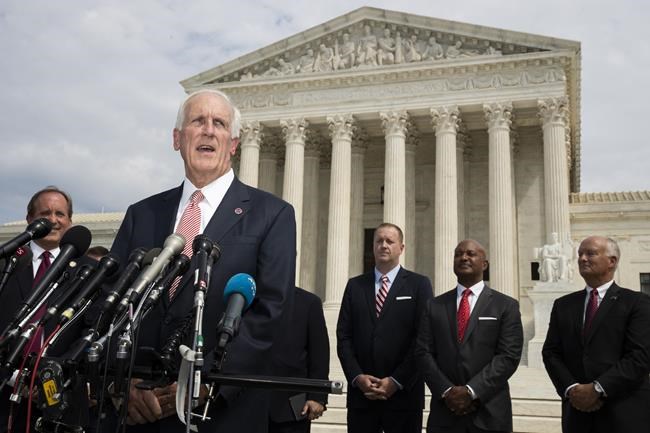
FILE - Tennessee Attorney General Herbert Slatery speaks to reporters in front of the U.S. Supreme Court on Sept. 9, 2019, in Washington. A federal court on Tuesday, June 28, 2022, allowed Tennessee's ban on abortion as early as six weeks into pregnancy to take effect, citing the Supreme Court's decision last week to overturn the landmark Roe v. Wade abortion rights case. Slatery filed an emergency motion on Friday, June 24, to allow the state to begin implementing the six-week ban. (AP Photo/Manuel Balce Ceneta, File)

Democratic lawmakers at the time attempted to amend the measure to allow exceptions for incest and rape — including rape of a child — but Republicans ultimately spiked those suggestions.

Bans pegged to the “fetal heartbeat” concept — such as Tennessee’s six-week ban — have been signed into law in more than a dozen states. Supporters commonly argue that abortion as early as six weeks into pregnancy “stops a beating heart,” but medical experts say those claims are false.

That’s because at the point where advanced technology can detect that first flutter, as early as six weeks, the embryo isn’t yet a fetus and it doesn’t have a heart. An embryo is termed a fetus beginning in the 11th week of pregnancy, medical experts say.

The Supreme Court’s ruling last week is likely to lead to abortion bans in roughly half of the states.

Additionally, in Tennessee, voters approved an amendment in 2014 declaring that the state’s constitution doesn’t protect or secure the right to an abortion or require funding for abortions.

Trigger laws, like Tennessee’s 2019 version, are also being targeted by lawsuits in other states. In Louisiana on Monday, a state district judge in New Orleans temporarily blocked enforcement of that state’s trigger-law ban on abortion, after abortion rights activists argued that it is unclear. The ruling is in effect pending a July 8 hearing.

Tennessee’s 2020 law includes the six-week ban and bans longer into the pregnancy, in the event that the Supreme Court did not fully overturn Roe v. Wade.

Report Error Submit a Tip

More Stories

Fact Check

1 minute read Thursday, Nov. 30, 2023

Fact Check

Having problems with the form?Contact Us Directly |

Public asked to support Stella’s employees amid harassment allegations

Melissa Martin 5 minute read Preview

Public asked to support Stella’s employees amid harassment allegations

Melissa Martin 5 minute read Saturday, Nov. 10, 2018

The deluge of allegations about worker harassment, abuse and exploitation at Stella's shows no signs of slowing. 

Now, some of the women at the forefront of the #NotMyStellas movement are calling on Winnipeggers to support former and current workers, whose livelihoods may be at risk as allegations pile up and the public fallout mounts.

On Saturday afternoon, three former Stella's employees met the media to reiterate their five calls to action against what they describe as a toxic and often abusive culture that "permeated every level" of the local restaurant chain.

Those calls begin with two very clear requests: one, for a full acknowledgement from the company of the abuses and harassment reported by workers. Two, for a formal apology from company owners and top-level management. 

Read
Saturday, Nov. 10, 2018

The importance of political trust

Paul G. Thomas 5 minute read 2:00 AM CDT

Political trust refers to people’s positive expectations that the political system, the institutions which comprise it and the actors who participate in its operations will do what they have said they will do, that they will act in the public interest and that they will conduct themselves in a manner which does not disrespect the democratic process.

Political scientists use the terms “diffuse” and “specific” to differentiate between trust in the political system as a whole, and trust in individual actors. Asked to rank occupations in terms of trustworthiness, respondents typically place politicians at or near the bottom of the list. Individuals who have first-hand experience dealing with politicians tend to have more positive viewpoints.

Unfortunately, systematic surveys on trust levels in Manitoba are rare, so any discussion must be based on national results.

Beginning in the late 1960s, a slow erosion of trust in Canadian politicians and political institutions began, with only occasional, short-lived upticks. In the summer of 2025, a national Environics survey found that only a minority of Canadians had a lot of trust in political actors and institutions, such as the political parties and Parliament. The survey report also revealed that trust levels had held steady over the past 15 years.

Remembering Canada’s first national internment

Peter Manastyrsky 4 minute read Preview

Remembering Canada’s first national internment

Peter Manastyrsky 4 minute read 2:00 AM CDT

Canada’s first national internment operation, from 1914 to 1920, is a part of Canadian history that is at times forgotten. Oct. 28 marks the anniversary of the Canadian government passing an order-in-council (essentially an executive decree) in 1914, under the War Measures Act. The order legally authorized the arrest and internment of Canadian civilians as enemy aliens during the First World War, and thousands of Canadians were sent to internment camps across the country.

The war of 1914-18 created difficulty for new Canadians hoping to become naturalized citizens. Many new immigrants to Canada came from regions of Europe that was under the rule of the Austro-Hungarian Empire at the start of the First World War.

The Canadian government, under Prime Minister Sir Robert Borden introduced internment camps throughout Canada, fearing that many eastern European immigrants would have some form of affiliation with the Austro-Hungarian Empire.

Even though there was never any evidence of disloyalty, people were imprisoned needlessly and forced to do heavy labour in 24 internment camps throughout Canada’s frontier hinterland. There were two identified internment camps in Manitoba, one in Brandon and the other in Winnipeg.

Read
2:00 AM CDT

AI and the quiet erosion of human judgment

Rod Lastra 5 minute read 2:00 AM CDT

In 1986, Paul Simon sang of “days of miracle and wonder” in the song The Boy in the Bubble, from his Graceland album. It was hardly a hymn to progress. Scientific ingenuity coexisted with violence and vulnerability. The world was becoming more technologically capable but not necessarily wiser.

Four decades later, I find the sentiment difficult to improve upon. Since ChatGPT’s release in November 2022, predictions about AI have arrived in rapid succession. Sam Altman, Dario Amodei, Elon Musk and others in the tech industry’s so-called “broligarchy” have fuelled recent headlines about approaching “superintelligence” and futures ranging from human flourishing to catastrophe. The advances are real but the predictions often carry more confidence than evidence. The future, it seems, is permanently scheduled for an upgrade.

Yet a more immediate question risks being lost — as AI systems become more capable and we delegate increasingly complex work to them, will our capacity to understand, question and oversee their outputs keep pace?

That question begins with understanding what we are delegating. AI is not a single technology. Specialized systems have helped scientists predict protein structures. ChatGPT relies on general-purpose language models trained on vast datasets. The most advanced systems are often called “frontier models”. They can write, translate, analyze and converse across subjects, but fluency does not guarantee accuracy. Success at one task does not establish competence at another.

Hassan gets 3 distance medals in amazing Olympic odyssey

Gerald Imray, The Associated Press 4 minute read Preview

Hassan gets 3 distance medals in amazing Olympic odyssey

Gerald Imray, The Associated Press 4 minute read Sunday, Aug. 8, 2021

TOKYO (AP) — By the time she reached the 65th and final lap of her eight-day Olympic odyssey, Sifan Hassan's neck had seized up and she couldn't turn her head. She could barely breathe and she couldn't feel her arms anymore.

As she neared the end, she couldn't see properly and thought “why did they move the finish line?”

Her legs knew right where it was.

Deep into her sixth race across three distances that covered more than 24 kilometers on Tokyo's sweltering Olympic track, Hassan burst past world-record holder Letesenbet Gidey to win the 10,000-meter gold on Saturday.

Read
Sunday, Aug. 8, 2021