‘Truth, justice and healing:’ Métis and Inuit delegates meet with Pope Francis

Advertisement

Advertise with us

ROME - Angie Crerar says she was nervous when she walked into a room at the Vatican and came face to face with Pope Francis.

Read this article for free:


By clicking the button above, an account will be created and you will begin to receive some of our recommended newsletters. You may opt out of any newsletter by visiting your Email and Communication Preferences page or by clicking "unsubscribe" at the bottom of any email.

or

Already have an account? Log in here »

To continue reading, please subscribe:

Digital Subscription

One year of digital access for only $1.44 a week*

  • Enjoy unlimited reading on winnipegfreepress.com
  • Read the E-Edition, our digital replica newspaper
  • Access News Break, our award-winning app
  • Play interactive puzzles

*Billed as $5.77 plus GST every four weeks. After 52 weeks, price increases to the regular rate of $19.95 plus GST every four weeks. Offer available to new and qualified returning subscribers only. Cancel any time.

To continue reading, please subscribe:

Add Free Press access to your Brandon Sun subscription for only an additional

$1 for the first 4 weeks*

  • Enjoy unlimited reading on winnipegfreepress.com
  • Read the E-Edition, our digital replica newspaper
  • Access News Break, our award-winning app
  • Play interactive puzzles
Start now

*Your next Brandon Sun subscription payment will increase by $1.00 and you will be charged $17.95 plus GST for four weeks. After four weeks, your payment will increase to $24.95 plus GST every four weeks.

Hey there, time traveller!
This article was published 28/03/2022 (1678 days ago), so information in it may no longer be current.

ROME – Angie Crerar says she was nervous when she walked into a room at the Vatican and came face to face with Pope Francis.

But she left feeling empowered.

The 85-year-old Métis elder knew when she was in a residential school as a child that what was happening wasn’t right. She wanted to tell the person in charge — the one at the top. Now, almost 80 years later, she has.
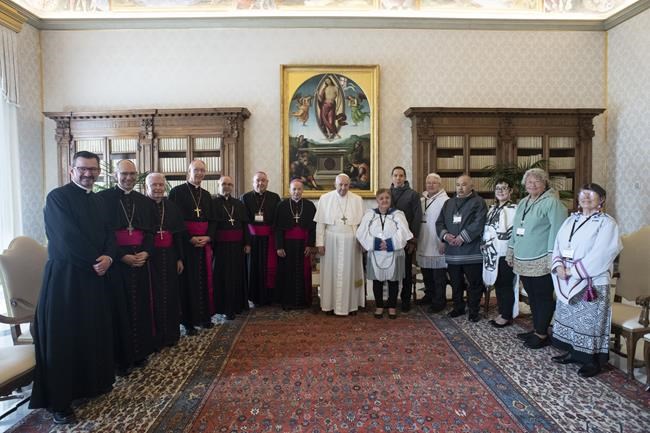
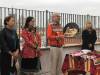
Pope Francis meets with the Canadian Metis delegates at the Vatican, Monday March 28, 2022. THE CANADIAN PRESS/HO-Vatican Media **MANDATORY CREDIT**

“They did not break us. We are still here and we intend to live here forever,” said Crerar, who is from Grande Prairie, Alta.

Métis and Inuit residential school survivors and leaders had meetings with the head of the Roman Catholic Church at the Vatican on Monday.

The weight of the historic moment was palpable to many. Delegates spoke about wanting the Pope to truly hear their stories and understand how they’ve been shaped by the legacy left by the Catholic Church and colonialism.

Inuit residential school survivor Martha Greig said she told the Pope there is a need to heal. That means working toward forgiveness, which she says the church must play a role in. If Pope Francis came to Canada to deliver an apology, it would mean a lot to survivors and their families, she said.

“If you don’t forgive, it eats at you, though you don’t forget,” Grieg said.

Those who met with the Pope on Monday said justice, transparency and an apology are even more important now that unmarked graves have been found at former residential schools across Canada.

The pontiff did not offer an apology to either group of delegates.

Cassidy Caron, president of the Métis National Council, said she feels Francis committed to a journey of justice.

“He repeated ‘truth, justice and healing’ and I take that as a personal commitment,” Caron said outside St. Peter’s Square.

The Métis have always requested that any apology take place on Canadian soil, she added.

Eight Métis delegates spent an hour with the pontiff and three survivors shared their stories of residential schools.

The group presented the Pope with a pair of red, beaded moccasins as a sign of the Métis people’s willingness to forgive if there is meaningful action. The red represents the traditional red papal shoes, the group explained, and the Pope walks with the legacy of those who came before him — including the terrible parts.

Pixie Wells, president of the Fraser Valley Métis Association in B.C., said she was proud to be a two-spirit person in the room with the Pope. She said that homophobia is directly connected to colonization and residential schools.

“We are bringing back that cultural component of being a two-spirit individual,” Wells said. “We were leaders, healers in our communities … that was my power in that room for every other two-spirit person.”

The eight Inuit delegates presented Francis with a stole, which is a liturgical vestment, and a rosary case, both made of seal skin. They also provided him with two carvings and some personal messages.
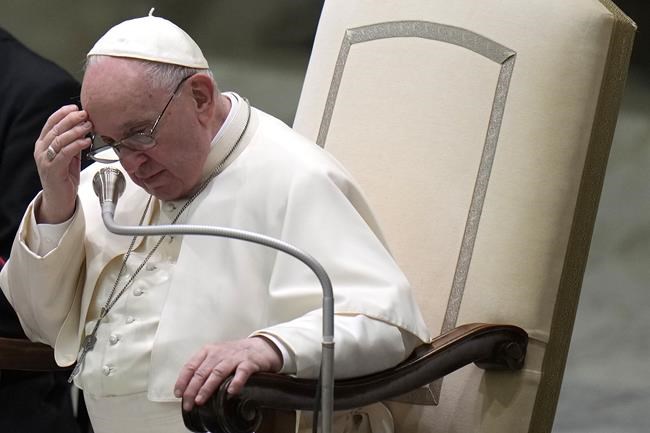
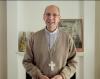
Pope Francis gestures, during his weekly general audience in the Paul VI Hall, at the Vatican, Wednesday, March 23, 2022. Métis and Inuit delegates are set to speak with Pope Francis at the Vatican in two separate meetings today.THE CANADIAN PRESS/AP/Alessandra Tarantino

Natan Obed, president of Inuit Tapiriit Kanatami, specifically asked the Pope to intervene in the case of an Oblate priest, Johannes Rivoire, who continues to live free in France despite multiple allegations of sexual abuse linked to his time in Nunavut.

“We ask that the Pope speak with Father Rivoire directly and ask him to go to Canada to face the charges he is up on in Canada,” Obed said.

Obed asked the Pope to request that France step in if Rivoire is not receptive

Obed said he wants the relationship with the Catholic Church to be based on action, and that includes seeing members of the church brought to justice if they have done harm.

There were also positive conversations about the role of the church moving forward, he said.

“There was a true sense of openness and kindness that was showed to us.”

First Nations delegates are to meet with the pontiff on Thursday. All three groups are to gather with the Pope on Friday.

An estimated 150,000 Indigenous children were forced to attend residential schools, more than 60 per cent of which were run by the Catholic Church.

A total of 32 Indigenous elders, leaders, survivors and youth are taking part in the Vatican meetings. The Canadian Conference of Catholic Bishops, which organized and is paying for the delegation, has also sent a handful of members.

Bishop William McGrattan, vice-president of the bishops, said the meetings are “just the beginning” and are important so that Pope Francis can hear first-hand the impacts of residential schools.

“We are not just doing this for now. We are doing it for generations to come,” he said.

This report by The Canadian Press was first published March 28, 2022.

Report Error Submit a Tip

The Free Press acknowledges the financial support it receives from members of the city’s faith community, which makes our coverage of religion possible.
More Stories

Olympics Overnight: Speedskater Blondin wins silver in the mass start, Bowman narrowly misses podium in halfpipe skiing, Jamaica returns to bobsled track

Richie Assaly - Toronto Star, Toronto Star 6 minute read Preview

Olympics Overnight: Speedskater Blondin wins silver in the mass start, Bowman narrowly misses podium in halfpipe skiing, Jamaica returns to bobsled track

Richie Assaly - Toronto Star, Toronto Star 6 minute read Saturday, Feb. 19, 2022

Here’s what you missed overnight at Day 15 of the 2022 Beijing Olympics.

Read
Saturday, Feb. 19, 2022

The new normal in Canadian politics

David McLaughlin 5 minute read Preview

The new normal in Canadian politics

David McLaughlin 5 minute read 2:01 AM CDT

“Nothing happening, all at once.”

Welcome to the new normal of Canadian politics, where normality is the new normal. Routine and stable are in; disruptive and excessive are out. Exhibits A and B are the Alberta referendum and the British Columbia election. Voters opted for stability over volatility.

The opposite of being normal is being different from the norm. In politics that means different from where we’ve been and what we’ve come to expect. Two competing trends have dominated our politics for the past decade and a half — progressivism and populism. Think Justin Trudeau and liberal, progressive identity politics in Canada, and Donald Trump and conservative, populist MAGA politics in America. We are now experiencing a swing away from both those trends.

Representing this “new normal” are Prime Minister Mark Carney, for one, and newly elected British Columbia premier, Lorne Doerksen, for another. Both are considered normal because they talk and act like adults in a childish political world. Their political flair is to not have any political flair. They stand out for not standing out.

Read
2:01 AM CDT

Defunding police ‘illogical step’: Pallister

Carol Sanders 6 minute read Preview

Defunding police ‘illogical step’: Pallister

Carol Sanders 6 minute read Tuesday, Jun. 9, 2020

Manitoba Premier Brian Pallister says he’s open to channelling justice funding to preventive programs, but questions whether defunding police is the best approach — warning there will always be criminals taking advantage of vulnerable people.

“I think the motivation that lies in frustrations of the actions of some police services — not necessarily here in Winnipeg exclusively, but elsewhere — is justifiable and understandable, and I get it,” Pallister said Tuesday, when asked to comment on the 30,000 signatures collected for a Justice 4 Black Lives Winnipeg petition calling for the abolition of the city police.

“But then moving to defunding police is, to me, an illogical step from that one. Don’t let your frustration lose your common sense... There’s a lot of people out there in vulnerable communities who depend on the police to protect them and make sure they’re safe from the action of criminals.”

There has been a widespread call to restructure police funding in the wake of George Floyd’s death May 25 in Minneapolis.

Read
Tuesday, Jun. 9, 2020

The long and winding road

Editorial 4 minute read Preview

The long and winding road

Editorial 4 minute read 2:01 AM CDT

As theatre goes, it sent a strong message.

Manitoba Premier Wab Kinew, standing in front of microphones and television cameras, holding up his Indigenous status card and saying that he didn’t feel Canada should have “a race-based form of identification in this country, but that is a reality,” adding that it was time to abolish the Indian Act.

“I think it’s time to abolish the Indian Act, get rid of the Indian Act, move past the Indian Act, and it needs to be done with First Nations people and First Nations governments, of course. I think it’s long overdue that we have a relationship with Indigenous Peoples in Canada that reflects who we are as Canadians today,” he said.

The Indian Act — the name alone suggests how out-dated and out of place the law has become. Originally dating from 1876, the law was put in place to “amend and consolidate the laws respecting Indians” and gave the Minister of the Interior the responsibility to “control and management of the reserves, lands, moneys and property of Indians in Canada.”

Read
2:01 AM CDT

Affordable southwest Winnipeg attached two-storey home designed with families in mind

Todd Lewys 5 minute read Preview

Affordable southwest Winnipeg attached two-storey home designed with families in mind

Todd Lewys 5 minute read 2:01 AM CDT

Those in the market for a new entry-level home tend to have one main thought in mind. That thought, in most cases, centres on how much value a dwelling delivers — in both price and livability.

Spencer Curtis, owner of Hilton Homes, says he and his design team are acutely aware of how meticulously prospective buyers scrutinize entry-level new house options, which in most cases are attached two-storey models.

“That’s why we keep tweaking plans to make those homes better,” Curtis says. “This model, the Wilkens, is by far our most popular plan. We put a lot of thought into its design, and are always working at making it as functional and family-friendly as possible.”

Right from the get-go, the Wilkens distinguishes itself from other attached two-storey homes with its square footage.

Read
2:01 AM CDT

A little toponder, a lot to celebrate

Erna Buffie 5 minute read 2:01 AM CDT

Well, another civic election season has come and gone, and I have to say it was a doozy. The most surprising event was the steady climb in support for young mayoral candidate Noah Redden, who started out with just four per cent public support in September but had reached a solid 14 per cent support in October.

On election day, Redden nearly came in second, less than one percentage point behind Kevin Klein, an experienced politician.

Indeed, the 27-year-old’s accomplishment was nothing short of astonishing. Particularly given that his shoestring campaign was given very little coverage — largely, according to one pundit, because he didn’t send out any press releases.

This when Redden’s unwritten press releases were there for everyone to see on Instagram, as he popped up in locations across the city, posting videos about what he hoped to achieve as mayor.