Catholic bishop hopes residential school apology will improve Indigenous relations

Advertisement

Advertise with us

A leader in Canada's national assembly of Catholic bishops says he hopes an apology for the harms endured at residential schools could mark a turning point in the church's relations with Indigenous Peoples, but some leaders within the community say it remains to be seen whether the expression of remorse will be backed up by meaningful action.

Read this article for free:


or

Already have an account? Log in here »

To continue reading, please subscribe:

Subscribe and receive a limited-edition Free Press branded hat or tote.

Digital Subscription

One year of digital access for only $205*

  • Enjoy unlimited reading on winnipegfreepress.com
  • Read the E-Edition, our digital replica newspaper
  • Access News Break, our award-winning app
  • Play interactive puzzles

*First annual payment billed as $205.00 + GST for one year. This annual subscription will automatically renew at $233.00 + GST every 52 weeks (10% off the regular annual price of $259.35). Offer available to new and qualified returning subscribers only. Cancel any time.

To continue reading, please subscribe:

Add Free Press access to your Brandon Sun subscription for only an additional

$1 for the first 4 weeks*

  • Enjoy unlimited reading on winnipegfreepress.com
  • Read the E-Edition, our digital replica newspaper
  • Access News Break, our award-winning app
  • Play interactive puzzles
Start now

*Your next Brandon Sun subscription payment will increase by $1.00 and you will be charged $17.95 plus GST for four weeks. After four weeks, your payment will increase to $24.95 plus GST every four weeks.

Hey there, time traveller!
This article was published 26/09/2021 (1832 days ago), so information in it may no longer be current.

A leader in Canada’s national assembly of Catholic bishops says he hopes an apology for the harms endured at residential schools could mark a turning point in the church’s relations with Indigenous Peoples, but some leaders within the community say it remains to be seen whether the expression of remorse will be backed up by meaningful action.

The Canadian Conference of Catholic Bishops apologized “unequivocally” Friday for the abuses committed by members of the church community who were involved in running residential schools.

Vice-president Bishop William McGrattan acknowledged that the church has a history of making apologies, but said the one-page statement ratified at a full meeting of the bishops last week reaffirms their commitment to the process of reconciliation and outlines “tangible” steps to be expanded on in the future.
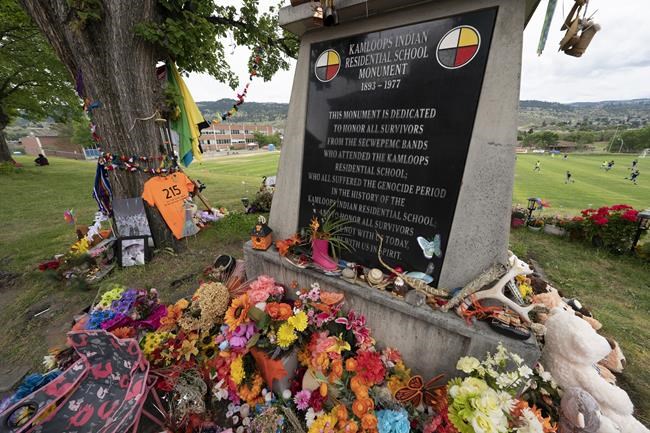
A memorial is seen outside the Residential School in Kamloops, B.C., on June 13, 2021. THE CANADIAN PRESS/Jonathan Hayward

“First Nations people have continually called for greater responsibility and accountability of the church,” the Calgary bishop said Sunday. “This is a long journey. And it’s one that hopefully we can begin again and renew that relationship.”

The bishops have pledged to provide records that could help “memorialize” the students believed to be buried in unmarked graves, raise money for initiatives endorsed by Indigenous leaders, and work on getting the Pope to visit Canada.

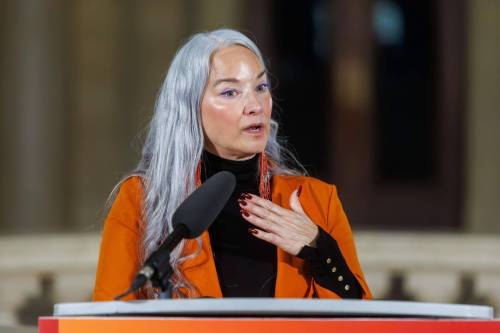
Assembly of First Nations National Chief RoseAnne Archibald said she welcomed the bishops’ full-throated apology, but noted that their promises fall short of the actions the Indigenous community has called for.

“The words of the apology speak to a commitment by the (Catholic) church to the healing path forward with First Nations and Indigenous peoples,” Archibald said in a statement Friday. “Only time will tell if concrete actions will follow the words of contrition by the Bishops.”

Archibald said she was disappointed that the bishops didn’t pass a resolution to formally invite the Pope to Canada to apologize to residential school survivors, their families and communities — one of the calls to action laid out in the Truth and Reconciliation Commission’s 2015 report.

McGrattan suggested an apology may not be far off as Indigenous leaders prepare to travel to the Vatican in December to meet with Pope Francis.

“We anticipate that this delegation going to Rome will be the first step,” he said. “It’s important, I think, to make sure that those steps are done properly.”

Archibald also expressed reservations about the bishops’ fundraising effort, noting that the church raised less than one-sixth of a $25-million fund promised for reconciliation and healing as part of the Indian Residential Schools Settlement Agreement more than a decade ago.

McGrattan noted that the Canadian Conference of Catholic Bishops was not a party to that settlement, but said the “somewhat disappointing” fundraising outcome underscores the need for a new approach.

Last spring’s discoveries of hundreds of unmarked graves on the sites of former residential schools prompted calls for the church to release records that could help identify the children who were believed to be buried, often without their families ever being told of their deaths.

The church has also faced heavy criticism for neglecting to provide all documents on the schools requested by the Truth and Reconciliation Commission.

McGrattan said many parishes near the burial sites plan to share sacramental records — such as registers of births, baptisms and deaths — to help families lay their loved ones to rest.

But he maintained that the church must exercise discretion when it comes to the disclosure of such documents.

“We just don’t want to, in a sense, allow for information sometimes just to be given generally, where loved ones need to be the first ones to receive that and to understand the history,” he said. “We are willing to work with them, but to just release information in a way that might harm them is also something that we don’t want to do.”

Evelyn Korkmaz, a survivor of St. Anne’s Residential School in Fort Albany First Nation, Ont., said she was deeply disappointed in the bishops’ apology. A founding member of the Ending Clergy Abuse organization and the Advocates for Clergy Trauma Survivors in Canada, Korkmaz noted that the bishops’ had not included the word “truth” in their statement, an indication that they still intend to “set the rules” of reconciliation.

“It is not up to the bishops to decide for the Indigenous people what is needed because as we know, when the bishops and the Vatican make decisions about Canada’s Indigenous peoples, this leads to an abuse of power with the Indigenous peoples of Canada taking the brunt of the abuse,” said Korkmaz.

“This said, a commitment to Truth and Reconciliation by the Canadian Conference of Catholic Bishops needs to include full and unfettered access to the residential school archives held by the dioceses in Canada and at the Vatican.”

More than 150,000 Indigenous children were forced to attend residential schools for more than a century when the Canadian government enacted a policy to assimilate Indigenous children, tearing them from their culture, families and languages.

The Catholic and Anglican churches ran most of the schools where children were subjected to rampant emotional, physical and sexual abuse.

This report by The Canadian Press was first published Sept. 26, 2021.

Report Error Submit a Tip

The Free Press acknowledges the financial support it receives from members of the city’s faith community, which makes our coverage of religion possible.
More Stories

Americanizing education is pure folly

John R. Wiens 5 minute read Thursday, Apr. 8, 2021

BILL 64, if passed, would succeed in cutting some of the last strands tying education to democracy in the English-speaking western world, a movement which had its beginnings in the post-war European continent.

Friedrich von Hayek, the founder of neoclassical economic theory, persuaded the political elite of the day that their future lay in a deregulated capitalistic marketplace, and in the reduction of government investment in public services. But even he would be shocked by the latest developments in Manitoba.

A rough timeline would have had Hayek meeting the newly elected Tory leader, Margaret Thatcher, in 1975. Immediately upon her election as prime minister in 1979, she began to implement his economic theory of mass privatization of state assets. The oil and gas industry and the national British Airways were privatized. The powerful miners’ unions were relentlessly pilloried as enemies of the state.

Public services such as health and education were methodically dismantled, systematically privatized in the name of personal choice, while taxes for the wealthy were reduced. In the name of creativity, entrepreneurship and innovation, among other public goods, airlines, telecommunications, banking, trucking and environmental protections were deregulated. Is this starting to sound familiar?

Mayoral candidate Vogiatzak criticized for living outside Winnipeg

Malak Abas 4 minute read Preview

Mayoral candidate Vogiatzak criticized for living outside Winnipeg

Malak Abas 4 minute read 5:08 PM CDT

A mayoral hopeful took heat from other candidates Friday for living outside Winnipeg while running in the civic election.

Mike Vogiatzakis’s primary residence is in the Rural Municipality of St. Andrews, about 25 kilometres north of Winnipeg — a community with its own mayor and councillors.

But the funeral director said he owns a home in Winnipeg where he divides his time, and he would move to the city full-time if elected mayor.

“It doesn’t matter where a person lives. Why are we dividing St. Andrews and Manitoba and Winnipeg? I’ve met the criteria to run for mayor,” Vogiatzakis said Friday morning.

Read
5:08 PM CDT

Province putting $8M into safe space for Thompson Indigenous women and families

Free Press staff 3 minute read Preview

Province putting $8M into safe space for Thompson Indigenous women and families

Free Press staff 3 minute read 12:40 PM CDT

An $8-million provincial investment in the Mino’Ayaawag Ikwewag Northern Lodge in Thompson fulfils the NDP’s 2023 election promise to establish three new 24-7 safe spaces for Indigenous women and their families in that city, Winnipeg and Brandon.

The lodge is expected to be up and running in 2028, Families Minister Nahanni Fontaine, who is also responsible for women and gender equity, said at a news conference in Winnipeg. It builds on a 2025 investment of $3.5 million to establish a first-of-its-kind 24-7 safe space for Indigenous women and their children in Winnipeg, and a 2024 investment of $500,000 to support the creation of Franny’s Place, a new 24-7 safe space in Brandon.

The Mino’Ayaawag Ikwewag (Anishinaabemowin for “all women doing well”) Northern Lodge will operate as a community of care, offering culturally grounded supports that help individuals and families heal, stabilize and rebuild lives at risk of violence.

It will include 10 short-term private studio suites, a communal kitchen and living area, counselling and program space, laundry facilities and a dedicated child-minding area with Indigenous cultural teaching and play-based learning. Residents will have access to trauma-informed supports, cultural programming, parenting supports, peer support and supported connections to housing, health, education, employment and legal services.

Read
12:40 PM CDT

Suspension upheld for teen hockey player involved in hazing

Free Press staff 3 minute read Preview

Suspension upheld for teen hockey player involved in hazing

Free Press staff 3 minute read Sunday, Aug. 9, 2026

A high school hockey player who was found to have been involved in sexualized hazing of rookie teammates lost his suspension appeal.

The youth player was barred from Hockey Canada-sanctioned activities. He was handed the four-year and nine-month suspension from sanctioned hockey after an interim ban issued in March 2024.

He appealed his suspension late last year to the Sport Dispute Resolution Centre of Canada, an independent conflict tribunal, but the centre upheld the youth’s suspension, according to a written decision issued earlier this year.

An independent investigator who probed the hockey player’s actions described the youth as a veteran player who both participated in and co-ordinated the “assigning” of rookie team members to veteran players to perform tasks for them. He himself was “assigned” a rookie, the decision said.

Read
Sunday, Aug. 9, 2026

Today’s horoscope

Georgia Nicols 4 minute read Preview

Today’s horoscope

Georgia Nicols 4 minute read 2:00 AM CDT

MOON ALERT: Caution! Avoid shopping (except food and gas) and important decisions until after 3:30 p.m. today. After that, the moon moves from Gemini into Cancer.

ARIES (March 21-April 19)

This is a creative day for you. Because you’re the artisan of the zodiac, tap into your talents and make some art or explore one of your many hobbies. However, avoid intense discussions with partners, spouses and friends. Keep things light.

TAURUS (April 20-May 20)

Read
2:00 AM CDT

Cops handcuffed by bail issues, lack of mental-health options, WPS chief tells residents in crime-ridden North End neighbourhood

Nicole Buffie 6 minute read Preview

Cops handcuffed by bail issues, lack of mental-health options, WPS chief tells residents in crime-ridden North End neighbourhood

Nicole Buffie 6 minute read 5:30 PM CDT

Weak bail reform and a lack of mental-health resources and addictions treatment beds are making it more difficult to tackle crime in inner-city neighbourhoods such as William Whyte, where there has been a significant increase in criminal behaviour compared to last year, the city’s top police officer says.

Winnipeg Police Services Chief Gene Bowers made the remarks Thursday night at an event hosted by the William Whyte Neighbourhood Association, where about two dozen residents gathered to share their concerns about crime in the North End community.

“Fentanyl and meth, that’s caused a strain on all our front lines and and all these agencies that are trying to help people,” Bowers told the room of people at Inner City Youth Alive on Aberdeen Avenue Thursday night.

“What really is the problem is there’s no treatment. That’s the gap, because (police and agencies) are all churning the same people through, and we’re all seeing them. We’re all frustrated that there’s no help.”

Read
5:30 PM CDT