Precious place
Parish marks half-century of worship in unique building

Advertisement
Read this article for free:
or
Already have an account? Log in here »
To continue reading, please subscribe:
Digital Subscription
One year of digital access for only $1.44 a week*
- Enjoy unlimited reading on winnipegfreepress.com
- Read the E-Edition, our digital replica newspaper
- Access News Break, our award-winning app
- Play interactive puzzles
*Billed as $5.77 plus GST every four weeks. After 52 weeks, price increases to the regular rate of $19.95 plus GST every four weeks. Offer available to new and qualified returning subscribers only. Cancel any time.
To continue reading, please subscribe:
Add Free Press access to your Brandon Sun subscription for only an additional
$1 for the first 4 weeks*
- Enjoy unlimited reading on winnipegfreepress.com
- Read the E-Edition, our digital replica newspaper
- Access News Break, our award-winning app
- Play interactive puzzles
*Your next Brandon Sun subscription payment will increase by $1.00 and you will be charged $17.95 plus GST for four weeks. After four weeks, your payment will increase to $24.95 plus GST every four weeks.
Read unlimited articles for free today:
or
Already have an account? Log in here »
Hey there, time traveller!
This article was published 02/06/2018 (3059 days ago), so information in it may no longer be current.
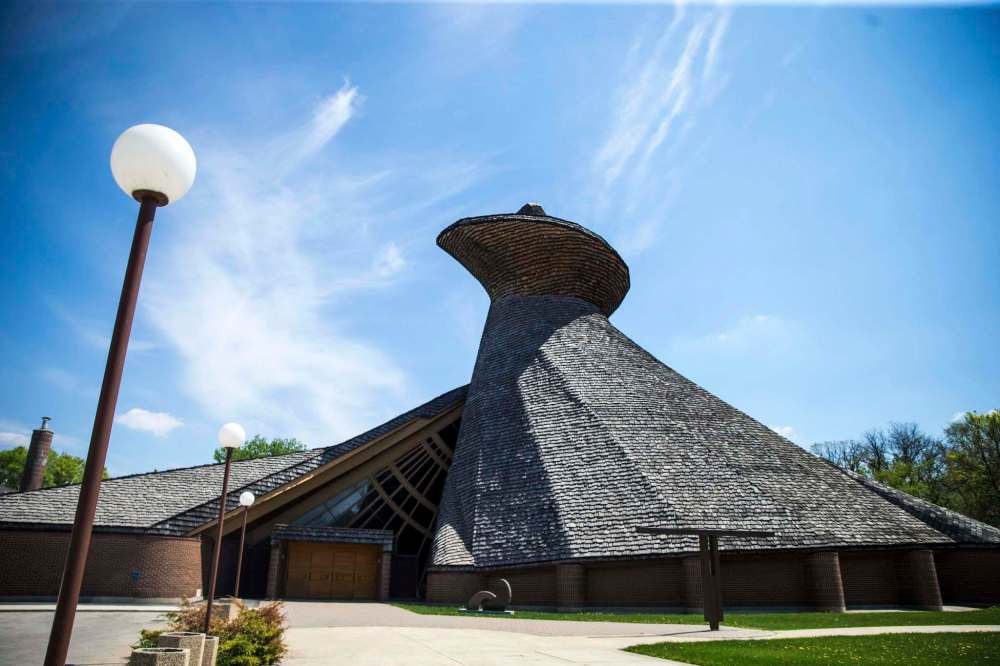
For half a century, the spiralling roofline of a Winnipeg church has stood out against the domes and spires of other religious institutions.
But that unusual circular design of Precious Blood Roman Catholic Church nearly didn’t happen, renowned Winnipeg architect Étienne Gaboury said in a recent conversation.
Originally, parish priest Rev. Aurèle Lemoine asked Gaboury to design a church for 600 people on top of an existing rectangular basement adjacent to the current site at Kenny Street and Enfield Crescent in Norwood.
The French-speaking congregation, part of the archdiocese of Saint-Boniface, worshipped in the basement sanctuary for many years.
But the priest disliked the first plan because of the many stairs to the front door, says the architect, who also designed Winnipeg landmarks such as the Royal Canadian Mint, the Esplanade Riel as well as Canada’s embassy in Mexico City.
“They rejected that scheme and we did four others before we arrived at this one,” says the 88-year-old Gaboury of the design process, which began in 1964.
On Sunday, parishioners of Precious Blood — Précieux-Sang in French — celebrate 50 years of worship in what is sometimes dubbed the “corkscrew church.”
Constructed at a cost of $397,064, this one-level cedar, brick and glass building with its 26-metre-high ceiling at its tip remains largely the same as when it opened its doors on June 28, 1968.
“Nothing has really changed, we haven’t changed anything since the opening,” Gaboury says during a recent tour of the church.
Inspired by the winds of change blowing through the Roman Catholic Church from the Second Vatican Council, which concluded in 1965, Gaboury and his associate Denis Lussier sought to design a space that reflected the church’s adaptation to modern times and its renewed focus on the liturgy.
“At that time, there was a lot of effervescence around the renaissance of the church,” Gaboury says.
“It’s not surprising we were at the same time as Vatican II and the same spirit of change.”
What may have been surprising is the shape of the building, designed with the centre of both the altar and the structural centre of the building at the middle of the spiral. That asymmetrical circular plan contrasted sharply with the rectangular A-frame churches of the time.
“That (A-frame) is what I think they expected here,” says Gaboury, who later went on to design the new Saint Boniface Cathedral after fire destroyed the original historic structure a month after the completion of Precious Blood.
“They did approve (the design), but they didn’t expect it.”
That unexpected plan has shaped the worship practice and community life of the parish, which delights in the distinctive building that is designed to lead people to a journey of God through the upward curve of the roof.
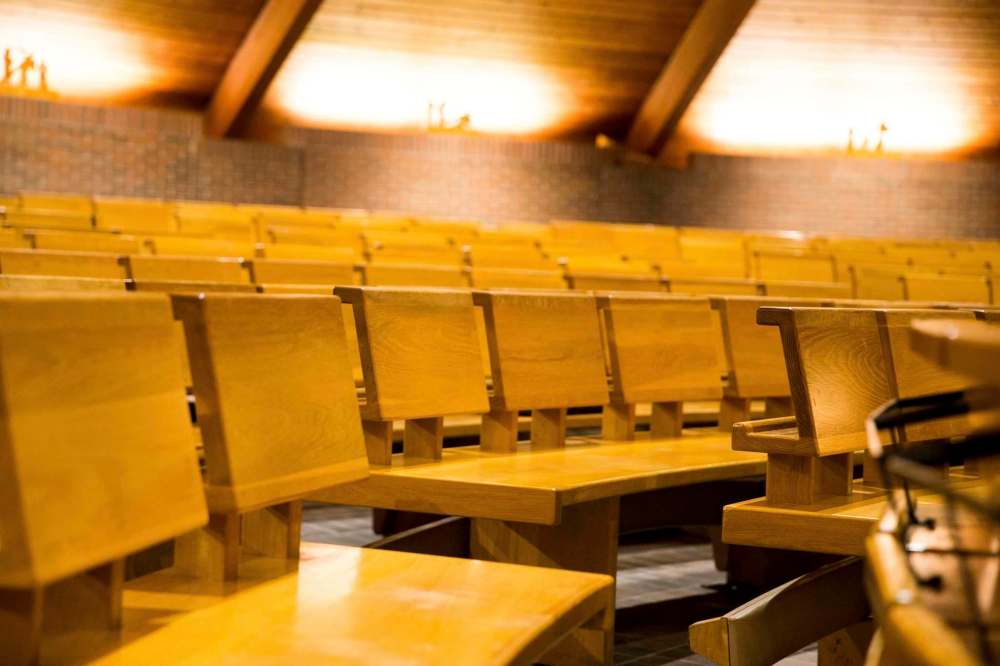
“People see each other here and they know who they are (worshipping) with,” says pastoral council member Pierre Lemoine of how the chunky wooden pews laid out in semicircular design creates a sense of community during a weekend mass.
“The space is very inspiring and definitely intimate,” adds lay reader and longtime parishioner Francis Fontaine.
That connection between parishioners was intentional, says Gaboury, a member of both the Order of Canada and the Order of Manitoba.
“We designed the seating so it’s an integral part of the church,” he says.
The grade-level accessible entrance invites worshippers inside, where they first pass by the baptismal font as a reminder of their baptism. Confessionals are located to their left, and then the spiral leads parishioners to the curved rows of pews facing the limestone altar, situated directly in the centre of the spiral.

“Instead of the priest facing the altar and having separation between the altar and the nave, the altar and priest face the congregation,” says Gaboury of how Precious Blood’s altar placement differs from churches built before it.
This church doesn’t have a choir singing from a rear balcony. The musicians are seated at the far edge of the semicircle, close to the piano and organ, leading music from the heart of the sanctuary.
“You can see the people singing with you, and praying together, and singing together,” choir member Evelyne Lessard says.
Although the building has remained much the same, the parish of about 200 families has had to adapt to changing times. With a decline in attendance, the parish, initially established in 1945, will soon share its space with the French-speaking St. Kizito African Catholic Church.
brenda@suderman.com
The Free Press is committed to covering faith in Manitoba through our Religion in the News project. This reporting continues because readers like you step forward to fund it.
Donate now to support our reporting on religion.
Your donation is eligible for a charitable tax receipt.
BECOME A FAITH JOURNALISM SUPPORTER
Brenda Suderman has been a columnist in the Saturday paper since 2000, first writing about family entertainment, and about faith and religion since 2006.
Our newsroom depends on a growing audience of readers to power our journalism. If you are not a paid reader, please consider becoming a subscriber.
Our newsroom depends on its audience of readers to power our journalism. Thank you for your support.
Celebration planned
• Precious Blood Roman Catholic parish marks the 50th anniversary of their building on Sunday with an 11 a.m. ma•ss in French, a barbecue lunch at 12:30 p.m., exhibits and bilingual guided tours from 1 to 3 p.m., and a fundraising concert by the Saint Kizito African Community Choir at 7 p.m. Admission is $20 for adults, and is free for 17 and under.
• The spiral church was designed by Winnipeg architect Étienne Gaboury and built by Bockstael Construction at a cost of $397,064. It was officially opened on June 28, 1968.
• The nave, or church sanctuary, measures 27 metres across and the full width of the church is 55 metres.
• The 26-metre-high ceiling is supported by 25 glued laminated wood beams.
The Free Press is committed to covering faith in Manitoba through our Religion in the News project. This reporting continues because readers like you step forward to fund it.
Donate now to support our reporting on religion.
Your donation is eligible for a charitable tax receipt.
BECOME A FAITH JOURNALISM SUPPORTER
Brenda Suderman has been a columnist in the Saturday paper since 2000, first writing about family entertainment, and about faith and religion since 2006.
Our newsroom depends on a growing audience of readers to power our journalism. If you are not a paid reader, please consider becoming a subscriber.
Our newsroom depends on its audience of readers to power our journalism. Thank you for your support.
Related Articles
Manitoba's greatest architect dies at 92
Advertisement Advertise With Us
Advertisement Advertise With Us
The Free Press acknowledges the financial support it receives from members of the city’s faith community, which makes our coverage of religion possible.