

Once welcome, now worried
Separation dominating the conversation, but Alberta’s immigrants are feeling a xenophobic chill from five of ‘The Nine’ other questions in Monday’s referendum

Advertisement
Read this article for free:
or
Already have an account? Log in here »
To continue reading, please subscribe:
Digital Subscription
One year of digital access for only $1.44 a week*
- Enjoy unlimited reading on winnipegfreepress.com
- Read the E-Edition, our digital replica newspaper
- Access News Break, our award-winning app
- Play interactive puzzles
*Billed as $5.77 plus GST every four weeks. After 52 weeks, price increases to the regular rate of $19.95 plus GST every four weeks. Offer available to new and qualified returning subscribers only. Cancel any time.
To continue reading, please subscribe:
Add Free Press access to your Brandon Sun subscription for only an additional
$1 for the first 4 weeks*
- Enjoy unlimited reading on winnipegfreepress.com
- Read the E-Edition, our digital replica newspaper
- Access News Break, our award-winning app
- Play interactive puzzles
*Your next Brandon Sun subscription payment will increase by $1.00 and you will be charged $17.95 plus GST for four weeks. After four weeks, your payment will increase to $24.95 plus GST every four weeks.
Read unlimited articles for free today:
or
Already have an account? Log in here »
EDMONTON — When Gurnam Singh Dodd came to Canada in 1976, he landed first in southern Ontario, where his brother lived. At the time, the province was mired in the era of stagflation, and it was difficult to find work; but he had some friends living in Edmonton, and asked for their advice.
“Come to Alberta,” they told him. It was a land of opportunity. The economy was booming, bolstered by soaring oil and gas prices; Dodd could surely find multiple jobs within days. With that, the young Sikh newcomer packed up and headed west, looking to put down roots on the edge of the Canadian Prairies.
Nearly 50 years later, that proved to be a wise decision. Dodd worked hard to succeed in his new home, moving up from his first minimum-wage jobs to a successful career with Edmonton Transit, and then as a driver’s licence examiner. He raised a thriving family, gave back to his community and became, in all ways, a very proud Albertan.
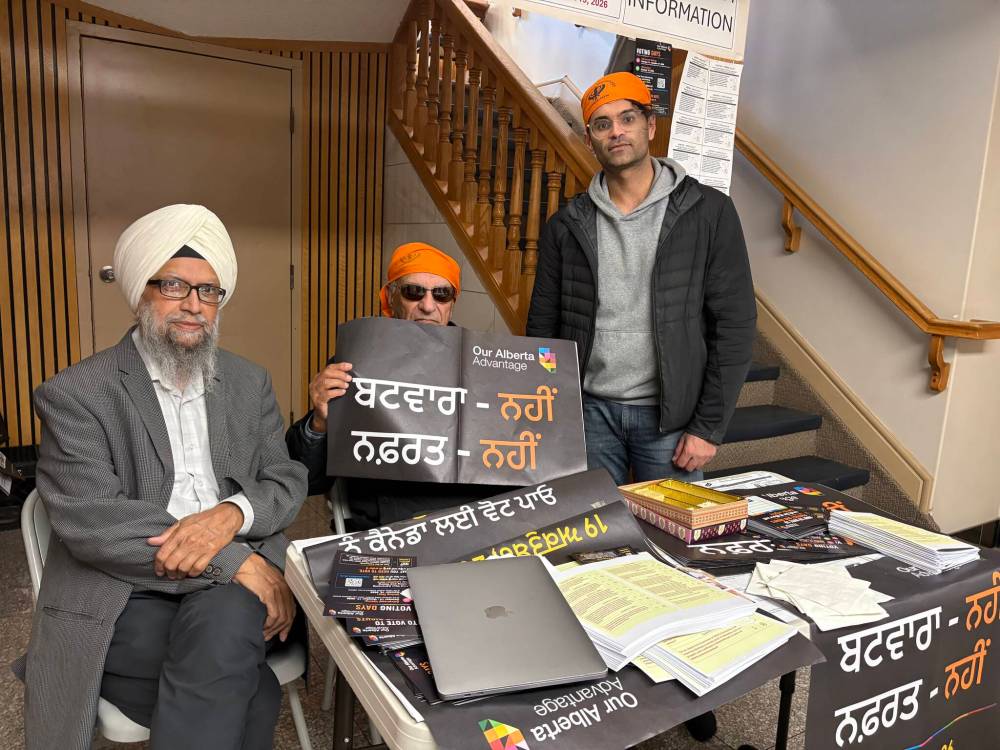
Melissa Martin / Free Press
(From left) Gurdwara Millroads chairperson Surinder Singh Hoonjan, along with volunteer Surinder Brar and Avnish Nanda, founder of the Our Alberta Advantage campaign, at a voter information booth at the Gurdwara Millroads in Edmonton.
Around the turn of the millennium, eager to do his part in the province’s public life, he joined what was then Alberta’s Progressive Conservative party, under the leadership of premier Ralph Klein. (Klein’s father, Dodd says proudly, was a friend, and helped get him into politics.)
In 2004 he even ran for the PCs in his provincial district of Edmonton-Ellerslie. He lost, narrowly, to the Liberal candidate, but though he never ran for office again, he remained active in the party. So in 2022, when Danielle Smith was making her run for United Conservative Party leader after the ouster of premier Jason Kenney, she reached out to Dodd for help.
Dodd was happy to introduce her to Edmonton’s Sikh community, which had grown to more than 40,000 people. He took her to Nagar Kirtan, an annual celebration of the faith’s holy scriptures, to meet some local movers and shakers. He helped campaign for her in Edmonton and Grande Prairie.
He never imagined that, just four years later, Smith would push Alberta into a referendum that takes aim not only at the province’s future in Canada, but the future of immigrants in Alberta.
“I was supporting her at that time, but I didn’t know we were coming to this,” Dodd says, shaking his head.
As Alberta prepares to vote on Monday — advance polls opened this week — the matter of whether it will choose to stay in Canada is dominating headlines across the country. But explicit separatism isn’t the only topic up for decision. Voters will also consider nine other questions, referred to by many here simply as “The Nine.”
Five of them directly focus on concerns about immigration, including whether Alberta should take more control over immigration to decrease it, and whether temporary legal residents — who pay income taxes just like any other worker — should pay a fee to access provincial health care and education, an expense critics call “double-dipping.”
These questions come amidst rising tensions over immigration, rashes of hate graffiti popping up in Canadian cities and some more serious incidents. In August, an attacker stabbed two worshippers at a Sikh gurdwara near Edmonton; luckily, both victims survived, and the alleged attacker was arrested.
Edmonton police have said there is insufficient evidence the attack was motivated by hate; the accused had been released from prison one day before. But combined with a swelling tide of hostility directed at many immigrants online, and now a referendum seeking to change how they might live and work in Alberta, it left many communities on edge.
“The feeling is as if immigrants are being targeted for a failure of the government,” says Surinder Singh Hoonjan, chair and co-founder of the Gurdwara Millroads in Edmonton, chatting on a recent afternoon in the Sikh temple’s langar dining hall, where worshippers gather to share meals as a key part of their faith.
“Everything was going fine. We were living peacefully with the rest of the communities. Immigrants are part of Alberta, they did so much for the development of Alberta, but since the UCP has its new leader, everything changed, especially after COVID. That’s the way we see it. It is as if we are unwelcome here, after all these years.”
What has left many immigrants confused, and worried, is just how quickly the change seemed to happen. In 2024, Smith proclaimed a goal to more than double Alberta’s population to 10 million, up from the current 4.6 million — growth that could only feasibly come through immigration.
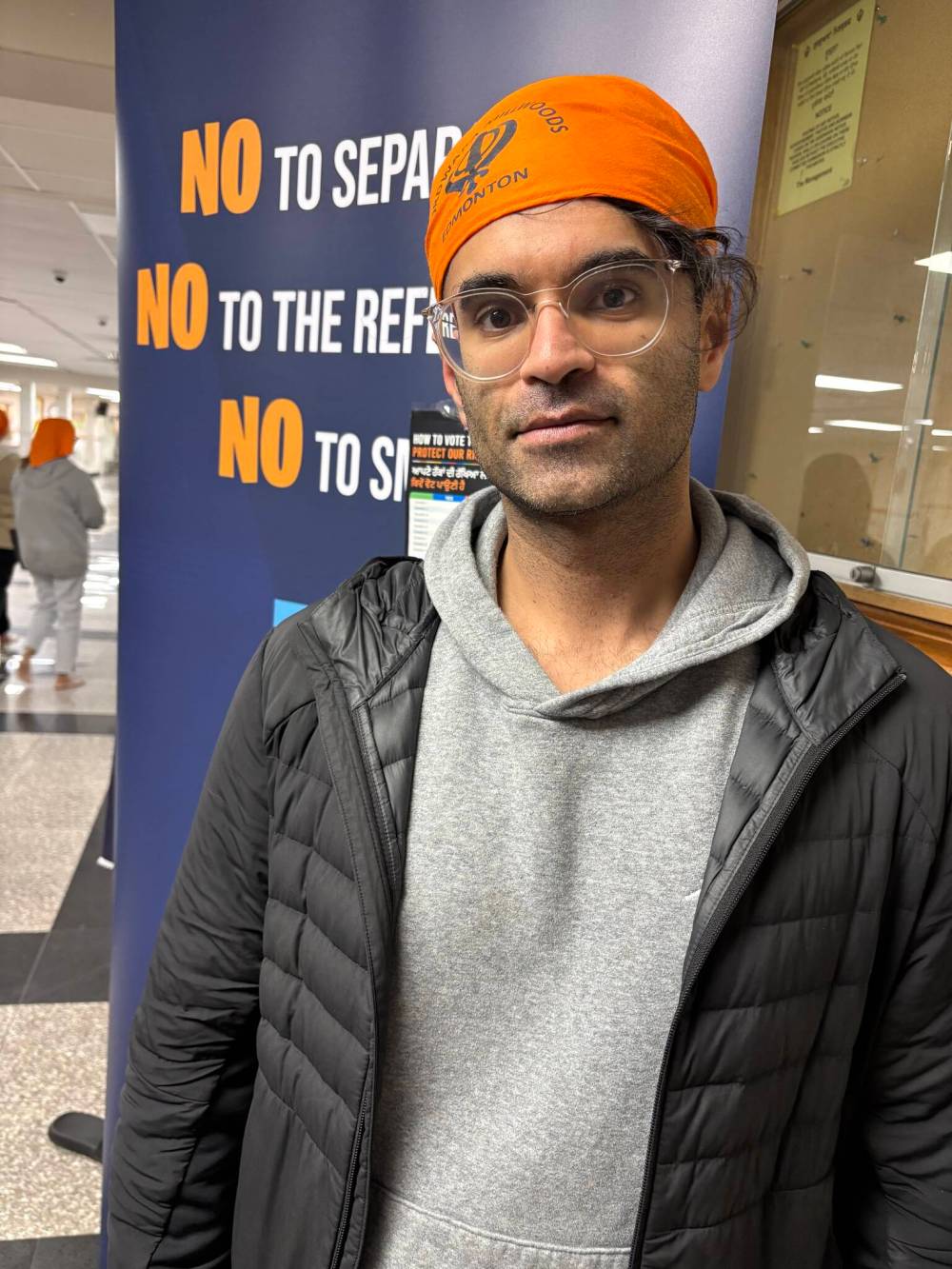
Melissa Martin / Free Press
Edmonton lawyer Avnish Nanda launched the campaign Our Alberta Advantage to organize the immigrant vote in Monday’s referendum.
To many immigrants in Alberta — including those who have been here for over a half-century, such as Dodd — this change in tone felt like whiplash. Every immigrant the Free Press spoke with this week mentioned Smith’s former pledge to double the population. To some, the referendum’s focus on curtailing immigrant rights felt like a betrayal.
“There was shock and surprise,” says Avnish Nanda, a public interest lawyer who has been working to educate voters about the immigration-focused referendum questions. “There is real concern about just turning on these communities… from the very top of the political ladder here in Alberta.”
Part of that concern, Nanda says, comes from how sudden the change seemed to be. Until recently, he says, the UCP and prior conservative governments were “big tent parties” that “embraced diversity,” and included many members from immigrant communities.
“I think it’s clear that Danielle Smith sees her path to remaining in power through the separatists, not through the diverse mainstream in Alberta,” Nanda says. “Those groups may have latched on to nativist xenophobic populist movements… it’s part of the rhetoric. As vehement as they are about separation, they’re as vehement about immigrants.”
In April, to help mobilize voters, Nanda launched Our Alberta Advantage, a registered third-party advertiser, with a clear message: “Stay in Canada — No to The Nine.” Since then the organization has held information sessions with many diverse communities and released radio ads in multiple languages, including Punjabi, Mandarin, Cantonese and Tagalog.
“This is as Canadian as any experience I’ve had,” says Nanda, a first-generation Canadian who was born and raised in Edmonton. “When you feel like this is being threatened, that we’re going to be pariahs or scapegoats for some agenda… I think there’s an obligation to do something.”
The referendum’s separatist question has little chance of passing; support for leaving Canada has never crept much higher than about one in five voters. But the other nine questions have much wider support. And although the referendum is non-binding, advocates fear a strong showing could give the province a mandate to cut back immigrant rights.
“One of the things we notice is Albertans who are pushing for staying in Canada don’t even look at the first five questions,” says Marco Luciano, director of Migrante Alberta, which supports many Filipino migrant workers in the province. “They don’t even consider them as an important question. So for migrants, regardless of who wins, it’s still a lose-lose situation.
“There’s still going to be a higher rate of xenophobia, a higher rate of racism and discrimination for those that look like a migrant, even if they’re born here.”
Many Filipinos came to Alberta under temporary foreign worker programs, invited to fill needed roles in meat-processing plants and the service industry. In recent weeks, Luciano says, he has seen increasing anxiety in the community, with some considering making a move to Saskatchewan or Manitoba.
“There’s tension within the community, tension within the migrant community and division within our neighbourhoods,” he says. “Let’s really be inclusive, let’s talk about how we can include the voices of the voiceless. Because they are not going away. Migration is very important in relation to the economy of Alberta, and the rest of Canada.”
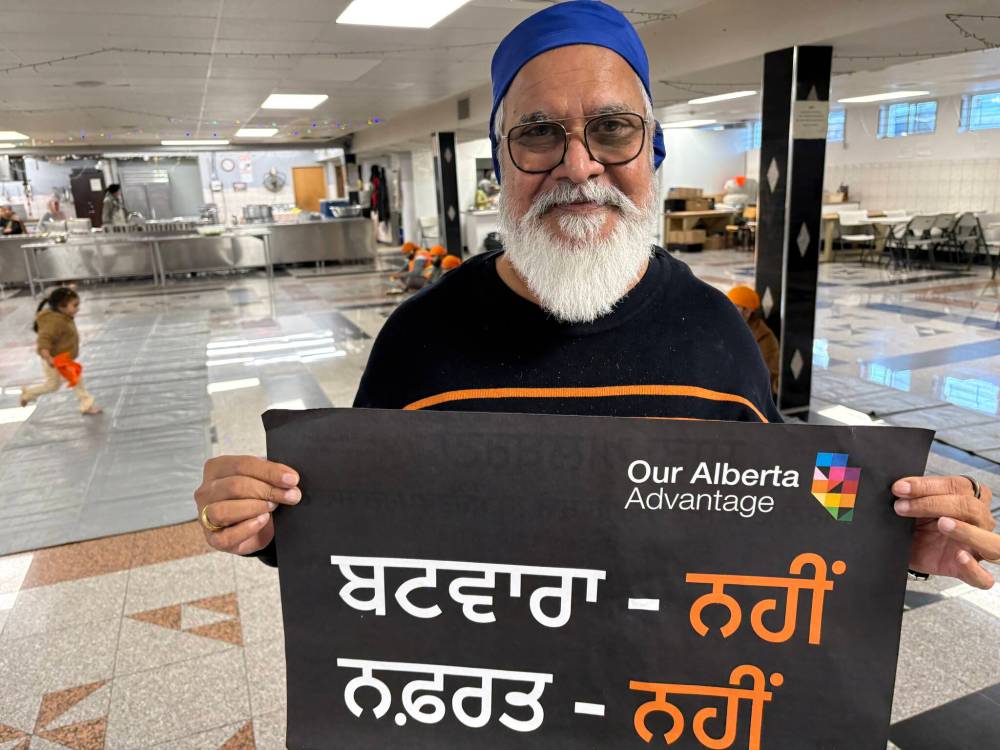
Melissa Martin / Free Press
Longtime United Conservative Party member Gurnam Singh Dodd once supported now-Alberta premier Danielle Smith when she ran for party leader. This week he officially resigned his UCP membership in advance of Monday’s referendum.
In the closing days of the campaign, some leaders are focusing on this topic. On Wednesday, in a joint op-ed in the Calgary Herald, former PC premiers Ed Stelmach and Alison Redford and former NDP premier Rachel Notley urged voters to reject all five immigration questions, calling them a “clear and present threat to Alberta’s continued prosperity.”
The key, perhaps, will be mobilizing voters. This week, as advance polls opened, Our Alberta Advantage volunteers set up information booths in multiple Sikh temples, encouraging visitors to get out and vote. By late afternoon on Tuesday, their first day of operation, volunteers at Gurdwara Millroads had got about 200 people to cast a ballot.
In the dining hall of another temple a short drive down the road, Dodd was among the volunteers sitting at an Our Alberta Advantage table, smiling as he handed out information pamphlets written in both Punjabi and English. That morning, he’d formally submitted his letter of resignation to Danielle Smith’s UCP.

“After more than 25 years of loyalty, candidacy, organization and membership recruitment, I regret that the party no longer represents the balanced, responsible and nation-building conservative I once proudly supported,” he wrote in his resignation. “I therefore resign on principle, with sadness but without hesitation.”
Dodd will always be a proud Albertan, he says. He could have left the province when he retired in 2018, and maybe gone somewhere warmer. But over the last five decades, he watched his Edmonton neighbourhood grow from a small suburb surrounded by farmer’s fields to a flourishing family friendly hub in a city of nearly 1.3 million.
“We worked hard here in this place, and it wasn’t that easy to get acceptance in the mainstream,” he says. “We did have to go the extra miles to get the acceptance, but we finally did get accepted and we earned some respect… I’ve seen it growing, and it’s been great to be part of it.
“I’m not going away because of this, I’m staying here to be part of it.”
melissa.martin@freepress.mb.ca
Our newsroom depends on a growing audience of readers to power our journalism. If you are not a paid reader, please consider becoming a subscriber.
Our newsroom depends on its audience of readers to power our journalism. Thank you for your support.
Our newsroom depends on a growing audience of readers to power our journalism. If you are not a paid reader, please consider becoming a subscriber.
Our newsroom depends on its audience of readers to power our journalism. Thank you for your support.
Advertisement Advertise With Us
Advertisement Advertise With Us