Dear Herb: Could I use a religious defence against cannabis charges?

Canadian courts have been skeptical of the argument that "cannabis is part of my religion"

Advertisement

Advertise with us

Dear Herb: Has anyone in Canada ever used the religious defence when they were charged with cannabis possession? (I'm possessed, I tell you!)

Read this article for free:


By clicking the button above, an account will be created and you will begin to receive some of our recommended newsletters. You may opt out of any newsletter by visiting your Email and Communication Preferences page or by clicking "unsubscribe" at the bottom of any email.

or

Already have an account? Log in here »

To continue reading, please subscribe:

Digital Subscription

One year of digital access for only $1.44 a week*

  • Enjoy unlimited reading on winnipegfreepress.com
  • Read the E-Edition, our digital replica newspaper
  • Access News Break, our award-winning app
  • Play interactive puzzles

*Billed as $5.77 plus GST every four weeks. After 52 weeks, price increases to the regular rate of $19.95 plus GST every four weeks. Offer available to new and qualified returning subscribers only. Cancel any time.

To continue reading, please subscribe:

Add Free Press access to your Brandon Sun subscription for only an additional

$1 for the first 4 weeks*

  • Enjoy unlimited reading on winnipegfreepress.com
  • Read the E-Edition, our digital replica newspaper
  • Access News Break, our award-winning app
  • Play interactive puzzles
Start now

*Your next Brandon Sun subscription payment will increase by $1.00 and you will be charged $17.95 plus GST for four weeks. After four weeks, your payment will increase to $24.95 plus GST every four weeks.

Hey there, time traveller!
This article was published 09/05/2018 (3095 days ago), so information in it may no longer be current.

Dear Herb: Has anyone in Canada ever used the religious defence when they were charged with cannabis possession? (I’m possessed, I tell you!)

If I had been created by Cannabis and spent my life in service to Cannabis, spreading the good news and sharing the sacrament, would that not be a religion and worthy of protection under our Charter?

Herb answers your questions about legal consumption and growing, the law, etiquette — you name it, he'll look into it.

C-45 is very clear that you can’t give cannabis to an organization. Would a church be different? — The Hon. Reverend Reefer

Dear Reverend: So, you thought you’d figured out the loophole that would defeat government cannabis prohibition once and for all, eh?

All it would take is a little cannabis-inspired revelation, building a temple and sticking some sacramental bud upon the altar — and maybe some cool robes for good measure — and presto, your cannabis use would be protected from the long arm of the law under the Canadian Charter of Rights and Freedoms, which guarantees freedom of religion.

It’s a neat idea, Reverend, but it’s been tried before.

The Assembly of the Church of the Universe considers cannabis a holy sacrament, and church members have taken that belief to Canadian courts many times.

Let’s take a look at a relatively recent case involving a Church of the Universe member. It doesn’t involve criminal charges for cannabis possession, but it does show that federal courts have been skeptical about the idea of cannabis use as a religious practice.

In 2010, Christopher Bennett sought a legal exemption from federal law that would let him grow enough cannabis to use seven grams per day “for his personal religious consumption.” Bennett’s argument, which is still available online, describes his 1990 “cannabis-induced epiphany during which he came to the intuitive (understanding) that cannabis was the Biblical Tree of Life.”

“The fact that Mr. Bennett’s religious and spiritual practices are illegal causes him significant anxiety, emotional and psychological anguish,” wrote his lawyer Kirk Tousaw in a memo to the court.

The Minister of Health refused Bennett’s exemption request. Bennett took it to court, arguing his Charter rights were violated.

But in his 2011 ruling, Justice Michel Shore dismissed those Charter arguments outright, finding “both his practice of smoking seven grams of marihuana per day and the underlying belief that cannabis is the tree of life are secular in nature.”

“They form the basis of a cannabis-centred lifestyle that the Applicant wishes to pursue without interference by the state,” ruled the judge. “The lifestyle choices such as these are not protected by the right to freedom of religion.”

Finding that Bennett was entitled to a religious exemption from the law “would mean that anyone who made a similar assertion would be entitled to the same relief,” wrote the judge, which would undermine the objectives of the federal Controlled Drugs and Substances Act.

Bennett lost in 2011, but in 2013 he was granted an appeal. The appeals court found “conflicting factual findings” about whether Bennett’s “beliefs and activities concerning cannabis constitute a religious practice… as opposed to a secular practice or lifestyle choice.”

As far as I can tell, that second trial never took place. (I’ve asked Bennett’s lawyer for more information, and will update this column if I get it.)

Anyhow, Reverend, the upshot here is that you wouldn’t be the first Canadian to try “the religious defence” for cannabis in court, and it looks like it would be an uphill battle. If you want to give it a shot, I’d make sure your flock of cannabis worshippers donates generously to your legal defence fund — you’ll likely need it.

As for whether a church counts as an organization for the purposes of Bill C-45, I’m going to say: absolutely. C-45 uses the Criminal Code definition of “organization,” which is:

  1. a public body, body corporate, society, company, firm, partnership, trade union or municipality, or
  2. an association of persons that
  1. is created for a common purpose, 
  2. has an operational structure, and 
  3. holds itself out to the public as an association of persons

Sounds like a church to me!

Until next time, readers, accept this blessing from Father Herb and keep the questions coming.


Got a question about cannabis? Herb answers your questions about legal consumption and growing, the law, etiquette — you name it, he’ll look into it.  Email dearherb@theleafnews.com or to submit anonymously, fill out the form below. Please include an email address if you’d like to be notified when Herb answers your question:  

(dearHerbForm)

Report Error Submit a Tip

More Stories

Waiting for Cormier verdict the ‘calm before the storm’

Katie May 6 minute read Preview

Waiting for Cormier verdict the ‘calm before the storm’

Katie May 6 minute read Thursday, Feb. 22, 2018

As the jury room door closed behind the seven women and four men who are now deliberating on the evidence against Tina Fontaine’s accused killer, Thelma Favel rose from the chair she’s occupied for most of Raymond Cormier’s second-degree murder trial.

Almost every day over the past three weeks, Favel, the woman who raised 15-year-old Tina, has sat right up front, directly across from the jury box, listening, sobbing and soaking in disturbing details of the teen’s last days that have come to light over the course of Cormier’s second-degree murder trial.

On Wednesday afternoon, after Court of Queen’s Bench Chief Justice Glenn Joyal instructed the jury and sent them off to be sequestered until they decide whether 56-year-old Raymond Cormier is guilty of killing Tina, Favel got up and hugged Crown prosecutor Breta Passler. It was one of many moments, this one shielded from jurors, that have long since proven the emotional impact of the case and the lasting power of Tina’s legacy.

Tina’s death sparked a public outcry that renewed calls for a national inquiry into disproportionately high rates of missing and murdered Indigenous women and girls across Canada, and the criminal trial for the man accused of killing her hasn’t happened in a vacuum.

Read
Thursday, Feb. 22, 2018

Dear Herb: Could I use a religious defence against cannabis charges?

4 minute read Preview

Dear Herb: Could I use a religious defence against cannabis charges?

4 minute read Wednesday, May. 9, 2018

Dear Herb: Has anyone in Canada ever used the religious defence when they were charged with cannabis possession? (I'm possessed, I tell you!)

If I had been created by Cannabis and spent my life in service to Cannabis, spreading the good news and sharing the sacrament, would that not be a religion and worthy of protection under our Charter?

C-45 is very clear that you can't give cannabis to an organization. Would a church be different? — The Hon. Reverend Reefer

Dear Reverend: So, you thought you'd figured out the loophole that would defeat government cannabis prohibition once and for all, eh?

Read
Wednesday, May. 9, 2018

Three in-custody fatalities trigger inquests

Free Press staff 2 minute read Preview

Three in-custody fatalities trigger inquests

Free Press staff 2 minute read 1:50 PM CDT

The province’s chief medical examiner has called inquests into the deaths of three men, including two who died by suicide in correctional facilities earlier this year.

Craig Flett, 32, was found hanging in his cell in the Stony Mountain Institution prison on Feb. 10 this year.

Corrections officers were able to cut him down and tried to resuscitate him, but he later died of a brain injury. Flett was serving a life sentence at the time.

Sebastian Atkinson, a 25-year-old inmate at the Winnipeg Remand Centre, was found hanging in his cell by a linen sheet tied to a metal bar about five feet from the floor.

Read
1:50 PM CDT

2026 Winnipeg election results: Mayor and council

1 minute read Preview

2026 Winnipeg election results: Mayor and council

1 minute read Thursday, Oct. 22, 2026

Complete results for the 2022 election races for Winnipeg mayor and city councillors.

Read
Thursday, Oct. 22, 2026

The landscape that taught us to see

Stephen Borys 6 minute read Preview

The landscape that taught us to see

Stephen Borys 6 minute read 2:01 AM CDT

The white pine stood at the edge of the lake, leaning out over the water, its branches bent by years of wind and weather. Beyond it stretched an expanse of blue water beneath a clear sky, a distant tree line and other pines rising along the rocky shoreline. From the deck above, the landscape seemed both expansive and remarkably still.

I had been looking at it for only a few moments when Tom Thomson and the Group of Seven entered the picture. Not literally, of course. But once the association appeared, I could not unsee it. The pine became The Jack Pine and The West Wind. The surrounding rocks, water and sky called up A.Y. Jackson, Arthur Lismer, Franklin Carmichael and Lawren Harris. A landscape I had been looking at all weekend suddenly became part of a visual history Canadians have carried with them for more than a century.

Perhaps that is the Group of Seven’s greatest achievement. They did not simply paint the Canadian landscape. They changed the way we see it.

I was at the lake for a quiet weekend, reflecting on the cultural, community and development projects that occupy much of my work through Civic Muse. Increasingly, I see these pursuits as part of the same conversation — place and identity, how we understand it, care for it and decide what is worth carrying forward.

Read
2:01 AM CDT

Director Schrader returns to silver screen with complex view of religion and belief

Alison Gillmor 4 minute read Preview

Director Schrader returns to silver screen with complex view of religion and belief

Alison Gillmor 4 minute read Thursday, Jun. 14, 2018

Bleak, wintry and rigorously controlled — until it’s not — this Book of Job-like drama from American filmmaker Paul Schrader looks at the challenges of faith.

The 71-year-old Schrader, known for scripting four Martin Scorsese films (including Taxi Driver and Raging Bull) and for directing his own (including American Gigolo, Affliction and Auto Focus), grew up in a strict Calvinist home — he famously did not see a film until he was 17 — and has always been drawn to stories of agonizing and uncertain redemption.

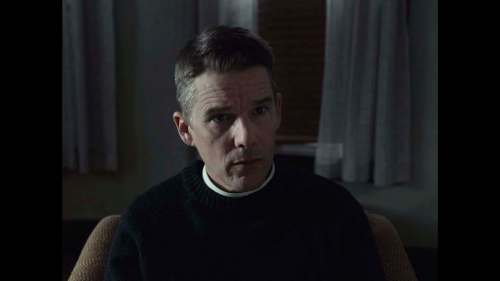
As the Rev. Toller (Ethan Hawke) wrestles with what it means to lead a righteous life in our badly broken world, his spiritual fate remains in doubt. It is certain, however, that First Reformed marks a cinematic rebirth for Schrader after recent disasters like The Canyons and Dog Eat Dog. Serious, complex and moving, this is not a perfect film, but even its flaws are powerful.

Toller is a solitary man who has come to the ministry late in life, after a family tragedy and a failed marriage. First Reformed, a historic church in upstate New York that was once a stop on the Underground Railroad, has since been reduced to an austerely beautiful tourist shop, more of a museum than a place of worship.

Read
Thursday, Jun. 14, 2018