Pandemic fatigue, divisive politics pose likely hurdles to return to masking: experts

Advertisement

Advertise with us

TORONTO - A plea by health officials to resume masking in Ontario and Quebec is a tall order that is unlikely to take hold without a significant culture shift, say observers who point to pandemic fatigue, mixed messages and divisive politics as likely hurdles.

Read this article for free:


By clicking the button above, an account will be created and you will begin to receive some of our recommended newsletters. You may opt out of any newsletter by visiting your Email and Communication Preferences page or by clicking "unsubscribe" at the bottom of any email.

or

Already have an account? Log in here »

To continue reading, please subscribe:

Digital Subscription

One year of digital access for only $1.44 a week*

  • Enjoy unlimited reading on winnipegfreepress.com
  • Read the E-Edition, our digital replica newspaper
  • Access News Break, our award-winning app
  • Play interactive puzzles

*Billed as $5.77 plus GST every four weeks. After 52 weeks, price increases to the regular rate of $19.95 plus GST every four weeks. Offer available to new and qualified returning subscribers only. Cancel any time.

To continue reading, please subscribe:

Add Free Press access to your Brandon Sun subscription for only an additional

$1 for the first 4 weeks*

  • Enjoy unlimited reading on winnipegfreepress.com
  • Read the E-Edition, our digital replica newspaper
  • Access News Break, our award-winning app
  • Play interactive puzzles
Start now

*Your next Brandon Sun subscription payment will increase by $1.00 and you will be charged $17.95 plus GST for four weeks. After four weeks, your payment will increase to $24.95 plus GST every four weeks.

Hey there, time traveller!
This article was published 15/11/2022 (1445 days ago), so information in it may no longer be current.

TORONTO – A plea by health officials to resume masking in Ontario and Quebec is a tall order that is unlikely to take hold without a significant culture shift, say observers who point to pandemic fatigue, mixed messages and divisive politics as likely hurdles.

The fact that a renewed push for personal protective measures remains voluntary means many people will consider it optional, and possibly even unnecessary, says behaviour expert and York University associate professor Rebecca Bassett-Gunter.

She notes that many people abandoned masks altogether after most pandemic precautions were lifted earlier this year.
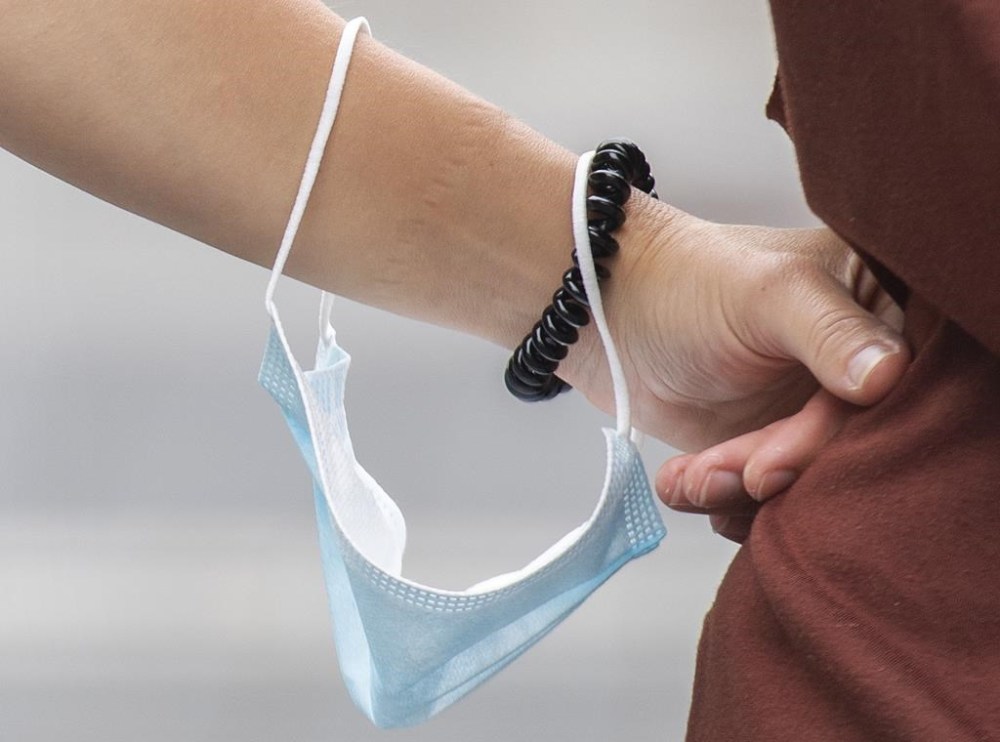
A disposable face mask is shown attached to a woman's arm in Old Montreal on July 18 2021. A plea by health officials to resume masking in Ontario and Quebec is a tall order that is unlikely to take hold without a significant culture shift, say observers who point to pandemic fatigue, mixed messages and divisive politics as likely hurdles. THE CANADIAN PRESS/Graham Hughes

It’s not clear that weeks of warnings from overwhelmed hospital staff over the “triple threat” of viral infections is enough to get those same people to put their masks back on.

“Without mandating it, I think people are hearing a message that it must not be as bad as it was,” says Bassett-Gunter, whose research at the school of kinesiology and health science has included a look at how to get people to comply with COVID-19 precautions.

“That’s a really hard implicit message to override, unfortunately.”

Add in pandemic fatigue and a yearning for festive holiday gatherings to return after two seasons of restraint, and public health officials face a tough psychological wall to break through, adds Dr. Eddy Lang, professor and department head for emergency medicine at the Cumming School of Medicine at the University of Calgary.

While his province isn’t seeing a surge in respiratory syncytial virus and influenza cases to the same degree as Ontario and Quebec, he noted cases are expected to increase as cold and flu season progresses.

“When we look at the wastewater analysis, RSV is still on the rise, which suggests that the worst of it may still be yet to come,” Lang said.

Already, a wave of viral illnesses among young students has pushed hospital capacity to dangerous levels. But given Alberta Premier Danielle Smith’s stated opposition to a school mask mandate, Lang doubts a masking plea is imminent or that there is much public support for more precautions.

“People are just so tired of public health directives,” says Lang.

“Until we really see a cultural shift … I don’t think this is going to work particularly well or give us much of an impact against hospitalizations.”

Health authorities in Canada’s two most populous provinces issued strong recommendations on Monday for people to mask up indoors to mitigate the spread of respiratory viruses that have overwhelmed hospitals and pediatric centres.

Ontario’s chief medical officer of health, Dr. Kieran Moore, stressed the vulnerability of babies and children younger than five to unseasonably high rates of RSV and rising rates of influenza. At the same time, he warned of emerging COVID-19 variants.

Quebec’s college of physicians made a similar appeal that the public don masks on a “voluntary and preventive basis” in public places, crowded private spaces and on public transit.

Last week, Canada’s top doctor stressed the need for “stepped-up precautions” while warning that COVID-19, RSV and the flu were challenging the health system in several parts of the country.

Turney McKee of the Montreal-based consultancy group Decision Lab was skeptical that “a mere recommendation” would be enough to drive the adoption needed to mitigate public health risks.

“Sure, our attitudes or values may align with one course of action, but then when actually put in the situation to either comply or not to comply, I think it’s very likely that we see a disconnect,” says McKee.

He sees politics as less a driver than fatigue, convenience and social pressure.

“When the mandate is no longer there, if it is no longer convenient, we’re probably going to stop,” says McKee, whose firm uses applied behavioural science to guide advice for organizations and government clients.

“And when we see everyone else around us starting to stop, the social influence can be very potent.”

However, that’s not to say this public health plea is completely powerless.

It sends a clear signal that stronger measures could follow and that the public should brace for a potential mandate, says McKee.

“It primes people to expect that maybe some more heavy-handed measures are around the corner,” he says.

Moore said a mask mandate could be possible if Ontario’s health-care system continues to see an increase in pressure due to respiratory illnesses, though he said that would be “the furthest we’d have to go.”

This report by The Canadian Press was first published Nov. 15, 2022.

Report Error Submit a Tip

More Stories

Today’s horoscope

Georgia Nicols 4 minute read Preview

Today’s horoscope

Georgia Nicols 4 minute read 2:00 AM CDT

MOON ALERT: There are no restrictions to shopping or important decisions today. The moon is in Cancer.

ARIES (March 21-April 19)

Avoid heated discussions regarding kids, social plans, shared expenses or dealing with authority figures. (This covers a wide swath.) People are touchy! Pull in your reins and tread carefully. You don’t have to be right. You don’t even have to be wrong.

TAURUS (April 20-May 20)

Read
2:00 AM CDT

Is Canada headed for time chaos this weekend?

Michelle Bastian 5 minute read 2:00 AM CDT

When Manitoba Premier Wab Kinew declared Sept. 17 that the province would remain on permanent daylight time, he suggested it was a historical moment people would share with their “great-great-grandkids.” But, while Sunday, Nov. 1 has been heralded as the date many Canadians will stop changing their clocks, there are rumblings behind the scenes suggesting this will actually cause more trouble than ever before.

There are, of course, the warnings from chrono-biologists and sleep scientists about the damage permanent daylight time will do. The lighter evenings will mean many more dark mornings. But there is another set of problems in the offing in the critical infrastructure that underpins our digital lives.

While it used to be common to spend the Sunday morning after a time change going around our homes updating the clocks, we now wake up to devices that have already adjusted to the new time. These automatic updates occur regularly for daylight time, as well as when we travel to new time zones.

Our clocks are able to change by themselves owing to the hard work of a group of volunteers who were recently named in a list of the people who hold up the internet. This group, led by Paul Eggert, a computer scientist at UCLA, maintains a little-known tool called the Time Zone Database. Since the 1980s, it has kept track of regional, national and international debates about clock time and provided an up-to-date table of what time it should be on our walls.

City rec facilities crumbling

Ryan Thorpe 6 minute read Preview

City rec facilities crumbling

Ryan Thorpe 6 minute read Monday, Oct. 22, 2018

Throughout Winnipeg, decades-old community assets — pools, arenas and recreation and leisure centres — are deteriorating so quickly that service disruptions are inevitable.

Meanwhile, the city’s community services department, which is responsible for managing those assets, operates with an annual deficit of roughly $80 million, meaning there are scant resources to do little more than bail water on a sinking ship.

Soon, Winnipeggers will have a choice: fewer community services or higher costs.

“It poses a huge challenge because we have very limited dollars that we have to invest in our existing facilities. We also have growing demands for new amenities in new areas. We have to be very strategic,” said Ken McKim, manager of asset management for the department.

Read
Monday, Oct. 22, 2018

Kinew will listen to city request for new taxes — but no promises

Nicole Buffie 5 minute read Preview

Kinew will listen to city request for new taxes — but no promises

Nicole Buffie 5 minute read Friday, Nov. 1, 2024

Premier Wab Kinew remained coy about whether he would support a new municipal tax in Winnipeg as the city struggles to maintain services.

Kinew dodged questions on the matter Friday afternoon.

“We want to see services strong, we want to see roads getting fixed,” Kinew said. “Affordability is really top of mind … we got to keep life affordable for the average person out there.”

Some of the items being considered for a new tax are: alcohol, online deliveries, vehicle registration, vacant homes, commercial parking and land transfers with an exemption for first-time homebuyers.

Read
Friday, Nov. 1, 2024

Notable quotes from 2020 Tokyo Olympics

The Canadian Press 4 minute read Sunday, Jul. 25, 2021

Correctional Services Canada is reopening prison farms. But in B.C., where it has no such programs, a wife and her late husband, who killed a man in a botched holdup, started Emma’s Acres, a unique prison farm she hopes to see expanded.

Security tightens at downtown library

Aldo Santin 5 minute read Preview

Security tightens at downtown library

Aldo Santin 5 minute read Saturday, Feb. 16, 2019

Users of the downtown Millennium Library will be subject to several new security screening measures, more commonly seen at airports and sporting facilities.

City hall announced Friday that effective Feb. 25, all visitors to the Donald Street library will undergo bag checks and be subjected to a hand-held metal detector sweep for alcohol and prohibited weapons. Visitors who refuse to participate will be barred from entering the library.

“The number of incidents (has) increased in the past four to five years, incidences involving violence, threats, alcohol, substance abuse and it was concerning. We met with police and our security contractor. After discussing, we came up with this course of action,” Ed Cuddy, manager of library services, told reporters. “We feel it’s a big change, but we feel it’s justified based on the kind of incidents we’ve been experiencing recently.”

Cuddy wouldn’t elaborate on the nature of the incidents, but did say library workers have not been the victims.

Read
Saturday, Feb. 16, 2019