WEATHER ALERT

In tune with the heartbeat of Mother Earth

Advertisement

Advertise with us

David Budd remembers when there were no powwows in his community of Fisher River Cree Nation.

Read this article for free:


By clicking the button above, an account will be created and you will begin to receive some of our recommended newsletters. You may opt out of any newsletter by visiting your Email and Communication Preferences page or by clicking "unsubscribe" at the bottom of any email.

or

Already have an account? Log in here »

To continue reading, please subscribe:

Digital Subscription

One year of digital access for only $1.44 a week*

  • Enjoy unlimited reading on winnipegfreepress.com
  • Read the E-Edition, our digital replica newspaper
  • Access News Break, our award-winning app
  • Play interactive puzzles

*Billed as $5.77 plus GST every four weeks. After 52 weeks, price increases to the regular rate of $19.95 plus GST every four weeks. Offer available to new and qualified returning subscribers only. Cancel any time.

To continue reading, please subscribe:

Add Free Press access to your Brandon Sun subscription for only an additional

$1 for the first 4 weeks*

  • Enjoy unlimited reading on winnipegfreepress.com
  • Read the E-Edition, our digital replica newspaper
  • Access News Break, our award-winning app
  • Play interactive puzzles
Start now

*Your next Brandon Sun subscription payment will increase by $1.00 and you will be charged $17.95 plus GST for four weeks. After four weeks, your payment will increase to $24.95 plus GST every four weeks.

Hey there, time traveller!
This article was published 25/07/2022 (1561 days ago), so information in it may no longer be current.

David Budd remembers when there were no powwows in his community of Fisher River Cree Nation.

After moving to Winnipeg as an adult, Budd, who works for the Ma Mawi Wi Chi Itata Centre as a youth cultural worker, attended his first powwow, an event the 61-year-old remembers vividly.

“I heard that drum for the first time and I went home and I cried,” Budd said. “Years later, some of the elders said that’s like blood memory. There’s a connection between that drum and the heartbeat of Mother Earth.”

After 30 years, his dancing days are done, but David Budd, 61, cherishes his regalia and still attends powwows with great pride. (Ethan Cairns / Winnipeg Free Press)

When he was in his 30s, Budd began dancing in powwows as a way to reclaim his culture. He no longer dances in powwows —the drumbeat has since outpaced his feet — but attends them with pride each year.

Each year, powwow season brings Indigenous peoples together in celebration. People travel far and wide to sing, drum, dance and share traditions in their home communities.

“There are many people who do not live in the communities but are still obviously in our traditional lands,” Grand Chief Jerry Daniels of the Southern Chiefs Organization said. “They travel throughout Turtle Island and go to the farthest reaches of these lands in order to hear the drums that they love, to hear the songs they love, and to see their families who they may not have seen for quite some time.”

Although the pandemic prompted many communities to halt celebrations for two years, they’ve now returned.

“People are really happy now that we’re able to get together,” Daniels said. “It’s a time when our citizens can gather together in celebration and share songs, share dance and share time together.”

The word “powwow” is believed to stem from the word “pau wau” from the Algonquin language, roughly translating to “he or she dreams.”

For years, powwows were repressed; the 1876 Indian Act placed restrictions on Indigenous cultural ceremonies and the wearing of regalia.

“For a long time, they were outlawed. Dance and song were relegated to the insides of our forests and our bushes,” Daniels said.

The effects were lasting. Budd describes Fisher River as a once heavily Christianized reserve, where students were convinced their traditions were buried in the past.

“When I was going to school, we only had white teachers on the reserve. They were saying ‘there’s nothing left of your culture,’ like they wanted us to fully assimilate,” Budd said.

But the powwow prevailed.

“When I heard that drum, I grabbed it. I said ‘I found something, it’s not dead!’” Budd said.

By the 1960s, a powwow resurgence had started. Over the years, powwows expanded to celebrate the accomplishments of Indigenous students.

Three decades ago, a University of Manitoba student named Margaret King had the desire to bring Indigenous culture to the university and honour First Nations, Métis and Inuit graduates. King worked alongside Kali Storm, a native student adviser, and committee members Earl Hall and Shannon Pelletier to establish the university’s first graduation powwow.

Elder Carl Stone has been attending the university’s graduation powwow since its inception in 1989. Today, there are dozens of graduation powwows hosted at secondary and post-secondary institutions across the province.

“Back then, you got to know that we were just returning to our cultural roots,” Stone said. “Over the last 30 years, 40 years, there are celebrations across Canada every weekend now.”

Stone first participated as a drummer and walked across the podium in 1995 when he graduated from the institution.

“I attended the graduation powwow for me, when I got my undergrad, and that was a rich experience in itself. Then when I attended convocation, that was a wonderful event in itself as well,” Stone said. “Both combined to a rich feeling of accomplishment by both the community and the institution.”

In May, the U of M hosted its 33rd annual graduation powwow to celebrate the accomplishments of hundreds of Indigenous graduates.

There are a few things people attending their first powwow should know ahead of time. Touching regalia without permission is considered disrespectful, Stone said. When in doubt, don’t hesitate to ask questions.

“Try to enjoy the music and the songs. Greet people, introduce yourself to people,” Daniels said.

For many Indigenous people, powwows are a reminder of survival. A ceremony that was once repressed by the state now thrives in fields, gymnasiums and forests across the land. It’s a time to sing, dance, and share traditions between generations.

cierra.bettens@freepress.mb.ca

Report Error Submit a Tip

More Stories

Teemu Selanne living the good life in southern California

Mike McIntyre 19 minute read Preview

Teemu Selanne living the good life in southern California

Mike McIntyre 19 minute read Friday, Oct. 15, 2021

LAGUNA BEACH — He likes his coffee black. His steak “medium rare plus.” And he’s an extremely generous pour, especially when it comes to a Moscow mule.

His left knee is giving him all sorts of trouble these days, he’s admittedly almost always running behind schedule and his biggest pride and joy are his four children, who keep him and his wife Sirpa hopping with their numerous athletic pursuits.

He is Teemu Selanne, the beloved Winnipeg Jets legend who, you’ll be happy to know, is still living the good life just a stone’s throw from the Pacific Ocean in this little piece of southern California paradise.

Despite being nearly eight years removed from the end of a Hall of Fame hockey career, the Finnish Flash remains a big deal around here. That was clear as we sat down earlier this week for an exclusive chat inside “Selanne’s Steak Tavern” — a high-end eatery he owns that sits along the stunning Pacific Coast Highway.

Read
Friday, Oct. 15, 2021

Another embarrassing loss: Arniel

Mike McIntyre 7 minute read Preview

Another embarrassing loss: Arniel

Mike McIntyre 7 minute read 6:15 PM EST

RALEIGH — No sticks were smashed. No walls punched. And nary a naughty word was uttered.

Instead, the Winnipeg Jets filed off the ice here at Lenovo Center on Sunday afternoon much like they’d just played the preceding game against the Carolina Hurricanes — with no emotion, no passion, no urgency.

You’d have thought yet another loss, this one in truly humiliating fashion and a ninth consecutive overall, might have triggered something.

Anything.

Read
6:15 PM EST

Today’s horoscope

Georgia Nicols 4 minute read Preview

Today’s horoscope

Georgia Nicols 4 minute read 2:00 AM EST

MOON ALERT: There are no restrictions to shopping or important decisions today. The moon is in Leo.

ARIES (March 21-April 19)

Avoid disputes about shared property, inheritances, taxes, debt and insurance issues. This might also include shared expenses. Just coast. Parents should be vigilant about their kids. Social plans might suddenly change. It’s a good day to make art.

TAURUS (April 20-May 20)

Read
2:00 AM EST

Imperialist crusades: 21st-century style

John R. Wiens 5 minute read Preview

Imperialist crusades: 21st-century style

John R. Wiens 5 minute read Wednesday, Jul. 8, 2026

In the 11th century and lasting into the 13th, the papacy launched a series of at least eight military campaigns we now refer to as the Crusades, or Holy Wars. They were an imperialistic call to arms for Christians to retake Jerusalem, which was at the time under Muslim rule.

Spiritual rewards for participation were implied, and other incentives offered, to dull the extra taxation demanded to fund the campaigns. Over time, the “crusades” morphed to become massacres of not only Muslims but also Jews and Christian dissidents — in other words, any enemies of the papacy. If today’s news sounds like déjà vu all over again, it probably should.

The stories keep repeating themselves in many forms. We now know that two 20th century world wars, global in scope, were caused by imperialistic ambitions, changes in the balance of international powers and corresponding arms races. The first was attributed to the assassination of the heir to the Austro-Hungarian throne by a Bosnian Serb, a kind of “regime change” initiative. The second resulted from rising tensions between Allied and Axis powers, triggered by the rise of European fascism and Japanese militarism. The human toll of both was unimaginable.

In the First World War, 15 to 22 million people, including soldiers and civilians, were killed and another 23 million were wounded. These numbers do not account for those otherwise affected — victims of chemical warfare whose compromised health shortened their lives; of the subsequent Spanish flu epidemic amplified by the displacement of peoples; others who died from other diseases caused by war conditions; and those who were malnourished or starved. Nor do they account for the ongoing trauma and resentments passed on intergenerationally to this day.

Read
Wednesday, Jul. 8, 2026

Go with the snow

Eva Wasney 6 minute read Preview

Go with the snow

Eva Wasney 6 minute read Tuesday, Feb. 8, 2022

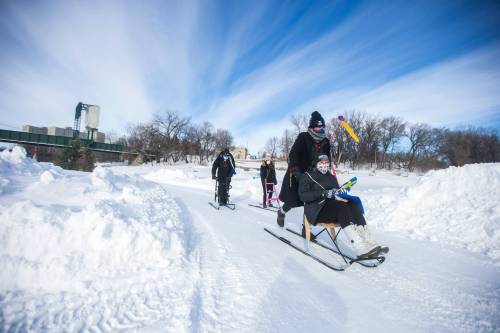
Wearing a dusty pink snowsuit and a face mask emblazoned with colourful Dala horses, Sonja Lundstrom is excited.

“This is going to be my 80th birthday present to myself,” she says, pointing to a nearby wooden kicksled poised for takeoff. “My grandma had one of these and my dad made me one out of hockey sticks for all my children… but these are the new modern ones and I haven’t had one of those.”

But today’s frosty jaunt is less of a test drive and more of a diplomatic adventure. Lundstrom is the president of the Swedish Cultural Association of Manitoba and is at The Forks to give Urban Ahlin, the Swedish Ambassador to Canada, a little taste of home.

“In my part of Sweden we use the (kicksleds) when we go out on the ice for ice fishing,” says Ahlin, who was in town recently with several other Nordic ambassadors to meet with the premier. “This is a very climate-friendly means of transportation and you can use it for lots of different reasons… it’s actually pretty fun to ride as well.”

Read
Tuesday, Feb. 8, 2022

Court ruling concludes Canadian Wheat Board saga

Laura Rance-Unger 4 minute read Preview

Court ruling concludes Canadian Wheat Board saga

Laura Rance-Unger 4 minute read Yesterday at 2:01 AM CDT

It remains to be seen whether the recent court ruling in a lawsuit filed after Canadian Wheat Board’s dissolution in 2012 puts the whole debate to rest, as some no doubt hope.

But either way, the dust has settled on the post-CWB world. The sun still rises and a new generation of farmers on the land only knows by name an institution that for generations influenced every aspect of Prairie grain farming.

The first Rural Revival column I wrote for this newspaper more than 30 years ago was about a thousand farmers from Western Canada demonstrating in support of the Wheat Board. It was in the aftermath of the Western Grain Marketing Panel report, one of several efforts that eventually included a plebiscite to help the federal government decide what to do about a vocal minority of farmers who wanted marketing “freedom.”

The polls at the time suggested about two-thirds of farmers were comfortable enough with the single-desk system for food wheat and barley to keep it around. It served as a counterbalance to canola, which they sold on the open market. They essentially had a dual market.

Read
Yesterday at 2:01 AM CDT