Vaccine protection against Omicron variant still largely unknown: experts

Advertisement

Advertise with us

Experts and global health leaders say it's still too soon to tell whether the Omicron variant will significantly threaten immunity gained from current COVID-19 vaccines as calls grow in some corners for expanded booster shots.

Read this article for free:

or

Already have an account? Log in here »

To continue reading, please subscribe:

Subscribe and receive a limited-edition Free Press branded hat or tote.

Digital Subscription

One year of digital access for only $205*

  • Enjoy unlimited reading on winnipegfreepress.com
  • Read the E-Edition, our digital replica newspaper
  • Access News Break, our award-winning app
  • Play interactive puzzles

*First annual payment billed as $205.00 + GST for one year. This annual subscription will automatically renew at $233.00 + GST every 52 weeks (10% off the regular annual price of $259.35). Offer available to new and qualified returning subscribers only. Cancel any time.

To continue reading, please subscribe:

Add Free Press access to your Brandon Sun subscription for only an additional

$1 for the first 4 weeks*

  • Enjoy unlimited reading on winnipegfreepress.com
  • Read the E-Edition, our digital replica newspaper
  • Access News Break, our award-winning app
  • Play interactive puzzles
Start now

*Your next Brandon Sun subscription payment will increase by $1.00 and you will be charged $17.95 plus GST for four weeks. After four weeks, your payment will increase to $24.95 plus GST every four weeks.

Hey there, time traveller!
This article was published 08/12/2021 (1696 days ago), so information in it may no longer be current.

Experts and global health leaders say it’s still too soon to tell whether the Omicron variant will significantly threaten immunity gained from current COVID-19 vaccines as calls grow in some corners for expanded booster shots.

Pfizer released a press release Wednesday saying that while two doses of its vaccine appear to be less effective against the new threat, a booster dose may offer important protection by raising antibody levels.

Pfizer’s data, which hasn’t been reviewed by the scientific community, also suggested that two doses of the vaccine should still protect against severe disease with Omicron, since the variant’s mutations don’t appear to hamper T-cell defences that fight the virus after infection sets in.
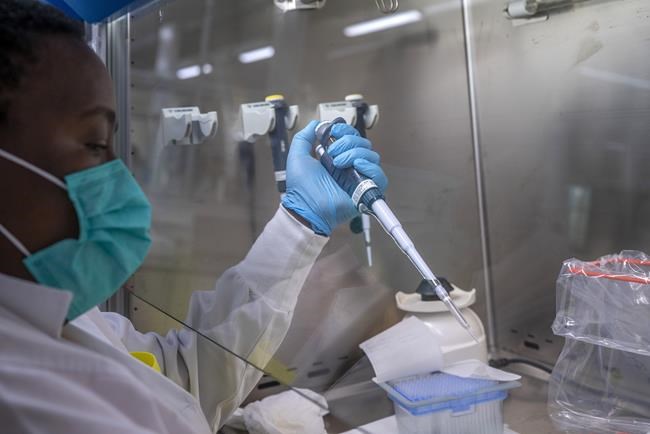
Puseletso Lesofi prepares to sequence COVID-19 Omicron samples at the Ndlovu Research Center in Elandsdoorn, South Africa on Wednesday Dec. 8, 2021. THE CANADIAN PRESS/AP-Jerome Delay

The Omicron variant, discovered late last month, carries an unusually large number of mutations on its spike protein, which is what the current mRNA vaccines target.

Cynthia Carr, an epidemiologist in Winnipeg, said the extent of those changes are still unknown. But even significant mutations likely won’t hamper vaccine effectiveness entirely.

Carr likened the antibody response to a baseball fielder wearing a glove, with the ball representing the COVID-19 virus trying to enter our cells. A fielder can catch the ball to make the out — extinguishing the viral threat before it even embeds itself.

“If that ball changes shape to a football, it doesn’t quite fit the glove, but you still know what you’re looking for and it’s not a zero chance of catching the ball,” Carr said. “It doesn’t evade entirely … but it’s more challenging.

“But that’s where your T-cells are so important, because they get in there and chase the antigen and kill it to help the antibodies that are blocking it.”

Pfizer said one way to increase protection against the Omicron variant is with a third dose of its current vaccine, developed with Germany’s BioNTech. The pharmaceutical company and others are also working on an Omicron-specific shot that will likely need clinical trials before it’s made available to the public.

Omar Khan, a biomedical engineering expert with the University of Toronto, said third doses of the already approved jabs work by boosting antibody levels, which is especially important for older members of the population and those with weakened immune systems.

Khan said antibody levels naturally drop over time and are re-triggered when exposed to the pathogen.

“But in the face of imminent exposure and to save people from being infected, you can boost their antibody levels (with a third dose),” he said. “That way, when they’re imminently exposed, they’re already ready to fight because they have more antibodies.

“They’re a little less efficient, but there’s enough of them to cover it.”

Scientists are still racing to learn how easily Omicron spreads, whether it causes more severe illness than previous variants, and how much it might evade the protection of prior vaccination.

Pfizer said blood samples taken a month after a booster showed Omicron-neutralizing antibody levels that were similar to amounts sparked by the initial two doses, which proved protective against earlier variants.

While some Canadian experts urge jurisdictions to accelerate third-dose rollouts to larger portions of the population — most provinces allow boosters for older or immunocompromised people and health-care workers six months after their second dose — Khan said more research is likely needed before expanding eligibility to everyone.

“Informed decisions need scientific data and we need more time for that data,” he said.

The World Health Organization’s chief scientist Dr. Soumya Swaminathan, shared a similar message in a briefing Wednesday, saying “it’s premature” to know whether a drop in neutralizing antibodies will result in “significant reduction in vaccine effectiveness.”

However, Jason Kindrachuk, a virologist with the University of Manitoba, said it’s better to be “proactive” on third doses in order to slow transmission of Omicron before it becomes a larger problem in Canada — and to continue staving off the still-circulating Delta variant.

“We’re getting data telling us that two doses is not going to offer us complete protection from infection (against Omicron) and we’re going to see more breakthroughs,” he said, pointing to preliminary studies from South Africa as well as Pfizer’s non-reviewed data.

“We have to do everything we can to protect and conserve our health-care system and certainly the health of those (vulnerable) people, but also stop transmission because the more transmission there is, the more potential for new variants to emerge.”

— With files from The Associated Press.

This report by The Canadian Press was first published Dec. 8, 2021.

Report Error Submit a Tip

More Stories

Jennifer was Jonesing to get back on the ice

Jason Bell 6 minute read Preview

Jennifer was Jonesing to get back on the ice

Jason Bell 6 minute read Tuesday, Sep. 29, 2020

The latest on-ice triumph for Jennifer Jones generated minimal attention and won't warrant a special section on the former Winnipegger's glitzy curling résumé.

But it was definitely one to savour, says the former Olympic gold medallist, two-time world champion and six-time Canadian champion.

Jones and her husband, Brent Laing, combined forces to win a mixed doubles event in Kitchener-Waterloo, Ont., over the weekend, their first time competing since the COVID-19 pandemic began in March.

The Cameron's Brewing cashspiel drew 10 duos to the KW Granite Club and wrapped up in just 48 hours. The Jones-Laing partnership posted five consecutive victories, including a 7-1 rout of fellow Ontarians Maddy Warriner and Charlie Richard in Sunday's final.

Read
Tuesday, Sep. 29, 2020

For years, Winnipeg has asked police officers to do a job they were never trained to do.

Somewhere along the way, police became the city’s default response to virtually every crisis, not just those involving crime. Mental-health emergencies, addiction episodes, wellness checks and people in emotional distress increasingly landed on the desks of police dispatchers because there simply wasn’t another option available around the clock.

That has placed an enormous burden on police resources while often failing to provide vulnerable people with the help they actually need.

The city’s proposal to create a “fourth crisis response pathway” is a long-overdue recognition that public safety doesn’t always require a badge and a gun. Sometimes it requires a social worker, a mental-health professional or someone with specialized crisis-intervention training.

The BEST PLACE on Earth

By Kelly Taylor 12 minute read Preview

The BEST PLACE on Earth

By Kelly Taylor 12 minute read Saturday, Jun. 20, 2009

ORLANDO, Fla. — Ponce de Leon scoured Florida looking for the fountain of youth.

Walt and Roy Disney built it 450 years later.

On an unremarkable spit of land, near an otherwise unremarkable town, the Disneys built what would give rise to the theme-park capital of the world.

Walt Disney World opened in 1971, five years after Walt's death and three months before Roy's.

Read
Saturday, Jun. 20, 2009

Enlist landlord to turn down neighbours’ volume

Maureen Scurfield Miss Lonelyhearts 3 minute read Tuesday, Apr. 19, 2022

DEAR MISS LONELYHEARTS: My side-by-side duplex neighbour sings loud, horrible duets with his girlfriend. She sings in a screechy soprano, and he bangs on the piano, and attempts to “harmonize” with her.

It’s just painful. We can hear them clearly through our cheap walls. For some reason, they get inspired late at night. Then they can go for up to an hour “singing” together. It’s endless when you’re trying to go to sleep and have to work in the morning. We figure they must be hitting the bottle.

I end up having to bang on the wall and swear at the top of my lungs to shut them up. Last night the guy banged back, and yelled through the wall, “What’s your problem, you idiot? Why don’t you come over here!”

Should I go see them? My girlfriend wants me to shut down their singing for good, no matter what it takes.

911: It’s a matter of life and death

Editorial 4 minute read Preview

911: It’s a matter of life and death

Editorial 4 minute read 2:00 AM CDT

Imagine the frustration and fear that would follow if you faced an emergency situation and the response to your desperate 911 call was … nothing.

For a number of Manitobans — too many, regardless of what the actual total turns out to be — this harrowing prospect has not been a hypothetical; rather, they have been failed by the 911 system that is supposed to provide an anytime/anywhere connection to critical police, fire or ambulance services.

The most recent occurrence was on July 22, when 911 service suddenly became unavailable to areas of Manitoba outside Winnipeg. According to Bell Canada, which provides 911 service in this province, the outage — which lasted from 1 p.m. to shortly after 4 p.m. — was caused by a “third-party cable cut” during construction near Winnipeg; a fibre optic line was severed, disrupting calls routed to the public safety answering point in Brandon. Nearly 90 emergency calls were affected, according to an official at the Brandon facility.

An alert sent out to some mobile customers during the event referred to “a province-wide 911 service disruption impacting Manitoba, excluding the City of Winnipeg,” and directed users to try 911 first, but if they were unable to get through, to “call your local 10-digit emergency numbers for fire, police and ambulance.”

Read
2:00 AM CDT

University of Manitoba faculty walk off the job over salary demands

Maggie Macintosh 5 minute read Preview

University of Manitoba faculty walk off the job over salary demands

Maggie Macintosh 5 minute read Tuesday, Nov. 2, 2021

Professors at the University of Manitoba hit pause on teaching classes Tuesday to take up physical and online picket lines after negotiations for a new contract with improved salaries fell apart a day earlier.

The faculty association at Manitoba’s largest university, which represents upwards of 1,200 professors, instructors and librarians, set a strike deadline of Nov. 2 amid a deadlock in contract negotiations.

Job action, featuring marches with protest signs, got underway at various university entrances across the city and the Manitoba legislature at 7 a.m. Tuesday; pickets are expected to start early and continue until 5 p.m. daily until a resolution is reached.

“We are on strike because we really care about students and the quality of education that they receive here in Manitoba — but in order for them to continue getting that quality education, we need to be able to recruit and retain our faculty members,” said Orvie Dingwall, president of the University of Manitoba Faculty Association, at a morning rally held at the intersection of Chancellor Matheson Road and Pembina Highway.

Read
Tuesday, Nov. 2, 2021