How would COVID-19 vaccine makers adapt to variants?

Advertisement

Advertise with us

How would COVID-19 vaccine makers adapt to variants?

Read this article for free:


or

Already have an account? Log in here »

To continue reading, please subscribe:

Subscribe and receive a limited-edition Free Press branded hat or tote.

Digital Subscription

One year of digital access for only $205*

  • Enjoy unlimited reading on winnipegfreepress.com
  • Read the E-Edition, our digital replica newspaper
  • Access News Break, our award-winning app
  • Play interactive puzzles

*First annual payment billed as $205.00 + GST for one year. This annual subscription will automatically renew at $233.00 + GST every 52 weeks (10% off the regular annual price of $259.35). Offer available to new and qualified returning subscribers only. Cancel any time.

To continue reading, please subscribe:

Add Free Press access to your Brandon Sun subscription for only an additional

$1 for the first 4 weeks*

  • Enjoy unlimited reading on winnipegfreepress.com
  • Read the E-Edition, our digital replica newspaper
  • Access News Break, our award-winning app
  • Play interactive puzzles
Start now

*Your next Brandon Sun subscription payment will increase by $1.00 and you will be charged $17.95 plus GST for four weeks. After four weeks, your payment will increase to $24.95 plus GST every four weeks.

Hey there, time traveller!
This article was published 25/02/2021 (2043 days ago), so information in it may no longer be current.

How would COVID-19 vaccine makers adapt to variants?

By tweaking their vaccines, a process that should be easier than coming up with the original shots.

Viruses constantly mutate as they spread, and most changes aren’t significant. First-generation COVID-19 vaccines appear to be working against today’s variants, but makers already are taking steps to update their recipes if health authorities decide that’s needed.
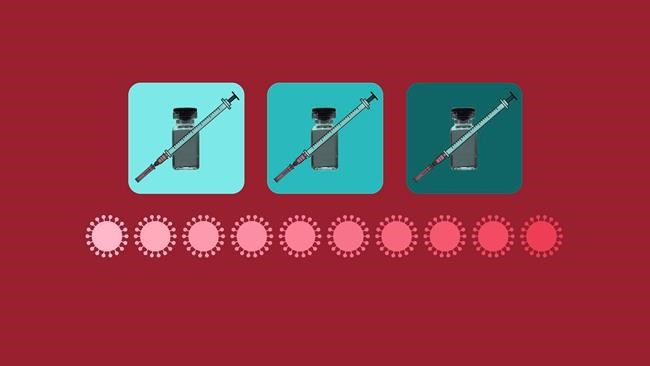
How will COVID-19 vaccine makers adapt to variants? (AP Illustration/Peter Hamlin)

COVID-19 vaccines by Pfizer and Moderna are made with new technology that’s easy to update. The so-called mRNA vaccines use a piece of genetic code for the spike protein that coats the coronavirus, so your immune system can learn to recognize and fight the real thing.

If a variant with a mutated spike protein crops up that the original vaccine can’t recognize, companies would swap out that piece of genetic code for a better match — if and when regulators decide that’s necessary.

Updating other COVID-19 vaccines could be more complex. The AstraZeneca vaccine, for example, uses a harmless version of a cold virus to carry that spike protein gene into the body. An update would require growing cold viruses with the updated spike gene.

The Food and Drug Administration said studies of updated COVID-19 vaccines won’t have to be as large or long as for the first generation of shots. Instead, a few hundred volunteers could receive experimental doses of a revamped vaccine and have their blood checked for signs it revved up the immune system as well as the original vaccines.

More difficult is deciding if the virus has morphed enough to modify shots.

Globally, health authorities will monitor coronavirus mutations to spot vaccine-resistant mutations. They’d also have to decide whether any revamped vaccine should protect against more than one variant.

Overall the process would be similar to what already happens with flu vaccine. Influenza viruses mutate much faster than coronaviruses, so flu shots are adjusted every year and must protect against multiple strains.

___

The AP is answering your questions about the coronavirus in this series. Submit them at: FactCheck@AP.org.

Read previous Viral Questions:

How do we know the COVID-19 vaccines are safe?

Can I take painkillers before or after a COVID-19 vaccine?

What should I know about COVID-19 vaccines if I’m pregnant?

Report Error Submit a Tip

More Stories

Use it twice: a data centre we could support

Hersh Seth 5 minute read Preview

Use it twice: a data centre we could support

Hersh Seth 5 minute read Thursday, Jul. 30, 2026

In June, Premier Wab Kinew rejected a massive AI data centre planned near Île-des-Chênes. The project would have used 500 megawatts of power, which is about the same as the Grand Rapids generating station, and would have run on six natural gas turbines. Kinew said the environmental cost was too high and the long-term benefit for Manitobans was too low.

He made the right call. But simply saying no to data centres is not enough.

Winnipeg is a cold city. Data centres are basically huge electric heaters with computers inside. Almost every watt they use turns into heat, and most facilities pay to release it into the air. In a city that spends half the year paying to stay warm, that’s not just waste; it’s an opportunity. The idea is simple: use the energy twice. First for computing, then for heating our buildings.

The stakes are real. Manitoba Hydro’s new resource plan says peak demand will exceed our capacity as early as 2029 or 2030, and that the province will need about 1,760 additional megawatts of dependable capacity by 2035.

Read
Thursday, Jul. 30, 2026

Billions of dollars spent on health, but scattershot financial reporting leaves decision-makers, Manitobans in the dark, auditor general says

Nicole Buffie 3 minute read Preview

Billions of dollars spent on health, but scattershot financial reporting leaves decision-makers, Manitobans in the dark, auditor general says

Nicole Buffie 3 minute read 5:20 PM CDT

Manitoba’s auditor general says significant gaps in health-sector financial reporting make it difficult to understand how billions of dollars in public funds are spent.

Auditor General Tyson Shtykalo is calling for clearer, more transparent reporting in his latest report, titled Observations on Health Sector Financial Reporting and Accountability in Manitoba.

“Manitoba spends nearly $10 billion annually on health care, but current financial reporting does not provide a clear picture of how that money is spent, what services cost, or the financial pressures facing the system,” Shtykalo said in a news release.

While some financial information is available, the reports do not provide a “complete, consistent, or easily understood” picture of how health-care funds are spent, the report said.

Read
5:20 PM CDT

How would COVID-19 vaccine makers adapt to variants?

The Associated Press 3 minute read Preview

How would COVID-19 vaccine makers adapt to variants?

The Associated Press 3 minute read Thursday, Feb. 25, 2021

How would COVID-19 vaccine makers adapt to variants?

By tweaking their vaccines, a process that should be easier than coming up with the original shots.

Viruses constantly mutate as they spread, and most changes aren't significant. First-generation COVID-19 vaccines appear to be working against today's variants, but makers already are taking steps to update their recipes if health authorities decide that's needed.

COVID-19 vaccines by Pfizer and Moderna are made with new technology that's easy to update. The so-called mRNA vaccines use a piece of genetic code for the spike protein that coats the coronavirus, so your immune system can learn to recognize and fight the real thing.

Read
Thursday, Feb. 25, 2021

Today’s horoscope

Georgia Nicols 4 minute read Preview

Today’s horoscope

Georgia Nicols 4 minute read Sunday, Aug. 16, 2026

MOON ALERT: There are no restrictions to shopping or important decisions today. The moon is in Libra.

ARIES (March 21-April 19)

The day is a mixed bag. For the most part, it’s romantic, friendly, congenial and a great time to socialize with others and enjoy playful activities with kids. Nevertheless, you might meet a real sourpuss or someone who is a wet blanket. Keep things light!

TAURUS (April 20-May 20)

Read
Sunday, Aug. 16, 2026

Esoteric hair works meant to muss up mores

AV Kitching 5 minute read Preview

Esoteric hair works meant to muss up mores

AV Kitching 5 minute read Saturday, Oct. 18, 2025

Sandra Klowak likes playing with hair, though not all of it is hers.

Every day she twists and pulls, deftly twirling and looping strands into intricate shapes.

Petals bloom beneath her fingers, lank locks and wavy curls coil into tightly furled roses and wide-open blossoms with buttons for pistils.

The artist weaves and sculpts body matter into art for clients who want to memorialize loved ones in an intimate and profoundly personal manner.

Read
Saturday, Oct. 18, 2025

Titanic model an unexpected gift of unsinkable memories of my dad

Melissa Martin 7 minute read Preview

Titanic model an unexpected gift of unsinkable memories of my dad

Melissa Martin 7 minute read Thursday, Jun. 18, 2020

When I was a little girl, I became briefly obsessed with nautical disasters. It was an early sign of what would become a lifelong fixation with how people behave in moments of crisis: the men who gave up their spot on the lifeboat. The men who forced their way on. The captain who watched his ship die, and stood firm.

In the midst of this obsession, my father, cheerfully unruffled by the macabre tenor of his youngest daughter’s new interest, brought home a model Titanic, one of those paint-your-own kits they sell at hobby stores. We spent hours working on it at the dining room table, dabbing brushes in tiny pots of paint while I rattled off Titanic facts.

“Dad, did you know the ship broke in two pieces when it sank?”

With a few careful brush strokes, a miniature plastic propeller is clad in silver.

Read
Thursday, Jun. 18, 2020