

Use it twice: a data centre we could support
Advertisement
Read this article for free:
or
Already have an account? Log in here »
To continue reading, please subscribe:

Digital Subscription
One year of digital access for only $205*
- Enjoy unlimited reading on winnipegfreepress.com
- Read the E-Edition, our digital replica newspaper
- Access News Break, our award-winning app
- Play interactive puzzles
*First annual payment billed as $205.00 + GST for one year. This annual subscription will automatically renew at $233.00 + GST every 52 weeks (10% off the regular annual price of $259.35). Offer available to new and qualified returning subscribers only. Cancel any time.
To continue reading, please subscribe:
Add Free Press access to your Brandon Sun subscription for only an additional
$1 for the first 4 weeks*
- Enjoy unlimited reading on winnipegfreepress.com
- Read the E-Edition, our digital replica newspaper
- Access News Break, our award-winning app
- Play interactive puzzles
*Your next Brandon Sun subscription payment will increase by $1.00 and you will be charged $17.95 plus GST for four weeks. After four weeks, your payment will increase to $24.95 plus GST every four weeks.
Read unlimited articles for free today:
or
Already have an account? Log in here »
In June, Premier Wab Kinew rejected a massive AI data centre planned near Île-des-Chênes. The project would have used 500 megawatts of power, which is about the same as the Grand Rapids generating station, and would have run on six natural gas turbines. Kinew said the environmental cost was too high and the long-term benefit for Manitobans was too low.
He made the right call. But simply saying no to data centres is not enough.
Winnipeg is a cold city. Data centres are basically huge electric heaters with computers inside. Almost every watt they use turns into heat, and most facilities pay to release it into the air. In a city that spends half the year paying to stay warm, that’s not just waste; it’s an opportunity. The idea is simple: use the energy twice. First for computing, then for heating our buildings.
Darren Calabrese / THE CANADIAN PRESS
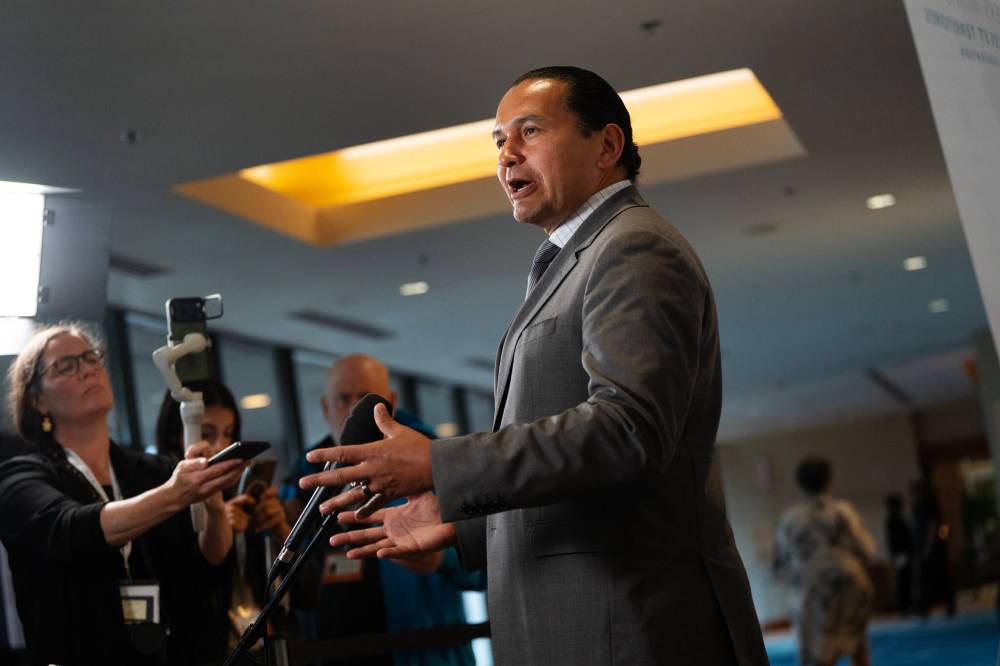
Hersh Seth writes Premier Wab Kinew was right to cancel an AI project near Île-des-Chênes — but other options for data centres might actually be a good choice for Winnipeg.
The stakes are real. Manitoba Hydro’s new resource plan says peak demand will exceed our capacity as early as 2029 or 2030, and that the province will need about 1,760 additional megawatts of dependable capacity by 2035.
A growing population, electric vehicles and the shift away from gas heating are all straining the same grid, and some energy-hungry projects have already been delayed because spare power isn’t available.
Artificial intelligence is now adding even more demand, and this is not optional.
On the same day Manitoba said no to Île-des-Chênes, Ottawa announced its national AI strategy. Canada has decided it needs its own computing power, so our researchers, businesses and public institutions do not have to rely entirely on foreign companies to store Canadian data and run important systems. That computing will end up on someone’s grid.
In these pages, Fred Wilson and Robert Chernomas have asked what kind of AI Canada needs, what purpose it should serve, and who should own it. Winnipeggers should add a fourth question: what will this infrastructure give back to the community that hosts it?
If Manitoba simply opts out, the build-out will happen somewhere else. In places such as Alberta, some of it is powered by new natural gas, which locks in emissions for decades. Saying no to the wrong projects only matters if we can say yes to the right ones.
Here is what the right project looks like. Almost all the electricity a data centre uses turns into low-grade heat in its cooling system. Capture that heat and use heat pumps to raise its temperature. The International Energy Agency estimates that 70 to 80 per cent of it can be recovered. Then, send it through insulated pipes to the buildings next door.
Cold cities already do this. Stockholm uses data centre heat in its district heating network.
Outside Helsinki, Microsoft and the utility Fortum are building data centres that will warm nearby communities. The obvious objection is that those cities have district heating pipes, and Winnipeg mostly does not.
That is true, which is why our model is not city-wide district heat. Instead, it is co-location: a right-sized facility, powered by new clean energy, built next to the customers who need its warmth. This could be a hospital campus with round-the-clock demand, a recreation centre where the pool is a great match for low-grade heat, or a greenhouse cluster growing food through February.
Many of these buildings are publicly owned, so city hall can choose to be the main customer instead of just watching from the sidelines. This makes it a municipal opportunity, not just a provincial issue.
None of this should be a favour to developers.

Before any construction starts, a proponent should have signed agreements with heat customers and should help pay for the connections. Any project should also cover its share of grid upgrades, accept strict limits on water use, and publicly report its energy consumption and heat recovery every year. A data centre that cannot meet those terms is the kind we just turned down.
Heat recovery does not remove the need for new generation, transmission and backup. Nothing can do that. But when electricity is scarce, the worst thing we can do is use it once and let the byproduct escape into the January sky.
Canada’s computing will be built somewhere. Winnipeg has what most cities do not — steady cold, clean and reliable power, and buildings that need heat. Put these together, and the data centre boom stops being a threat to our grid and becomes a way to warm our homes, our hospitals and our oldest neighbourhoods.
Use it twice. That is how Winnipeg leads, in a classically Manitoban way.
Hersh Seth is a Winnipeg resident and community organizer.