Trump’s age, health woes raise his risk for COVID-19 illness

Advertisement

Advertise with us

President Donald Trump has several strikes against him — age, obesity, elevated cholesterol and being male — that could put him at greater risk of becoming seriously ill from the coronavirus infection he disclosed early Friday.

Read this article for free:


or

Already have an account? Log in here »

To continue reading, please subscribe:

Subscribe and receive a limited-edition Free Press branded hat or tote.

Digital Subscription

One year of digital access for only $205*

  • Enjoy unlimited reading on winnipegfreepress.com
  • Read the E-Edition, our digital replica newspaper
  • Access News Break, our award-winning app
  • Play interactive puzzles

*First annual payment billed as $205.00 + GST for one year. This annual subscription will automatically renew at $233.00 + GST every 52 weeks (10% off the regular annual price of $259.35). Offer available to new and qualified returning subscribers only. Cancel any time.

To continue reading, please subscribe:

Add Free Press access to your Brandon Sun subscription for only an additional

$1 for the first 4 weeks*

  • Enjoy unlimited reading on winnipegfreepress.com
  • Read the E-Edition, our digital replica newspaper
  • Access News Break, our award-winning app
  • Play interactive puzzles
Start now

*Your next Brandon Sun subscription payment will increase by $1.00 and you will be charged $17.95 plus GST for four weeks. After four weeks, your payment will increase to $24.95 plus GST every four weeks.

Hey there, time traveller!
This article was published 02/10/2020 (2195 days ago), so information in it may no longer be current.

President Donald Trump has several strikes against him — age, obesity, elevated cholesterol and being male — that could put him at greater risk of becoming seriously ill from the coronavirus infection he disclosed early Friday.

Trump’s doctor said later in the day that the president felt fatigued and that he had been given an experimental treatment aimed at staving off a severe case of COVID-19. Friday evening he was flown to a military hospital where he will spend a “few days.” Being there would allow for closer monitoring, such as if doctors decide they’d like scans of his lungs, and a quicker reaction time if he takes a turn for the worse.

“The odds are far and away that he’ll have a mild illness” as most people with the virus do, said Dr. Gregory Poland, an infectious disease specialist at the Mayo Clinic who has no role in Trump’s care.

U.S. President Donald Trump throws hats to supporters after speaking at a campaign rally at Duluth International Airport in Duluth, Minn., on Wednesday.  (AP Photo/Alex Brandon, File)
U.S. President Donald Trump throws hats to supporters after speaking at a campaign rally at Duluth International Airport in Duluth, Minn., on Wednesday. (AP Photo/Alex Brandon, File)

But COVID-19 is very unpredictable, he stressed.

“We have young people who die. We have nursing home patients, a lot of them, who actually do quite well,” Poland said.

Here’s what experts say about Trump’s outlook and next steps.

SIGNS AND SYMPTOMS

Infection causes mild or no symptoms in about 80% of cases. About 15% of people become seriously ill and 5% get critically ill.

Symptoms, when they do occur, usually appear two to 14 days after infection and can include loss of smell or taste, coughing, a sore throat, trouble breathing, fatigue, muscle or body aches, headache, nausea or vomiting, diarrhea and fever.

Up to half of patients who are hospitalized don’t have a fever when admitted but nearly all develop one. How people fare varies widely — some seem to be recovering and then suddenly worsen.

Pneumonia, often with a specific appearance on X-rays, sometimes develops but complications in virtually every organ of the body have been reported.

Doctors also increasingly recognize that some people have long-lasting symptoms.

TRUMP’S RISKS

Older age, being male and having any other health problems increase the chance of severe illness, and Trump has those.

At 74, “his age would be the primary risk factor,” said Dr. David Banach, an infectious diseases physician at the University of Connecticut’s health system.

People ages 65 to 74 are seven times more likely to be hospitalized for COVID-19 than those who are 18 to 29 years old, according to the U.S. Centers for Disease Control and Prevention. The risks rise exponentially at older ages.

Trump also is obese, with a body mass index just past 30.

“Obesity is a state of chronic lowered immunity. In other words, you don’t respond to vaccines as well, you don’t respond to infections as well” as people of normal weight, Poland said.

Trump takes a statin drug to lower his cholesterol, and that condition also raises his risk for COVID-19 complications, doctors said.

NEXT STEPS

Doctors likely will check Trump often for any difficulty breathing, coughing or other symptoms, Banach said.
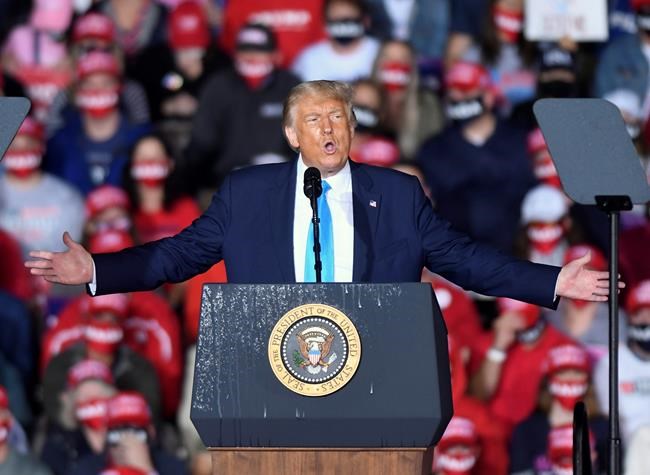
In this Sept. 26, 2020, file photo, President Donald Trump speaks during a campaign rally at Harrisburg International Airport in Middletown, Pa. President Trump and first lady Melania Trump have tested positive for the coronavirus, the president tweeted early Friday. (AP Photo/Steve Ruark, File)

No drugs are known to help for people with no or very mild symptoms. Remdesivir and steroids have shown benefit for certain moderately and severely ill patients and remdesivir is now being tested for patients in the early stages of COVID-19.

Late Friday, Trump’s physician, Dr. Sean Conley, said the president had been given remdesivir at the military hospital.

Earlier, Trump was given an experimental antibody drug that’s currently in late-stage studies from Regeneron Pharmaceuticals Inc.

Antibodies are proteins the body makes when an infection occurs. They attach to a virus and help it be eliminated. The Regeneron drug is made with purified versions of two such antibodies.

RISK TO OTHERS

Could Trump have infected Democratic presidential nominee Joe Biden during the debate Tuesday night?

Possible, but not likely, experts said. The candidates were more than 6 feet apart. But both candidates, especially Trump, spoke loudly, which research suggests can make virus particles travel farther, Poland said.

Biden said Friday on Twitter that he and his wife, Jill, tested negative.

Dr. George Abraham, who heads the infectious disease board for the American Board of Internal Medicine, warned that “a negative test doesn’t guarantee that someone is not harbouring virus” because there might be too little to detect early in infection.

“This is a wakeup call” that shows the need for social distancing, wearing masks and other measures to reduce spread, Abraham said.

Biden similarly tweeted, “I hope this serves as a reminder: wear a mask, keep social distance, and wash your hands.”

A myriad of other people who have been around Trump in the previous 48 hours are at risk, doctors said.

“Contact tracing is going to be really important,” Banach said. “The president comes into contact with many individuals during the day.”

___

The Associated Press Health and Science Department receives support from the Howard Hughes Medical Institute’s Department of Science Education. The AP is solely responsible for all content.

Report Error Submit a Tip

More Stories

The alternative is in the ground

Stuart Williams 5 minute read Wednesday, Jul. 29, 2026

The cheapest 750 megawatts isn’t a methane plant. It’s our own furnaces.

Manitoba Hydro wants to build up to $3 billion worth of additional methane turbines near Brandon — 750 megawatts of fossil-fuelled power, to get us through the coldest winter evenings and the driest years.

As the Public Utilities Board weighs the plan this summer, Manitobans should ask a simple question — is burning methane really the cheapest way to keep the lights on and the furnaces running?

The evidence says no.

Botched execution revives death penalty debate

Arthur Chapman 5 minute read 2:00 AM CDT

The United States of America’s seemingly endless, often futile, search for the painless, bloodless method of executing prisoners continues. The latest horrifying chapter occurred in Tennessee on Sept. 30, when the state tried to kill convicted murderer Christa Pike by lethal injection.

It didn’t work. Pike survived two dosages of pentobarbital. She was rushed to a hospital where, according to her lawyer, she was receiving “lifesaving care”.

Tennessee governor Bill Lee has cancelled upcoming executions, but he isn’t moving away from capital punishment.

Lee said, as quoted in the New York Times: “The people of Tennessee have determined that capital punishment is the appropriate sentence for the most heinous of crimes. The people of Tennessee expect those sentences to be carried out in a manner that’s not only legal and constitutional but effective, and that didn’t happen.”

Wasteful operations should be held accountable

Barry E. Prentice 5 minute read Preview

Wasteful operations should be held accountable

Barry E. Prentice 5 minute read Yesterday at 2:00 AM CDT

Rising water bills are a top-of-mind issue for residents of Winnipeg going into the fall election. Management of the water and waste system is under question, with citizen’s groups, as well as the Free Press, calling for proper oversight of rates (Time for the PUB to review Winnipeg water rates, Editorial, Sept. 26).

The need to increase rates to build the North End sewage plant is understandable. Siphoning off utility proceeds to make up other tax revenue shortfalls is another matter. But it is not the only questionable practice. If there was Public Utilities Board oversight of Winnipeg’s water and sewer rates, it would certainly be asking why the city is spending more than $3 million annually to operate the 164-kilometre-long, Greater Winnipeg Water District railway (GWWD) on ratepayers’ behalf.

The GWWD has come to the attention of the Railway Relocation Study, led by Lloyd Axworthy. All existing rail lines within the city are under review, as is the feasibility of a new railway bypass.

The GWWD is an example of a railway that has outlived its usefulness and sits on a pocket of land close to downtown that could be converted to higher-value uses.

Read
Yesterday at 2:00 AM CDT

City emergency crews to administer drug that stops opioid withdrawal symptoms

Joyanne Pursaga 5 minute read Preview

City emergency crews to administer drug that stops opioid withdrawal symptoms

Joyanne Pursaga 5 minute read Monday, Aug. 10, 2026

Winnipeg Fire Paramedic Service crews will soon give out a medication that stops withdrawal symptoms after someone is treated for an opioid overdose.

Emergency workers will be administering a drug called buprenorphine, after Health Canada granted WFPS permission to use the controlled substance.

“Buprenorphine is a medication that offers people who are in active addiction — so those people who have received naloxone as a result of an overdose and those that are experiencing significant and, at times, dangerous withdrawal symptoms — just a bit of a reprieve … (It) reduces cravings and prevents those immediate withdrawal symptoms, which allows more time to connect those patients to further care,” said Michelle Long, WFPS assistant chief of paramedic operations.

The treatment option is in response to a persistently high number of WFPS opioid calls.

Read
Monday, Aug. 10, 2026

Real journalists matter in an AI world

Paul Deegan 4 minute read Preview

Real journalists matter in an AI world

Paul Deegan 4 minute read 2:00 AM CDT

An algorithm can decide what you see, but it doesn’t report the news. Nunatsiaq News, an award-winning newspaper in Nunavut, recently reported that a so-called “news” website was posting AI-generated articles about the north by stealing real news stories produced by real journalists.

The articles were supposedly written by Nunavut correspondent Leah Qammaniq — a fake journalist, with a fake photo and a fake bio.

Governor General Louise Arbour warned us of fake news in her installation speech in June. She said, “We must continue to protect the public space in which our national debates take place: from schools and universities to the media, political parties, unions and civil society organizations …With instant access to vast amounts of information, it is very tempting to pay little attention to the reliability of sources. The lines between knowledge and belief, between truth and falsehood, between facts and assumptions, are increasingly blurred. AI could be threatening not only the way we live and work, but also the control we exercise over our own destiny.”

The Government of Canada has recognized the problem as well. Its recent discussion paper, Enhancing trust in artificial intelligence through increased transparency, stated, “Canadians encounter news reporting, product reviews, and audio-visual content across the internet, often without any indication of whether it was written by a person, generated by an AI system, or produced through some combination of both … A particular concern within this broader landscape is that generative AI greatly enables the creation and dissemination of deceptive or misleading content.”

Read
2:00 AM CDT

Letters, Oct. 6

6 minute read 2:00 AM CDT

High road not so easy

Re: Khan should’ve taken high road: Goertzen (Oct. 3)

Politics is a tough game. Just ask former provincial Liberal leader Dougald Lamont. He got thrown under the bus by a prominent Manitoba/Canadian Liberal who advised people to vote NDP in the last provincial election.

As Lamont said when he lost the election, he is “human” and what happened to him “hurt.” Khan is also human. It is easy to criticize him for not taking the “high road.”