Trump gets experimental drug aimed at curbing severe illness

Advertisement

Advertise with us

The experimental antibody drug given to President Donald Trump has been called one of the most promising approaches to preventing serious illness from a COVID-19 infection.

Read this article for free:


or

Already have an account? Log in here »

To continue reading, please subscribe:

Subscribe and receive a limited-edition Free Press branded hat or tote.

Digital Subscription

One year of digital access for only $205*

  • Enjoy unlimited reading on winnipegfreepress.com
  • Read the E-Edition, our digital replica newspaper
  • Access News Break, our award-winning app
  • Play interactive puzzles

*First annual payment billed as $205.00 + GST for one year. This annual subscription will automatically renew at $233.00 + GST every 52 weeks (10% off the regular annual price of $259.35). Offer available to new and qualified returning subscribers only. Cancel any time.

To continue reading, please subscribe:

Add Free Press access to your Brandon Sun subscription for only an additional

$1 for the first 4 weeks*

  • Enjoy unlimited reading on winnipegfreepress.com
  • Read the E-Edition, our digital replica newspaper
  • Access News Break, our award-winning app
  • Play interactive puzzles
Start now

*Your next Brandon Sun subscription payment will increase by $1.00 and you will be charged $17.95 plus GST for four weeks. After four weeks, your payment will increase to $24.95 plus GST every four weeks.

Hey there, time traveller!
This article was published 02/10/2020 (2195 days ago), so information in it may no longer be current.

The experimental antibody drug given to President Donald Trump has been called one of the most promising approaches to preventing serious illness from a COVID-19 infection.

Its maker, Regeneron Pharmaceuticals Inc., said the company agreed to supply a single dose, given through an IV, for Trump at the request of his physician under “compassionate use” provisions, when an experimental medicine is provided on a case-by-case emergency basis, while studies of it continue.

The new drug is in late-stage testing and its safety and effectiveness are not yet known. No treatment has yet proved able to prevent serious illness after a coronavirus infection.
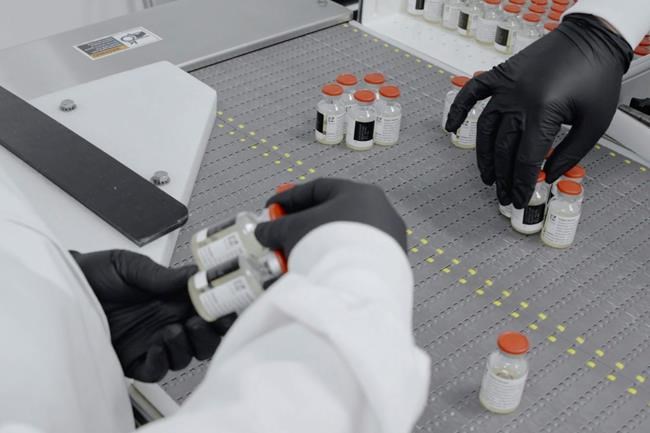
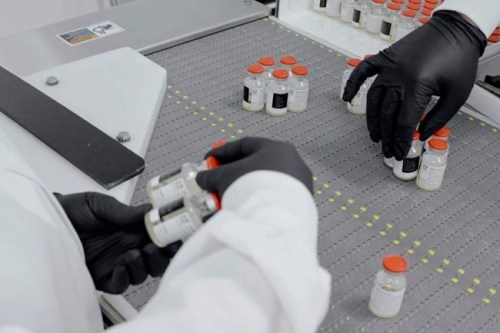
In this undated image from video provided by Regeneron Pharmaceuticals on Friday, Oct. 2, 2020, vials are inspected at the company's facilities in New York state, for efforts on an experimental coronavirus antibody drug. Antibodies are proteins the body makes when an infection occurs; they attach to a virus and help the immune system eliminate it. (Regeneron via AP)

Trump was given the experimental drug at the White House on Friday before he was taken to Walter Reed National Military Medical Center, where he’ll be monitored, officials said. So far, Trump has had only mild symptoms, including fatigue.

Several physicians who treat COVID-19, including Dr. David Boulware at the University of Minnesota, had speculated that doctors might use the antibody drug, given that this approach has worked against other diseases in the past.

“They’re not going to just sit around and watch to see if he gets sick,” Boulware said.

HOW ANTIBODIES WORK

Antibodies are proteins the body makes when an infection occurs; they attach to a virus and help the immune system eliminate it. Vaccines trick the body into thinking there’s an infection so it makes these antibodies.

But it can take weeks for them to form after natural infection or a vaccine. The drugs aim to give that protection immediately, by supplying concentrated versions of one or two antibodies that worked best against the coronavirus in lab and animal tests.

Regeneron’s drug contains two antibodies to enhance chances that it will work. The company previously developed a successful Ebola treatment from an antibody combo.

WHAT’S KNOWN SO FAR

The drug is given as a one-time treatment through an IV. In multiple studies, Regeneron is testing it both for preventing infection and in people already infected, like Trump, to try to prevent serious illness or death.

Earlier this week, Regeneron said partial results from about 275 COVID-19 patients who were not sick enough to need hospitalization suggested it might be cutting how long symptoms last and helping reduce the amount of virus patients harbour.
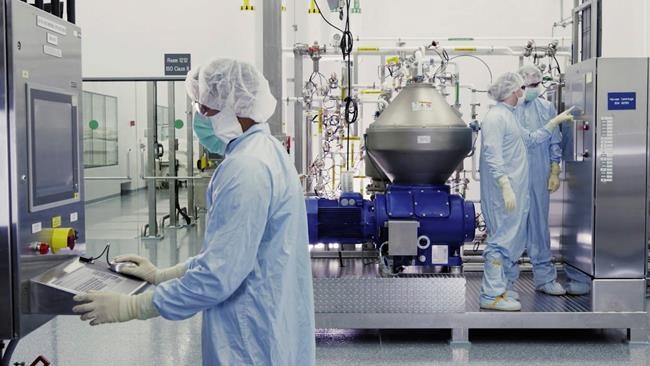
In this undated image from video provided by Regeneron Pharmaceuticals on Friday, Oct. 2, 2020, scientists work with a bioreactor at a company facility in New York state, for efforts on an experimental coronavirus antibody drug. Antibodies are proteins the body makes when an infection occurs; they attach to a virus and help the immune system eliminate it. (Regeneron via AP)

However, the study has not been completed, the results were only announced in a company news release and have not been published or reviewed by other scientists.

TRUMP’S OTHER TREATMENTS

Trump’s physician, Dr. Sean Conley, said late Friday that Trump had also been given the antiviral drug remdesivir at the military hospital. The Gilead Sciences drug has been shown to help some COVID-19 patients recover faster.

Earlier, Conley said Trump also was taking zinc, vitamin D, an antacid called famotidine, melatonin and aspirin. None of those have been proven to be effective against COVID-19.

Trump apparently is not receiving hydroxychloroquine, a drug he widely promoted that has been shown in many studies to be ineffective for preventing or treating COVID-19.

___

The Associated Press Health and Science Department receives support from the Howard Hughes Medical Institute’s Department of Science Education. The AP is solely responsible for all content.

Report Error Submit a Tip

More Stories

Trump gets experimental drug aimed at curbing severe illness

Marilynn Marchione, The Associated Press 4 minute read Preview

Trump gets experimental drug aimed at curbing severe illness

Marilynn Marchione, The Associated Press 4 minute read Friday, Oct. 2, 2020

The experimental antibody drug given to President Donald Trump has been called one of the most promising approaches to preventing serious illness from a COVID-19 infection.

Its maker, Regeneron Pharmaceuticals Inc., said the company agreed to supply a single dose, given through an IV, for Trump at the request of his physician under “compassionate use” provisions, when an experimental medicine is provided on a case-by-case emergency basis, while studies of it continue.

The new drug is in late-stage testing and its safety and effectiveness are not yet known. No treatment has yet proved able to prevent serious illness after a coronavirus infection.

Trump was given the experimental drug at the White House on Friday before he was taken to Walter Reed National Military Medical Center, where he’ll be monitored, officials said. So far, Trump has had only mild symptoms, including fatigue.

Read
Friday, Oct. 2, 2020

Seven Wilsons, one regional spirit

Hersh Seth 5 minute read Preview

Seven Wilsons, one regional spirit

Hersh Seth 5 minute read 2:00 AM CDT

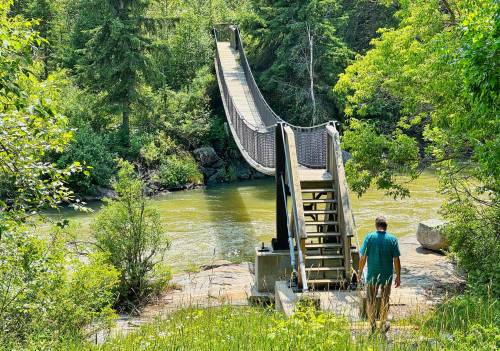
In Dryden, Ont., a 34-metre suspension bridge crosses the Wabigoon River rapids. It is named after a man who paid for a quarter of the bridge himself. A plaque recognizes Roy Wilson’s “many contributions to City Revitalization” and mentions his 40 years in the Rotary Club, whose motto is “service above self”.

My father sold business machines from the 1970s through the ’90s, during the shift from carbon copy machines and typewriters to photocopiers, fax machines, and early office computers and printers. His sales territory — which he covered mostly by car but also by propeller plane — was Saskatchewan, the Northwest Territories, Manitoba, and northwestern Ontario, though much of it really belonged to the Wilsons.

In business machines, selling the machine was only half the job — the other half was ensuring a technician would fix it in January. Wilson’s set the standard for dealers across most of my dad’s regions. My father worked with Roy’s son Greg (who would later go on to become mayor of Dryden) but really respected Roy for teaching Greg to run the company with the towns they served as the priority.

Wilson’s service routes went beyond where roads stopped. Even if customers lived north of the highway system, Wilson’s still found a way to help, using three company planes based at the Dryden airport. As a result, a stationery shop from a paper mill town served all of northwestern Ontario and later northern Manitoba. Imagine a photocopier strapped into a small plane, a technician beside it, and a gravel runway waiting at the other end.

Read
2:00 AM CDT

Real journalists matter in an AI world

Paul Deegan 4 minute read Preview

Real journalists matter in an AI world

Paul Deegan 4 minute read 2:00 AM CDT

An algorithm can decide what you see, but it doesn’t report the news. Nunatsiaq News, an award-winning newspaper in Nunavut, recently reported that a so-called “news” website was posting AI-generated articles about the north by stealing real news stories produced by real journalists.

The articles were supposedly written by Nunavut correspondent Leah Qammaniq — a fake journalist, with a fake photo and a fake bio.

Governor General Louise Arbour warned us of fake news in her installation speech in June. She said, “We must continue to protect the public space in which our national debates take place: from schools and universities to the media, political parties, unions and civil society organizations …With instant access to vast amounts of information, it is very tempting to pay little attention to the reliability of sources. The lines between knowledge and belief, between truth and falsehood, between facts and assumptions, are increasingly blurred. AI could be threatening not only the way we live and work, but also the control we exercise over our own destiny.”

The Government of Canada has recognized the problem as well. Its recent discussion paper, Enhancing trust in artificial intelligence through increased transparency, stated, “Canadians encounter news reporting, product reviews, and audio-visual content across the internet, often without any indication of whether it was written by a person, generated by an AI system, or produced through some combination of both … A particular concern within this broader landscape is that generative AI greatly enables the creation and dissemination of deceptive or misleading content.”

Read
2:00 AM CDT

Band keeps plight of MMIWG close to heart on new track

Ben Waldman 6 minute read Preview

Band keeps plight of MMIWG close to heart on new track

Ben Waldman 6 minute read 2:00 AM CDT

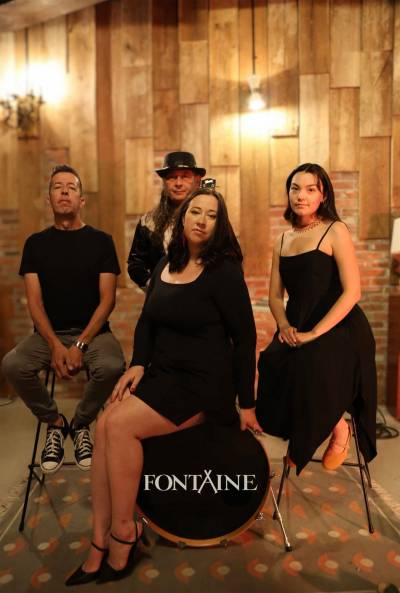
Gabrielle Fontaine won’t stop talking about them and neither will her bandmates.

As a teenager, the Winnipeg songwriter — whose late father Vince was the passionate leader of musical projects including Eagle & Hawk — would volunteer at Wiping Away the Tears, an annual gathering hosted by Ka Ni Kanichihk that offers space for healing, ceremony and support for relatives of missing and murdered Indigenous women, girls and two-spirit people.

Though Indigenous people make up less than five per cent of the Canadian population, Indigenous women make up 16 per cent of all female homicide victims and 11 per cent of missing women, according to the Assembly of First Nations.

Seeking a way to help in the community, Fontaine regularly volunteered as a child-minder during memorial events, an experience she says shaped her outlook as a musical storyteller.

Read
2:00 AM CDT

Messing credits teammates for support

Lori Ewing, The Canadian Press 6 minute read Preview

Messing credits teammates for support

Lori Ewing, The Canadian Press 6 minute read Friday, Jan. 17, 2020

MISSISSAUGA, Ont. - The rink had always felt like home for Keegan Messing. But in the days and weeks after his brother's death, the Canadian figure skater struggled to find solace on the ice.

In a sport that requires steely nerves to reel off big jumps, and the ability to dig deep to push through searing pain, Messing had lost his will.

"It was the question of: why am I doing this?" Messing said. "In the grand scheme of life, it was: should I still do this? Can I still do this?"

Less than four months after his younger brother Paxon died in a motorcycle crash in Anchorage, Messing is aiming for his first national title at the Canadian figure skating championships, and a spot on the world championship team. He credits fellow Canadian skaters Nam Nguyen and Piper Gilles for getting him to the start gate.

Read
Friday, Jan. 17, 2020

Odermatt wins super-G, keeps season title hopes alive

The Associated Press 3 minute read Preview

Odermatt wins super-G, keeps season title hopes alive

The Associated Press 3 minute read Sunday, Mar. 7, 2021

SAALBACH-HINTERGLEMM, Austria - Marco Odermatt dominated the penultimate men’s World Cup super-G of the season Sunday to keep himself in the race for the discipline title.

The Swiss skier finished his gutsy run on the Schneekristall course 0.62 seconds ahead of runner-up Matthieu Bailet.

The Frenchman was the 2016 junior world champion and earned his first podium result on the World Cup circuit.

Vincent Kriechmayr, the double world champion from Austria, trailed Odermatt by 0.81 in third, a day after he won the downhill on the same hill. Another Austrian, Raphael Haaser, finished two-hundredths behind Kriechmayr in fourth.

Read
Sunday, Mar. 7, 2021