

Seven Wilsons, one regional spirit
Advertisement
Read this article for free:
or
Already have an account? Log in here »
To continue reading, please subscribe:

Digital Subscription
One year of digital access for only $205*
- Enjoy unlimited reading on winnipegfreepress.com
- Read the E-Edition, our digital replica newspaper
- Access News Break, our award-winning app
- Play interactive puzzles
*First annual payment billed as $205.00 + GST for one year. This annual subscription will automatically renew at $233.00 + GST every 52 weeks (10% off the regular annual price of $259.35). Offer available to new and qualified returning subscribers only. Cancel any time.
To continue reading, please subscribe:
Add Free Press access to your Brandon Sun subscription for only an additional
$1 for the first 4 weeks*
- Enjoy unlimited reading on winnipegfreepress.com
- Read the E-Edition, our digital replica newspaper
- Access News Break, our award-winning app
- Play interactive puzzles
*Your next Brandon Sun subscription payment will increase by $1.00 and you will be charged $17.95 plus GST for four weeks. After four weeks, your payment will increase to $24.95 plus GST every four weeks.
Read unlimited articles for free today:
or
Already have an account? Log in here »
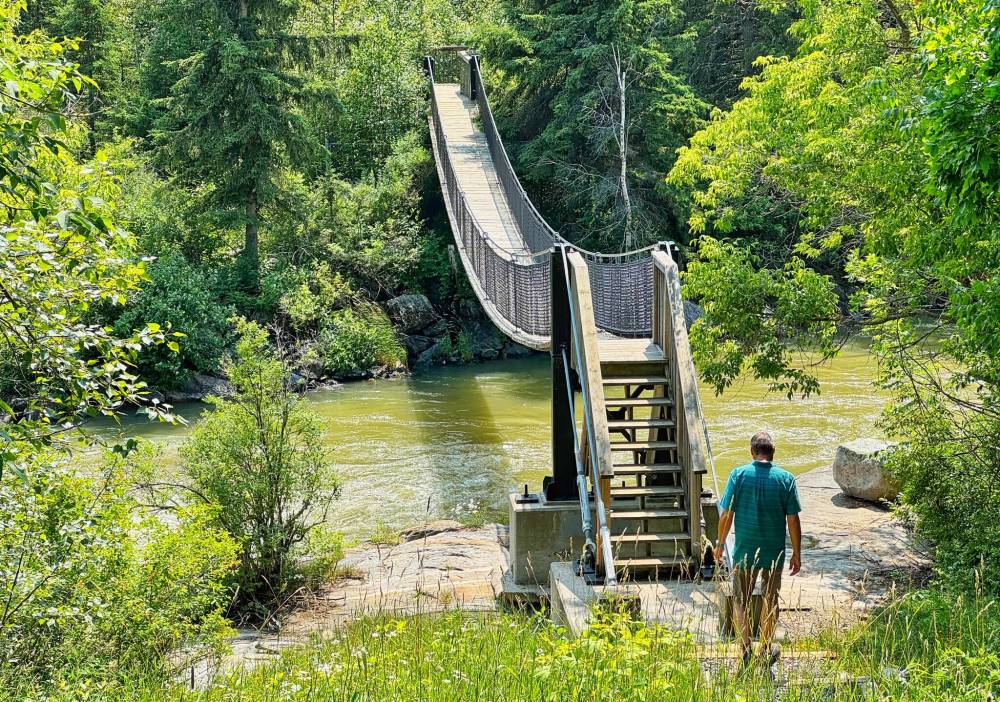
In Dryden, Ont., a 34-metre suspension bridge crosses the Wabigoon River rapids. It is named after a man who paid for a quarter of the bridge himself. A plaque recognizes Roy Wilson’s “many contributions to City Revitalization” and mentions his 40 years in the Rotary Club, whose motto is “service above self”.
My father sold business machines from the 1970s through the ’90s, during the shift from carbon copy machines and typewriters to photocopiers, fax machines, and early office computers and printers. His sales territory — which he covered mostly by car but also by propeller plane — was Saskatchewan, the Northwest Territories, Manitoba, and northwestern Ontario, though much of it really belonged to the Wilsons.
In business machines, selling the machine was only half the job — the other half was ensuring a technician would fix it in January. Wilson’s set the standard for dealers across most of my dad’s regions. My father worked with Roy’s son Greg (who would later go on to become mayor of Dryden) but really respected Roy for teaching Greg to run the company with the towns they served as the priority.
TED MCGRATH / FLICKR
The Roy Wilson Suspension Bridge crosses the Wabigoon River near Dryden, Ont. It is named for Roy Wilson, who ran Wilson’s Business Solutions.
Wilson’s service routes went beyond where roads stopped. Even if customers lived north of the highway system, Wilson’s still found a way to help, using three company planes based at the Dryden airport. As a result, a stationery shop from a paper mill town served all of northwestern Ontario and later northern Manitoba. Imagine a photocopier strapped into a small plane, a technician beside it, and a gravel runway waiting at the other end.
Roy, his brothers Alex and Jim, and Greg helped the family business, which took over Dryden’s newspaper in 1940, gain national recognition. When the Dryden Observer began to decline, Roy came out of retirement and kept the paper running well into his 80s. He passed away in 2015 at age 86.
Eight hundred kilometres west, in Kenton, Man. — in the heart of Westman — more Wilsons have been shaping their region for the better. Nicole Wilson and her son James sit on the committee that landed a $39,000 Co-op Community Spaces grant toward a $125,000 inclusive playground. Down the highway in Hamiota, Kerri Wilson took a top award at the Westman juried art show.
That’s seven Wilsons — Roy, Alex, Greg, and Jim in Dryden; Nicole, James, and Kerri in Westman. Are they all related? Not as far as my research can tell. But that’s the point. Wilson is one of the most common names in the country. What they share is not blood or even clan, but rather a local custom — the practice of community — building the projects your town or city needs by gathering whatever resources you can: a provincial grant in one case, a Legion fundraiser in another, money from the Co-op’s community fund, and even your own chequebook.
This kind of nostalgia for local places and people matters now more than ever.
Dryden does not set its clocks to Toronto, New York, or London time; it runs on Winnipeg time. People in northwestern Ontario come to Winnipeg to shop, fly, and use hospitals. Westman is connected to Winnipeg and Dryden by an east-west highway. While economists have terms for what can seem divided, my dad’s sales route showed the real connections.

Economist Jane Jacobs called what he observed “import replacement” behaviour — economies grow by learning to produce and repair what they used to import, and only then do they have something valuable to sell to the world.
Wilson’s idea was import replacement with a twist. Instead of waiting for Toronto or Washington to provide a market, they created their own, taking customers one at a time and flying to the edge of the market to find and service new regional customers. Recent research supports this — regions become wealthy by expanding into activities close to what they already do. A region’s strengths cannot be imported; they must be built from what is already there.
We are only now realizing that far-away trading partners can be risky and might suddenly change the rules. Meanwhile, the International Monetary Fund found in January that Canada’s internal barriers act like a nine per cent tariff, a tax we put on ourselves before any foreign leader gets involved. So yes, we should buy Canadian products, but first we should buy from our neighbours.
When all the drama is over, when the tariff talks, summits, and slogans have ended, our neighbours will still be next door, and someone will still need to fix a stalled machine in January. What my father and I learned from the Wilsons matters most — it is not the machines, but the communities they connect that hold the real value.
Hersh Seth is a Winnipeg resident and community organizer.