IATA calls for end to in-flight distancing measures but no bathroom queues

Advertisement

Advertise with us

The trade association for the world's major airlines is proposing a range of measures aimed at relaunching the global air travel industry — including an end to in-flight physical distancing rules — that run counter to the established policies of Canadian carriers and the federal government.

Read this article for free:


or

Already have an account? Log in here »

To continue reading, please subscribe:

Subscribe and receive a limited-edition Free Press branded hat or tote.

Digital Subscription

One year of digital access for only $205*

  • Enjoy unlimited reading on winnipegfreepress.com
  • Read the E-Edition, our digital replica newspaper
  • Access News Break, our award-winning app
  • Play interactive puzzles

*First annual payment billed as $205.00 + GST for one year. This annual subscription will automatically renew at $233.00 + GST every 52 weeks (10% off the regular annual price of $259.35). Offer available to new and qualified returning subscribers only. Cancel any time.

To continue reading, please subscribe:

Add Free Press access to your Brandon Sun subscription for only an additional

$1 for the first 4 weeks*

  • Enjoy unlimited reading on winnipegfreepress.com
  • Read the E-Edition, our digital replica newspaper
  • Access News Break, our award-winning app
  • Play interactive puzzles
Start now

*Your next Brandon Sun subscription payment will increase by $1.00 and you will be charged $17.95 plus GST for four weeks. After four weeks, your payment will increase to $24.95 plus GST every four weeks.

Hey there, time traveller!
This article was published 19/05/2020 (2301 days ago), so information in it may no longer be current.

The trade association for the world’s major airlines is proposing a range of measures aimed at relaunching the global air travel industry — including an end to in-flight physical distancing rules — that run counter to the established policies of Canadian carriers and the federal government.

The International Air Transport Association’s roadmap to restarting commercial flights — which have dropped off by more than 95 per cent among Canadian airlines due to the COVID-19 pandemic — suggests that passenger face coverings have “obviated” the need for physical distancing on board, that aircraft seats provide a further barrier to viral transmission and that air filtration systems are equivalent to those at hospital operating theatres.

Nonetheless, the trade group backs a ban on washroom lineups to reduce “congregation of passengers” in the cabin.
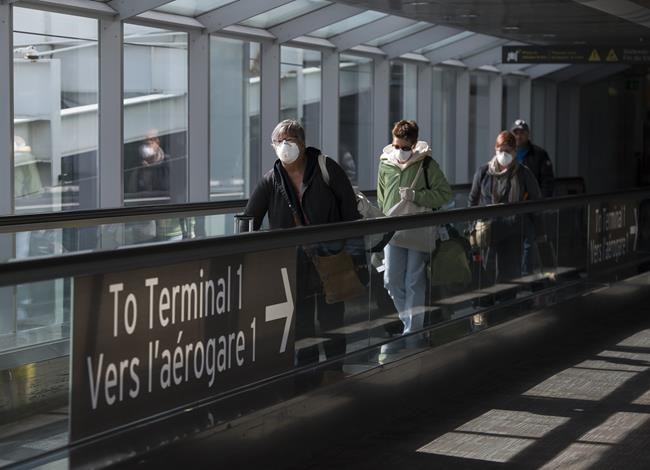
People leave the airport after arriving at Pearson International Airport in Toronto on Monday, March 16, 2020. The International Air Transport Association says it is opposed to physical distancing on airplanes, a position that clashes with government recommendations and Canadian airline policies as countries mull re-opening their borders amid the COVID-19 pandemic. THE CANADIAN PRESS/Nathan Denette

“If we don’t take these first steps in a harmonized way, we will spend many painful years recovering ground that should not have been lost,” said IATA director general Alexandre de Juniac.

IATA’s other proposed in-flight measures include pre-packaged meals to reduce interaction between passengers and crew and frequent “deep cleaning” of the cabin. But even with those precautions — already in place at most airlines — packing travellers into a plane is “really inviting disaster,” said Tim Sly, epidemiologist and professor emeritus at Ryerson University’s School of Public Health.

“That’s bad enough, putting 250 people in an aluminium cigar tube, all elbow to elbow breathing the same air for two, three, four, five, 10 hours,” Sly said in a phone interview.

He conceded modern airplanes have “a heck of a filter system built in,” but said masks alone cannot prevent the on-board spread of COVID-19.

“I think we have to be very, very careful,” he said, “unless the people sit there with almost a hazmat kind of set-up…connected directly to the air supply above.”

Safety and health authorities have stressed physical distancing on land and in the skies since the outbreak began.

Transport Canada listed “social” distancing among the “key points” in preventing the spread of the virus as part of a guide issued to the aviation industry last month.

“Operators should develop guidance for spacing passengers aboard aircraft when possible to optimize social distancing,” the document states.

Air Canada and WestJet Airlines Ltd. — both of which the association counts among its 290-odd members — say their pandemic policies block the sale of adjacent seats in economy class or throughout the entire plane.

“The middle seat on our Boeing 737s and 787 aircraft and every other seat on our Bombardier Q400 has been made unavailable to book to ensure our guests and crew can continue to fly safely and have more space to adhere to social distancing guidelines,” WestJet spokeswoman Morgan Bell said in an email.

The policy is in place until June 30, “and we will re-evaluate this initiative as required,” she said.

An Air Canada spokesman said that “it is not possible to speculate on the future possibilities.”

In its proposal — titled Biosecurity for Air Transport: A Roadmap for Restarting Aviation — IATA recommended temperature screening by government staff at airport points of entry before departure and, if required by authorities, upon arrival.

Temperature checks’ effectiveness remains disputed as the virus may still be in an incubation period or manifest only mild or no symptoms when an individual is scanned.

“The more you actually understand this virus, the more you begin to know that temperature-taking is not effective at all,” Dr. Theresa Tam, Canada’s top public health official, said earlier this month.

“Even if you are infected, we know that the likelihood of picking up someone who is symptomatic is relatively inefficient,” she said.

Pre-flight measures should aim to reduce contact points and lines — the defining traits of many passengers’ airport experience — through measures such as “redesigned gate areas” and unassisted bag drops with home-printed luggage tags, IATA said.

On arrival, travellers should expect health declarations and automated customs processes that rely on apps and biometric technologies, it added.

Dr. Paul Pottinger, professor of infectious diseases at the University of Washington’s School of Medicine, said face coverings do “the great majority of work” to reduce transmission risk. But “inevitably” some passengers will touch shared armrests or lower their mask to eat, making physical distancing all the more important.

“The proverbial two-metre personal space, that is based on science,” Pottinger said. “It is a layer of protection that I envision for all of us regardless of whether you are squeezed into an aluminum tube or walking down the street — the virus doesn’t care.

“The question, I think, is not one of viruses and infection, it’s one of economics,” he said. “Is that risk small enough that people would be willing to pay a price for in terms of the premium on their ticket?”

IATA estimates that revenues generated by airlines in the Canadian market will fall by $14.6 billion or 43 per cent this year as travel remains at a virtual standstill amid border shutdowns and plummeting demand.

This report by The Canadian Press was first published May 19, 2020.

Companies in this story: (TSX:AC)

Report Error Submit a Tip

More Stories

Billboard evangelism may look outdated but group says it’s effective

John Longhurst 5 minute read Preview

Billboard evangelism may look outdated but group says it’s effective

John Longhurst 5 minute read Yesterday at 2:02 AM CDT

Maybe you’ve seen them in Winnipeg — billboards that say things like: “Jesus is alive!” “Are you prepared to meet Jesus?” “After you die, you will meet God.” They include a phone number to call: 844-FIND-TRUTH.

There are two billboards in Winnipeg. One is on Henderson Highway in Elmwood. The other is on Balmoral Street, by Cumberland.

Have you ever wondered who is behind them, and why they do it?

You might be surprised to learn they are created and sponsored by an Amish/Mennonite organization called Christian Aid Ministries (CAM). Based in rural Ontario, the group is funded by Amish and some conservative Mennonite denominations and individuals.

Read
Yesterday at 2:02 AM CDT

A Winnipeg family is urging others to pay close attention to their prescriptions after a highly-potent pill — 10 times the strength it was supposed to be — made their child seriously ill.

Andrea Thidrickson and Kevin Barkley’s 10-year-old daughter is shaken after experiencing an accidental overdose and subsequent visit to the emergency room last week.

Their daughter’s pediatrician has, for several months now, prescribed two milligrams of the medication in question on a daily basis, the duo said.

On Aug. 14, the girl took a single pill containing 20 milligrams of it.

Remembering when, where we were when Putin invaded Ukraine

Melissa Martin 7 minute read Preview

Remembering when, where we were when Putin invaded Ukraine

Melissa Martin 7 minute read Thursday, Feb. 24, 2022

As a child, I learned history through books and movies but lived it vicariously through the eyes of my father, gathering up all his where-were-you-whens with an insatiable hunger. Every time I learned about an event that had shaped the course of the world, my young mind did a hasty calculation and, having verified he’d been alive at the time, I’d ask him the question.

Where was he on May 8, 1945, when news broke that Germany had made an unconditional surrender? He was young, almost too young to remember, except in fragmented pictures: the kitchen of his little house in small-town Michigan, the hem of his mother’s dress, newscasters declaring victory on the radio, people running down the street in jubilation.

Where was he on Nov. 22, 1963, when John F. Kennedy was assassinated? In a classroom at the American university where he was teaching, finishing up a lecture. He went home through stunned streets and yelled at the dog; my mother, seeing this, snapped back that the dog didn’t do it, so he sat and wept and felt the world he knew fall apart.

By the time I was eight years old, I had committed most of these stories to memory. None were dramatic. None of them had my father at the heart of what was the most violent or important or transforming. He was, like many folks in North America and all of those who are lucky, only a second-hand witness to the greatest machinations of geopolitical trauma.

Read
Thursday, Feb. 24, 2022

Controlling pace of response path to success

Tim Kist 5 minute read Yesterday at 2:02 AM CDT

WITH the recent collapse of Canada-U.S. trade talks, the economic, political and social changes are coming at business leaders on a daily basis.

While you cannot control the pace of these changes, you can control the pace of response and timing of actions your organization takes. This is a time for thoughtful analysis and careful action, not chasing the latest trends.

Artificial intelligence, for example, can write articles, create images, draft emails and perform seemingly countless other tasks. But is this new tool solving a current business problem?

Successful companies know they must develop a strategy before launching any tactics. Otherwise, the strategy is based on “hope” — and we all know hope is not a strategy.

Letters, Sept. 5

7 minute read Yesterday at 2:02 AM CDT

Clearing the air

Re: QDoc patients in middle of billing dispute (Sept. 4)

QDoc has been fortunate to have a genuine partner in the Manitoba government over the past several years. Premier Wab Kinew and Health Minister Uzoma Asagwara have been consistently clear that no Manitoban should go without care because of where they live, and that commitment is exactly why virtual care exists as a permanent, publicly available option today. We built MediNav, the province’s online appointment booking system, together with Manitoba Health, and that same collaborative spirit has helped make more than 350,000 patient visits possible through our platform — many of them evenings, overnights and weekends, reaching rural and underserviced communities that need it most.

We want to be direct with the people who rely on us: QDoc is not going anywhere. We continue to see patients today, and we will keep doing so tomorrow. The issue reported this week is a technical billing matter, not a service disruption, and we are actively working with the province to resolve it quickly, so we can keep growing our capacity to serve Manitobans rather than limiting it.

Smith’s pretzel logic confuses

Editorial 4 minute read Preview

Smith’s pretzel logic confuses

Editorial 4 minute read Yesterday at 2:02 AM CDT

Alberta Premier Danielle Smith had both sides of her mouth working overtime on Aug. 30, when she spoke at an event in Calgary to commemorate Alberta Day, the annual celebration of the province’s entry into Confederation in 1905 (officially Sept. 1, it was celebrated on the weekend).

Smith’s comments — and the things she did not say — revealed a lot about the political tightrope the premier is trying to walk over the challenges currently faced by her province. At the top of that list of challenges is a persistent campaign to separate Alberta from the aforementioned Confederation. A campaign that Smith appears to both support and oppose, depending on which day of the week it is.

Her Alberta Day remarks were an excellent case in point.

Smith has decided that on Oct. 19, Albertans will vote on a series of non-binding propositions in a province referendum. One of those questions will ask Albertans whether they want to hold a referendum on separation, thus making this fall’s vote a “referendum on whether to hold a referendum,” as some observers have dubbed it.

Read
Yesterday at 2:02 AM CDT