Grand span
The Provencher Bridge and Riel Esplanade gracefully link St. Boniface to the city centre while connecting Winnipeg's cultures and languages
Advertisement
Read this article for free:
or
Already have an account? Log in here »
To continue reading, please subscribe:

Digital Subscription
One year of digital access for only $205*
- Enjoy unlimited reading on winnipegfreepress.com
- Read the E-Edition, our digital replica newspaper
- Access News Break, our award-winning app
- Play interactive puzzles
*First annual payment billed as $205.00 + GST for one year. This annual subscription will automatically renew at $233.00 + GST every 52 weeks (10% off the regular annual price of $259.35). Offer available to new and qualified returning subscribers only. Cancel any time.
To continue reading, please subscribe:
Add Free Press access to your Brandon Sun subscription for only an additional
$1 for the first 4 weeks*
- Enjoy unlimited reading on winnipegfreepress.com
- Read the E-Edition, our digital replica newspaper
- Access News Break, our award-winning app
- Play interactive puzzles
*Your next Brandon Sun subscription payment will increase by $1.00 and you will be charged $17.95 plus GST for four weeks. After four weeks, your payment will increase to $24.95 plus GST every four weeks.
Read unlimited articles for free today:
or
Already have an account? Log in here »
Hey there, time traveller!
This article was published 01/02/2020 (2442 days ago), so information in it may no longer be current.
In Gabrielle Roy’s famous 1955 novel Rue Deschambault, (Street of Riches in English), the narrator describes crossing the Provencher Bridge from St. Boniface into downtown Winnipeg as a young, wide-eyed child, her hand clasped firmly in her mother’s.
They are walking from their familiar French-speaking village to the up-and-coming city on the other side of the river to go shopping at Eaton’s. The child watches in bewilderment as her powerful, no-nonsense Maman suddenly shrinks into a faltering obsequious old woman in the face of the haughty English-speaking clerk. Still, she is delighted by the wild possibilities of this completely “foreign” experience so close to her own village.
Roy repeated this story in the opening pages of her 1987 autobiography Enchantment and Sorrow. Here she noted the fascinating mix of many different immigrant languages heard on Portage Avenue, in and among the dominant English. Gabrielle and her mother both loved the adventure of walking across the Red River on the bridge, watching the seagulls below; as they did so, fantasizing that they too could spread their wings and fly across the world in search of adventure.
Bridges are like that, magical links between different worlds. They are spectacular architectural and engineering feats as well. Many people have lost their lives over the centuries in the heroic act of building them. Sometimes they need to be rebuilt a few days after real-life traffic exposes structural design flaws. This happened with the first bridge built near here in 1882, then called the Broadway Bridge. The next version of the bridge, now called the Provencher Bridge, was built in 1918, close to the time Roy is documenting in her novel.
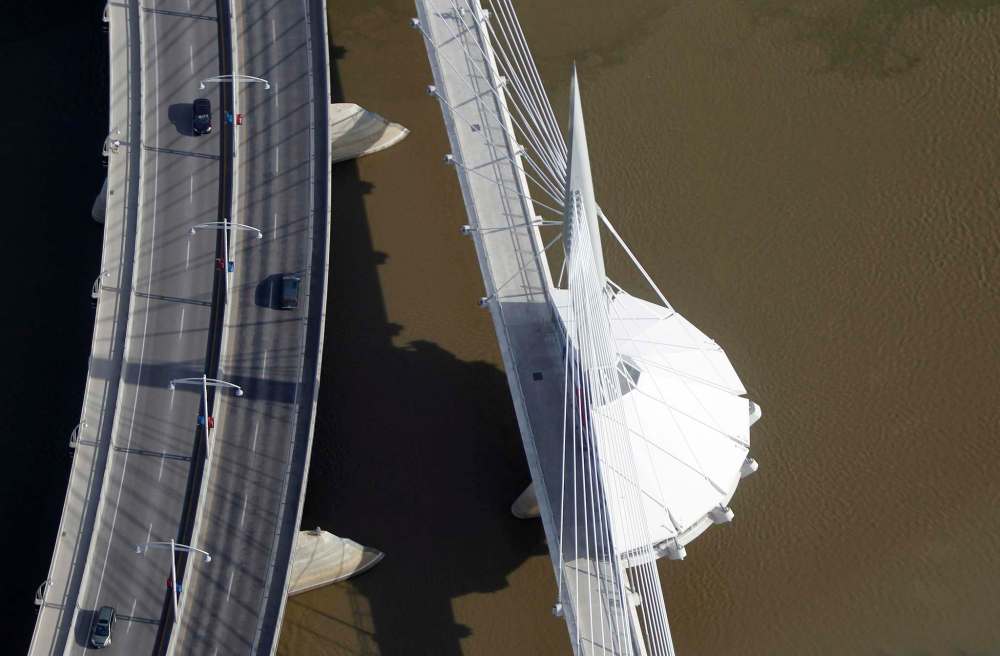
Can we agree the current Provencher Bridge and accompanying Riel Esplanade are Winnipeg’s finest? The Esplanade gracefully points its white harp-like chords toward the open Prairie sky above the darkly rushing Red River near where it meets the Assiniboine at The Forks.
The side-spar, cable-stayed walking bridge was designed by celebrated architects Étienne Gaboury and Guy Prefontaine, of Gaboury Prefontaine Perry Architects Inc., and engineer Colin Douglas Stewart of Waldrop Engineering, and completed in 2003. The driving bridge that accompanies it curves gracefully alongside the Esplanade, joining St. Boniface, which retains its French language and character in the present, to English-speaking Winnipeg.
Even though St. Boniface officially joined Winnipeg in 1972, the ward has continued to promote French language and culture through a rich array of theatre, radio, museum, restaurant and college institutions and program offerings, and has contributed immensely to the city’s bilingual understanding of itself.
Our biennial literary award for the best book of poetry in Manitoba, for example, the prestigious Lansdowne Poetry Prize, or Prix Lansdowne de poésie, established in 2007, is available to both French and English language poetry books. This one prize alone has helped to span the language and publishing divide in Winnipeg in brilliant ways, bringing writers and readers of our country’s and city’s two official languages together in poetic celebration every two years. (What if we opened the prize to poetry books published in Manitoba in other languages than these two? Let’s think about doing that.)
The Provencher Bridge invites a multicultural, multi-language, and Indigenous-inflected understanding of Winnipeg, not only with the graceful access it offers to the centre of our city and our iconic traditional Indigenous meeting place at The Forks, but also with the pictographic and mythopoetic inscriptions on its concrete sides.

The stylized images of animals, birds, insects, flowers, leaves and sun, visible to walkers on the Esplanade, appear almost like fossil records in limestone, woven together visually with textile designs reminiscent of the traditional Métis sash. The accompanying text describes the birth of the world and proliferation of life forms upon the earth, locating our present life in the city on a grand timeline with cosmological overtones.
Winnipeg’s annual winter festival, the popular Festival du Voyageur, held at the historic Fort Gibraltar and surrounding Whittier Park near the bridge in St. Boniface each February, has been exemplary in taking up the challenge to showcase Indigenous and multicultural talent in our cosmopolitan urban context, flourishing especially in the areas of visual art, snow sculpture, musical and dance performance, pavilion design, cuisine and more.
The elegant, gracious Maison Gabrielle Roy not far from the Provencher Bridge hosts multi-language spoken word poetry events every few months, as well as honouring the legacy of the great Gabrielle Roy, claimed by both French and English readers as their own, and other Prairie writers of note. How wonderful to hear many languages being spoken in poetic gatherings here in the heart of our city, at the magical centre of the continent, close to where the great rivers of Turtle Island meet.
Di Brandt was the City of Winnipeg’s inaugural poet laureate (2018-19).
di.brandt@shaw.ca