Pay the same, get less: How ‘shrinkflation’ masks price increases

Advertisement

Advertise with us

As increasing commodity prices, higher shipping fees and labour shortages drive up costs for food manufacturers, experts say reducing the amount of food in a package is a subtle way to adjust for inflation without raising prices.

Read this article for free:


or

Already have an account? Log in here »

To continue reading, please subscribe:

Subscribe and receive a limited-edition Free Press branded hat or tote.

Digital Subscription

One year of digital access for only $205*

  • Enjoy unlimited reading on winnipegfreepress.com
  • Read the E-Edition, our digital replica newspaper
  • Access News Break, our award-winning app
  • Play interactive puzzles

*First annual payment billed as $205.00 + GST for one year. This annual subscription will automatically renew at $233.00 + GST every 52 weeks (10% off the regular annual price of $259.35). Offer available to new and qualified returning subscribers only. Cancel any time.

To continue reading, please subscribe:

Add Free Press access to your Brandon Sun subscription for only an additional

$1 for the first 4 weeks*

  • Enjoy unlimited reading on winnipegfreepress.com
  • Read the E-Edition, our digital replica newspaper
  • Access News Break, our award-winning app
  • Play interactive puzzles
Start now

*Your next Brandon Sun subscription payment will increase by $1.00 and you will be charged $17.95 plus GST for four weeks. After four weeks, your payment will increase to $24.95 plus GST every four weeks.

Hey there, time traveller!
This article was published 02/09/2021 (1805 days ago), so information in it may no longer be current.

As increasing commodity prices, higher shipping fees and labour shortages drive up costs for food manufacturers, experts say reducing the amount of food in a package is a subtle way to adjust for inflation without raising prices.

Food makers are steadily shrinking package sizes to offset rising input costs while keeping prices stable, a retail strategy known as “shrinkflation.”

“Food processors tend to be hit hard by higher input costs,” said Sylvain Charlebois, director of the Agri-Food Analytics Lab at Dalhousie University.
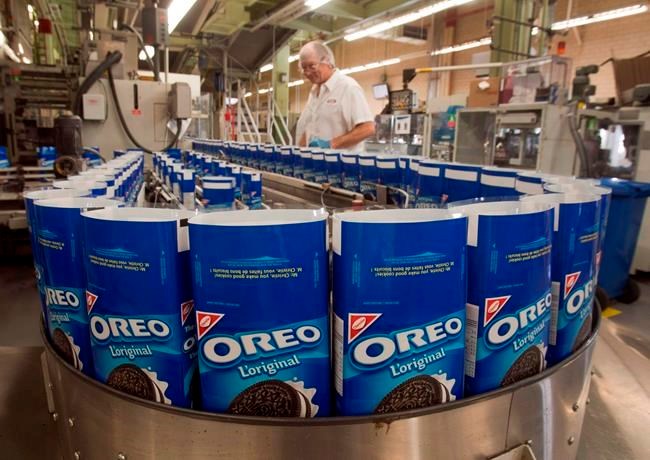
A worker keeps an eye on the Oreo cookie production line at the plant that makes all the Oreos for Canada, Wednesday, February 29, 2012 in Montreal. THE CANADIAN PRESS/Ryan Remiorz

“They want to remain competitive in an inflationary market, and in order to do that they play around with quantities instead of charging more for products.”

The shrinking-package strategy ultimately leaves consumers with less for their money for everything from cookies and chips to cheese and orange juice.

An original package of Oreo cookies, for example, has shrunk by about three cookies to 270 grams from 303 grams, a roughly 10 per cent reduction by weight.

A spokesman for Mondelēz Canada Inc., which makes the iconic cookie brand, said the company reduced the size of some Oreo packages earlier this year.

“It’s important to note that this change was a result of several factors, most significantly higher commodity costs which have been a challenge across the industry for some time,” Noah Farber said in an email.

“We work hard to ensure we offer value for money for our consumers, but we will never compromise on the taste or quality of Oreo which is loved by millions of consumers around the world.”

Consumers may also notice fewer chips in a bag, crackers in a box or granola bars in a package. A bag of Lay’s potato chips now weighs 165 grams, down from 180 grams, Quaker Chewy granola bars come with five bars rather than six or 120 grams instead of 156 grams, and Armstrong cheese is 600 grams rather than 700 grams, according to data compiled by Charlebois.

Food producers have also redesigned orange juice bottles to create a larger hollow bubble of space on the bottom, giving consumers the impression that the bottle is the same size while in fact reducing the amount of juice, he said.

Oasis orange juice containers, for example, now fit 1.5 litres rather than 1.65 litres, while Tropicana juice containers have 1.54 litres of juice rather than 1.75 litres, Charlebois said.

“It is subtle because they do alter the packages,” he said. “It gives you the illusion that you’re actually buying the same amount for the same price but you’re not.”

The “shrinkflation” retail tactic irks consumers, with recent social media posts calling out the stealth price hike strategy as sneaky.

But Charlebois said the price per 100 grams or 100 millilitres is disclosed to consumers in grocery stores, and that shrinking package sizes might have a positive impact on food waste.

“My biggest concern with shrinkflation is how we track food inflation rates in Canada,” he said, noting that we might be underestimating food inflation if shrinking package sizes aren’t accounted for.

Statistics Canada said its consumer price index compares the cost of a fixed basket of goods and services over time. The federal agency said its commodity specialists are able to do a quantity adjustment that accounts for changes in package size to ensure price increases are reflected in CPI.

A spokesperson with the Food, Health & Consumer Products of Canada, an industry group representing food manufacturers in Canada, was unavailable for an interview.

This report by The Canadian Press was first published Sept. 2 , 2021.

Report Error Submit a Tip

More Stories

WHO team in Wuhan departs quarantine for COVID origins study

Emily Wang Fujiyama, The Associated Press 5 minute read Preview

WHO team in Wuhan departs quarantine for COVID origins study

Emily Wang Fujiyama, The Associated Press 5 minute read Thursday, Jan. 28, 2021

WUHAN, China - A World Health Organization team emerged from quarantine in the Chinese city of Wuhan on Thursday to start field work in a fact-finding mission on the origins of the virus that caused the COVID-19 pandemic.

The researchers, who were required to isolate for 14 days after arriving in China, left their quarantine hotel with their luggage — including at least four yoga mats — in the midafternoon and headed to another hotel.

The mission has become politically charged, as China seeks to avoid blame for alleged missteps in its early response to the outbreak. A major question is where the Chinese side will allow the researchers to go and whom they will be able to talk to.

Yellow barriers blocked the entrance to the hotel, keeping the media at a distance. Before the researchers boarded their bus, workers wearing protective outfits and face shields could be seen loading their luggage, including two musical instruments and a dumbbell.

Read
Thursday, Jan. 28, 2021

Kripps headlines Canada's bobsled team for Beijing

The Canadian Press 5 minute read Preview

Kripps headlines Canada's bobsled team for Beijing

The Canadian Press 5 minute read Thursday, Jan. 20, 2022

After piloting his two-man sled to glory at the Pyeongchang Olympics, Justin Kripps turned his attention to perfecting his four-man driving.

Kripps headlines Canada's 18-member bobsled team for the Beijing Games, and the defending two-man champion is hoping to climb the medal podium twice this time around.

"I've traditionally had more success in the two-man, and so I wanted to get the four-man up to speed and we've definitely done that and had a lot of success over the last four years. I'm really excited about the four-man in Beijing," Kripps said from Konigssee, Germany, where the Canadian team is in a holding camp before travelling to Beijing.

Cynthia Appiah and Christine de Bruin headline the talented women's bobsled team, announced Thursday. Olympic veterans Jane Channell of Calgary and Mirela Rahneva of Ottawa and rookie Blake Enzie of Calgary are Canada's three skeleton athletes.

Read
Thursday, Jan. 20, 2022

Today’s horoscope

Georgia Nicols 4 minute read Preview

Today’s horoscope

Georgia Nicols 4 minute read 2:00 AM CDT

MOON ALERT: Caution! Avoid shopping or major decisions after noon today. The solar eclipse (new moon) in Leo peaks at 12:37 p.m.

ARIES (March 21-April 19)

This is the perfect time to hatch some new ideas and plans, perhaps related to vacations, your kids or an artistic project that appeals. Even though it’s a sudden decision, it might lead to more stability in the future.

TAURUS (April 20-May 20)

Read
2:00 AM CDT

The circle of life — garden-sized

5 minute read Preview

The circle of life — garden-sized

5 minute read 2:00 AM CDT

“The lesson I have thoroughly learnt, and wish to pass on to others, is to know the enduring happiness that the love of a garden gives.” — Gertrude Jekyll (1843-1932), horticulturalist

It’s a chilly day for August — more like fall — but in the garden things are progressing as nicely as if every day this summer had been the perfect combination of sun and showers.

The peonies are spent, their heavy heads with a hangdog look. Soon the petals will fall, revealing the jester-hat seedpods within. The lilacs, too, their beautiful, fragrant blossoms now transformed into brown scruff.

But the day lilies are plumping up, ready for their big reveal. And the roses are still magnificent — dozens and dozens of fuchsia, red, white and coral blooms that turn our stone circle into a heavenly scented bower. It is here where we come after a hard day’s work in the garden, newly scrubbed and wearing fresh clothes, to sit at a little bistro table and have a glass of wine and enjoy the results of our labour.

Read
2:00 AM CDT

First Inuk GG sparks hope for new relationship

Teresa Wright, The Canadian Press 5 minute read Preview

First Inuk GG sparks hope for new relationship

Teresa Wright, The Canadian Press 5 minute read Tuesday, Jul. 6, 2021

More than five years after he refused to intervene in a young man’s death by suicide in High Park, then lied about being on another call, a Toronto police officer has been demoted in rank for two years for his “serious” misconduct.

Read
Tuesday, Jul. 6, 2021

Tabulating long-term impact of long COVID

Dan Lett 6 minute read Preview

Tabulating long-term impact of long COVID

Dan Lett 6 minute read Monday, Feb. 7, 2022

Throughout a career dedicated to health research, Dr. Alan Katz had never seen anything like it.

In fall 2021, it was announced the Manitoba Centre for Health Policy (which Katz leads) had been awarded a grant to study “long COVID-19,” the name given to the prolonged suffering experienced by people who contracted, and survived, the novel coronavirus.

Soon after the news broke, Katz said something extraordinary happened: he started getting direct calls from people who believed they were suffering from long COVID, and who wanted to participate in the study.

“I’ve done research for a long time and I’d never seen anything like it before,” he said.

Read
Monday, Feb. 7, 2022