

Banning Russia from world juniors right move
Advertisement
Read this article for free:
or
Already have an account? Log in here »
To continue reading, please subscribe:
Digital Subscription
One year of digital access for only $1.44 a week*
- Enjoy unlimited reading on winnipegfreepress.com
- Read the E-Edition, our digital replica newspaper
- Access News Break, our award-winning app
- Play interactive puzzles
*Billed as $5.77 plus GST every four weeks. After 52 weeks, price increases to the regular rate of $19.95 plus GST every four weeks. Offer available to new and qualified returning subscribers only. Cancel any time.
To continue reading, please subscribe:
Add Free Press access to your Brandon Sun subscription for only an additional
$1 for the first 4 weeks*
- Enjoy unlimited reading on winnipegfreepress.com
- Read the E-Edition, our digital replica newspaper
- Access News Break, our award-winning app
- Play interactive puzzles
*Your next Brandon Sun subscription payment will increase by $1.00 and you will be charged $17.95 plus GST for four weeks. After four weeks, your payment will increase to $24.95 plus GST every four weeks.
Read unlimited articles for free today:
or
Already have an account? Log in here »
When it comes to elite-level sports, there are two kinds of politics.
There are the inherent, internal politics of the sports themselves, and there are geopolitics, where individual nations use sport as a brush to obscure human rights abuses.
The International Ice Hockey Federation (IIHF), the global body that oversees hockey competitions between nations, appears to be failing at both kinds of politics, putting itself and its marquee hockey tournaments in grave jeopardy.
Matt Krohn / The Associated Press
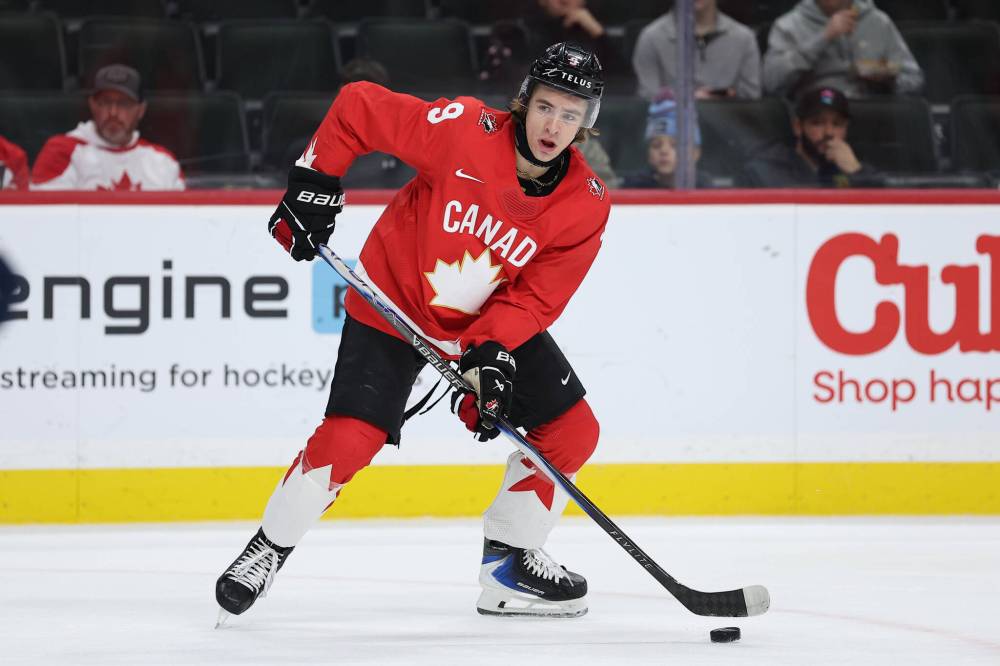
Canada’s Gavin McKenna at the IIHF World Junior Hockey Championship in January.
The jeopardy was triggered on Oct. 30 when the Court for Arbitration in Sport ruled that Russia should be permitted to compete in all IIHF hockey championships. Since 2022, when it invaded Ukraine, Russia had been banned from IIHF events such as the annual world championships and world junior championships.
Immediately following the court decision, a number of hockey nations announced they would not share the ice with the Russians. This protest was led by the Finland Ice Hockey Federation and quickly joined by federations in Sweden, Denmark, Norway, Latvia and Czech Republic.
A day later, Prime Minister Mark Carney said Canada would deny entry to the Russian national team for world junior hockey championships next month in Edmonton and Red Deer, Alta.
The protesting nations have put the IIHF in an untenable position. If these nations boycott IIHF events, it would mean the cancellation of tournaments and possibly a re-evaluation of the need for the IIHF in the face of a toothless response to the court decision.
Although many hockey nations are upset with the court, history will show the IIHF has been its own worst enemy in this story.
In 2022, following the invasion of Ukraine, international sports organizations moved quickly to ban Russian teams and athletes. In addition to the IIHF, organizations such the International Olympic Committee (IOC), World Athletics, the Fédération Internationale de Football Association and the Union of European Football Associations agreed to exclude Russian teams and athletes.
Some governing bodies specifically cited the invasion of Ukraine as the reason for the Russian ban. Others, including the IIHF, tried to ban Russia without engaging in the politics surrounding the Ukraine invasion. This proved to be a doomed strategy.
Instead of hanging their decision solely on the Ukraine invasion, the IIHF cited “safety and security risks” in its decision. Thus, it was hardly surprising that when Russia appealed the IIHF ban, the court could find no clear evidence of something as vague as safety or security risks.

Two facts should be noted at this point.
First, the IIHF is not the only governing body that has abandoned sanctions on Russia. In July, the IOC lifted its ban so that Russia could compete fully at the 2028 Los Angeles Olympics, arguing it no longer wanted to punish individual athletes for the actions of their government.
And second, Russia has successfully been able to argue it has been treated unfairly because sport governing bodies have not punished all countries guilty of human rights abuses. Russia deserved to be banned from international sports, but so do a host of other countries.
Banning an entire country from sporting events — and punishing athletes for actions and decisions they had no part in — is an enormous challenge. That said, in a day and age of “sport washing,” where elite sports are used to distract attention from human rights abuses, it is reasonable to expect governing bodies to make challenging decisions.
In that context, Canada’s decision to refuse entry to Russian players for the upcoming world junior hockey championships is the morally correct thing to do. One can only hope that other nations — and governing bodies — join the cause.