Dramedy captures 20-something angst, confusion
Protagonist finding her way in Montreal’s creative milieu

Advertisement
Read this article for free:
or
Already have an account? Log in here »
To continue reading, please subscribe:

Digital Subscription
One year of digital access for only $205*
- Enjoy unlimited reading on winnipegfreepress.com
- Read the E-Edition, our digital replica newspaper
- Access News Break, our award-winning app
- Play interactive puzzles
*First annual payment billed as $205.00 + GST for one year. This annual subscription will automatically renew at $233.00 + GST every 52 weeks (10% off the regular annual price of $259.35). Offer available to new and qualified returning subscribers only. Cancel any time.
To continue reading, please subscribe:
Add Free Press access to your Brandon Sun subscription for only an additional
$1 for the first 4 weeks*
- Enjoy unlimited reading on winnipegfreepress.com
- Read the E-Edition, our digital replica newspaper
- Access News Break, our award-winning app
- Play interactive puzzles
*Your next Brandon Sun subscription payment will increase by $1.00 and you will be charged $17.95 plus GST for four weeks. After four weeks, your payment will increase to $24.95 plus GST every four weeks.
Read unlimited articles for free today:
or
Already have an account? Log in here »
Canadian writer-director Chandler Levack is becoming an auteur of spiky, self-aware, semi-autobiographical nostalgia.
Her 2022 feature debut I Like Movies related the awkward coming-of-age story of a teenage video store clerk in Burlington, Ont., in 2003.
In this deliberately loose dramedy, which debuted at last year’s Toronto International Film Festival, Levack sets her wayback machine to the summer of 2011 in Montreal. Grace (Euphoria’s Barbie Ferreira), a 24-year-old music critic, has just got off the bus, determined to do important work, have sex and possibly learn French.
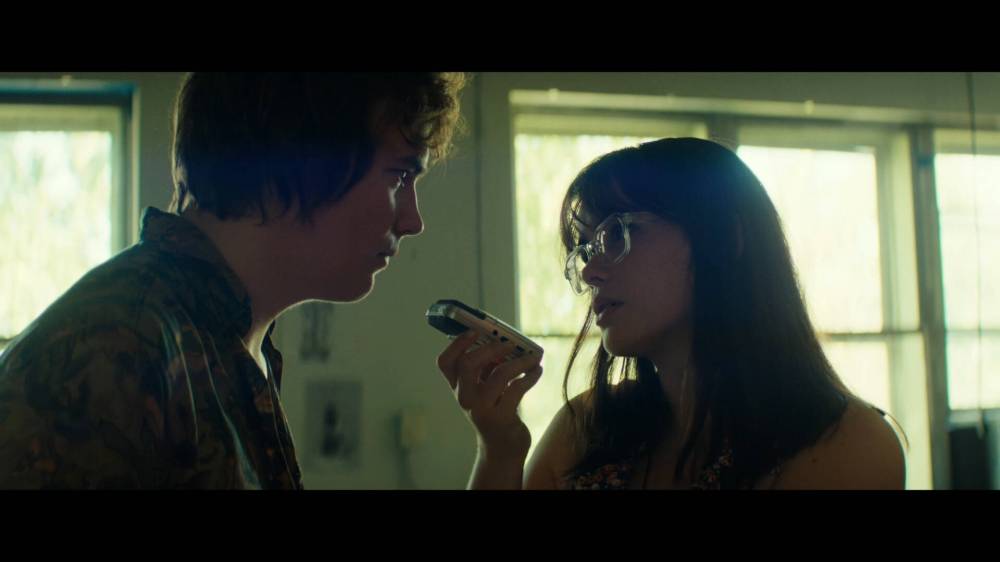
Joe Fuda photo
Grace (Barbie Ferreira, right) becomes fascinated with Chevy (Stanley Simons) in Mile End Kicks.
Low rents on cool apartments in the neighbourhood of Mile End are drawing young artists, writers and musicians from all over Canada, Grace explains in an article she’s writing about the city’s indie music scene.
Everyone is hustling to make it in their creative fields — at least until “they run out of money and have to move to Toronto and get a real job,” as one character later adds in a melancholy bit of fact-checking.
Levack is recreating a very specific time and place. There are lots of crowded, sweaty loft parties where you get the feeling you’ve just missed a sighting of Arcade Fire or Grimes. There are lots of creative types subsisting on bagels, beer, cigarettes and MDMA.
But beyond nailing this particular setting, Levack is catching something more universal — that poignant, painful, beautiful 20-something moment when you have lunatic certainty about some things and woeful confusion about so many others.
Grace, for instance, is planning to write an entry for the popular 33 1/3 book series on iconic albums. Pitching her plan to dive into Alanis Morissette’s Jagged Little Pill, she tells her New York-based editor that the singer-songwriter “is a Canadian icon.”
“Yeah, nobody cares about that,” her editor replies.
The editor is much more intrigued by Grace’s take on gender. “Society hates it when women talk about themselves,” Grace suggests. Citing the runaway resonance of Jagged Little Pill, Grace calls it “the first time in the culture a young woman has expressed how f—king angry she was, and it actually translated to millions of dollars.”
Still, because Levack likes self-deluded, slightly mixed-up characters, we see that while Grace may be hyper-aware of Morissette’s rage, she is constantly ignoring and tamping down her own.
There is her experience at a magazine with a horrible boss (BlackBerry’s Jay Baruchel, playing against type) who isn’t paying her. There are the bro-ish colleagues and critics who practically turn their backs on her while getting into intense debates about the influence of the Minutemen.
Then, when Grace ought to be writing her Morissette book, she’s instead caught up in a one-sided obsession with showy, self-absorbed Chevy (Stanley Simons of The Iron Claw), lead singer of a band called Bone Patrol. This is in spite of — or maybe because of — a warning from Grace’s worldly-wise roommate Madeleine (Juliette Gariépy of Red Rooms) that Chevy is “the worst guy in Montreal.”
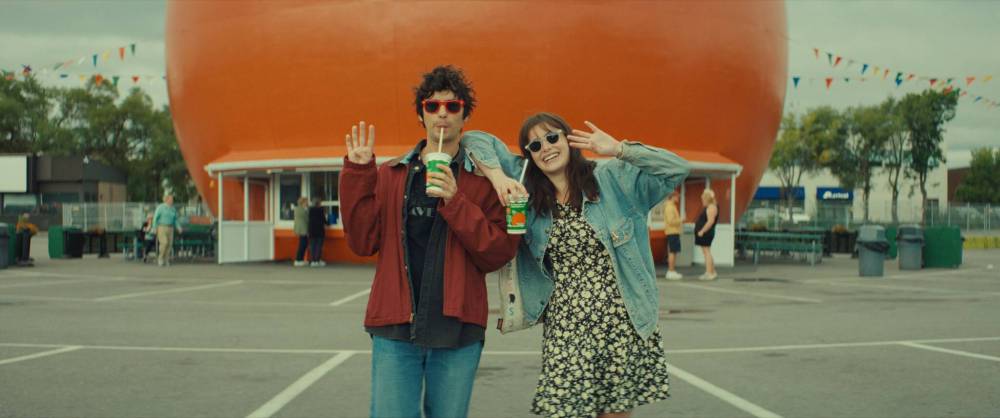
Joe Fuda photo
Devon Bostick (left) plays Archie, a guitarist and friend to Barbie Ferreira’s Grace, a music critic, in Mile End Kicks.
Grace is also hanging out with Bone Patrol guitarist Archie (Devon Bostick from Diary of a Wimpy Kid), a nice guy with a secret issue that keeps him celibate. (He introduces himself to Grace by saying, “I also have social anxiety,” which actually seems like a pretty good 2011 pickup line.)

She ends up caught between two guys, which is the basic rom-com template that runs from Jane Austen to last year’s Materialists. Levack gives the trope a raggedy, rueful indie spin, though, complete with bad sex, cringey conversations and loads of millennial ennui.
Levack has a feel for emotional beats that are sweet but not sappy, and she catches the slightly aimless, messy, self-destructive vibe of Grace’s 24-year-old life. One sometimes wishes, though, that the script was just a bit tighter and clearer in terms of structure and motivation.
It’s hard to understand, for example, what Grace sees in the awful — and not even particularly charismatic — Chevy. Fortunately, Ferreira’s fresh, honest, relatable performance goes a long way to bringing us along as she stumbles toward some belated feminist epiphanies.
Grace might never finish that book on Alanis Morissette, but at least she’s going to make her voice heard, get paid what she’s worth and stop pretending she loves Infinite Jest just to impress boys.
winnipegfreepress.com/alisongillmor
Studying at the University of Winnipeg and later Toronto’s York University, Alison Gillmor planned to become an art historian. She ended up catching the journalism bug when she started as visual arts reviewer at the Winnipeg Free Press in 1992.
Our newsroom depends on a growing audience of readers to power our journalism. If you are not a paid reader, please consider becoming a subscriber.
Our newsroom depends on its audience of readers to power our journalism. Thank you for your support.
Movie review
Mile End Kicks
Starring: Barbie Ferreira, Stanley Simons and Devon Bostick
● Polo Park
● 14A, 111 minutes
★★★½ out of five
Other voices
Mile End Kicks wants to mirror the haphazard freedom of a young woman out on her own… To that end, the writer-director, Chandler Levack, establishes an agreeably slapdash attitude of hedonistic adventure.
— Owen Gleiberman, Variety
The film is like a song that I liked — but didn’t love — upon first spin, but its melodies and lyrics grew on me to the point where I can’t help but recommend it.
— Zachary Lee, RogerEbert.com
This is a movie that can’t believe how dumb smart women act when there’s a man putting in the absolute bare minimum involved.
— Katie Rife, IndieWire
Not everyone will relate to being a critic navigating the mess of their early 20s, nor does the film compromise to win them over, but for this one, it cements Levack as an astute filmmaker worth following to whatever she puts her pen and camera to next.
— Chase Hutchinson, TheWrap
Studying at the University of Winnipeg and later Toronto’s York University, Alison Gillmor planned to become an art historian. She ended up catching the journalism bug when she started as visual arts reviewer at the Winnipeg Free Press in 1992.
Our newsroom depends on a growing audience of readers to power our journalism. If you are not a paid reader, please consider becoming a subscriber.
Our newsroom depends on its audience of readers to power our journalism. Thank you for your support.
Advertisement Advertise With Us
Advertisement Advertise With Us