

Who has been invited to the table?
Advertisement
Read this article for free:
or
Already have an account? Log in here »
To continue reading, please subscribe:

Digital Subscription
One year of digital access for only $205*
- Enjoy unlimited reading on winnipegfreepress.com
- Read the E-Edition, our digital replica newspaper
- Access News Break, our award-winning app
- Play interactive puzzles
*First annual payment billed as $205.00 + GST for one year. This annual subscription will automatically renew at $233.00 + GST every 52 weeks (10% off the regular annual price of $259.35). Offer available to new and qualified returning subscribers only. Cancel any time.
To continue reading, please subscribe:
Add Free Press access to your Brandon Sun subscription for only an additional
$1 for the first 4 weeks*
- Enjoy unlimited reading on winnipegfreepress.com
- Read the E-Edition, our digital replica newspaper
- Access News Break, our award-winning app
- Play interactive puzzles
*Your next Brandon Sun subscription payment will increase by $1.00 and you will be charged $17.95 plus GST for four weeks. After four weeks, your payment will increase to $24.95 plus GST every four weeks.
Read unlimited articles for free today:
or
Already have an account? Log in here »
Last Friday, I spoke at Booth University College’s inaugural Honour and Hope Harvest Dinner in support of Shelter U. I had been asked to speak about the power of art in the community, a subject I have spent much of my professional life thinking about — as a museum director, writer and teacher, and now through my consulting work with Civic Muse.
What continues to interest me is not simply what museums, universities and other public institutions do, but whether their work actually matters — whether they make a difference in the lives of the people and communities around them.
Preparing for the evening brought me back to an even more fundamental question: Who has been invited in?
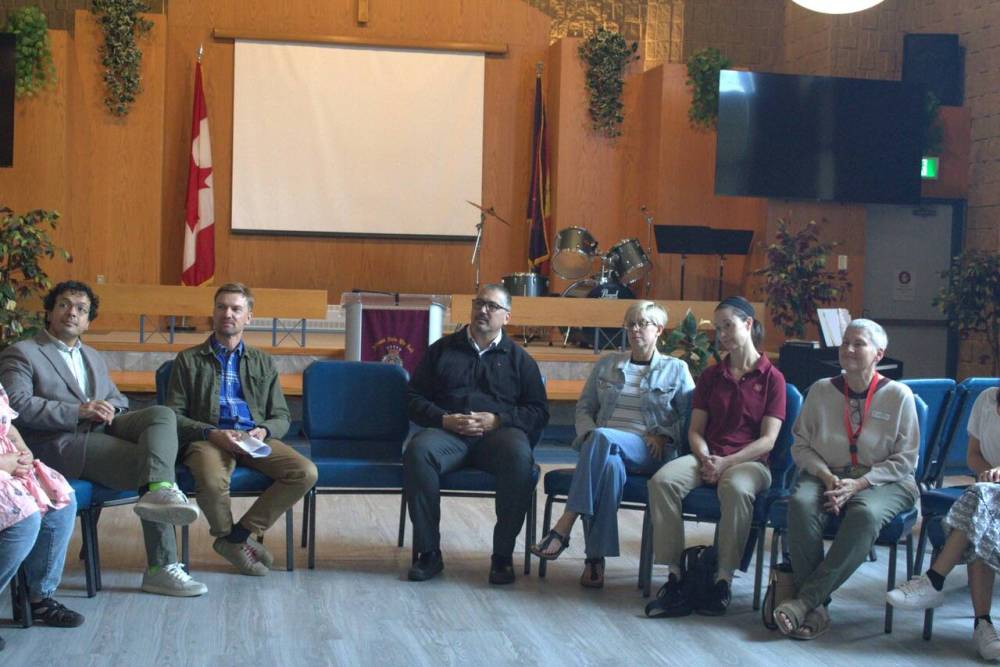
Submitted/Sylvester Olumuyiwa Awojide
Faculty and staff of Booth University College and The Salvation Army gather at a Shelter U program at The Salvation Army Center of Hope, Winnipeg.
One of my museum mentors used to remind me that institutions often begin the conversation about public engagement too late. Before engagement comes the welcome, and before the welcome comes the invitation. We can create extraordinary buildings, exhibitions and programs and say that everyone is welcome. But unless people believe that these places are also meant for them, many will never cross the threshold.
There is a value proposition embedded in that invitation. Why should I come? Is there something here for me? Will my experience matter? What might I contribute or discover?
Those questions extend well beyond museums. They apply to universities, libraries, places of worship and community organizations. And they are particularly relevant to Shelter U.
I serve on Shelter U’s community advisory committee, largely because I was impressed by the work and vision of Dr. Aaron Klassen, a Winnipeg sociologist and educator whose research explores the relationship between culture, education and social change. Through Shelter U, Klassen has put those ideas into practice, extending the possibilities of university learning beyond its conventional boundaries. I was drawn to the idea that intellectual curiosity and the opportunity to learn should not depend upon one’s circumstances.
Shelter U draws inspiration from the Clemente Course in the Humanities, established by American writer and educator Earl Shorris in the 1990s to bring serious study of the humanities to people facing poverty and other barriers to higher education. Shelter U brings that idea into a Winnipeg context, offering university-level learning to people who have experienced homelessness, housing insecurity and circumstances that can make conventional post-secondary education difficult to access.
What interests me particularly is what happens once people enter the classroom. Shelter-based and campus-based students learn together. They read, question, discuss and create. The classroom does not divide people neatly into those who possess knowledge and those who receive it.
As a teacher, I have come to believe that the most interesting classrooms are places of exchange. Students bring experience, curiosity and ways of seeing the world that can change the conversation for everyone in the room. Shelter U takes that principle seriously. Access matters, but belonging requires something more: the recognition that your presence is not simply being accommodated; it has value.
That distinction matters to our cultural institutions as well.
We live in an age of measurement. Museums count visitors, memberships, admissions, program participation and digital engagement. We build dashboards, establish targets and report performance indicators. Much of that is necessary. Public institutions should be accountable, and numbers can tell us important things about whom we are reaching and how resources are being used.
But numbers can also give us the illusion that measurement tells us the whole story.
A museum can increase attendance and still fail to create meaningful engagement. A gallery can meet every target on a spreadsheet and still know remarkably little about what happened when someone stood before a work of art. Did it disturb an assumption, awaken a memory, create curiosity or offer consolation? Did it start a conversation or change the way someone saw themselves or another person?
This is a question that has followed me throughout my museum and consulting work: how do we distinguish activity from impact? I encountered a wonderfully direct version of it through the United Way approach to assessing community impact: Are you making a difference?
Some of the things that matter most resist measurement.
A former colleague at the National Gallery of Art in Washington once told me about a U.S. senator who, over the course of one summer, regularly appeared in the same European painting gallery during his lunch hour. Week after week, he sat quietly among the same works. Eventually my colleague found the courage to ask him why he kept returning.
The senator explained that his wife had died two years earlier. The gallery was somewhere they had loved visiting together, and sitting among those paintings was his way of spending time with her. The gallery had become a place where something of their life together still existed — where absence could, for a little while, feel like presence.
I have never forgotten that story because there is no useful metric for it. The museum could record every visit and add it to its attendance figures, but the number would tell us almost nothing about what was actually happening in that room. Art had become part of the way one person carried memory, grief and love. No dashboard could capture that, but surely it belongs among the reasons museums exist.
Education can work in similarly difficult-to-measure ways. We can count enrolment, attendance and course completion. Those things matter. But how do we measure the moment when someone discovers a voice, encounters an idea that changes an assumption, recognizes an ability that has gone unnoticed, or begins to imagine a different future?

Shelter U cannot solve homelessness, and education cannot substitute for housing, health care or income supports. Nor should we ask it to. What it can do is create a place where people encounter one another first as learners — as people capable of thinking, questioning, creating and contributing.
There is a larger lesson here for museums, universities and every institution that claims a public purpose. Being civic is not simply a matter of opening our doors. It means understanding ourselves as part of a network of relationships with the communities around us. It means listening as well as speaking, and recognizing that the people who enter our institutions bring their own knowledge and experience with them. They do not leave it at the door.
That may be the measure that matters most: not simply how many people participated, but whether something meaningful became possible because they did.
The invitation still matters. But what matters even more is what happens after someone accepts it.
Stephen Borys is president and CEO of Civic Muse, an arts and cultural consulting practice based in Winnipeg. www.civicmuse.ca